
A standardized compliance letter is a formal written notice that identifies a specific discrepancy between a homeowner’s current actions and the rules governing their community or regulatory environment. HOA boards, property managers, and homeowners all encounter these letters, yet few understand exactly what makes them effective or legally sound. Getting the structure right matters. A poorly written compliance letter can escalate a minor issue into a formal dispute, while a well-crafted one resolves the problem quickly and professionally. This article breaks down the standardized compliance letter explained in full, covering structure, best practices, and real-world application in community management.
What is a standardized compliance letter?
A standardized compliance letter is a formal notice identifying discrepancies compared to governing rules and initiating a structured resolution process. The industry term for this document in HOA contexts is a “compliance notice” or “violation notice,” though “compliance letter” is the most widely used label across community management, regulatory agencies, and legal practice.
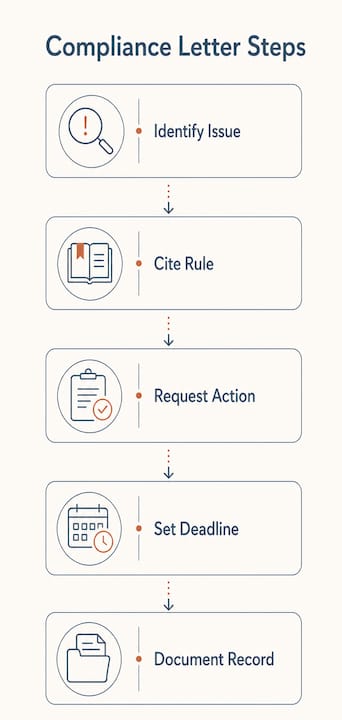
The letter serves three functions at once. It documents the issue on record, notifies the recipient of the specific rule being violated, and specifies what action the recipient must take to resolve the matter. Without all three elements, the letter loses its legal and practical weight.

Understanding compliance letters starts with recognizing what they are not. They are not informal warnings or friendly reminders. They carry formal standing within the community’s governing documents, such as the CC&Rs (Covenants, Conditions, and Restrictions) or bylaws, and they create a paper trail that can be used in enforcement proceedings if the issue goes unresolved.
What are the essential components of a compliance letter?
Every effective compliance letter follows a consistent structure. That consistency is what makes it “standardized.” The components of an effective compliance letter include a unique reference ID, a clear citation of the governing rule, numbered responses addressing each issue, and only the requested supporting documents attached.
The core elements every compliance letter must include are:
- Unique reference ID: A letter or case number that allows both parties to track the matter across all future communications.
- Recipient identification: Full name, property address, and unit number where applicable.
- Rule citation: The exact section of the CC&Rs, bylaws, or local ordinance being violated. Vague references like “community standards” are not sufficient.
- Clear statement of the issue: A numbered or itemized description of each specific compliance problem observed.
- Required action and deadline: A precise statement of what the homeowner must do and by when. 30 days is the standard deadline for responding to formal compliance inquiries. That timeline gives the recipient enough time to act while keeping the resolution process moving.
- Attachments: Only documents explicitly requested or directly relevant to the issue. Attaching extra materials creates confusion and can invite unnecessary follow-up questions.
- Contact information: A named point of contact at the HOA or management company, with a phone number and email address.
Pro Tip: Keep the letter focused. Each paragraph should address one issue only. If you have three separate violations, number them clearly and address each one in its own paragraph. Mixing issues in a single block of text makes it harder for the recipient to respond and harder for you to track resolution.
The formatting of the letter also matters for legal compliance. Boards should review compliance letter formatting best practices to confirm their letters meet both structural and legal standards before sending.
How does a compliance letter differ from other enforcement documents?
Not every letter an HOA sends carries the same weight. Boards and property managers often confuse compliance letters with related documents, and that confusion leads to the wrong tool being used at the wrong time.
Compliance letters differ from certificates of compliance and informal nudge letters in both formality and enforcement power. A nudge letter prompts a voluntary review and does not represent a formal investigation. A compliance letter, by contrast, carries formal standing and creates an enforceable record.
| Document Type | Formality | Enforcement Power | Typical Use |
|---|---|---|---|
| Nudge letter | Informal | None | Prompt voluntary action before a formal issue arises |
| Warning letter | Semi-formal | Limited | First notice of a potential violation, no penalties yet |
| Compliance letter | Formal | Full | Official notice of a rule violation with required action |
| Certificate of compliance | Formal | Confirmatory | Confirms that a prior violation has been resolved |
The distinction between a warning letter and a compliance letter is particularly important. A warning letter is often a courtesy notice sent before any formal enforcement begins. A compliance letter signals that the board has documented the issue and expects a formal response. Sending a compliance letter when a warning letter would suffice can damage community relations unnecessarily.
Nudge letters that go ignored increase escalation risk significantly. The same principle applies in HOA management. Boards should treat an unanswered informal notice as a signal to move to a formal compliance letter, not to send another informal one.
What are best practices for writing and responding to compliance letters?
Writing a compliance letter well requires discipline. Responding to one requires equal care. Both sides of the process follow the same core principle: address the specific issue, nothing more.
Follow these steps when writing a compliance letter:
- State the issue without editorializing. Describe what was observed, cite the rule, and stop there. Opinions about the homeowner’s intent or history have no place in a formal compliance letter.
- Number each compliance point separately. Responding to each numbered point separately allows explicit verification and reduces the risk of follow-up requests. Never combine two issues into one numbered item.
- Set a clear deadline. State the exact date by which the homeowner must respond or resolve the issue. “As soon as possible” is not a deadline.
- Use a professional tone throughout. Professional tone and avoiding admission of guilt in opening statements improve compliance communication outcomes. This applies to both the board’s letter and the homeowner’s response.
- Attach only what is necessary. Over-communication beyond requested documents is a common pitfall that leads to unnecessary additional inquiries. Attach the relevant rule excerpt and any photographic evidence. Nothing else.
- Seek professional review when the issue involves potential legal action. A property manager or HOA attorney should review any letter that could lead to fines, liens, or legal proceedings.
When responding to a compliance letter as a homeowner, the same discipline applies. Address each numbered point individually. Keep copies of all documents you submit. Never send originals. Acknowledge the issue without admitting fault, and focus your response on the corrective action you have taken or plan to take.
Pro Tip: Keep a dedicated compliance file for each property. Store every letter sent, every response received, and every photo taken as evidence. If a dispute escalates to a hearing or legal action, that file is your most important asset.
Ignoring compliance letters increases the risk of escalation to formal investigations or penalties. Boards and homeowners alike should treat every compliance letter as a time-sensitive document requiring a written response.
How do compliance letters function in HOA communication and issue resolution?
Compliance letters are the backbone of HOA enforcement. They create a documented, repeatable process that treats every homeowner consistently and protects the board from claims of selective enforcement.
The practical benefits of using standardized compliance letters in community management include:
- Rule enforcement: Letters create a formal record that the board identified and communicated a specific violation. That record is necessary if the issue escalates to a fine or legal action.
- Clear communication: A well-structured letter removes ambiguity. The homeowner knows exactly what rule applies, what they must do, and when they must do it.
- Risk mitigation: Standardized compliance letters aid in conflict resolution and risk mitigation by replacing informal, inconsistent communications with a documented process that holds up to scrutiny.
- Consistency across the community: When every violation of the same rule triggers the same letter format, the board cannot be accused of treating one homeowner differently from another.
- Faster resolution: Homeowners who receive a clear, specific letter with a firm deadline resolve issues faster than those who receive vague or informal notices.
A practical example: a board notices an unapproved fence installation at a property. The board sends a compliance letter citing the specific CC&R section on structural modifications, attaching a photo of the fence, and requesting either removal or a retroactive approval application within 30 days. The homeowner submits an approval application on day 20. The board reviews it, approves it, and sends a certificate of compliance. The entire process is documented, fair, and resolved without conflict.
Boards that skip the standardized letter and go straight to informal conversations often find themselves in disputes where neither party has a clear record of what was said or agreed. The letter protects both sides.
Key Takeaways
A standardized compliance letter works because it combines a clear rule citation, a specific required action, and a firm deadline into one documented notice that protects both the board and the homeowner.
| Point | Details |
|---|---|
| Core definition | A compliance letter is a formal notice citing a specific rule violation and requiring a documented response. |
| Standard deadline | 30 days is the established standard for responding to formal compliance letters in most contexts. |
| Number each issue | Address every compliance point separately and never combine issues in a single numbered item. |
| Tone and scope | Use a professional tone, avoid admitting fault, and attach only the documents explicitly requested. |
| Ignoring escalates risk | Unanswered compliance letters lead to formal enforcement actions, fines, or legal proceedings. |
Why boards get compliance letters wrong more often than they think
Most board members I have worked with assume a compliance letter just needs to state the problem. That assumption is where things go sideways. The letter also needs to cite the exact rule, set a hard deadline, and number every issue separately. Miss any one of those elements and you have handed the homeowner a procedural argument that can delay resolution for months.
The other mistake I see constantly is over-explaining. Boards add paragraphs of context, history, and warnings about future consequences. Reusing templates without tailoring language to the specific compliance context creates legal and reputational risks that most boards do not anticipate until they are already in a dispute. A compliance letter is not a lecture. It is a formal notice. Keep it tight, keep it specific, and let the governing documents do the heavy lifting.
The boards that handle compliance well share one habit: they treat every letter as a legal document from the moment they draft it. They review the legal formatting requirements before sending, they keep copies of everything, and they follow up within the deadline window without exception. That discipline is what separates communities that resolve issues quickly from those that spend years in disputes over the same violations.
— Blake
Hoaletterai makes compliance letters faster and more accurate
Writing a compliant, well-structured compliance letter from scratch takes time that most boards and property managers do not have. Hoaletterai generates professional HOA compliance letters in minutes, with state-specific language built in and formatting that meets legal requirements.
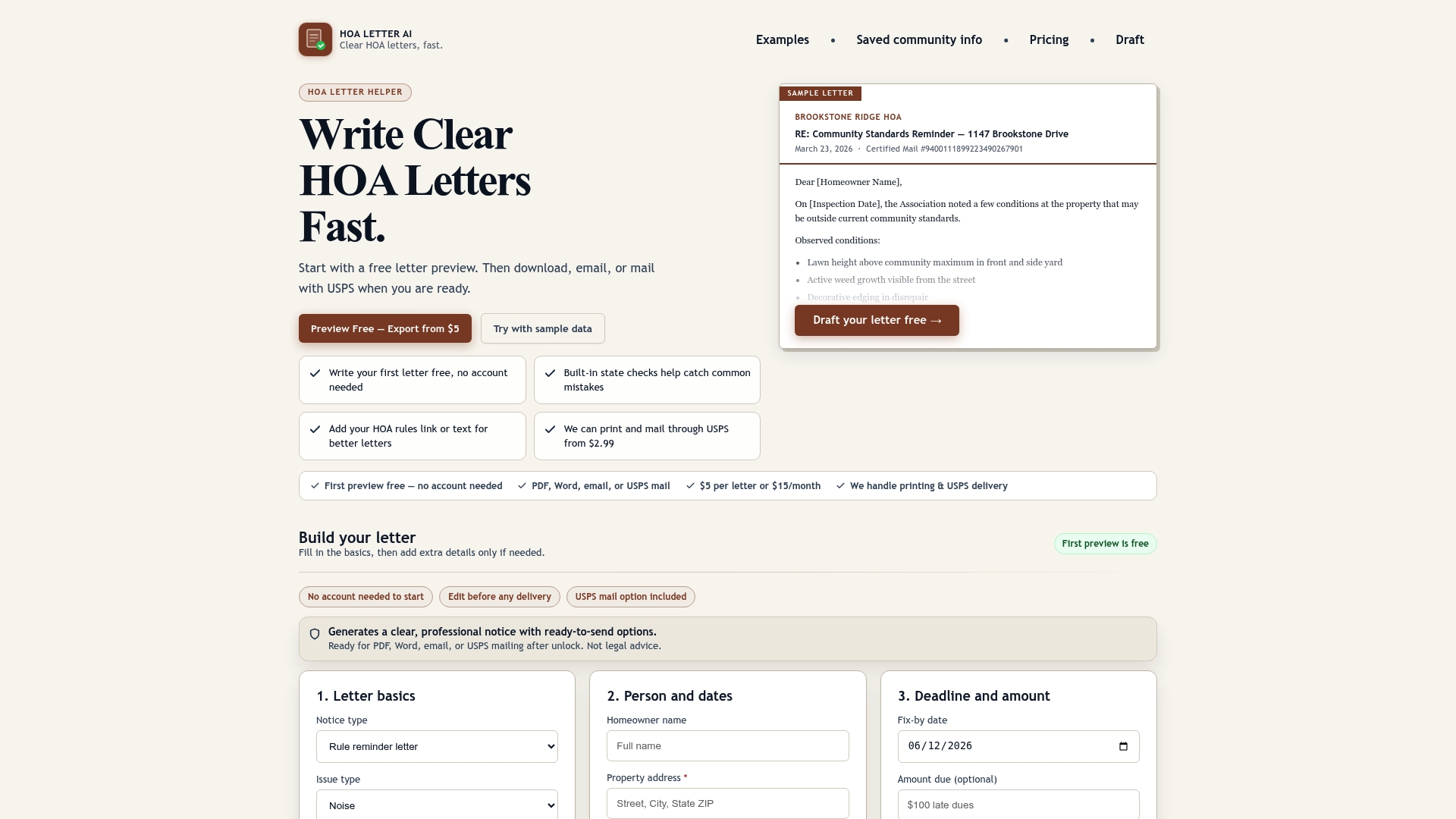
Every letter includes the correct rule citations, numbered issue statements, and deadline language for your state. Boards can preview the full letter on one page before sending, and USPS mailing is available directly through the platform. Check the HOA violation letter laws by state page to confirm the legal requirements in your jurisdiction before you send. When you are ready to draft, the HOA violation letter generator gives you a compliant letter in minutes, not hours.
FAQ
What is a standardized compliance letter?
A standardized compliance letter is a formal written notice that identifies a specific rule violation, cites the governing document, and requires the recipient to take a defined corrective action within a set deadline.
How long does a homeowner have to respond to a compliance letter?
The standard response deadline for formal compliance letters is 30 days. Some HOA governing documents set shorter or longer windows, so boards should confirm the deadline in their CC&Rs.
What happens if a homeowner ignores a compliance letter?
Ignoring a compliance letter increases the risk of escalation to formal enforcement actions, fines, or legal proceedings. Boards should follow up in writing if no response is received before the deadline.
What should a homeowner include in their response?
A homeowner’s response should address each numbered compliance point individually, describe the corrective action taken or planned, and attach only the documents explicitly requested. Keep copies of everything submitted.
How is a compliance letter different from a warning letter?
A warning letter is a courtesy notice sent before formal enforcement begins. A compliance letter is a formal document with legal standing that creates an enforceable record and requires a written response.