
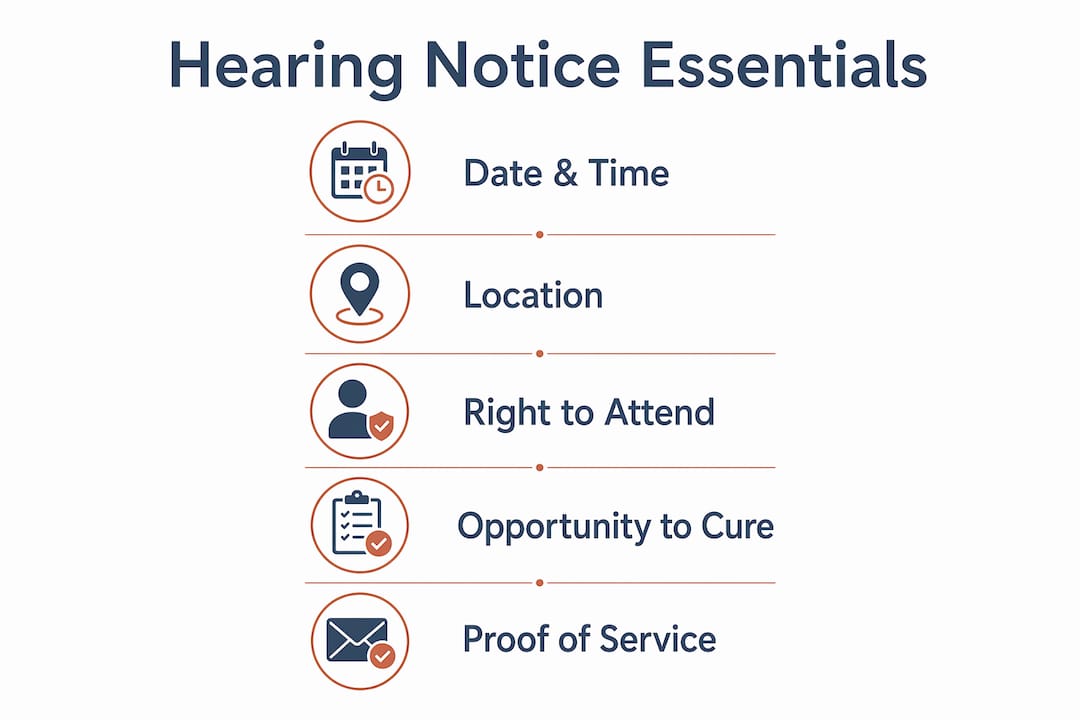
A legally adequate HOA hearing notice must include the date, time, and location of the hearing; a clear description of the alleged violation with a specific CC&R or rule citation; a statement of the member’s right to attend and present evidence; and proof that delivery was made by a method and within a timeframe that satisfies your state statute or governing documents. Miss any one of those elements and the notice may be defective, which can void the entire disciplinary action.
Quick checklist for scanning a notice you’ve received or drafted:
- Date, time, and place of the hearing
- Description of the alleged violation (specific, not vague)
- Citation to the exact CC&R section, rule, or bylaw violated
- Statement that the member has the right to attend and address the board
- Statement of the right to present evidence or witnesses
- Reference to any cure opportunity where the statute requires one
- Delivery method and date that satisfies the applicable statute (example: California Civil Code §5855 requires at least 10 days’ advance written notice; Texas Property Code §209.006 requires certified mail)
- Name of the association and contact information
HOA Letter AI is built specifically to help boards and property managers draft notices that hit every one of these points without missing a statutory requirement.
Table of Contents
- What does a compliant HOA hearing notice have to include?
- How do timing windows and delivery methods work by state?
- What actually happens at an HOA hearing?
- What are the post-hearing requirements boards must follow?
- How should homeowners prepare for an HOA hearing?
- What notice mistakes do boards make that can void discipline?
- A practical checklist and example notice outline for boards
- Key Takeaways
- Why procedural rigor protects everyone, not just the board
- HOA Letter AI makes compliant hearing notices faster to draft
- Useful sources
What does a compliant HOA hearing notice have to include?
Every element of a hearing notice serves a due-process function. Courts and state statutes treat the notice as the core instrument of that process, and omitting any required element can make the notice legally defective regardless of whether the underlying violation is real.
Date, time, and place
The notice must state a specific date, time, and physical (or virtual, if authorized) location. Vague language like “a hearing will be scheduled” does not satisfy this requirement. The member needs enough information to show up.
Description of the alleged violation
This is where most defective notices fail. The description must be specific enough that the member understands exactly what conduct is at issue. “Landscaping violation” is not enough. “Failure to maintain lawn height below 6 inches as required by Section 4.3(b) of the CC&Rs” is.
A hearing notice that cites only a general category of violation — without naming the specific governing-document provision — gives the member no meaningful opportunity to prepare a defense. Courts have found such notices procedurally defective even when the underlying violation was clear.
Right to attend and present evidence
The notice must affirmatively state that the member has the right to attend the hearing and address the board. Many states also require the notice to state the member’s right to present evidence and bring witnesses. Under Davis-Stirling practice guidance, failure to include this statement is itself a defect.

Cure opportunity
Where a statute requires it, the notice must describe the owner’s right to cure the violation before the hearing. Texas Property Code §209.006, for example, requires the initial notice to give the owner a reasonable period to cure before a hearing is even scheduled.
Record items the notice should create
Every notice should be accompanied by a file that includes a copy of the notice itself, the delivery receipt or tracking confirmation, and a reference to the specific governing-document section. That file is your defense if the disciplinary action is ever challenged.
Pro Tip: Draft the violation description by pasting the exact CC&R or rule language into the notice, then adding one sentence describing the specific observed conduct. That pairing makes the citation airtight and gives the member clear notice of what they need to address.
How do timing windows and delivery methods work by state?
Timing and delivery rules vary significantly by state, and getting them wrong is one of the most common ways a board voids an otherwise valid enforcement action.
Common statutory windows
| State | Advance Notice Required | Delivery Method | Post-Hearing Decision |
|---|---|---|---|
| California | 10 days (discipline); 15 days (suspension) | Individual delivery by mail | Written decision within 14 days |
| Texas | Certified mail required for initial notice; owner has 30 days to request hearing | Certified mail | Statutory period after request varies by state |
| Virginia | At least 14 days | Certified or registered mail in many provisions | Short window per Virginia POA Act |
| Florida | 14 days for member meetings; board meeting notice 48 hours (posted) or 7 days (mailed) | Mail, delivery, or authorized electronic transmission | Per bylaws |
California’s Civil Code §5855 is one of the most detailed statutes in the country on this point. It requires 10 days’ notice for discipline and 15 days for suspension of membership rights, and it mandates a written decision within 14 days after the hearing.
Permitted delivery methods
- Personal delivery: Handing the notice directly to the member; most reliable proof
- Individual delivery by mail: First-class mail to the member’s address of record; most states allow this as a baseline
- Certified mail: Required in Texas for initial violation notices; provides a signed return receipt
- Electronic delivery: Allowed in California, Florida, and several other states when the member has consented in writing to receive notices electronically
- Posted notice: Acceptable for general board meeting notices in Florida (48 hours in advance) but generally not sufficient for individual disciplinary hearing notices
Proof of service
Proof of delivery is not optional. A board that cannot show the member received the notice faces a serious procedural challenge. Acceptable proof includes a signed return receipt from certified mail, USPS tracking confirmation showing delivery, a date-stamped copy in the association’s file, or a documented email delivery confirmation where electronic notice is authorized. The Texas HOA Hearings Handbook specifically recommends preserving every piece of delivery documentation as part of the enforcement record.
Pro Tip: When mailing notices, send both a certified copy and a regular first-class copy. If the certified mail is refused or unclaimed, the first-class copy still establishes delivery under most state statutes.
What actually happens at an HOA hearing?
The hearing itself follows a predictable sequence, but boards that treat it as a formality rather than a record-building exercise tend to create the problems they were trying to avoid.
Pre-hearing steps
- Provide the member with a list of the evidence the board intends to use (photos, inspection reports, prior notices).
- Allow the member to review that evidence before the hearing date.
- Accept written statements from the member if they cannot attend in person.
- Grant a continuance if the member makes a reasonable request with adequate notice.
Practice handbooks recommend proactive evidence sharing as a dispute-reduction tool. When members see the board’s evidence in advance, many disputes resolve before the hearing.
At the hearing
The member has the right to attend, speak, and present evidence. They may bring witnesses or, in most jurisdictions, legal counsel. The board should designate one person to manage the proceeding, allow the member to present their position without interruption, and then ask clarifying questions. The hearing may proceed in the member’s absence if valid notice was provided and the member simply does not appear.
Executive session is an option in many states. Members can request that the hearing be held in executive session to protect privacy. Boards must honor that request when the statute or governing documents allow it. Conversely, a board cannot force an owner into executive session if the owner wants an open hearing and no statute or document authorizes that choice.
Board deliberation and decision
- After the member presents their case, the board deliberates, ideally in executive session.
- The board’s decision should be based on the evidence in the record, not on information gathered outside the hearing.
- If the board and member reach an agreement, the board should draft a written resolution immediately. Under California Civil Code §5855(e), a signed written resolution is binding and enforceable.
- If no agreement is reached, the board issues a formal decision.
Pro Tip: Designate one board member as the record-keeper for every hearing. That person’s job is to note what evidence was presented, what the member said, and what the board’s factual findings were. Those notes become the hearing minutes and are your primary defense against a later legal challenge.
What are the post-hearing requirements boards must follow?
The hearing is not the end of the process. Post-hearing obligations are where many boards stumble, and the consequences can be severe.
Missing the post-hearing notice deadline can void the disciplinary action entirely, regardless of whether the violation was real and the hearing was properly conducted. California Civil Code §5855(f) and (g) make this explicit: the written decision must be delivered within 14 days.
What a proper Notice of Decision must include
- Date of the hearing
- Whether the member attended
- Summary of the evidence the board reviewed
- The board’s factual findings
- The specific rule or CC&R provision violated
- The penalty imposed (fine amount, suspension period, reimbursement assessment)
- The member’s right to appeal or request internal dispute resolution (IDR)
Post-decision enforcement and homeowner remedies
Once the decision is delivered, the board may impose fines, suspend privileges, or levy reimbursement assessments depending on what the governing documents and state law allow. Homeowners who believe the process was flawed have several options. IDR is a required pre-litigation step in California and several other states. If IDR fails or is not required, the member may pursue alternative dispute resolution or litigation.
The Virginia POA Act requires the board to deliver its decision within a short window after the hearing by certified or registered mail. Missing that window in Virginia carries the same risk as missing it in California: the discipline may not hold.
How should homeowners prepare for an HOA hearing?
Receiving a hearing notice is stressful, but the process gives you real rights. Use them.
Step-by-step preparation checklist
- Confirm the notice is complete. Check it against the elements listed in the opening section. If the notice is missing a required element, note it in writing before the hearing.
- Request the evidence. Ask the board in writing for a list of all evidence it intends to use. Most practice guides recommend this, and some states require it.
- Verify the delivery method. Confirm that the notice was delivered by a method your state statute or governing documents authorize. A notice sent by email when your documents require first-class mail may be defective.
- Gather your own evidence. Photos, contractor invoices, prior correspondence, and witness statements all belong in your file.
- Consider representation. You can bring an attorney or, in some states, another representative. If the potential fine or suspension is significant, legal counsel is worth considering.
- Request an executive session if you want privacy. Most states allow members to request that the hearing be held in executive session rather than before the full board in an open meeting.
- Ask for a continuance if you need more time. A reasonable request made promptly is usually granted.
Pro Tip: Send your evidence request by email or certified mail and keep a copy. If the board refuses to share its evidence before the hearing, that refusal is itself a procedural issue you can raise at the hearing or in any subsequent appeal.
Homeowners in California can also find state-specific guidance on what to do after receiving a notice and how to prepare for the hearing process.
What notice mistakes do boards make that can void discipline?
Procedural errors in hearing notices are the single most common reason disciplinary actions fail. Here are the mistakes that come up repeatedly.
A board that skips a required element in the notice, uses the wrong delivery method, or misses a statutory deadline does not just face a procedural inconvenience. The entire disciplinary action can be voided, and the board may face attorney-fee exposure if the member litigates.
Common drafting and process errors
- Vague violation descriptions: “Violation of community rules” without citing the specific provision
- Missing rule citation: Describing the conduct but not naming the CC&R section or rule number
- Wrong delivery method: Emailing a notice when the governing documents require first-class mail, or mailing to an outdated address
- Missed timing window: Sending the notice eight days before the hearing when the statute requires ten
- No proof of delivery: Sending the notice but keeping no record of how or when it was delivered
- Missing right-to-attend statement: Omitting the sentence that tells the member they can appear and speak
- No post-hearing written decision: Imposing a fine without delivering a written decision within the statutory window
What a defensible record looks like
A board that maintains a complete enforcement file is far less likely to face successful legal challenges. That file should contain: a copy of the notice as sent, proof of delivery (tracking number, signed receipt, or date-stamped copy), the evidence packet used at the hearing, hearing minutes that reflect what was presented and the board’s findings, and the written decision with delivery confirmation. Davis-Stirling practice guidance treats this documentation as the primary defense against later legal challenges.
A practical checklist and example notice outline for boards
Use this as a drafting guide, not a final template. Your state’s statute and your governing documents control the specific language.
Notice checklist
- Association name, address, and contact information
- Member’s name and property address
- Hearing date, time, and location (specific room or virtual link)
- Nature of the alleged violation (one to two sentences, specific conduct)
- Citation to the exact CC&R section, rule, or bylaw
- Statement of right to attend and address the board
- Statement of right to present evidence and witnesses
- Cure language where required by statute
- Delivery method and date
- Signature of authorized board officer or manager
Example notice outline
- Header: Association name, date of notice, member name and address
- Subject line: “Notice of Disciplinary Hearing — [Brief Description of Violation]”
- Violation clause: “The Board has determined that [specific conduct, e.g., ‘the fence installed at your property at [address]’] appears to violate Section [X.X] of the [CC&Rs/Rules and Regulations], which provides: [quote the relevant sentence of the governing document].”
- Hearing details: “A hearing has been scheduled for [date] at [time] at [location].”
- Rights statement: “You have the right to attend this hearing, address the Board, and present evidence or witnesses on your behalf.”
- Cure clause (if applicable): “You may cure the violation prior to the hearing by [specific action]. If the violation is cured before the hearing date, please notify the Board in writing.”
- Closing: Authorized signature, title, contact information
Attach or reference the specific governing-document language in the notice file. Store the evidence packet, proof of delivery, and hearing minutes together. For a ready-to-adapt version, the HOA hearing notice template from HOA Letter AI maps each of these fields to common statutory requirements.
Key Takeaways
A compliant HOA hearing notice requires specific violation language, a governing-document citation, a rights statement, timely delivery by an authorized method, and a written post-hearing decision delivered within the statutory window.
| Point | Details |
|---|---|
| Notice must be specific | Cite the exact CC&R or rule section and describe the specific conduct, not just a general category. |
| Timing varies by state | California requires 10 days for discipline; Texas requires certified mail with a 30-day owner window; Virginia requires at least 14 days. |
| Delivery method matters | Use the method your statute or governing documents require and keep proof of delivery in the enforcement file. |
| Post-hearing decision is mandatory | California Civil Code §5855 requires a written decision within 14 days; missing that deadline can void the discipline. |
| HOA Letter AI reduces drafting errors | HOA Letter AI’s state-aware templates and built-in checks help boards hit every required element before a notice goes out. |
Why procedural rigor protects everyone, not just the board
Most HOA disputes that end in litigation did not start as complicated legal questions. They started as a notice that was vague, a deadline that was missed, or a delivery method that did not match what the statute required. The member felt blindsided, the board felt justified, and neither side had a clean record to point to.
Following the statutory and governing-document steps is not just about protecting the board from liability. It creates a process the member can trust, even when they disagree with the outcome. A member who receives a specific, timely, properly delivered notice knows exactly what the board is alleging and has a real opportunity to respond. That transparency resolves a surprising number of disputes before they reach the fine stage.
The practical win here is straightforward: clear notices plus pre-hearing evidence exchange tend to produce agreements. When boards treat hearings as record-building exercises rather than formalities, they end up with fewer contested fines, fewer appeals, and far less attorney-fee exposure. The paperwork is not the burden. The paperwork is the protection.
HOA Letter AI makes compliant hearing notices faster to draft
Drafting a hearing notice that satisfies California Civil Code §5855, Texas Property Code §209.006, or Virginia’s POA Act requirements is not complicated once you know what each element needs to say. The problem is that boards and property managers draft these notices under time pressure, often without a checklist in front of them, and one missed element can unwind months of enforcement work.
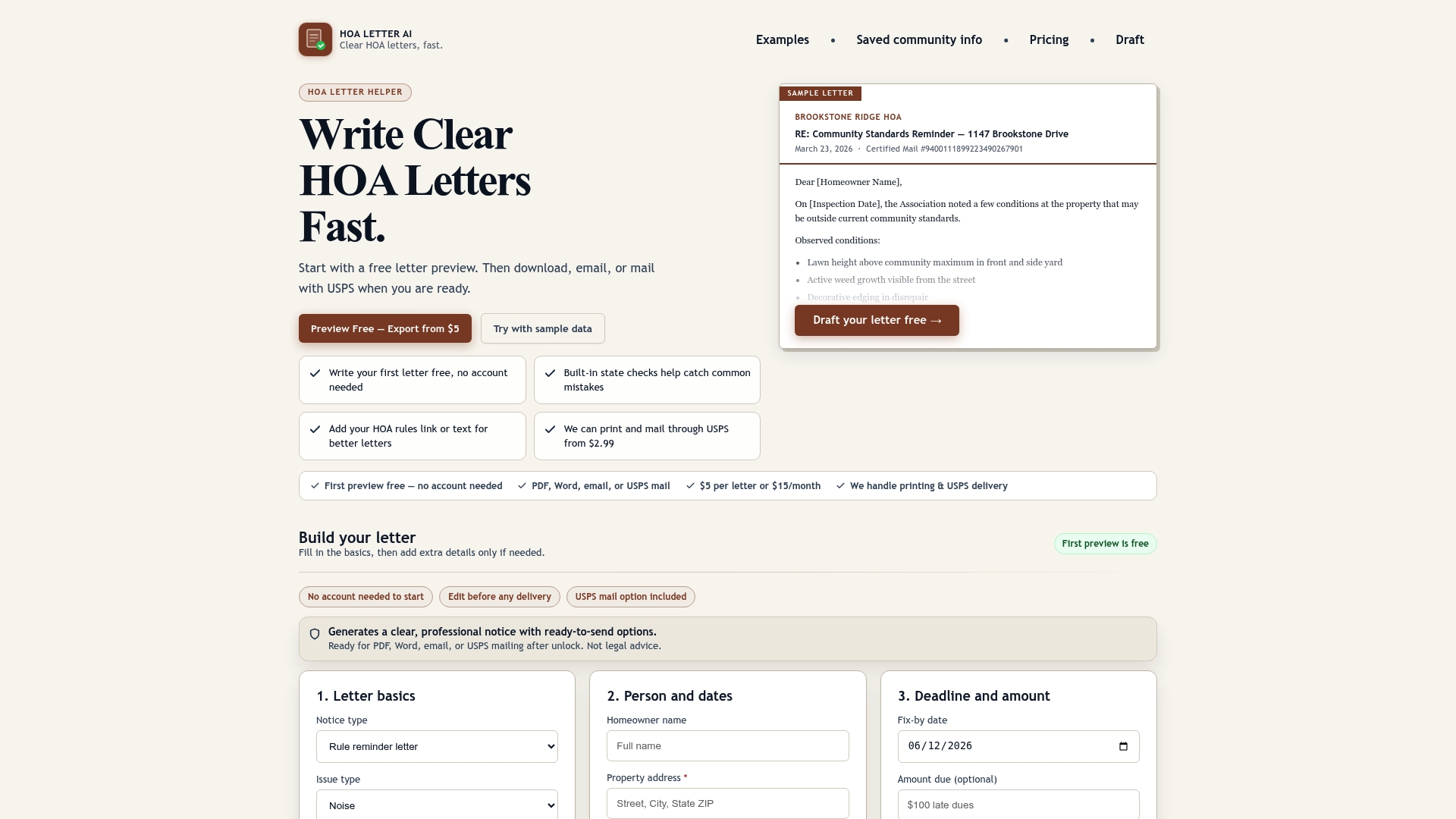
HOA Letter AI addresses that directly. Its state-aware templates pull in the statutory requirements for your jurisdiction, built-in checks flag missing elements before the notice goes out, and the one-page preview lets you confirm the notice reads correctly before delivery. For management teams handling multiple communities, reusable community profiles mean you are not re-entering the same governing-document language every time. USPS mailing integration generates proof of service automatically, which closes the gap that most enforcement files are missing.
Check your state’s specific notice requirements and access ready-to-use templates at the HOA violation letter laws by state page, or go straight to the hearing notice template to start a compliant draft now.
Useful sources
The statutes and practice guides below are the authoritative starting points for verifying hearing notice requirements in your state.
- California Civil Code §5855 — FindHOALaw explanation and full text: covers the 10-day and 15-day notice windows, required notice contents, and the 14-day post-hearing decision deadline. Best for California boards and homeowners.
- Davis-Stirling.com — Due Process in Disciplinary Actions — Practice guidance: the leading California HOA practice reference; explains required notice elements, hearing procedures, and post-hearing obligations in plain language.
- FindHOALaw — Notice and Hearing Requirements — Practice summary: covers written resolution requirements and executive session rules; useful for California and general practice questions.
- Texas HOA Hearings Handbook — Practice guide (PDF): covers Texas Property Code §209.006 and §209.007 in detail, including certified-mail requirements, cure periods, and hearing scheduling rules. Best for Texas boards.
- Virginia Property Owners’ Association Act — Virginia Code: the primary statutory source for Virginia HOA notice and hearing requirements, including the 14-day advance notice rule and post-hearing delivery windows.
- Florida Statutes §720.306 and §720.303 — Florida Senate and Florida House: the governing statutes for Florida HOA meeting and notice requirements, including the 14-day member meeting notice rule and authorized electronic delivery.
- LegalClarity — HOA Notice and Hearing Rights — Practical overview: accessible summary of notice elements and homeowner rights; useful for homeowners who want a plain-language explanation before consulting an attorney.
- The HOA Handbook — How to Prepare for an HOA Hearing — Preparation guide: practical steps for homeowners preparing for a hearing, including evidence requests and continuance procedures.
This article is general information, not legal advice. Notice requirements vary by state and governing documents. Confirm the current rules for your association with your state’s statutes or a qualified HOA attorney before acting.