
HOA compliance letters are formal legal notices that trigger an enforcement process with real financial and legal consequences. Understanding why HOA letters require response is the first step toward protecting your rights as a homeowner or fulfilling your duties as a board member. HOA letters start an enforcement ladder that moves from warning to fines to liens to foreclosure. A written, timely reply can pause or reset that ladder entirely. Silence, by contrast, is treated as admission.
Why HOA letters require response: the core legal reason
HOA letters are not suggestions. They are official communications that trigger a formal enforcement process starting with a warning letter, moving through fines, and potentially ending in a lien or legal action. Every letter sets a clock running. That clock determines whether you keep your right to dispute the issue or lose it entirely.
Failing to respond in writing by the stated deadline is treated as a waiver of due process. That means you forfeit your right to a hearing or an appeal. The HOA does not need to prove you received the letter and chose to ignore it. Silence alone is enough to close the door on your options.

Homeowners typically have 10 to 30 days to respond to an HOA violation notice. That window is short. Missing it does not just delay resolution. It removes your ability to contest the violation at all.
What types of HOA letters require a response?
Not every piece of HOA mail carries the same weight, but most formal letters demand a written reply. Knowing the type of letter you received tells you how fast you need to act and what your response should say.
The three most common types are:
- Violation notices. These describe a specific rule infraction, such as an unapproved fence, a parked vehicle, or an overgrown lawn. They include a remediation deadline and often a warning that fines will follow. A violation notice requires a written reply that either acknowledges the issue, disputes the finding, or requests a hearing.
- Demand letters. These arrive after a violation notice goes unanswered or unresolved. They typically state a specific dollar amount owed and a hard deadline. Demand letters are one step removed from lien proceedings. Responding quickly with a payment plan proposal or a written dispute is critical at this stage.
- Compliance letters. These request that a homeowner meet a community standard, such as repainting a home or removing a structure. They are less urgent than demand letters but still require a written acknowledgment and a timeline for compliance.
Each type differs in urgency. A first violation notice gives you room to negotiate. A demand letter gives you very little. Treating any of them as informal mail is the most common and costly mistake homeowners make.
What are the consequences of ignoring HOA letters?
The consequences of ignoring HOA letters follow a predictable and painful sequence. Understanding that sequence makes the importance of responding to HOA letters impossible to dismiss.
- Warning letter issued. The HOA documents the violation and notifies you in writing. No fine yet, but the clock starts.
- Fine assessed. If no response arrives by the deadline, fines begin. Fines can escalate from hundreds to thousands of dollars over a period of months. Each missed deadline adds another layer.
- Hearing opportunity lost. Most HOA governing documents give homeowners the right to request a hearing before fines become final. Failing to respond in writing by the deadline waives that right automatically.
- Lien placed on property. Unpaid fines can result in a lien against your home. A lien complicates refinancing, selling, or transferring the property.
- Foreclosure proceedings. In some states, HOAs can foreclose on a property to collect unpaid assessments and fines. All foreclosure cases are preceded by missed opportunities to respond during earlier enforcement stages.
The enforcement ladder is not a threat. It is a documented process that moves forward automatically when homeowners stay silent. Proof of written, timely responses is the single most important factor in preventing legal escalation. A paper trail does not just help you argue your case. It can stop the process entirely.
Pro Tip: *Send every response by certified mail with return receipt requested. That green card is your proof of delivery and your best defense if the dispute ever reaches a lien or foreclosure proceeding.*
How to properly reply to an HOA notice
Responding well matters as much as responding at all. A poorly written reply can inflame a dispute that a calm, documented letter would have resolved in days.
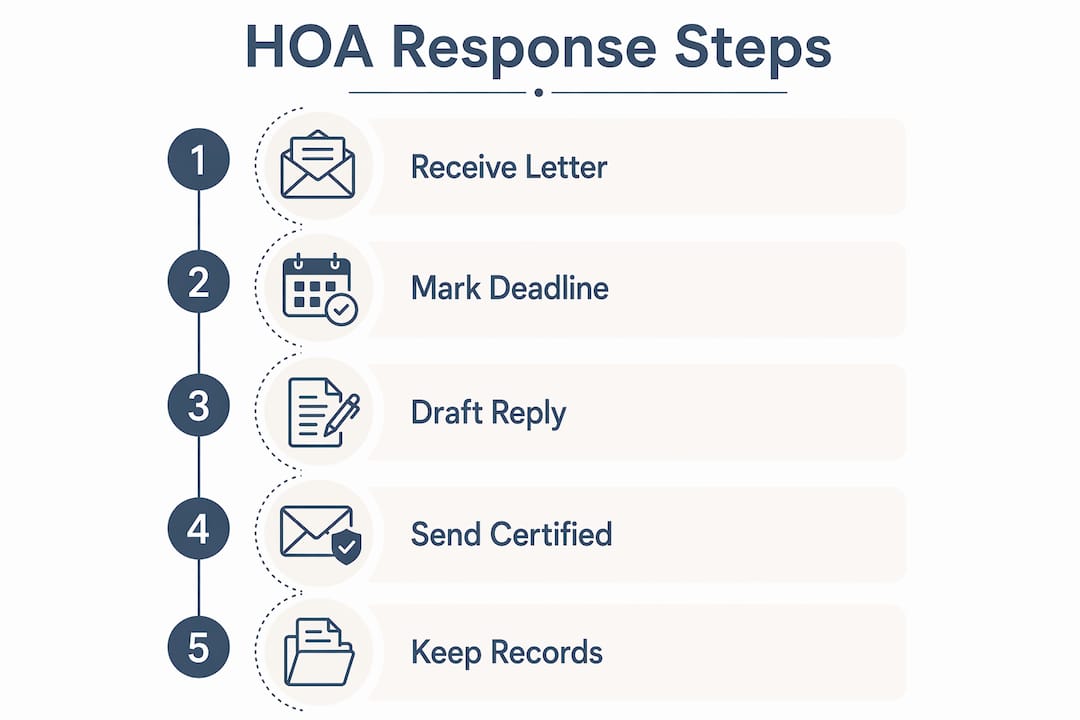
- Read the letter completely before writing anything. Identify the specific rule cited, the deadline, and the remedy requested. Many homeowners respond to what they assume the letter says rather than what it actually says.
- Choose your position clearly. Your reply should do one of three things: acknowledge the violation and commit to a fix, dispute the finding with evidence, or request a formal hearing. Vague responses that do neither give the board no path forward.
- Attach supporting evidence. Photos, receipts, contractor quotes, or prior correspondence all strengthen your position. Reference the specific section of the CC&Rs or bylaws that supports your argument.
- Use a respectful, objective tone. Aggressive or accusatory language reduces the board's willingness to negotiate. A calm, factual letter signals that you take the process seriously and are open to resolution.
- Request an extension if you need one. Boards generally grant reasonable extension requests made in writing before the deadline passes. Asking for more time is far better than missing the deadline entirely.
- Send via certified mail. Responding by certified mail or another proof of delivery method protects your position if the dispute escalates.
Typical response deadlines run 10–30 days. Mark the deadline the day you receive the letter. Many disputes resolve before legal action when homeowners provide documented, timely responses that follow governing document procedures.
Pro Tip: *Avoid mentioning attorneys in your first response unless the situation is already at the lien stage. Premature legal threats reduce the board's willingness to negotiate and can turn a routine dispute into a formal legal proceeding.*
How should HOA boards respond to homeowner letters?
The obligation to respond runs both ways. HOA boards that ignore homeowner letters create exactly the kind of conflict they are supposed to prevent. Some states mandate specific response times for boards to homeowner inquiries. Failing to meet those timelines exposes the association to legal liability and erodes community trust.
Timely board responses reduce conflict, demonstrate procedural fairness, and protect the association from claims of selective enforcement. A homeowner who receives a prompt, clear reply is far less likely to escalate to an attorney or a state regulatory complaint.
Boards benefit from establishing a written communication policy that sets internal response deadlines, assigns responsibility for replies, and documents all correspondence. Clear HOA response timelines increase accountability and reduce homeowner frustration. That reduction in frustration translates directly into fewer disputes reaching the formal enforcement stage.
Pro Tip: *Board members should treat every homeowner letter as a record. Log the date received, the date of your reply, and the method of delivery. That log protects the association if a homeowner later claims they never received a response.*
Common pitfalls when responding to HOA letters
Most homeowner mistakes in HOA disputes come down to a few recurring errors. Recognizing them in advance is the fastest way to avoid them.
- Treating the letter as informal. HOA letters are formal legal notices, not neighborly suggestions. Homeowners often underestimate the formal nature of these communications, which leads to waived rights and escalating penalties.
- Using emotional language. Anger is understandable. Putting it in writing is not. Emotional responses shift the conversation away from the facts and toward personal conflict.
- Skipping proof of delivery. Dropping a letter in the mailbox without tracking is not enough. If the board claims they never received your reply, you have no defense without a delivery receipt.
- Ignoring internal dispute resolution. Most HOA governing documents require homeowners to exhaust internal procedures before pursuing outside legal action. Skipping those steps can invalidate your claim entirely.
- Missing the deadline. A response sent one day late carries the same consequence as no response at all in many associations. The deadline is not a suggestion.
- Assuming the problem will resolve itself. HOA enforcement processes move forward automatically. No one pauses the clock because a homeowner is busy or confused.
Key Takeaways
Responding to HOA letters in writing, on time, and with documented delivery is the single most effective way to protect your rights and prevent costly escalation.
| Point | Details |
|---|---|
| Response deadlines are strict | Homeowners typically have 10–30 days to reply before losing appeal rights. |
| Silence waives due process | Failing to respond in writing forfeits your right to a hearing or appeal. |
| Certified mail is non-negotiable | Proof of delivery is your primary defense if disputes escalate to liens. |
| Tone determines outcomes | Respectful, evidence-based letters encourage negotiation and faster resolution. |
| Boards must respond too | Timely board replies reduce conflict and protect the association from liability. |
What I've learned watching HOA disputes escalate needlessly
The most preventable HOA disputes I have seen share one thing in common. The homeowner received a letter, felt it was unfair, and did nothing. That decision, made in a moment of frustration, turned a $150 fine into a $4,000 lien.
What strikes me most is how rarely homeowners understand that silence is a legal act. They assume that not responding means the dispute is on hold. The HOA sees it differently. Silence confirms the violation, waives the hearing, and authorizes the next enforcement step. The process does not wait for you to feel ready.
The fix is simpler than most people expect. A one-page letter, sent by certified mail, stating your position and referencing the relevant governing document section, stops the clock. It does not need to be written by an attorney. It needs to be written, delivered, and documented.
Boards are not immune to this either. I have watched associations lose homeowner trust entirely because a board member forgot to reply to a reasonable inquiry for six weeks. The homeowner filed a state regulatory complaint. The association spent more on legal fees defending that complaint than the original dispute was worth.
Respectful, evidence-focused communication is not just good manners. It is the most cost-effective dispute resolution tool available to both sides. Use it every time, without exception.
> *— Blake*
Hoaletterai makes HOA letter responses faster and more accurate
Writing a compliant HOA response letter from scratch takes time most homeowners and board members do not have. Getting the tone, deadlines, and state-specific language wrong can make a manageable dispute worse.

Hoaletterai generates state-compliant HOA letters in minutes, with built-in checks for common errors and customizable options for your community's specific rules. Whether you need a violation response letter or an appeal, the platform produces a clear, formatted letter ready for certified mail delivery. Before you write your next response, check the HOA violation letter laws for your state so your reply meets every procedural requirement.
FAQ
What happens if I don't respond to an HOA violation letter?
Ignoring an HOA violation letter is treated as a waiver of due process, which means you forfeit your right to a hearing or appeal. Fines can escalate from hundreds to thousands of dollars, and the enforcement process moves forward automatically.
How long do I have to respond to an HOA letter?
Homeowners typically have 10–30 days to respond to an HOA violation notice. Missing that window removes your ability to contest the violation and triggers the next enforcement step.
Does my HOA response need to be in writing?
Yes. Verbal responses carry no legal weight in HOA enforcement proceedings. Send your reply in writing via certified mail with return receipt requested to create a documented record.
Can an HOA foreclose on my home for unpaid fines?
In many states, an HOA can place a lien on your property for unpaid fines and assessments, and some states permit foreclosure to collect those amounts. Every foreclosure case is preceded by missed opportunities to respond during earlier enforcement stages.
What should I include in my HOA response letter?
Your response should clearly state your position, reference the specific governing document section that supports your argument, attach any supporting evidence, and request a hearing if you dispute the finding. Keep the tone respectful and the language factual.
Recommended
- HOA Violation Response Letter: Template & Tips for Homeowners | HOA Letter AI
- Homeowner Response Letter to HOA: Full Guide | HOA Letter AI
- HOA Noise Complaint Response Letter (State-Compliant HOA Letter) | HOA Letter AI
- HOA Landscaping Violation Response Letter (State-Compliant HOA Letter) | HOA Letter AI
Drafting support for HOA notices
Use the HOA letter drafter to turn this guidance into a resident-ready notice, compare reusable HOA letter templates, or review the property manager workflow for higher-volume enforcement work.