
Whether your HOA can fine you usually comes down to what your CC&Rs say and whether your state limits that power. If your governing documents restrict short-term rentals, most associations can and will enforce that, including fines. Your first move isn’t panic. It’s preserving evidence and sending a factual written response before the cure period on your notice expires.
TL;DR:
- Most HOA fines for short-term rentals depend on specific CC&R language, with enforcement processes involving notice, cure periods, and hearings.
- Proper documentation, including timestamps and detailed evidence, is crucial to counter HOA violations and procedural defects.
- State law restrictions on fines and amendments may limit HOA authority, especially if the rental ban was adopted after your purchase without proper approval.
- Responding calmly with a factual, evidence-based letter that requests the HOA’s proof and a hearing often weakens the HOA’s case.
- Using automated, state-aware response tools can ensure procedural compliance and increase chances of resolving disputes without legal escalation.
HOA Letter AIDraft A Clear HOA ResponseCreate a professional compliance letter with guided drafting, state-specific context, community rules, built-in checks, and delivery options.Create your response letter
Table of Contents
- How HOA Enforcement Works: Notice, Cure Periods, and Evidence
- How to Read Your HOA’s Rules and Check State Law
- What Fines and State Caps Actually Look Like
- How to Draft and Send Your Response During the Cure Period
- Evidence and Procedural Defenses Worth Raising
- When Enforcement Escalates: Hearings, Injunctions, and Liens
- Preventive Steps If You Plan to Keep Hosting
- Why a Calm, Documented Response Beats a Defensive One
- Draft Your HOA Response Letter Without the Guesswork
- Sources
How HOA Enforcement Works: Notice, Cure Periods, and Evidence
An HOA’s authority to punish you for renting on Airbnb comes entirely from its governing documents. If the CC&Rs explicitly prohibit short-term rentals, courts generally side with the association. If those documents are silent on the issue, the HOA usually cannot invent a ban on the spot. It has to amend the rules first, which typically means formal notice to owners and a vote.
Enforcement follows a fairly predictable sequence once a board decides to act:
- Someone or something flags the listing (a neighbor, a board member, a monitoring service).
- The HOA sends written notice citing the specific rule violated.
- You get a cure period, commonly 15 to 30 days, to fix the problem.
- You’re typically entitled to a hearing before fines become final in most states.
- If you don’t respond or the board rejects your explanation, fines start and can escalate.
Boards rarely stumble onto a listing by accident. They use platform scans, third-party short-term rental trackers, and old-fashioned neighbor complaints backed by screenshots. One detail catches most hosts off guard: pulling your listing down after getting caught doesn’t erase the evidence the HOA already collected. Boards often screenshot listings, booking calendars, and even guest reviews before sending that first notice, so a quick deletion looks more like an admission than a fix.
A notice that will actually hold up needs a few specific things. It should cite the exact CC&R or rule section allegedly violated, not a vague reference to “unauthorized rental activity.” It needs a description of the conduct, a firm deadline to respond or cure, and a clear statement of your right to a hearing. If your letter is missing any of these, that’s not a minor clerical issue. It’s a potential procedural defect you can raise later.
How to Read Your HOA’s Rules and Check State Law
Before you write a single word back to your HOA, find the actual controlling documents. That means the recorded Declaration (your CC&Rs), the bylaws, any separately adopted rules and regulations, and the amendment history showing when and how those rules changed. Board meeting minutes matter too. They sometimes reveal whether a rule was properly adopted or just added to a homeowner handbook without a vote.
Read through the documents looking for specific language, not just a section titled “rentals.” Search for these terms:
- “Transient” or “transient occupancy,” language often used to describe stays under 30 days.
- “Hotel,” “motel,” or “commercial use,” phrases that signal the board views short-term rentals as a business activity, not residential use.
- “Minimum lease term,” which sets the shortest legal rental period, sometimes 30 days, sometimes six months or a year.
- “Residential use only,” a common catch-all clause that boards stretch to cover Airbnb even without naming it directly.
- “Rental frequency” or “rental cap,” which limits how often a unit can be rented in a given year regardless of duration.
State law adds another layer, and it varies more than most homeowners expect. California’s Davis-Stirling Common Interest Development Act governs how HOAs there can adopt and enforce rules, and recent state legislation has put limits on certain HOA fine amounts. Florida has its own quirks around how and when an HOA can amend its declaration to add new rental restrictions, and older declarations sometimes require a supermajority of owners to approve such a change. Arizona and Texas each have their own procedural wrinkles on notice and hearing rights that can trip up an HOA trying to rush enforcement.
Grandfathering deserves special attention. If your HOA adopted a short-term rental ban after you bought your home, and your state or your CC&Rs’ amendment clause requires a specific approval process, that later rule may not bind you the same way it binds a new owner. This is exactly the kind of technical argument worth raising in a written response rather than assuming the newest rule automatically wins.
Pro Tip: Pull the recorded Declaration from your county recorder’s office, not just the copy in your HOA’s welcome packet. Recorded versions show the actual amendment date and confirm whether the rule was properly filed, and welcome packets sometimes lag years behind the real document.
What Fines and State Caps Actually Look Like
HOA fine schedules for short-term rental violations tend to follow one of two structures: a flat per-violation fee varying widely depending on the community, or a daily accrual charge that keeps climbing until the listing comes down. Some associations layer both, hitting you with an initial fine plus a daily penalty if the violation continues past the cure deadline.
States are starting to push back on runaway fine schedules. California’s AB 130 legislation introduced caps on certain HOA fines, and Florida has separate limits on how associations can escalate penalties without additional process. The rules differ enough state by state that assuming your HOA’s fine schedule is automatically legal is a mistake. Checking your state’s specific notice and fine requirements before you pay anything is worth the ten minutes it takes.
A few warning signs suggest a fine might not survive a challenge:
- The HOA skipped the hearing it’s required to offer under your state’s law.
- The fine amount exceeds a documented state cap for that violation type.
- The board applied a new rule retroactively to conduct that happened before the rule existed.
- The notice cites no specific CC&R section, just general language about “rule violations.”
Quick Stat: Cure periods commonly run 15 to 30 days from the date of the written notice, and many states require the association to offer a hearing before fines become final rather than skipping straight to collection.
How to Draft and Send Your Response During the Cure Period
The clock starts the moment you receive that notice, so move fast on preservation before you move fast on drafting. Screenshot your Airbnb listing exactly as it appeared, including the calendar, price, and description, and make sure the screenshot captures a visible timestamp. Airbnb’s own account documentation can help confirm listing dates and account activity if the HOA disputes when the listing existed. Save every guest communication, booking confirmation, and payout record tied to the property. If you’ve already taken the listing down, note the exact date and time you did it and keep proof.
Once you’ve locked down your evidence, structure the response letter itself around four elements:
- Reference the notice directly. Cite the date, the notice number if one was assigned, and the specific rule the HOA claims you violated.
- Lay out your factual timeline. State plainly when the listing went up, when (if applicable) it came down, and what actually happened during the period in question. Don’t editorialize. Just state facts in order.
- Cite the CC&R language you reviewed. If the rule is ambiguous, silent, or was adopted through a process you believe was improper, say so and point to the specific section.
- Request the HOA’s evidence and demand a hearing. Ask what documentation supports the violation and provide your availability for the hearing your state or bylaws entitle you to.
Delivery matters as much as content. Send the letter by certified mail with a return receipt, and email a copy the same day to create a timestamped paper trail. Note the cure period deadline on your calendar and confirm your response arrives with days to spare, not hours. If you’ve taken remedial action, like removing the listing or canceling upcoming bookings, document that clearly in the letter itself. Boards often view a documented good-faith fix as reason to reduce or waive a first-time fine.
Writing this letter from scratch is where a lot of homeowners get tripped up, not because the facts are complicated but because the language has to hit specific procedural notes your state expects. An automated, state-aware letter tool like HOA Letter AI builds those requirements into the draft automatically, which matters more than it sounds. A response missing a required hearing-request phrase, for instance, can weaken your position even when your underlying facts are solid.
Pro Tip: Never send an emotional first draft. Write it, sit on it for a few hours, then reread it purely for tone. Boards respond better to calm, documented letters than to anything that reads like a complaint, even when your frustration is completely justified.
If you want a format reference for tone and structure, HOA Letter AI’s parking violation response letter and noise complaint response letter templates show the same neutral, evidence-first approach that works for short-term rental disputes.
Evidence and Procedural Defenses Worth Raising
The strongest short-term rental defense usually isn’t “I didn’t do it.” It’s proving the HOA’s process was flawed or that the violation is less severe than claimed. Gather these before your hearing:
- Booking receipts and payout records showing actual rental frequency, not assumed frequency.
- Timestamped screenshots showing when you removed the listing, ideally with metadata intact rather than a hand-cropped image.
- Any proof that no guests actually stayed during the period cited, if that’s the case.
- Written statements from neighbors or the property manager if they contradict the complaint.
- Copies of the specific CC&R or rule section, highlighted, so the board can’t claim ambiguity later.
On the procedural side, look for gaps the HOA can’t paper over. Did the notice cite a specific rule, or vague language about “unauthorized use”? Were you actually offered a hearing, or did the fine just show up on your account? Has the HOA enforced this rule against other short-term rental hosts in the community, or only against you, which raises a selective enforcement argument? Was the rule itself adopted through a proper amendment vote, or is the board relying on a rule that was never formally ratified?
Package all of this into one organized submission before the hearing, not a pile of loose documents you’re flipping through live. A short cover page listing your evidence, followed by labeled exhibits, makes it far easier for a board to actually engage with your argument instead of skimming past it.
When Enforcement Escalates: Hearings, Injunctions, and Liens
A board hearing is usually informal, but it’s still your best chance to present organized evidence and get a fine reduced or dismissed before things get expensive. Bring your documentation, state your timeline clearly, and don’t get pulled into arguing tone with a board member. Stick to facts and dates.
If a homeowner keeps hosting despite fines, some associations escalate to seeking a court injunction, a legal order forcing you to stop the short-term rental activity. That’s a serious step because it comes with legal costs on both sides and a court record. Unpaid fines can also turn into liens against your property in many states, and in rare, extreme cases, unresolved liens have led to foreclosure actions. The threshold and process for that vary significantly by state, so what happens in California looks different from what happens in Texas or Arizona.
The decision point for hiring an attorney usually comes down to dollar amount and complexity. If fines are modest and the procedural issues are clear cut, a well-drafted response and a hearing appearance often resolve things without legal fees. If you’re facing an injunction, a lien, or a fine amount that genuinely threatens your finances, that’s the point to bring in a real estate attorney familiar with HOA disputes rather than trying to argue Davis-Stirling nuances yourself. Mediation is worth requesting too. Many state statutes actually require an offer of mediation before litigation, which can save both sides money.
Preventive Steps If You Plan to Keep Hosting
If you’re determined to keep hosting legally, treat compliance as an ongoing project, not a one-time check. Before relisting anything, pull your CC&Rs and full amendment history so you know exactly what’s allowed today, not what was allowed when you bought the property. Confirm your local municipality’s short-term rental licensing rules too, since city and HOA restrictions operate independently of each other.
A few operational habits reduce your enforcement risk substantially:
- Register your rental activity with the HOA if your community requires it, rather than hoping it goes unnoticed.
- Post clear guest rules covering parking, noise, and trash pickup, and leave visible contact information for neighbors.
- Confirm your homeowner’s insurance covers short-term rental use, since standard policies often exclude it.
- Add the HOA as an additional insured on your policy if your governing documents or state law require it.
Financing is a related risk few hosts think about until it’s too late. Some lenders and reverse mortgage programs treat short-term rental use as a red flag if it conflicts with property-use restrictions in your governing documents, which is worth understanding if you’re considering a reverse mortgage on a rental property.
Pro Tip: Ask your HOA management company directly whether any short-term rental rule changes are pending. Boards sometimes discuss new restrictions for months before a formal vote, and getting ahead of that timeline beats finding out after you’ve already booked a season of guests.
Why a Calm, Documented Response Beats a Defensive One
Most homeowners who get an Airbnb violation notice respond the way anyone would: defensively, quickly, and emotionally. That instinct works against you almost every time. Boards deal with angry phone calls constantly, and a heated response rarely changes an outcome. What actually moves the needle is a letter that states facts in order, cites the exact rule in question, and asks for the HOA’s own evidence.
That last part matters more than most people realize. Requesting evidence and formally asking for a hearing does two things at once: it puts the board on notice that you’re taking the process seriously, and it often exposes procedural gaps, missing citations, skipped hearings, vague notices, that weaken the HOA’s position before anyone sets foot in a hearing room.
State-aware templates help here because the language requirements genuinely differ by state, and getting a phrase wrong or omitting a required hearing request can cost you leverage you didn’t need to lose. A well-built template assists with the mechanics of your response while you focus on the facts that actually matter to your case.
— Blake
Draft Your HOA Response Letter Without the Guesswork
Some tools generate a state-aware response letter quickly and provide a free one-page preview before payment, so you can review and adjust the letter before committing to it.
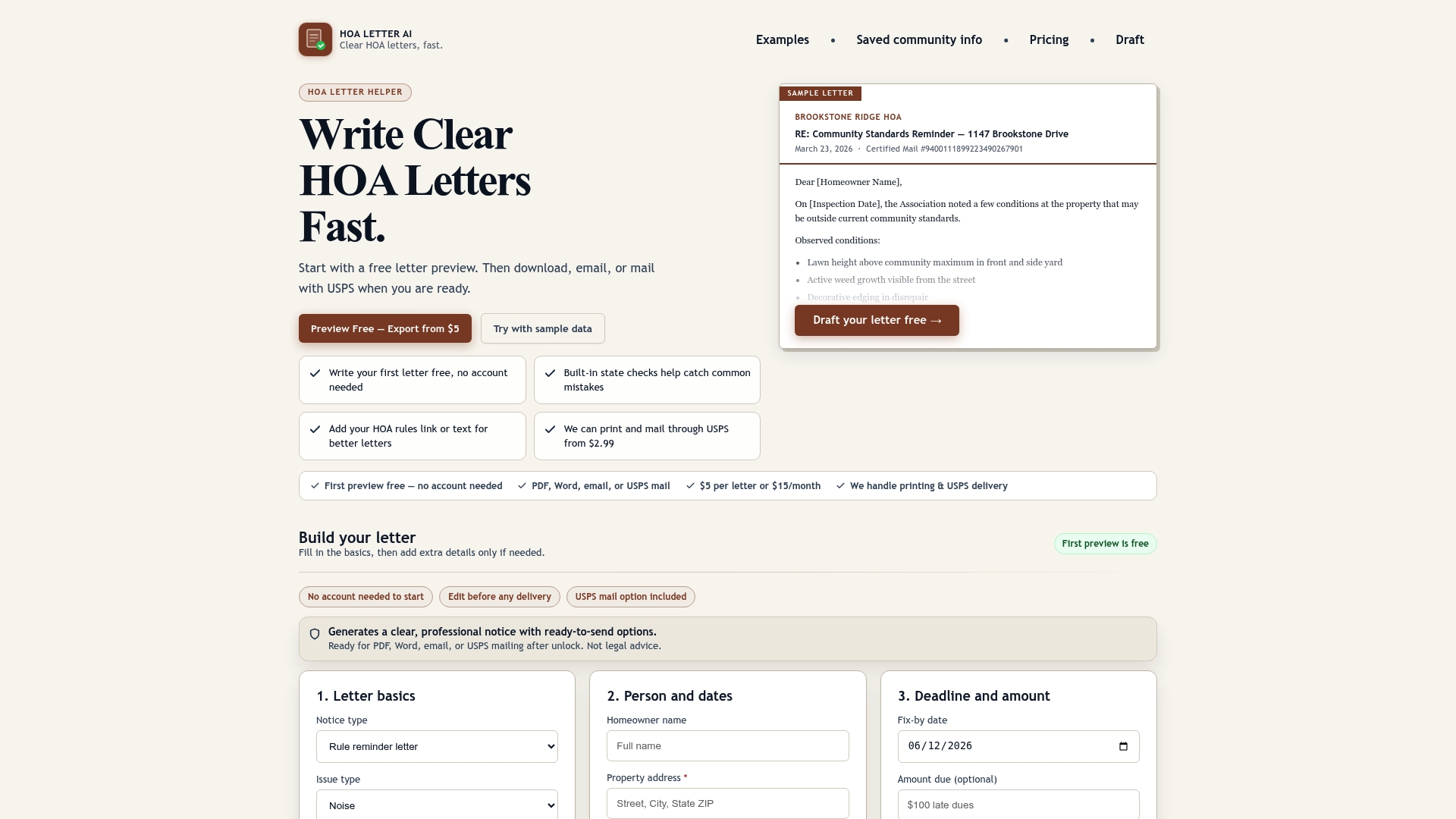
Such tools incorporate language expected by the state, including hearing requests, citations, or procedural language that boards check for. This helps homeowners avoid missing required phrases until after the cure period may have closed.
Use HOA Letter AI when you need a clear, factual draft fast, and bring in an attorney separately if you’re already facing a lien, an injunction, or a fine large enough to justify legal fees. For a straightforward first response, start with the HOA warning letter template or check your state’s specific notice and fine rules before you unlock and send your reply.
This article is general information, not a substitute for advice from a qualified lawyer. Consult a qualified legal professional about your own circumstances before acting on anything here.