
Effective cure-period wording states five things: the property and CC&R citation, an observable description of the violation, the exact corrective action required, a cure-by calendar date, and the consequences for missing it. Most boards start with a courtesy notice lasting about a week to two weeks, move to a formal cure period of around two weeks for general maintenance issues, and allow longer periods when the fix involves a contractor or a permit. Check your governing documents and state statute before finalizing any deadline.
TL;DR:
- Cure notices must specify the violation using exact CC&R citations, a clear observable description with dates, and a specific corrective action.
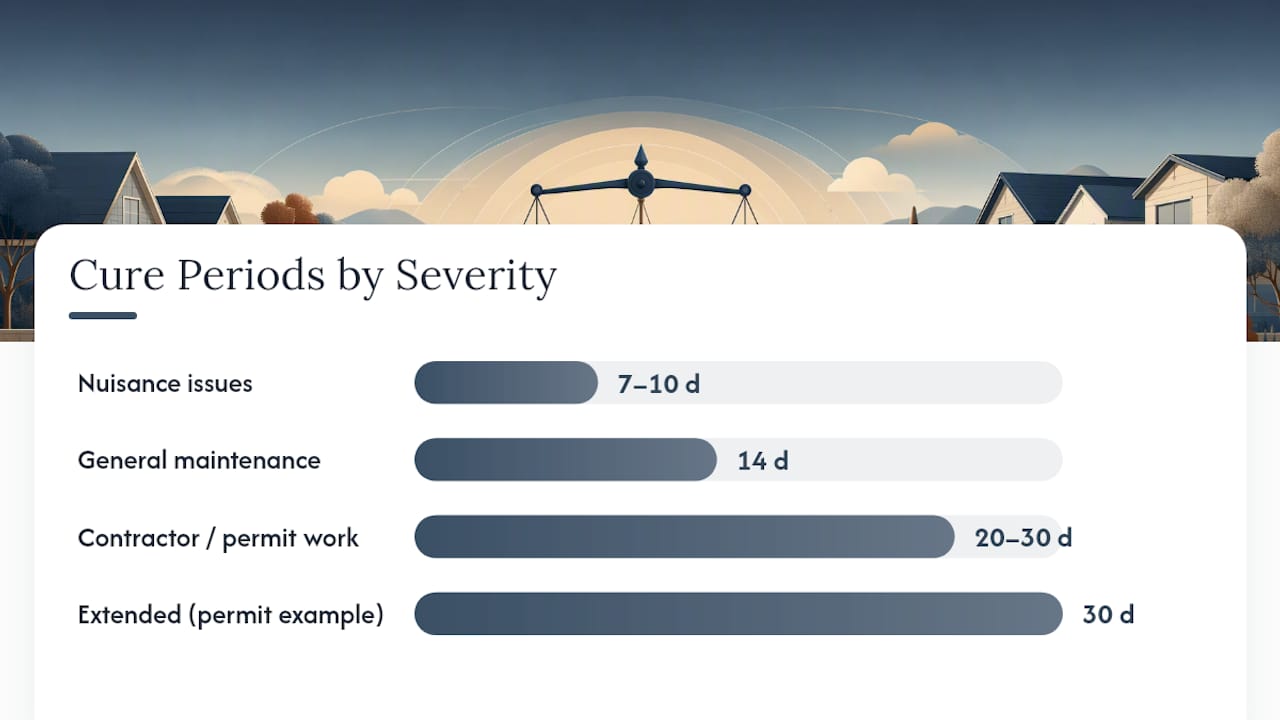
- The standard cure period ranges from 7 to 10 days for nuisances, 14 days for maintenance issues, and 20 to 30 days for repairs needing permits or contractors.
- Notices should be sent via certified mail or hand delivery with proof, and must include easy-to-understand contact info and consequences, avoiding vague language.
- Deviating from the prescribed notice sequence or deadlines risks enforcement failures, especially if state statutes override CC&R timelines.
- Maintaining a detailed, signed enforcement file with evidence of notices, delivery, photos, and follow-up is essential for legal defensibility.
Table of Contents
- What Should Cure Period Wording Actually Say?
- How Long Should a Cure Period Last?
- Copy-Ready Cure Notice Templates
- Delivery Methods and Statutory Traps to Avoid
- Building a Defensible Enforcement File
- What Boards Consistently Get Wrong About Cure Notices
- Draft, Preview, and Send Cure Notices Without Guesswork
- Sources
What Should Cure Period Wording Actually Say?
A vague notice is an unenforceable notice. Homeowners challenge fines successfully more often over sloppy wording than over the underlying violation itself, which is why every notice needs the same skeleton regardless of the offense.
Here’s what belongs in it:
- Identification: unit or lot address, owner name, and account number if your management software tracks one.
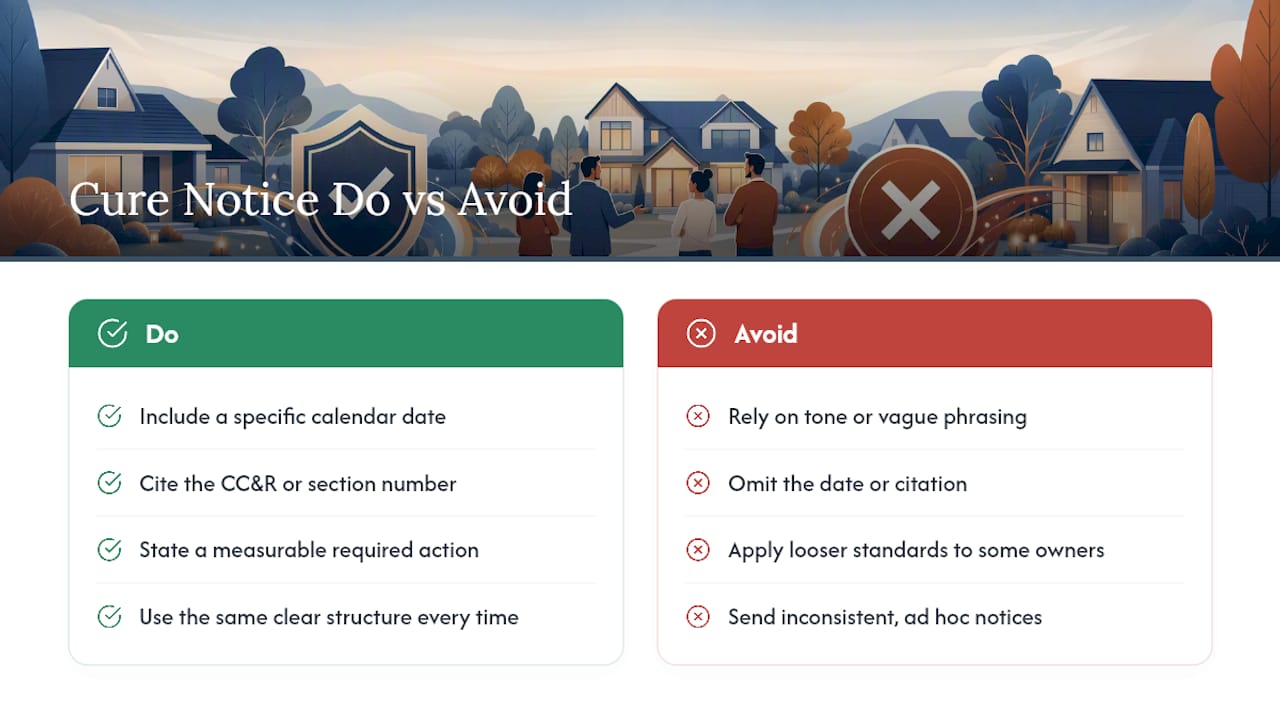
- CC&R or rule citation: the exact section number, not “per community rules.” A board that writes “Section 4.2(b)” survives a challenge that “our landscaping standards” does not.
- Observable description with dates: “Front lawn exceeded 8 inches as of March 3, 2026” beats “yard is unkempt.” Attach photos or an inspection report and reference them by date in the body text.
- Explicit corrective action: name the fix, not the goal. “Mow front and side yards to a maximum height of 4 inches” is enforceable language; “maintain the property” is not.
- Cure-by calendar date: “no later than March 20, 2026,” never “as soon as possible” or “immediately.” A calendar date removes the argument that the homeowner did not know when the clock ran out, a point LotWize’s enforcement guide makes repeatedly in its walkthrough of dispute-proof notices.
- Consequences and hearing rights: state the fine amount or schedule, and tell the owner how to request a hearing before that fine is assessed.
- Contact information: a name, phone number, or email for questions, ideally tied to the management company or board liaison.
Pro Tip: Never write a corrective action as a feeling (“keep the yard neat”). Write it as an instruction you could hand to a landscaper with no other context.
HOA Letter AI builds these elements into a guided draft, flagging missing mandatory language and checking phrasing against state-specific notice conventions before you send anything.
How Long Should a Cure Period Last?
There’s no single legal cure period. What exists is a set of practical ranges tied to how urgent and how logistically demanding the fix is.
- 7 to 10 days for nuisance issues: trash cans left out, unauthorized signage, minor parking violations. These are quick fixes with no material cost.
- 14 days for general maintenance: overgrown lawns, peeling paint, unapproved minor exterior changes. This is the default most boards land on, and it’s the cadence ManageCasa’s enforcement guide treats as standard practice.
- 20 to 30 days for anything requiring a contractor or a permit: roof repairs, fence replacement, structural fixes. Fifteen days is unrealistic when a homeowner needs a permit approval and a contractor slot before work can even start.
Shorten the period when the violation is a safety issue (exposed wiring, a collapsing structure) or an active nuisance affecting neighbors. Lengthen it when the corrective action genuinely can’t happen faster, and if you’re coordinating repair timing around a vendor, a property manager’s guide to scheduling contractor work is worth reviewing before you set a date you can’t defend.
Whenever you deviate from your association’s typical cadence, write the reason into the file. “Extended to 30 days due to permit requirement per contractor estimate dated 2/14” is a sentence that protects the board if a homeowner later claims the timeline was arbitrary or punitive.
Copy-Ready Cure Notice Templates
Three notices cover almost every enforcement sequence: a courtesy notice, a formal cure notice, and a final notice before a hearing. Replace the bracketed placeholders and adjust the deadline math for your community’s practice.
-
Courtesy notice (informational, 7 to 14 days). “Dear [Owner Name], during a recent inspection on [date], we observed [violation description] at [property address], which does not meet the standard outlined in [CC&R section]. Please correct this by [cure-by date]. No fine applies at this stage. Questions can be directed to [contact name/email].” This tone matters: an educational first notice resolves most disputes before they escalate, according to LegalClarity’s breakdown of HOA enforcement steps.
-
Formal cure notice (14 to 30 days depending on violation type). “This letter serves as formal notice that [property address] is in violation of [CC&R section] due to [specific, observable description]. You are required to [exact corrective action] no later than [calendar date]. Failure to cure by this date may result in a fine of [$amount] and/or referral to a compliance hearing under [governing document section].”
-
Final notice before hearing. “On [prior notice date], you were notified of a violation of [CC&R section] at [property address]. Our records indicate this violation has not been cured as of [current date]. You are entitled to a hearing before the board on [hearing date/how to request]. If uncured or unaddressed, a fine of [$amount] will be assessed per [fine schedule reference].”
Start from a free HOA violation letter template rather than a blank page, especially for recurring categories like lawn maintenance, where the corrective action language rarely changes month to month.
Delivery Methods and Statutory Traps to Avoid
Correct wording means nothing if you can’t prove the homeowner received it. Certified mail with return receipt is the gold standard; hand delivery with a signed acknowledgment works too. Email is only reliable if the homeowner has given written consent to receive notices that way, a distinction GavelHouse’s CC&R enforcement checklist flags as one of the most common gaps in enforcement files.
Watch for these traps:
- Assessing a fine before the cure period actually expires, even by a day.
- Using relative deadlines (“within 2 weeks”) instead of a calendar date.
- Skipping the follow-up inspection and photo documentation after the cure-by date passes.
- Deviating from the exact notice sequence your CC&Rs prescribe, even when your intent is reasonable.
State statutes often layer additional requirements on top of your governing documents. Notice and hearing timing requirements commonly run 10 to 30 days depending on the state, and HOA Legal’s overview of pre-fine notice requirements points out that Texas, for example, has specific statutory timing under its HOA law that can override a shorter CC&R deadline. Reconcile both before you send anything, and pause enforcement to consult counsel when a statute is ambiguous, a homeowner threatens litigation, or the violation touches a protected class issue like a reasonable accommodation request.
Building a Defensible Enforcement File
The notice is only half the record. What holds up on appeal is the paper trail behind it.
- Keep the original notice, dated and signed, alongside proof of delivery (mail receipt, signed hand-delivery acknowledgment, or consented email confirmation).
- File inspection photos and any follow-up correspondence with the homeowner, including partial-compliance updates.
- Memorialize any agreed extension in writing. A verbal “take your time” from a board member is not a record; a follow-up email confirming a new cure date is.
- Retain hearing minutes or transcripts and the fine assessment paperwork tied to that specific violation.
Pro Tip: Assign one person, board secretary or property manager, as the sole owner of the enforcement file per violation. Split ownership is how documentation gaps happen.
Keep these files for as long as your governing documents or state statute of limitations on HOA disputes requires, and check our rule enforcement checklist for board members for what happens after the cure period closes.
What Boards Consistently Get Wrong About Cure Notices
The biggest mistake in enforcement isn’t picking the wrong deadline. It’s writing a notice that sounds firm but says nothing specific. Boards reach for tone (“please be advised,” “failure to comply may result in action”) when they should be reaching for facts: a date, a section number, a measurable action.
Consistency matters more than severity. A board that sends the same clear structure every time, regardless of who’s violating what, builds a record that reads as fair and procedural rather than personal. That consistency is also what survives a hearing challenge, because the homeowner can’t point to a different, looser standard applied to someone else.
HOA Letter AI exists because most boards don’t have a lawyer on call every time they need to send a notice. Templates and state-aware checks won’t replace judgment, but they catch the missing calendar date or the absent CC&R citation before it becomes a hearing-room problem.
— Blake
Draft, Preview, and Send Cure Notices Without Guesswork
Writing a legally sound cure notice from scratch, every time, for every violation type, is where most boards lose hours or get the wording wrong. HOA Letter AI is built specifically for this: guided drafting that walks you through each required element, state-aware language checks that flag missing citations or vague deadlines, and a one-page preview so you see exactly what the homeowner will receive before it’s sent.
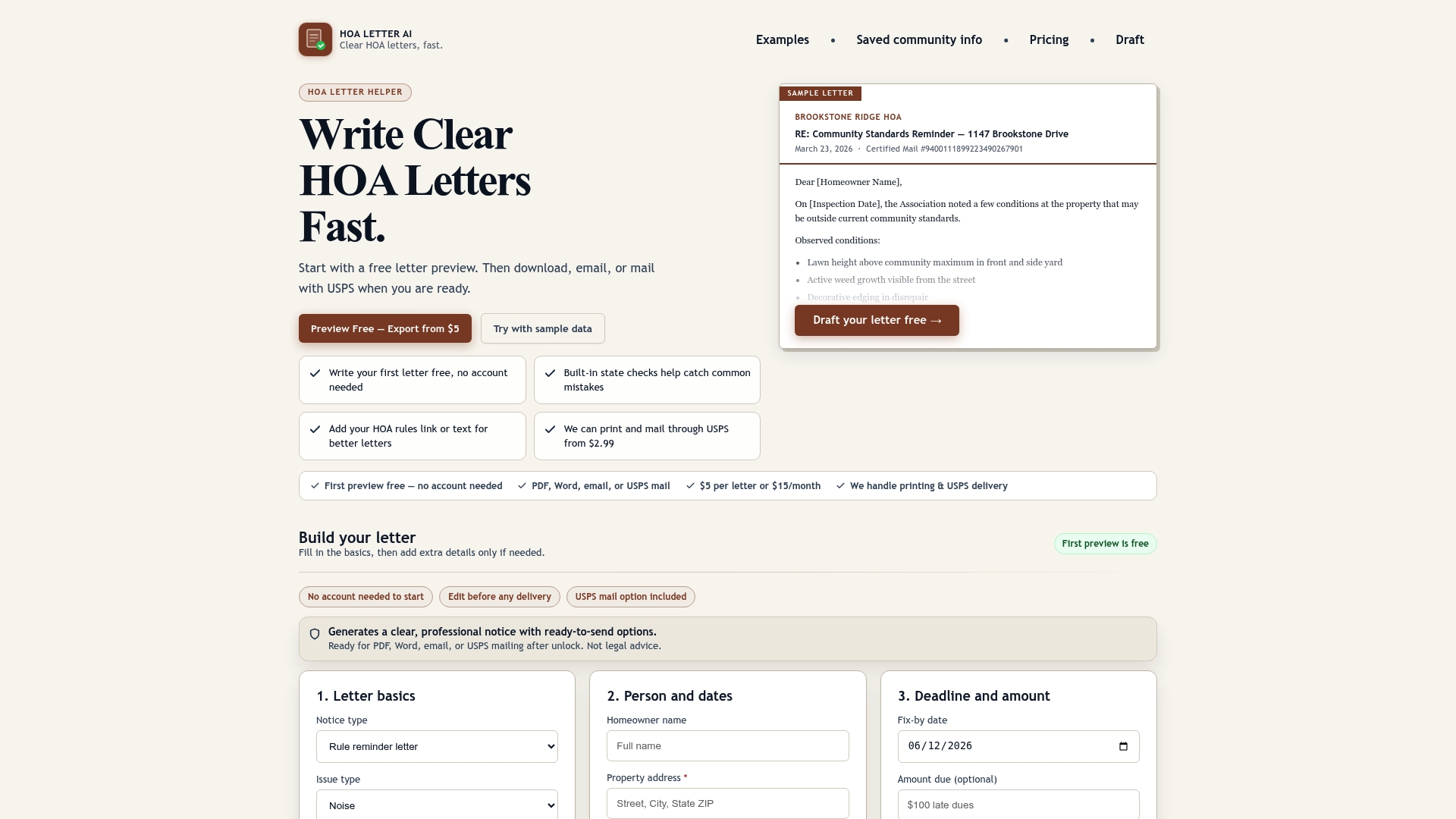
The platform includes ready-made templates for common violation categories, plus USPS delivery integration so you get built-in proof of mailing instead of tracking receipts manually. That delivery record matters more than most boards realize. It’s the difference between a fine that holds up at a hearing and one that gets thrown out on a technicality. If your community’s rules involve statutory notice periods that vary by jurisdiction, our state law guide helps you reconcile your CC&Rs with the applicable statute before you set a deadline.
Start with the HOA warning letter template for your next courtesy notice and see the state-aware checks in action.
Sources
- HOA violations and enforcement — the complete process guide | ManageCasa
- What type of notice is required before an HOA fine? | HOA Legal