

An Arizona HOA violation notice has to do more than say “fix it.” Before a board can fine an owner or start enforcement, the notice has to give the owner a chance to respond, and the association has to answer that response in writing within set deadlines. Planned communities follow A.R.S. § 33-1803, and condominiums follow A.R.S. § 33-1242. The safest notice puts everything the statutes require into the first letter, so the process never stalls halfway.
This guide covers what the notice must contain, how it is delivered, the 21-day and 10-business-day clocks, what changed in 2026, and what an owner can do when a notice looks wrong. It is written for board members, property managers and homeowners.
HOA Letter AIhoaletterai.comDraft Clearer HOA Violation NoticesCreate professional compliance letters with guided drafting, state-specific context, community rules, and built-in checks to help reduce avoidable errors.VisitTL;DR
- Before a fine or other enforcement, an Arizona association must give notice and an opportunity to be heard. The owner has 21 calendar days to answer by certified mail.
- The association then has 10 business days to reply in writing with the provision violated, the date, the observer’s name and how to contest, unless the first notice already said all of that.
- Condominiums (§ 33-1242) and planned communities (§ 33-1803) run on parallel rules, but who holds the penalty power differs.
- An owner who disagrees can petition the Arizona Department of Real Estate for a hearing under § 32-2199.01.
- Putting every required item in the first letter is the simplest way to avoid delays and disputes.
Table of Contents
- Two statutes, one process
- What the notice must contain
- The two clocks: 21 days and 10 business days
- The courtesy letter and the formal letter
- Fines: notice, a hearing opportunity and reasonableness
- What changed in 2026
- If you are the homeowner: responding to a notice
- Documenting violations so the notice holds up
- Open meetings: a separate notice rule
- Promo: building the notice in minutes
- Our perspective
- FAQ
- Sources
Two statutes, one process
Arizona does not have one HOA notice law. Planned communities (typical single-family subdivisions) fall under the Planned Communities Act, and condominiums fall under the Condominium Act. The two sets of rules for violation notices read almost the same.
The condominium rule is A.R.S. § 33-1242. The planned community rule is A.R.S. § 33-1803. Both give the owner a certified-mail response window and set the contents of the association’s reply and its deadline. One difference: under § 33-1242 the unit owners’ association holds the penalty authority, while under § 33-1803 it sits with the board of directors. For a notice writer, that mostly changes who is named as the sender.
If you manage a condo, everything below applies to you with § 33-1242 in place of § 33-1803. If you are searching for condominium violation notice rules in Arizona, this is the framework, and not a generic national one.
What the notice must contain
The statutes are specific about what the association owes the owner once the owner responds. Under § 33-1803(D), the association’s written reply must include at least:
- The provision of the documents or rules the owner is alleged to have violated.
- The date of the violation, or the date it was observed.
- The first and last name of the person or persons who observed it.
- The process the owner can use to contest the notice.
The statute adds an important exception: the association does not need to repeat these items if the original notice already provided them. That is why practitioners recommend front-loading them. Mulcahy Law Firm advises sending the notice by U.S. mail unless the governing documents specify another method, and detailing the rule violated, the date observed, how to contest, and the owner’s right to request a Department of Real Estate hearing.
A few practical points follow from that guidance:
- Cite the exact provision. “Landscaping violation” is not enough. Name the CC&R section, bylaw or rule, and quote the language if you can.
- State a date. If the violation is ongoing, give the date it was first observed and the date of the most recent inspection.
- Photographs help but are not required. Mulcahy treats them as a best practice, not a legal requirement.
- The observer’s name. The same firm notes the name need not appear in the notice unless the homeowner asks for it. Including it up front removes the question.
- Penalty enforcement information. Where a penalty is imposed, the notice must include information on how it will be enforced.
The two clocks: 21 days and 10 business days
Two deadlines drive the whole process.
The owner’s 21 calendar days. The owner may respond to the notice by certified mail within 21 calendar days. Count calendar days, weekends included.
The association’s 10 business days. After it receives that certified-mail response, the association must reply in writing within 10 business days with the four items above, unless the original notice already provided them.
There is a consequence attached. Unless the contest process was in the original notice, the association may not proceed with any enforcement action, including collecting attorney fees, before or during this exchange. The Arizona Senate’s 2024 issue brief confirms the same four items and the same pause on enforcement.
For a board, the lesson is simple. A thin first notice invites a response, and a response starts a 10-business-day clock you must meet. A complete first notice answers most of what the owner would ask.
A worked example
Suppose an owner in a planned community has a boat parked in the driveway in violation of a rule. The board mails a notice on a Monday that cites the rule section, states the date the boat was first seen and the date of the latest drive-by, names the inspecting manager, sets a compliance date, and explains how to contest. It also tells the owner about the right to petition the Department of Real Estate.
The owner mails a certified letter disputing it on day 15. Because the original notice already contained the required details, the board has what the statute needs in hand. A short written acknowledgment inside 10 business days keeps the file clean. Had the first notice only said “remove the boat,” the board would need to supply all four items in its reply, and could not fine or send the matter to an attorney until it did.
The courtesy letter and the formal letter
The statute focuses on what happens before enforcement beyond a courtesy letter. Shaw Lines’ 2026 summary of Arizona community association law explains that before imposing a fine or filing an injunction, the association must tell the owner about the 21-day certified-letter option and the option to petition the Department of Real Estate for a hearing, in writing.
That is why many associations use a two-step sequence. Mulcahy’s enforcement guidance describes a courtesy letter first, with the owner’s name, lot number, provision violated, date noticed, observer’s name, nature of the violation, compliance date, contest process and contact information. If the problem is not corrected, a formal letter follows, stating potential fines or court action, the first-notice date, the last inspection date, and the contest process with a named contact.
The sample below shows the order of a complete first notice:
| Element | What to include |
|---|---|
| Owner and property | Full name, lot or unit number, address |
| Provision | Exact CC&R, bylaw or rule section |
| Facts | Nature of the violation, date first observed, date of last inspection |
| Observer | Name of the person who observed it |
| Cure | What must change and the compliance date |
| Consequences | Possible fines or court action, and how a penalty would be enforced |
| Owner’s rights | 21 calendar days to respond by certified mail, and the right to petition the Department of Real Estate |
| Contact | A named person, address and phone or email |
Fines: notice, a hearing opportunity and reasonableness
Section 33-1803(B) allows a board to impose reasonable monetary penalties for violations of the declaration, bylaws and rules, but only after notice and an opportunity to be heard. It also limits late charges on a penalty: no more than the greater of $15 or 10% of the unpaid penalty, and a payment is late only if it is unpaid 15 or more days after its due date unless the documents allow longer.
Mulcahy’s Top 10 guide frames the minimum for a valid fine as three points: an actual violation, compliance with the notice requirements, and a reasonable amount. It recommends a written fine policy with a schedule. It also notes that associations can no longer record a lien for unpaid fines. They must sue, get a judgment and then record the judgment or garnish.
A written schedule helps the notice too. When the letter can point to a published amount for a first, second and third offense, the owner sees the consequence before it lands.

What changed in 2026
The 2026 legislative session matters because the duty of fairness now sits behind every enforcement step. Mulcahy’s 2026 legislative update reports seven signed bills affecting HOAs and condos, effective September 12, 2026 unless otherwise noted. One of them, HB 4011, requires associations to act reasonably, neutrally, fairly, without favoritism and in a non-arbitrary manner when exercising discretionary powers.
In practice, that favors boards whose notices look the same for every owner: same template, same cite-the-rule structure, same deadlines. Consistency is the easiest evidence that enforcement was neutral. Other bills were introduced in recent sessions, such as a 2026 proposal on published enforcement policies and penalty schedules. Check the Arizona Legislature’s site or your association’s attorney for what became law before relying on any proposal.
If you are the homeowner: responding to a notice
If you received a violation notice and think it is wrong, work through it in order.
- Read what it cites. Find the provision named in your CC&Rs or rules and confirm it says what the notice claims.
- Check the contents. Does it give the date, the provision and how to contest? Missing items do not erase the violation, but they matter to the association’s right to proceed.
- Respond by certified mail within 21 calendar days. Keep your receipt. This triggers the association’s duty to reply in writing within 10 business days.
- Fix what is legitimately a violation. If the problem is real, a documented cure with photos often ends the matter faster than a fight.
- Consider the state hearing. Either the owner or the association may petition the Department of Real Estate for a hearing about violations of the community documents or the governing statutes. The petition must be in writing on the department’s form, signed, with a filing fee set by the commissioner. The department mails the petition to the respondent by certified mail, a response is due within 20 days, and a failure to answer is treated as an admission.
Our guide on what to do after an HOA violation letter in Arizona walks through this in more detail. If you want a clear, formal reply on paper, our homeowner response letter is $5 one-off, and the notice-completeness checker lets you see whether the letter you received includes what Arizona requires.
Documenting violations so the notice holds up
Most disputes come from thin records, not from bad law. A board that documents well rarely has to argue.
- Photograph the issue with a date stamp, from the street or a common area.
- Record who observed it and when, and keep inspection logs.
- Quote the rule instead of paraphrasing it. Even a seasonal topic like HOA Christmas lights rules and animated display checklists shows why: a notice about a display needs the exact rule on timing, brightness or placement, not a general complaint.
- Keep a copy of every notice, the mailing proof, and any certified-mail response.
- Use the same template for every owner, and write the fine schedule down before you need it.
Open meetings: a separate notice rule
Violation notices are not the only notices boards send. If a fine hearing or a rule change goes to a members’ meeting, the secretary must send notice by hand delivery or prepaid U.S. mail not fewer than 10 or more than 50 days before the meeting, stating the date, time and place. The secretary must also provide an agenda by hand delivery, mail, website posting, email or other electronic means, or posting at a community center or similar location. That section is part of the planned community rules. Condominium boards should check the parallel condo provision with their attorney.
Promo: building the notice in minutes
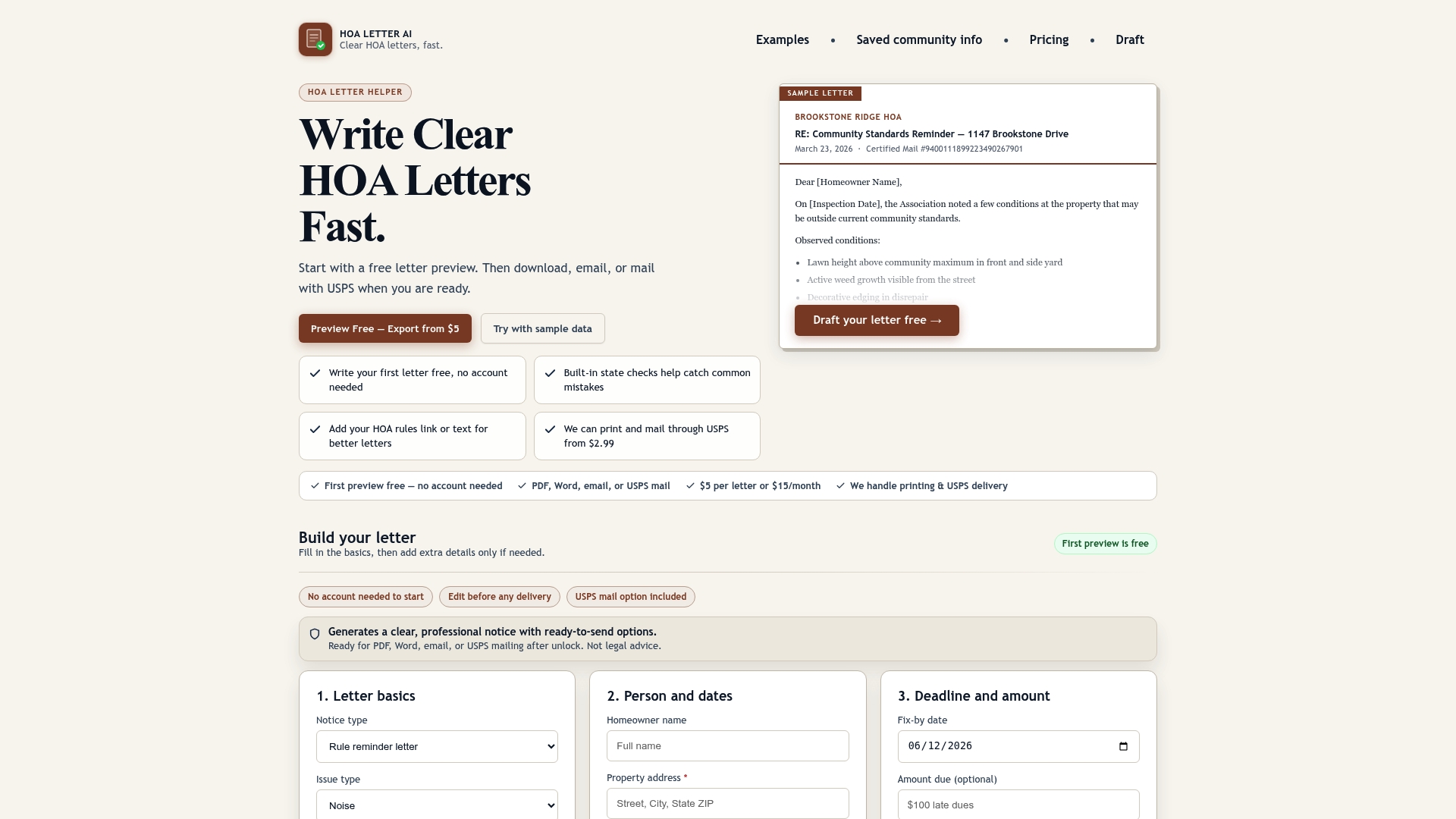
Writing a compliant notice from scratch means remembering the statute, the cite, the dates and the owner’s rights every time. We built HOA Letter AI around that checklist. It drafts violation letters with state-specific context, rule and CC&R citations, and automated checks for mandatory language, and you can preview a letter for free with no account. A single letter is $5 one-off, and optional USPS mailing starts from $2.99 one-off. Boards that send letters regularly can use the self-serve board lane at $15 per month. Start at our pricing page.
Property managers with several communities can keep reusable community profiles and branded templates. See PM Starter, PM Pro and the 30-day pilot. For the full rule summary, see our Arizona HOA violation letter requirements and the Arizona compliance guide.
Our perspective
Most notice problems we see in drafting come from the same place: the letter was written fast and the statute was remembered from memory. A board member knows the rule they care about, but not always the 21-day window, the 10-business-day reply or the Department of Real Estate hearing right.
Our view is that the first letter should carry everything. When the provision, the date, the observer, the contest process and the owner’s rights are in the first notice, the owner gets a fair, clear picture and the association keeps its options open.
That is why we built guided drafting with state-specific context and built-in checks for mandatory language. A letter should be consistent from owner to owner, and consistency is easier when the structure comes from the tool and not from whoever is typing.
Blake
FAQ
How must an Arizona HOA deliver a violation notice?
The association should use U.S. mail unless its governing documents specify another method, according to Mulcahy Law Firm’s guidance. Check your CC&Rs and bylaws for any required method before you mail.
How long does a homeowner have to respond?
The owner has 21 calendar days to respond by certified mail. The association must then reply in writing within 10 business days. Both deadlines come from A.R.S. § 33-1803 for planned communities, and § 33-1242 sets the same pattern for condominiums.
Can the HOA fine me without giving me a chance to respond?
No. A board may impose reasonable penalties only after notice and an opportunity to be heard. Unless the contest process was in the original notice, the association also may not proceed with enforcement during the response exchange.
Do condo associations follow the same notice rules?
They follow a parallel statute, A.R.S. § 33-1242, with the same 21-day and 10-business-day structure. The notice also has to tell the owner about the right to petition for an administrative hearing.
Sources
- A.R.S. § 33-1803, penalties and notice
- A.R.S. § 33-1242, condominium notice
- A.R.S. § 33-1804, open meetings
- A.R.S. § 32-2199.01, hearings
- Arizona Senate issue brief, 2024
- SB 1440, 2026
- Best Practices for Violations Notices and Fines
- Enforcement of Association Governing Documents
- Top 10 Things You Need to Know About Community Association Law
- 2026 Legislative Update
- 2026 Summary of Arizona Community Association Law
- Arizona HOA Fining Authority
- HB4011 summary
- HOA Christmas lights rules checklist