
Every valid HOA notice needs seven things: the date, clear identification of the recipient, a specific description of the violation, a citation to the governing rule or CC&R section, the required corrective action with a deadline, the consequences of noncompliance, and the sender’s identity and contact information. State rules refine these basics, as seen in Utah’s warning requirements and the Texas Property Code.
TL;DR:
- Utah requires at least 48 hours to cure continuing violations, while single incidents usually need no cure period because the conduct has ended.
- When state law and association rules set different minimum periods, use the longer one; issue a fine only after the warning period expires.
- Send violation notices directly to the owner of record, use the delivery method on file, and switch to mail if email bounces or consent ends.
- Keep delivery evidence such as certified mail tracking, email timestamps, or signed receipts, and log the recipient, date, method, and sender.
HOA Letter AIhoaletterai.comCreate Clearer HOA NoticesDraft professional compliance letters with guided writing, state-specific context, community rules, built-in checks, and a one-page preview.Create an HOA notice
Table of Contents
- Checklist: core required elements of an HOA notice or violation letter
- Who to name and how delivery rules work
- Timing, cure periods, and minimum notice windows
- Special notice types: meetings, votes, hearings, and fines
- Format, proof of delivery, and recordkeeping best practices
- State examples and legal highlights
- Why precise, state-aware notices pay off
- How HOA Letter AI keeps your notices complete and defensible
- FAQ
- Sources
Checklist: core required elements of an HOA notice or violation letter
A notice that skips any of these items gives a homeowner grounds to contest it, and gives a board a weaker position if the dispute reaches a hearing or a courtroom.
- Date of the notice, written clearly at the top, since it anchors every deadline that follows.
- Recipient identification, meaning the owner’s full name and property address as they appear on association records.
- Sender and board identity, including the association’s name and a return address or contact point.
- Specific rule citation, pointing to the exact CC&R section, bylaw, or rule violated rather than a vague reference to “community standards.”
- Clear description of the conduct, stated in plain terms: what was observed, where, and when.
- Required corrective action, telling the owner exactly what to do to resolve the issue.
- A specific cure deadline, given as a date or a defined number of days, not “promptly” or “as soon as possible.”
- Stated consequences, naming the fine amount, suspension of privileges, or next enforcement step if the deadline passes.
- Hearing rights and contact information, so the owner knows how to respond, request a hearing, or ask questions.
Continuing violations (an unapproved fence that stays up, overgrown landscaping) typically need an ongoing cure period measured in days, since the condition persists until fixed. One-time violations (a single noise complaint, a parking infraction on a specific date) often carry no cure period at all, since there is nothing left to correct after the fact. Writing “cure by [date]” into a notice for a one-time event creates confusion, so match the language to the violation type.
A compact example fragment shows how the pieces connect: “This letter cites Section 4.2 of the Declaration regarding unapproved exterior alterations. The shed installed at [address] was not submitted for architectural approval. Please remove the structure or submit a retroactive application by [date], or a fine of [amount] may be assessed.”
Pro Tip: Keep a one-sentence template for each violation type so board members fill in details rather than rewriting the structure each time.
Who to name and how delivery rules work
“Individual delivery” means a notice sent directly to one owner by name, typically by mail, email, or hand delivery. “General delivery” means a notice posted, published, or distributed broadly to the membership, used for community-wide announcements rather than a violation affecting one household. The “owner” of record is whoever appears on the association’s official roster, not necessarily the person currently occupying the unit, so keeping that roster current matters.
Associations are generally expected to ask members for their preferred delivery method and keep that preference on file, a practice detailed in Davis-Stirling guidance on notice and document delivery. When an email bounces or a member revokes consent to electronic delivery, the association should fall back to mail rather than assume the notice was received.
Acceptable general-delivery methods include:
- Posting in a common area designated in the governing documents.
- Inclusion with a billing statement mailed to all owners.
- Website posting when the association’s policies name that as an approved channel.
General delivery works for meeting announcements and policy updates, but individual delivery is the safer, often required, choice for anything tied to a specific owner’s conduct or potential fine.
Timing, cure periods, and minimum notice windows
When a state statute and an association’s governing documents set different minimum notice periods, the longer period controls, since neither document can waive a statutory floor.
- Confirm the statutory minimum for the violation type in the applicable state before calculating a deadline.
- Compare it to the association’s rule, and use whichever period gives the owner more time.
- Count days correctly: a common method excludes the day the notice is sent and includes the final day of the cure period, adjusting forward if that day falls on a weekend or holiday.
- Apply continuing-violation rules where they exist, such as the Utah requirement of at least a 48-hour cure period for ongoing issues.
- Sequence enforcement steps deliberately: send a warning first, allow the cure period to run in full, then issue a fine notice, and only then schedule a hearing if the violation remains unresolved.
Skipping a step, or sending a fine notice before the warning’s cure period expires, is one of the most common reasons an association loses an enforcement dispute. Building the sequence into a checklist or software workflow removes the guesswork.
Special notice types: meetings, votes, hearings, and fines
Different notices serve different legal purposes, and each carries its own required contents.
- Meeting notices need the date, time, and location, a written agenda, remote-access instructions when applicable, and information on how a member can request individual notice rather than relying on a posted or emailed general notice, consistent with guidance summarized by the Texas State Law Library’s meetings and voting guide.
- Vote notices need a defined advance window before ballots are due, a statement of whether mail or electronic ballots are accepted, and any instructions or disclosures that must accompany the ballot itself.
- Hearing and fine notices need the warning language already given to the owner, a brief summary of the evidence supporting the violation, the hearing date and procedure, and a clear statement of the owner’s right to appear, present evidence, or appeal the decision.
Using the wrong notice type, such as treating a fine notice like a general meeting announcement, strips out details a hearing officer or judge will expect to see.
Format, proof of delivery, and recordkeeping best practices
A notice that is easy to read is also easier to defend later. A short header identifying the type of notice, a single sentence naming the rule violated, and one clear call to action reduce the chance an owner can claim confusion about what was required.
Proof of delivery matters more than the act of sending, since an association’s strongest defense in a dispute is documentation, not memory. Useful options include:
- Certified mail with tracking, which creates a timestamped record the postal service maintains independently.
- Email logs with send and read timestamps, kept in a format that can be exported if needed.
- Signed receipts for hand-delivered notices, filed immediately rather than after the fact.
Pro Tip: Keep a dedicated delivery log with fields for date sent, method, tracking or certified-mail number, recipient name, unit number, and staff member who sent it, along with any return or bounce evidence. A consistent retention schedule, commonly several years, keeps these records available if a dispute resurfaces after the original violation is resolved.
State examples and legal highlights
Davis-Stirling guidance requires associations to solicit and record each owner’s preferred delivery method, and it outlines acceptable channels including mail, email with consent, posting, and billing-statement inserts, with bounce-back procedures expected to trigger a fallback to mail.
The Texas Property Code allows associations to adopt their own notice methods but requires specific notice, often by certified mail, before certain enforcement actions such as suspending common-area access, filing suit, or reporting a debt to a credit agency.
In Utah, state guidance on fines and hearings requires a written warning that describes the violation, cites the specific governing provision, states that fines may follow, and gives at least a 48-hour cure period when the violation is continuing. These examples show why a notice drafted for one state’s rules does not automatically satisfy another’s.

Why precise, state-aware notices pay off
Notices built around a consistent checklist produce fewer contested fines, faster cures, and homeowner responses that address the actual rule rather than disputing the process. A dated, well-documented delivery log turns a potential hearing argument into a quick confirmation, and it shortens the time boards spend defending routine enforcement. Associations handling tax reporting for fines or assessments can find related filing guidance through resources like TaxFormHero’s HOA filing overview. The practical takeaway: adopt one checklist, one delivery log format, and use both every time.
— Blake
How HOA Letter AI keeps your notices complete and defensible
Our service is built around the exact checklist above: templates that insert the right citation and cure period tailored to your state, a notice-completeness checker that flags a missing deadline or consequence before you send, and a one-page preview so you can confirm everything is correct in seconds. Delivery options include email, print, and USPS mail, enabling the same workflow that drafts your notice to also send it and leave a record behind.
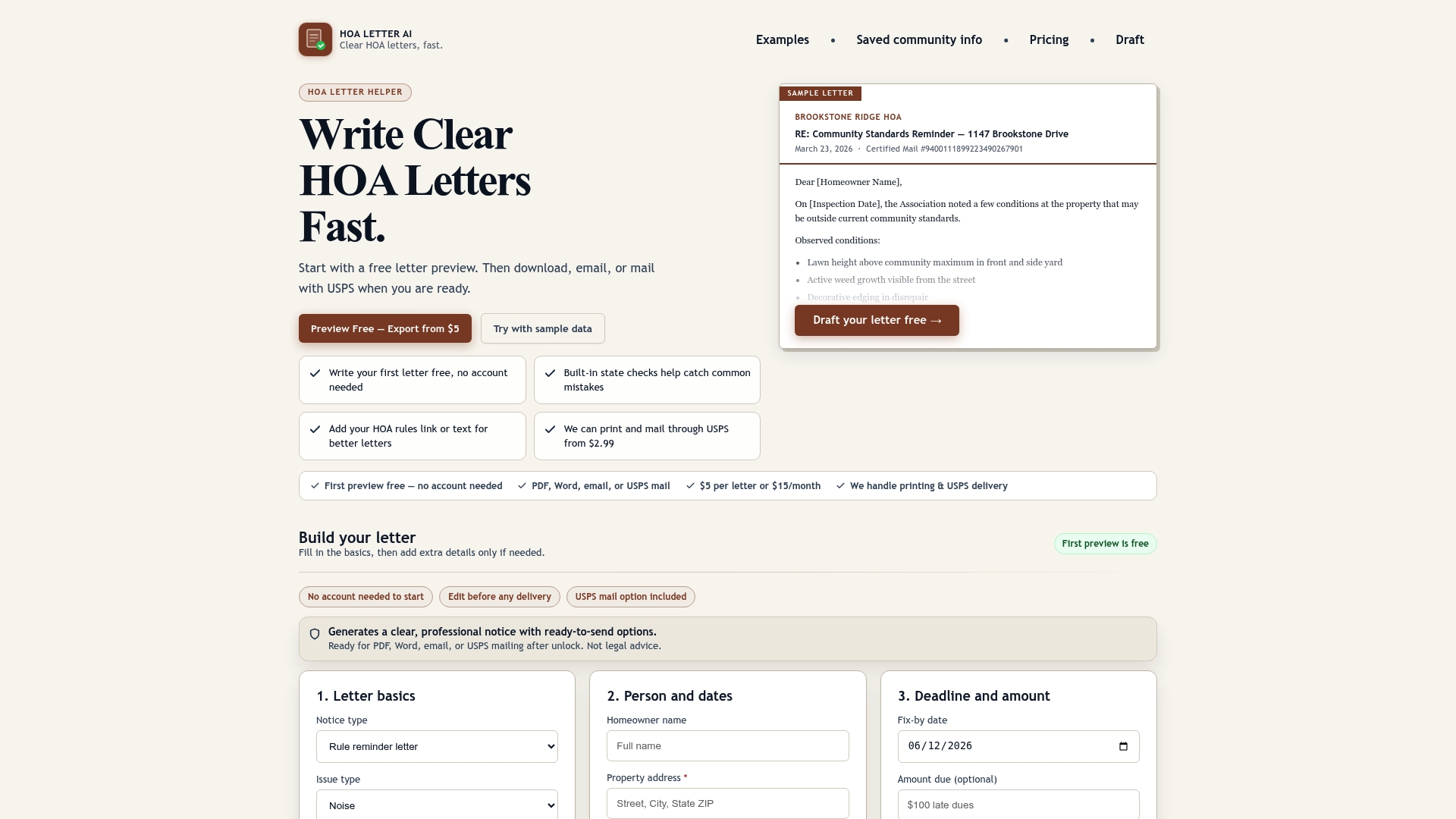
A single letter starts at $5, and property management teams managing multiple communities can compare the PM Starter and PM Pro plans for ongoing volume. If you want to see the required warning contents in context first, download our HOA warning letter template and preview it free before you commit to sending anything.
This article is general information, not a substitute for advice from a qualified lawyer. Consult a qualified legal professional about your own circumstances before acting on anything here.

FAQ
What makes an HOA notice legally valid?
A valid notice generally needs the date, the recipient’s identification, a specific rule citation, a description of the violation, a cure deadline or required action, and the consequences of noncompliance. Requirements vary by state, so always check your state’s specific notice rules before finalizing a letter.
How long must an HOA give a homeowner to fix a violation?
The cure period depends on the state and whether the violation is continuing or one-time; Utah requires at least 48 hours for continuing violations. Always compare the statutory minimum to your association’s own rules and use whichever gives the homeowner more time.
Can an HOA send a violation notice by email only?
It depends on whether the owner has consented to electronic delivery and whether your governing documents and state rules allow it as a sole method. Davis-Stirling guidance recommends falling back to mail if an email bounces or consent is withdrawn.
What should a fine or hearing notice include?
A fine or hearing notice should restate the warning already sent, summarize the supporting evidence, give the hearing date and procedure, and explain the owner’s right to appeal or present evidence. Leaving out the hearing-rights statement is a common reason enforcement actions get challenged.
Does HOA Letter AI check notices for missing required elements?
Yes, our notice-completeness checker reviews a draft against the core required elements, including rule citations and deadlines, before you send it. You can preview a letter for free, and a single letter unlocks for $5.
Sources
- Commerce
- Texas Property Code §209.006 - Notice required before enforcement action
- Notice & document delivery to the HOA & owners - Davis‑Stirling guidance
- Meetings & Voting - Property Owners’ Associations - Guides at Texas State Law Library