
Uniform, state-aware notice formats are mandatory operational controls for HOA boards and property managers. They protect the enforceability of fines, liens, and hearings. Without them, a single procedural error can void months of enforcement work.
Three things you can do today:
- Adopt a state-specific template for each notice type your association sends (violation, hearing, fine).
- Confirm your delivery method and proof-of-service process match your state statute and governing documents.
- Start a retention log that captures photos, delivery receipts, and hearing records for every enforcement action.
The sections below explain the legal stakes, the mandatory elements every notice must contain, how delivery and proof of service work, and a ready workflow you can implement at your next board meeting.
Key Takeaways
Uniform, state-aware notice formats are the single most reliable way to preserve an HOA’s enforcement rights and reduce legal exposure across every violation cycle.
| Point | Details |
|---|---|
| Strict compliance is mandatory | Courts in many states reject substantial compliance; one missed day or wrong delivery method can void fines and liens. |
| State modules protect your templates | Each template should embed the governing statute, minimum notice period, and permitted delivery methods, dated to the version used. |
| Proof of service is half the battle | Certified mail with tracking, signed personal delivery, or authorized email creates the layered record courts expect. |
| Neutral language reduces escalation | Fact-based, rule-cited language with a clear cure deadline and appeal contact is more defensible and less likely to provoke disputes. |
| HOA Letter AI accelerates compliance | State-aware templates, a completeness checker, and USPS mailing integration help boards send correct notices faster and keep audit-ready records. |
Table of Contents
- Why uniform notice formats are a legal requirement, not just good practice
- What every compliant HOA notice must contain
- How state law shapes your templates
- Which delivery methods hold up in court
- The operational case for standardized notice formats
- Drafting language that reduces conflict without losing enforceability
- A ready template skeleton and sample notice
- The enforcement workflow from violation to resolution
- The real cost of skipping standardization
- How HOA Letter AI supports this workflow
- Sources
Why uniform notice formats are a legal requirement, not just good practice
One Florida case makes the stakes concrete. In Dwork v. Executive Estates of Boynton Beach Homeowners Ass’n, Inc., 219 So. 3d 858 (Fla. 4th DCA 2017), the association gave 13 days’ notice of a fine hearing. Florida Statute §720.305(2)(b) required at least 14 days. The Fourth District Court of Appeal reversed the association’s monetary recovery and blocked foreclosure entirely.
The homeowner had actual notice. The court did not care. When a statute sets a minimum notice period, courts in many states treat it as a hard floor, not a guideline. Substantial compliance fails. That principle applies far beyond Florida: wherever a state statute or governing document specifies form, timing, or delivery method, the association must match it exactly or risk losing its remedies.
What every compliant HOA notice must contain
A notice that omits a required element is legally the same as no notice at all. According to a step-by-step violation notice guide, the core fields every compliant notice should include are:
- Date of notice — “This notice is dated [Month Day, Year].”
- Association name and address — full legal name as it appears in the CC&Rs.
- Owner name and property address — “This notice is directed to [Owner Name], owner of record at [Property Address].”
- Exact rule or CC&R citation — “This notice concerns a violation of Section 4.3(b) of the Declaration of Covenants, Conditions, and Restrictions.”
- Observable facts with dates — “On [Date], the following condition was observed: [describe condition]. Photographs are attached.”
- Cure deadline as a calendar date — “The violation must be corrected by [Month Day, Year].”
- Hearing details (if applicable) — date, time, location, and right to appear.
- Consequence language tied to statute or bylaws — “Failure to cure by the deadline may result in fines of $[amount] per day pursuant to [Section/Statute].”
- Delivery method and proof-of-service notation — “Sent via certified mail, USPS Tracking #[number], on [Date].”
- Signature block and appeal/contact instructions — name, title, phone, and email of the board contact.
Quick pre-send checklist:
How state law shapes your templates
Notice timing, required hearing procedures, and permitted delivery methods vary significantly by state. Florida §720.305 requires at least 14 days’ notice before a fine hearing — the exact requirement that produced the Dwork outcome. Other states set different minimums, require different delivery methods, or mandate specific statutory language inside the notice text itself. Some states permit email delivery when the governing documents authorize it; others require certified mail or physical posting.
The Florida HOA compliance guide covers the specific timing and citation requirements under Chapters 720 and 718 in detail. For other states, check your state’s HOA or condominium act directly and confirm whether your CC&Rs impose stricter requirements than the statute.
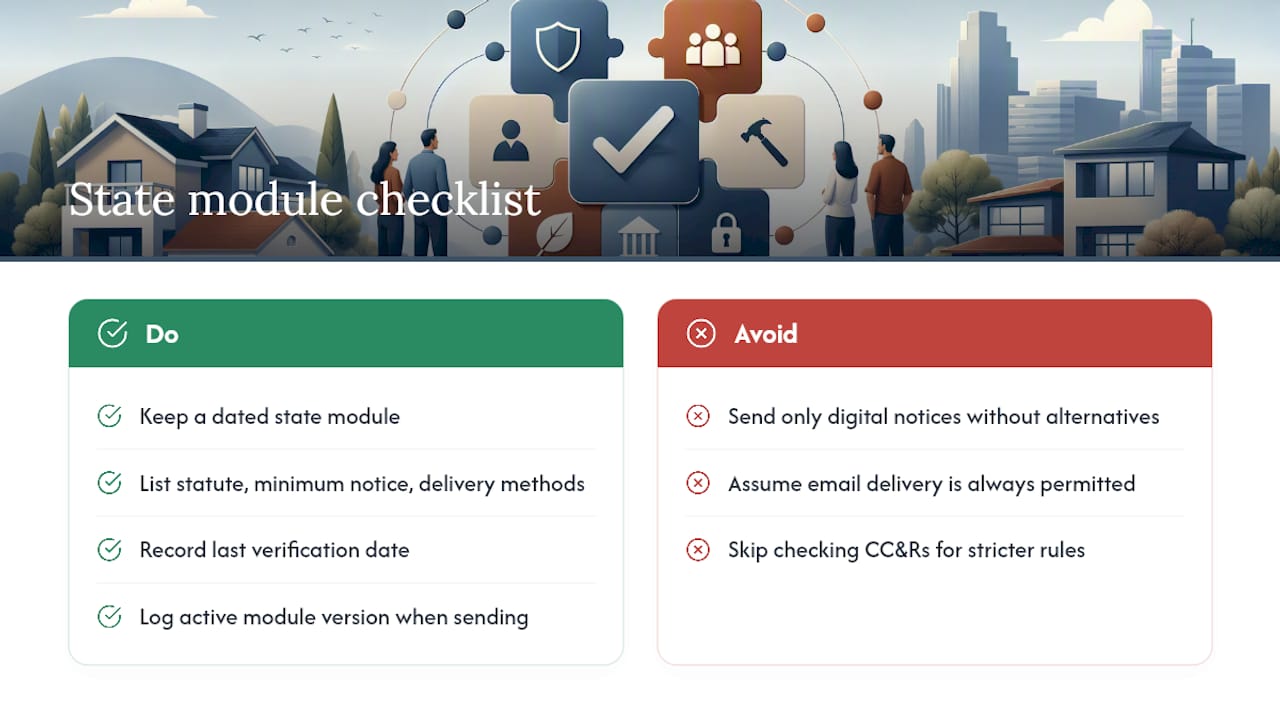
Pro Tip: Keep a “state module” as a separate, dated section at the top of each template. The module should list the governing statute, the minimum notice period, the permitted delivery methods, and the date you last verified the citation. When you send a notice, log which version of the module was active. That way, a court or auditor can see the exact authority you relied on at the time.
One more layer: the Fair Housing Act requires housing providers to consider reasonable accommodation requests. A board that sends only digital notices without a process for owners who need an alternative format may face a federal compliance issue. Log every accommodation request and any alternative delivery method you accept.
Which delivery methods hold up in court
Evidentiary strength matters when enforcement is challenged. Certified mail with return receipt is the gold standard: it creates a dated, trackable record that courts readily accept. Personal delivery with a signed acknowledgment is equally strong. First-class mail is weaker but widely used for courtesy notices. Email is admissible only where your governing documents or state statute explicitly authorize it.
| Delivery method | Evidentiary strength | Audit ease |
|---|---|---|
| Certified mail, return receipt | High | High — USPS tracking number |
| Personal delivery, signed acknowledgment | High | High — signed affidavit |
| First-class mail with certificate of mailing | Medium | Medium — postal stamp |
| Posting at property/common area | Low-medium | Low — photo required |
| Email (where authorized) | Medium | Medium — delivery/read receipt |
Proof-of-service log fields to capture for every notice:
- Date sent
- Delivery method used
- Tracking or receipt number
- Name of person who served or mailed
- File copy link or photo of the notice sent
- Any accommodation request and alternative method used
Documenting both the condition (photos with timestamps) and the full delivery chain creates the layered proof record courts prefer.
The operational case for standardized notice formats
Roughly 373,000 community associations serve more than 78 million U.S. residents. At that scale, inconsistent notice practices are not just a legal risk — they are an administrative failure waiting to happen.

Uniform formats cut drafting time because writers fill in fields rather than composing from scratch. They reduce selective enforcement claims because every owner receives a notice built from the same template. They make audits faster because records follow a predictable structure. And they reduce the cost of relitigation: the Dwork association had to absorb appellate costs and lost its fines and lien rights entirely because of a one-day timing error. A template with a built-in state module and a pre-send completeness check would have caught that gap before the notice went out.
Formal notice formatting standards and a template library with state modules materially reduce the risk that a notice will fail procedural muster in court.
Drafting language that reduces conflict without losing enforceability
Neutral, fact-based language protects the association legally and reduces the chance a homeowner escalates. The goal is to sound like a process, not a judgment.
Do:
- Cite the exact rule number and the governing document it comes from.
- State observable facts: dates, measurements, photographs.
- Give a calendar deadline, not a vague timeframe (“by March 15, 2026,” not “within a reasonable time”).
- Explain the next enforcement step clearly and tie it to the governing authority.
Don’t:
- Use opinionated adjectives (“your neglected yard,” “your persistent disregard”).
- Threaten remedies beyond what the statute or bylaws authorize.
- Leave cure instructions vague.
Before/after language swaps:
Before: “Your repeated failure to maintain your property is unacceptable and has damaged the community.” After: “The following condition was observed on [Date]: [description]. This condition does not meet the standard set in Section 4.3(b) of the CC&Rs.”
Before: “Fix this immediately or face serious consequences.” After: “Please correct the condition described above by [Date]. If the condition is not corrected by that date, the board may levy fines pursuant to [Section/Statute] and schedule a hearing.”
Pro Tip: Always include the name, phone number, and email of the board contact for appeals and questions. A homeowner who knows exactly how to respond is less likely to escalate — and your record of providing that information is itself a due process defense.
For more neutral notice language examples, the HOA Letter AI blog has before/after swaps across common violation types.
A ready template skeleton and sample notice
Violation notice template skeleton:
[Association Letterhead]
Date: [Month Day, Year]
To: [Owner Name], [Property Address]
Re: Notice of Violation — [Rule/Section Citation]

Dear [Owner Name],

This notice is to inform you that the following condition was observed at the above-referenced property on [Date of Inspection]: [Describe condition factually. Attach photographs dated [Date].]

This condition does not comply with [Section X.X] of the [CC&Rs/Rules and Regulations], which states: "[Quote relevant rule text]."

You are requested to correct the condition described above by [Cure Deadline — Month Day, Year]. If the condition is not corrected by that date, the board may [describe next step — e.g., levy fines of $X per day pursuant to Section X.X / schedule a hearing with at least 14 days' notice].

To request a hearing or discuss this matter, contact [Name, Title] at [Phone] or [Email] by [Date].

Sincerely,
[Board Officer Name, Title]
[Association Name]
[Delivery method: Certified Mail, USPS Tracking #XXXX, sent [Date]]
Sample notice (150 words):
March 10, 2026
To: Jane Smith, 123 Maple Lane Re: Violation Notice — Section 4.3(b), Lawn Maintenance
Dear Ms. Smith,
On March 8, 2026, the following condition was observed at 123 Maple Lane: grass height exceeding 6 inches across the front lawn. Photographs dated March 8, 2026, are attached.
This condition does not comply with Section 4.3(b) of the Declaration of Covenants, Conditions, and Restrictions, which requires lawn grass to be maintained at or below 4 inches.
Please correct this condition by March 25, 2026. If the condition remains uncorrected after that date, the board may schedule a fine hearing with at least 14 days’ notice pursuant to Florida Statute §720.305(2)(b).
To discuss this matter or request a hearing, contact the board manager at [Phone/Email].
Sincerely, [Board Officer] Sent via certified mail, USPS Tracking #XXXX, March 10, 2026.
The enforcement workflow from violation to resolution
Step-by-step process:
- Discover and document — Inspector or resident reports the condition. Photograph it with a timestamp. Note the date, address, and rule at issue.
- Issue the first notice — Send a courtesy warning using your state-module template. Log delivery method and tracking number.
- Cure period — Standard cure period is 30 days for most violations, though your CC&Rs or state statute may set a different period. Calendar the cure deadline.
- Re-inspect — On or after the cure deadline, re-inspect and photograph. Document the result.
- Issue a final notice or hearing notice — If uncured, send a formal violation notice or hearing notice. For Florida boards, this must go out at least 14 days before the hearing date per §720.305(2)(b).
- Hold the hearing — Fining committee or board hears the matter. Minutes must be taken and retained.
- Levy fines or impose lien — Only after the hearing, and only if the governing documents and statute authorize the remedy. Document the decision in writing.
Sample timeline:
- Day 0: Violation observed and photographed.
- Day 1–3: Courtesy warning sent via first-class mail.
- Day 30: Cure deadline. Re-inspect.
- Day 31–33: If uncured, send formal violation notice via certified mail.
- Day 45–48: If still uncured, send hearing notice (at least 14 days before hearing date).
- Day 62+: Hearing held. Minutes retained.
- Day 63+: Fine levied if authorized; decision documented.
Audit retention checklist:
- Photographs with timestamps (retain for the life of the enforcement action plus 7 years)
- Certified mail receipts and USPS tracking confirmations
- Portal delivery logs and email read receipts (where applicable)
- Copies of every notice sent, with the state module version noted
- Hearing minutes and written decisions
- Any accommodation requests and alternative delivery records
The real cost of skipping standardization
Most boards that lose enforcement actions in court did not lose because the homeowner was right on the merits. They lost because the process was wrong. The Dwork association had a legitimate underlying complaint. The homeowner received actual notice. None of that mattered once the court found the 13-day notice violated §720.305.
The uncomfortable truth is that a template system is not a bureaucratic nicety. It is the mechanism that keeps your enforcement rights intact. Boards that draft notices from scratch each time introduce variation — and variation is where procedural defects hide. A state module that locks in the correct notice period, a pre-send checklist that flags missing elements, and a delivery log that captures proof of service are not extra steps. They are the steps that make every prior step count.
Boards that have not yet standardized their notice process tend to discover the gap at the worst possible moment: mid-litigation, when fixing it is no longer an option.
How HOA Letter AI supports this workflow
Drafting state-aware drafts you review from scratch takes time most boards do not have. HOA Letter AI is built specifically for this workflow: state-aware templates that embed the correct statutory citations and minimum notice periods, a notice completeness checker that flags missing required elements before you send, USPS mailing integration with tracking confirmation, and reusable community profiles so property managers can generate consistent notices across multiple communities without rebuilding the template each time.
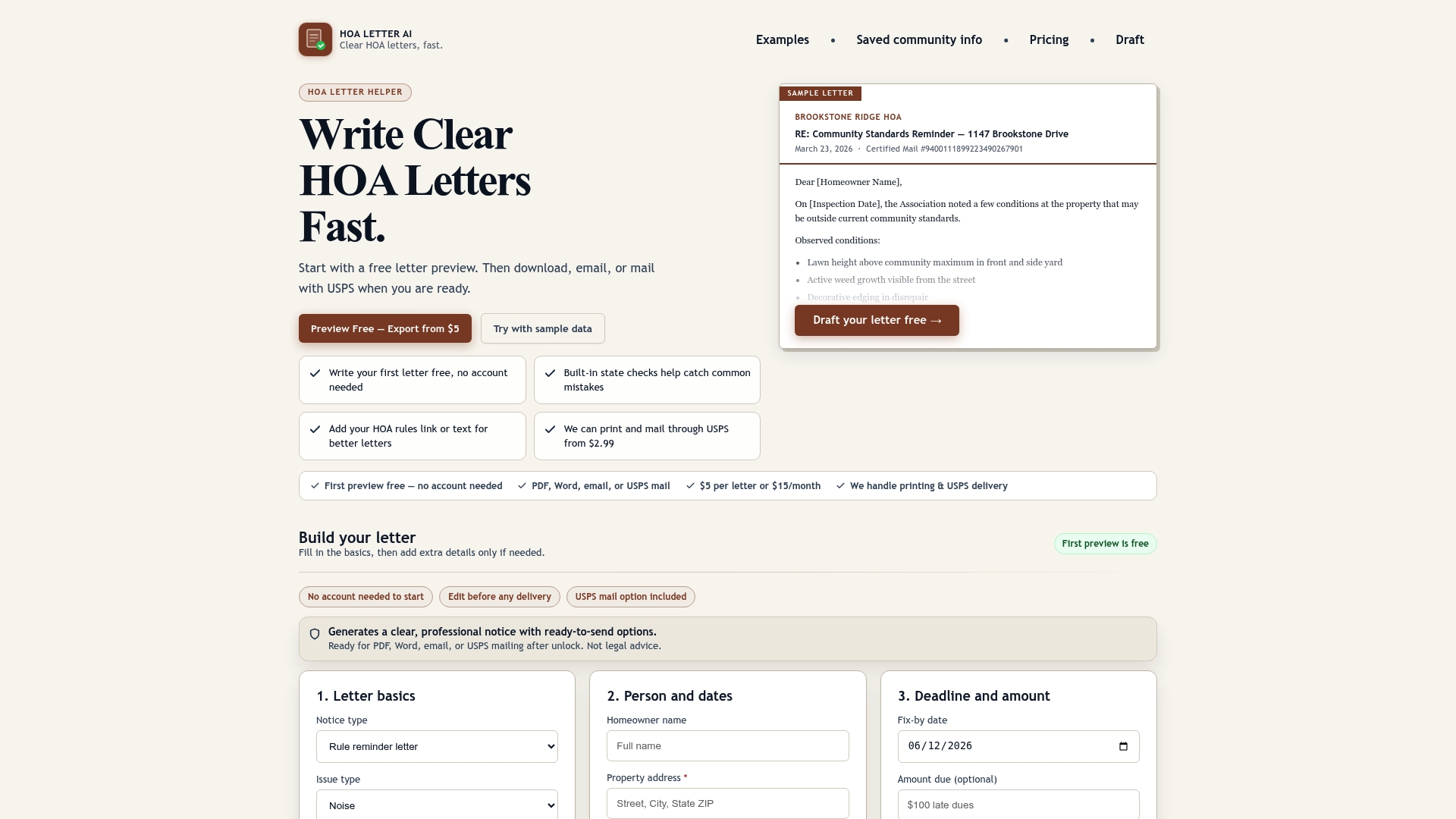
The HOA violation letter laws by state page gives plain-language summaries of notice requirements for each state, and the template library includes ready violation, fine, and hearing notice templates you can preview before committing. For boards that want to see exactly what a compliant notice looks like before their next enforcement action, a one-page preview is available at no cost.
Sources
Keep these links in your compliance folder. Consult qualified legal counsel for state-specific questions before taking enforcement action.
- Dwork v. Executive Ests. of Boynton Beach Homeowners Ass’n, Inc., 219 So. 3d 858 (Fla. 4th DCA 2017) - FLexlaw
- How to Write an HOA Violation Notice (Step-by-Step)
This article is general information, not a substitute for advice from a qualified lawyer. Consult a qualified legal professional about your own circumstances before acting on anything here.