
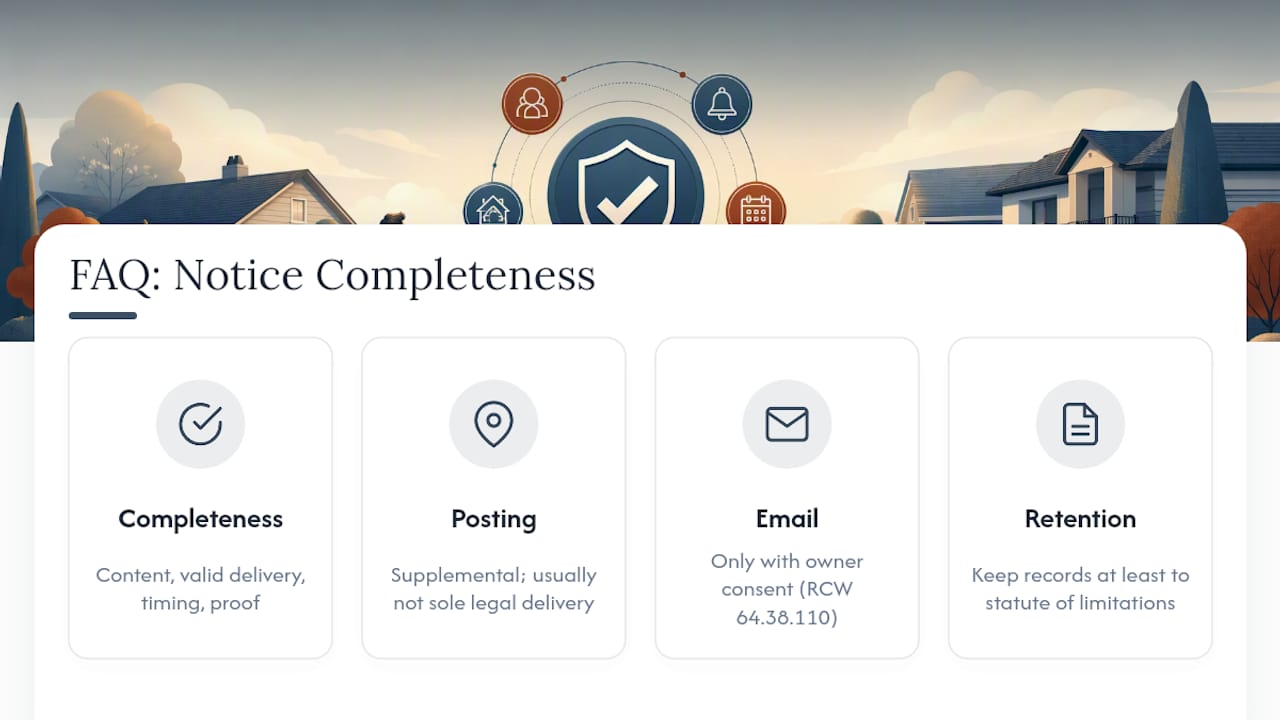
A legally complete HOA notice needs four things working together: the minimum content your statute or governing documents require, delivery through a method the recipient actually agreed to (or that state law defaults to), timing that gives the required advance window, and proof you can produce if someone challenges it later. Miss any one of the four and the notice is vulnerable, even if the other three are perfect.
That’s the whole concept in a sentence, but boards rarely fail on all four at once. Usually it’s one weak link: an email sent without consent on file, a fine notice that skips the cure period, or a mailed letter with no certificate of mailing to prove it went out. Here’s what a complete notice actually needs, and what to check right now.
- Who sent it and who it’s addressed to
- What the notice concerns, stated specifically (not “you’re in violation” but which rule, which date, which observation)
- When the meeting, hearing, or cure deadline falls
- Where the meeting happens, or where to submit a response
- How to respond or cure, plus the statute or CC&R section that governs the process
Pro Tip: Pull your state statute and your CC&Rs side by side before you send anything. Whichever one requires more notice, more detail, or more time wins. Following only one of the two is the most common way boards create a defective notice.
Key Takeaways
A complete HOA notice requires correct content, a valid delivery method, proper timing, and documented proof, and losing any one element makes the entire notice defensible only by luck.
| Point | Details |
|---|---|
| Match content to notice type | Meeting, violation, hearing, and lien notices each require different mandatory fields; don’t reuse one template for all four. |
| Confirm delivery method validity | Electronic notice only counts with documented owner consent; mail remains the reliable default. |
| Follow the stricter standard | When state statute and CC&Rs conflict, apply whichever requires more notice or more detail. |
| Keep a single notice log | Track every send with date, method, address, and approver to prove delivery if challenged. |
| Use state-aware tools for consistency | HOA Letter AI builds statute citations and required language into every letter automatically. |
Table of Contents
- What Makes HOA Notice Completeness Legally Sound
- Which Controls: State Law or Your Governing Documents?
- When Is a Notice Actually “Delivered”?
- Notice Content by Type: Meetings, Violations, Hearings, and Liens
- Proof of Delivery and Recordkeeping That Hold Up
- If a Homeowner Challenges a Notice, Act Fast
- How State Rules on Notice Vary
- A One-Page Completeness Checklist You Can Reuse
- Get Every Notice Right Before It Goes Out
- Frequently Asked Questions
- Sources
What Makes HOA Notice Completeness Legally Sound
Every enforceable notice, regardless of type, tends to include the same skeleton of mandatory fields. Courts and statutes don’t require poetry. They require specificity.
- Sender identity — the association’s legal name and the board or management company issuing the notice.
- Recipient identity — the owner of record, matched to the address on file with the association.
- Date, time, and location — for meetings and hearings, including dial-in or video link details if the meeting is hybrid or virtual.
- Clear statement of purpose — the specific agenda item, alleged violation, or action being proposed.
- Exact rule citation — the specific CC&R article, bylaw section, or rule number, not a general reference to “community rules.”
- Cure period and deadline — the calendar date by which the owner must act, not just a number of days from an ambiguous starting point.
- Penalty range or fine schedule — dollar amounts or escalation steps if the notice threatens enforcement.
- Statutory citation — when a state law governs the process, name it. This one line often decides whether a notice survives review.
“The method that statutes require and the notice content are both essential to enforceability. Delivery proof is often decisive when a notice ends up in litigation.” This is the core finding behind LegalClarity’s breakdown of HOA notice delivery rules, and it explains why boards that get content right still lose challenges over documentation.
Vague language is the single most common defect. “You are in violation of community standards” tells an owner nothing they can act on. “You are in violation of CC&R Section 4.3(b), which restricts trailer parking in visible driveways” gives them a rule to check, a fact to dispute, and a reason your notice holds up. Standardized notice templates help boards keep this level of specificity consistent across every letter, not just the ones a careful board member happens to draft personally.
Which Controls: State Law or Your Governing Documents?
State statutes generally set a floor, not a ceiling. Your CC&Rs or bylaws can require more notice, more detail, or more procedural steps than state law demands, but they can’t require less. When a conflict exists, the stricter standard usually wins, not the more convenient one.
- If your state statute requires 10 days’ notice for a hearing but your bylaws specify 15, follow the 15 day rule.
- If your CC&Rs are silent on a topic your state statute addresses directly, such as California’s individual delivery requirements, the statute fills the gap.
- If your governing documents attempt to waive a statutory protection, like a mandatory cure period, that waiver is typically unenforceable.
California associations operating under the Davis-Stirling framework deal with this constantly, since the statute bundles detailed timing and content rules that many other states leave to the CC&Rs. When the hierarchy isn’t obvious from a plain reading, that’s when to loop in counsel rather than guess.
When Is a Notice Actually “Delivered”?
Delivery method determines the effective date, and the effective date determines whether your cure period or hearing window even started running. Get this wrong and every deadline downstream is wrong too.
First-class mail is generally effective on deposit in most jurisdictions, following a version of the traditional mailbox rule. Certified or registered mail gives you a receipt but doesn’t necessarily change when the notice is legally “sent.” Personal delivery is effective immediately but requires documentation of who handed it to whom. Posting in a common area, like a clubhouse bulletin board, is common but frequently insufficient as the sole method for individual notices such as fine warnings or hearing notices, according to guidance compiled by the HOA Dispute Tool.
Electronic delivery is where boards get tripped up most often. Under statutes like Washington’s RCW 64.38.110, an email or portal notice only counts for owners who affirmatively consented and designated the address or system to be used. Send a hearing notice by email to an owner who never opted in, and you likely haven’t given notice at all, no matter how promptly they read it.
- First-class mail: effective on deposit in most states
- Certified/registered mail: adds proof, doesn’t always change the effective date
- Personal delivery: immediate, requires a delivery log
- Posting: often supplemental only, rarely sufficient alone
- Electronic transmission: valid only with documented consent
Pro Tip: Track consent for every owner who wants email or portal delivery, and monitor for bounce-backs. If an email fails, that owner needs a mailed backup copy before you can treat the notice as complete.
Notice Content by Type: Meetings, Violations, Hearings, and Liens
Different notice types carry different mandatory content, and treating them as interchangeable is where a lot of boards get sloppy.
Meeting notices (annual, special, emergency) need the agenda items to be voted on, proxy instructions if proxies are allowed, and any ballot materials required for elections. Special meetings often carry shorter windows than annual meetings, so check both separately. Meeting notice templates built around your state’s timing rules remove most of the guesswork here.
The violation cycle typically runs courtesy notice, formal violation notice, then hearing notice. Each stage needs to say something the last one didn’t:
- Courtesy notice: informal, names the observed issue, no fine threatened
- Formal violation notice: cites the specific rule, states the cure deadline, warns of potential fines
- Hearing notice: states the owner’s right to appear, the date and format of the hearing, and the possible penalty if the board proceeds
Sample phrasing that holds up: “You are in violation of Section 4.3(b) because a commercial vehicle was parked in your driveway on March 3, 2026. This must be cured by March 20, 2026, or a hearing will be scheduled.” That single sentence hits rule citation, factual basis, and deadline at once. A violation notice checklist keeps this structure consistent across every letter your board sends.
Enforcement notices, including fines and pre-lien demands, require itemized amounts, the specific violation each charge relates to, and often certified mail. Florida’s §720.305 requires at least 14 days’ notice in many contexts before a fine or suspension takes effect, a window some boards underestimate when trying to move quickly.
Proof of Delivery and Recordkeeping That Hold Up
Content and timing win the argument on paper. Proof of delivery wins it in a dispute. Boards that can’t produce a paper trail lose challenges even when the notice itself was written correctly, and that gap is exactly why documentation matters so much in enforcement actions.
Keep these on hand for every notice sent:
- USPS Certificate of Mailing or certified mail receipts
- Delivery confirmations and return receipts where applicable
- Email transmission logs, including timestamps and consent records
- Portal posting receipts, plus a separate notice of posting for owners who opted into electronic delivery
Maintain one running notice log, not scattered files, with the date sent, address used, delivery method, attachments included, and who approved the send. Keep records for at least as long as your state’s statute of limitations for HOA disputes allows, and longer if litigation is already active or anticipated.
If a Homeowner Challenges a Notice, Act Fast
A defective notice usually makes the underlying action voidable, not automatically void, which means quick, documented correction often resolves the problem before it becomes a bigger one.
- Preserve every record related to the notice immediately, including drafts and delivery logs.
- Recheck the governing documents and the controlling statute for the exact requirement in question.
- If a gap exists, consider re-noticing and re-voting rather than defending a flawed original notice.
- Document every mitigation step in the board’s meeting minutes.
- Escalate to legal counsel if the defect involves a missing statutory element or a proof-of-delivery gap you can’t close.
Missing statutory language or a break in the delivery chain are the two red flags that most often turn a simple complaint into real exposure, a pattern that shows up repeatedly in appellate decisions involving HOA notice defects.
How State Rules on Notice Vary
California, Texas, Florida, and Washington each handle notice differently enough that copying another state’s process is risky. California’s Davis-Stirling framework, detailed in Davis-Stirling’s guidance on notice and document delivery, sets specific windows for board and membership notices and spells out how to calculate notice periods. Texas Property Code §209 governs meeting and election notice requirements distinct from enforcement timelines. Florida’s §720.305 sets firm minimum windows before fines take effect. Washington’s electronic-consent rules are among the most detailed in the country for what counts as valid digital delivery.
- Electronic consent requirements vary sharply by state
- Hearing and assessment notice windows range from about 10 to 14+ days depending on jurisdiction
- Posting rules differ on whether posting alone ever satisfies individual notice
Look up your own state’s statute by name and section number, then cross-check it against your CC&Rs before assuming either one governs alone. State-specific notice examples can help confirm you’re reading the right provision.
A One-Page Completeness Checklist You Can Reuse
Before any notice goes out, confirm it answers: who sent it, who receives it, what it concerns, when action or attendance is required, where the CC&R or statute citation appears, what the cure deadline is, which delivery method applies, and what proof will exist afterward.
Sample language worth standardizing: cure language (“cure this violation by [date] to avoid further action”), hearing-rights language (“you have the right to appear and be heard before the board”), and rule-citation language naming the exact section every time. Formatting consistency matters here too. Boards using formal notice formatting standards catch missing fields before a letter ever gets mailed, and HOA Letter AI’s state-aware templates build these fields in by default so nothing gets skipped under deadline pressure.
A manager’s take on what actually breaks
Most notice failures aren’t legal errors. They’re operational ones: a board president posts a flyer instead of mailing individual notice, or nobody tracks who consented to email. Centralize logging, standardize templates, and pre-approve motion language in your minutes. Automated systems catch missed deadlines that busy volunteers miss.
Get Every Notice Right Before It Goes Out
Reading statutes side by side with your CC&Rs works, but it’s slow, and one missed citation can undo weeks of enforcement effort. HOA Letter AI builds the state statute directly into the drafting process, so the required cure period, hearing language, and rule citation populate automatically instead of depending on whoever’s writing the letter that week.
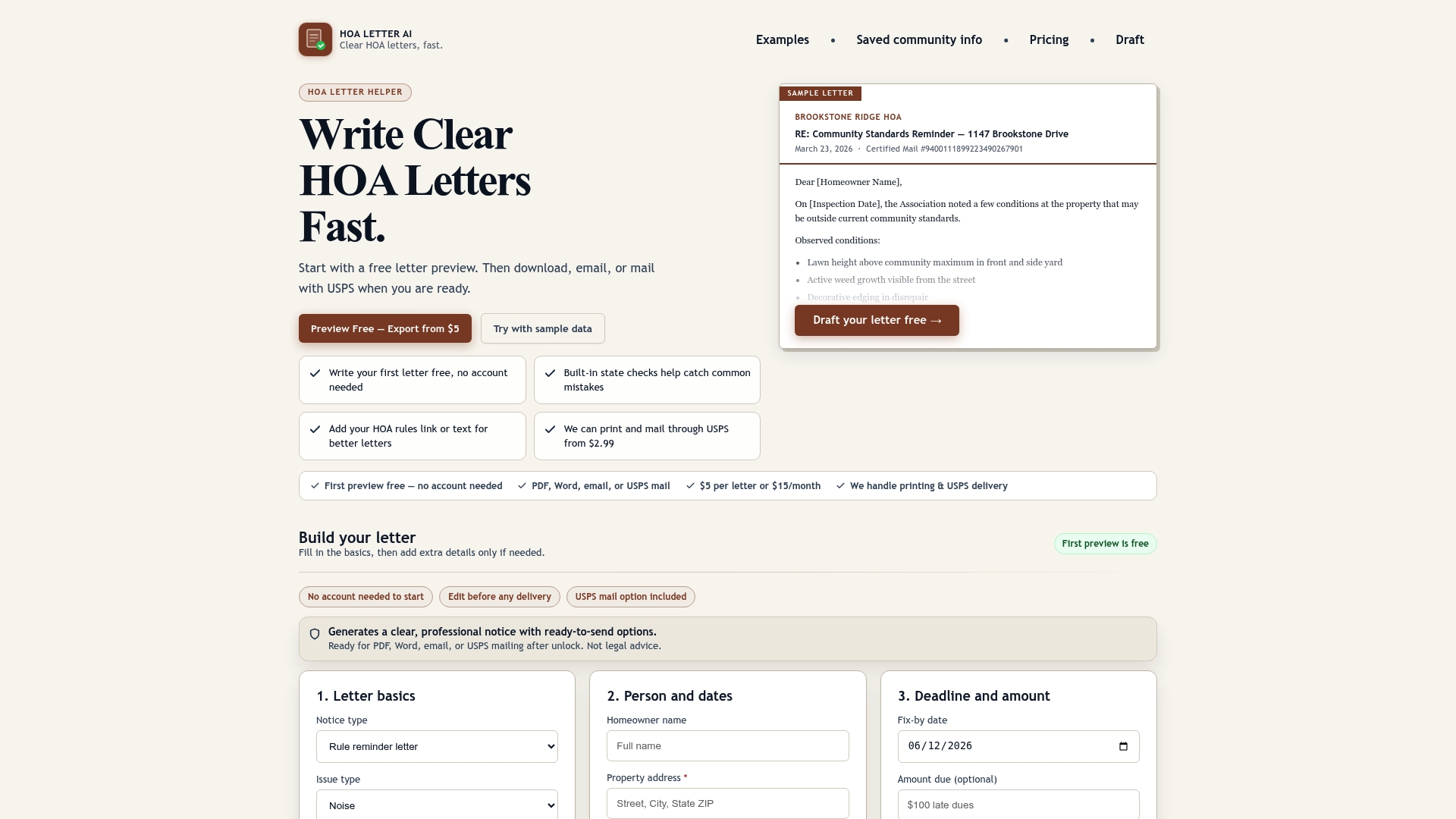
The tool checks for mandatory language before a letter goes out, cites the correct CC&R or bylaw section, and integrates USPS mailing so you get a delivery record without a separate trip to the post office. Property managers running multiple communities can save a reusable profile per association, so state-specific rules stay locked in even as board members and staff turn over. Homeowners drafting a response letter get the same state-aware structure for $19. Start by checking your state’s specific HOA notice and fine rules to confirm what your next notice legally needs to include.
Frequently Asked Questions
What does “HOA notice completeness” actually mean? It means a notice contains every legally required content element, uses a delivery method valid for that recipient, meets the required timing window, and comes with proof you can produce later if challenged.
Does posting a notice on a community bulletin board count as legal delivery? Usually not by itself for individual notices like fines or hearings. Posting typically works as a supplement to mailed or electronic notice, not a replacement for it.
Can an HOA send violation or hearing notices by email? Only if the owner has affirmatively consented to electronic delivery and designated the address or system to use, per statutes like Washington’s RCW 64.38.110. Without that consent, mail is the safer default.
What happens if a notice is missing required content? The underlying board action often becomes voidable rather than automatically void, which usually means the practical fix is re-noticing and re-voting after documenting the correction.
How long should an HOA keep proof of notice delivery? Keep records at least as long as your state’s statute of limitations for association disputes, and longer if any dispute or litigation is active or anticipated.
This article is general information, not a substitute for advice from a qualified lawyer. Consult a qualified legal professional about your own circumstances before acting on anything here.
Sources
- California Civil Code §4040 — LegInfo
- Washington RCW 64.38.110 — State Legislature
- Florida Statute §720.305 — FL Senate
- Texas Property Code §209 — Texas Legislature
Recommended
- HOA Violation Notice Checklist for Board Members | HOA Letter AI
- Why HOA Notices Require Documentation | HOA Letter AI
- HOA Hearing Notice Requirements for Boards and | HOA Letter AI
Drafting support for HOA notices
Use the HOA letter drafter to turn this guidance into a resident-ready notice, compare reusable HOA letter templates, or review the property manager workflow for higher-volume enforcement work.