
A California HOA violation notice is the written notice a board sends when it believes an owner broke the governing documents. When the board plans to discipline the owner or charge for common-area damage, Civil Code §5855 sets the rules: written notice at least 10 days before the board meeting, a description of the alleged violation, a chance to attend and be heard, and a chance to cure. A bill passed in 2025 (AB 130) tightened these rules, so older templates may be out of date.
This guide serves both sides. If you sit on a board or manage a community, it shows what the notice must contain and how to document it. If you are the homeowner holding a notice, it shows what to check and what you can do next.
HOA Letter AICreate Clearer California HOA NoticesDraft compliance letters with guided writing, state-specific context, community rules, and built-in checks to help reduce avoidable errors.Visit HOA Letter AITL;DR
- A notice that proposes discipline must arrive at least 10 days before the hearing. It must give the meeting date, time and place, describe the alleged violation, and say the member may attend and address the board.
- Deliver it personally or by an individual-delivery method under Civil Code §4040, such as first-class or certified mail. Email works only if the owner has given the required consent.
- For an ordinary violation, the fine is capped at the lesser of the HOA’s schedule amount or $100. Higher amounts need a written finding of a health or safety impact.
- The owner can cure before the meeting, or make a financial commitment to cure if the fix takes longer. The board may not discipline if the cure happens.
- If discipline is imposed, the written decision is due within 14 days. A board that skips a step can find the discipline ineffective.
Table of Contents
- What a California violation notice has to contain
- How the notice must be delivered
- The timeline from first notice to decision
- How much can a California HOA fine you?
- Cure rights: the part owners often miss
- What to do if you are the homeowner
- Our perspective: clear notices prevent most fights
- Drafting the notice with HOA Letter AI
- Common mistakes in California violation notices
- FAQ
- Sources
What a California violation notice has to contain
There are really two documents in a typical enforcement case. The first is a courtesy or warning letter that asks for a fix. The second is the formal notice of hearing, required when the board is going to consider a fine, suspension or other discipline. The statute governs the second.
Under §5855(b), the hearing notice must state:
- The date, time and place of the meeting.
- The nature of the alleged violation, or the common-area damage.
- That the member may attend and address the board.
That is the legal floor. A good notice goes further. Attorneys who write for California associations recommend naming the specific conduct and the exact governing-document provision, not a vague label like “rule violation.” They also suggest including the date the violation was reported and explaining what discipline is possible, subject to your governing documents and your counsel’s review.
A sample notice-and-hearing form from a Los Angeles community-association law office shows the practical fields: the owner’s name and mailing address, the violation’s date, time and location, a factual description, the cited CC&R, bylaw or rule, the hearing details, and the owner’s ability to attend, present evidence or witnesses, or submit a written defense.
A checklist for boards
| Element | Why it matters |
|---|---|
| Owner name and mailing address | Proves the notice went to the right person |
| Property address and violation location | Avoids disputes over which lot or common area |
| Date and time observed or reported | Anchors the facts |
| Plain description of the conduct | Replaces labels with observable facts |
| Cited CC&R, bylaw or rule section | Shows the authority for enforcement |
| Cure instructions and deadline | Gives the owner a real chance to fix it |
| Hearing date, time and place | Required by §5855(b) |
| Right to attend and be heard | Required by §5855(b) |
| Possible discipline | Sets expectations; confirm with counsel |
If you want a fuller walk-through, our HOA violation notice checklist for board members covers the review steps before sending.
How the notice must be delivered
Delivery is where many boards slip. Section 5855 requires the notice to be delivered personally or by an individual-delivery method under Civil Code §4040. Those methods include first-class mail, registered or certified mail, express mail and overnight delivery. Electronic delivery is allowed only when the owner has met the statutory requirements for consenting to it.
Two practical points follow:
- Use the address the owner designated. Posting a notice on the door or mentioning it in a newsletter is not individual delivery.
- Count the 10 days from delivery, not from the day you drop it in the mail. Leave room for mail time so the notice truly arrives at least 10 days before the meeting.
Keep proof. Epsten APC, a California association law firm, advises keeping proof of service with the association’s copy of the notice. It says a sworn statement of mailing is evidence the notice was sent, though proof of service is not required to enforce discipline. Proof is cheap insurance if an owner later says nothing arrived.
Our drafting tool can send the finished letter through USPS for an optional fee starting at $2.99 per letter, so the mailing is handled where you wrote it. See the draft page for details.
The timeline from first notice to decision
The sequence under §5855 looks like this:
- Board confirms its authority. The discipline process must be authorized by the governing documents. If the HOA imposes monetary penalties, it must have distributed its penalty schedule.
- Written notice goes out. At least 10 days before the meeting.
- Owner may cure. If the violation is cured before the meeting, the board may not impose discipline.
- Hearing. The owner may attend and address the board, and may ask for an executive-session hearing.
- Written decision. If the board imposes discipline or a damage charge, it must give written notice within 14 days.
The official text also says that a board that does not fulfill §5855 makes the discipline or damage charge ineffective. For boards, that is the strongest reason to treat the process as a checklist, not a courtesy.
What the decision notice should say
Epsten APC suggests the post-hearing notice identify the owner and property, the hearing date and location, the specific discipline, the cited provisions, and the effective date. If the board is charging for damage, include the amount and the payment deadline.
How much can a California HOA fine you?
This is the question most owners search, and the answer changed. Assembly Bill 130 amended §5855 effective June 30, 2025. For an ordinary governing-document violation, the fine is limited to the lesser of the HOA’s distributed schedule amount or $100 per violation.
There is one exception. A higher schedule amount is allowed only when the violation may adversely affect health or safety on the common area or another member’s property, and the board makes a written finding in an open meeting that specifies that impact. The statute also bars late fees and interest on the penalty.
So if your HOA’s old schedule says $250 for an unapproved paint color, the cap is $100 unless the board can make a genuine health or safety finding. A notice that simply lists the old figure deserves a question.

Cure rights: the part owners often miss
The 2025 amendment added a cure opportunity. Under §5855©, the member gets a chance to fix the problem before the meeting. If it is fixed, the board cannot impose discipline. If curing will take longer than the period between the notice and the meeting (replacing a roof, say, or a permit-dependent repair), the owner can make a financial commitment to cure and the board still may not impose discipline.

For boards, this changes how you write the notice. State what a cure looks like, and say how the owner can tell you the work is done. For owners, it means a quick written reply with photos can end the matter before a fine is ever considered.
What to do if you are the homeowner
Do not ignore the notice. Silence is the one response that helps no one.
- Read for the basics. Does it give a meeting date, time and place? Does it describe the violation? Does it cite a rule? Did it arrive at least 10 days before the meeting? Our notice-completeness checker for homeowners is built around these questions.
- Compare it to your documents. Pull the CC&R or rule cited. Does it actually cover what you are accused of doing?
- Cure if you can, and document it. Take dated photos and send them in writing. If it will take time, put your plan and a financial commitment in writing before the meeting.
- Attend and speak. You may address the board, and you may request that the hearing be held in executive session. Bring evidence or witnesses, or submit a written defense.
- Request internal dispute resolution if you still disagree. After the hearing, §5855(d) gives you the opportunity to request internal dispute resolution under §5910.
Grounds that commonly support a challenge
- The notice was not delivered by an allowed method, or arrived fewer than 10 days before the meeting.
- The notice did not describe the alleged violation or say you could attend.
- The fine exceeds $100 with no written health or safety finding.
- The decision was not delivered within 14 days.
- The board imposed discipline even though you cured.
These track the statute’s text, so cite the section in your reply. For help drafting that reply, see our guide on what to do after an HOA violation letter in California. If the stakes are large, such as a lien threat or a dispute about a rule’s validity, talk to a California attorney who handles community-association law.
Our perspective: clear notices prevent most fights
We see the same pattern in the letters people bring to us. Disputes rarely start with the rule itself. They start with a notice that is vague, arrives late, or quotes the wrong amount. An owner who cannot tell what they did wrong, or what to do about it, will either ignore the notice or fight it.
That is why we build around a few habits. State the facts in neutral words. Cite the exact provision. Say what cure looks like. Put the hearing details where the owner cannot miss them. Then keep a record of how and when the notice went out.
The 2025 changes make this more important, not less. With a $100 default cap and a built-in cure right, boards gain more from getting compliance quickly than from collecting fines. A calm, accurate first letter does that. We would rather help a board send one correct notice than three corrected ones.
— Blake
Drafting the notice with HOA Letter AI
If you are a board member or manager, our tool walks you through the letter step by step. You pick the violation, cite the CC&R or rule, and get state-aware context for California, with checks for mandatory language. You can preview the one-page letter for free, with no account required.
Pricing is straightforward: a single letter costs $5, and a self-serve board plan is $15 per month. Property management teams can look at PM Starter at $199 per month or PM Pro at $399 per month, with a 30-day pilot at $499. See pricing for individual and board options, or the property manager plans for teams.
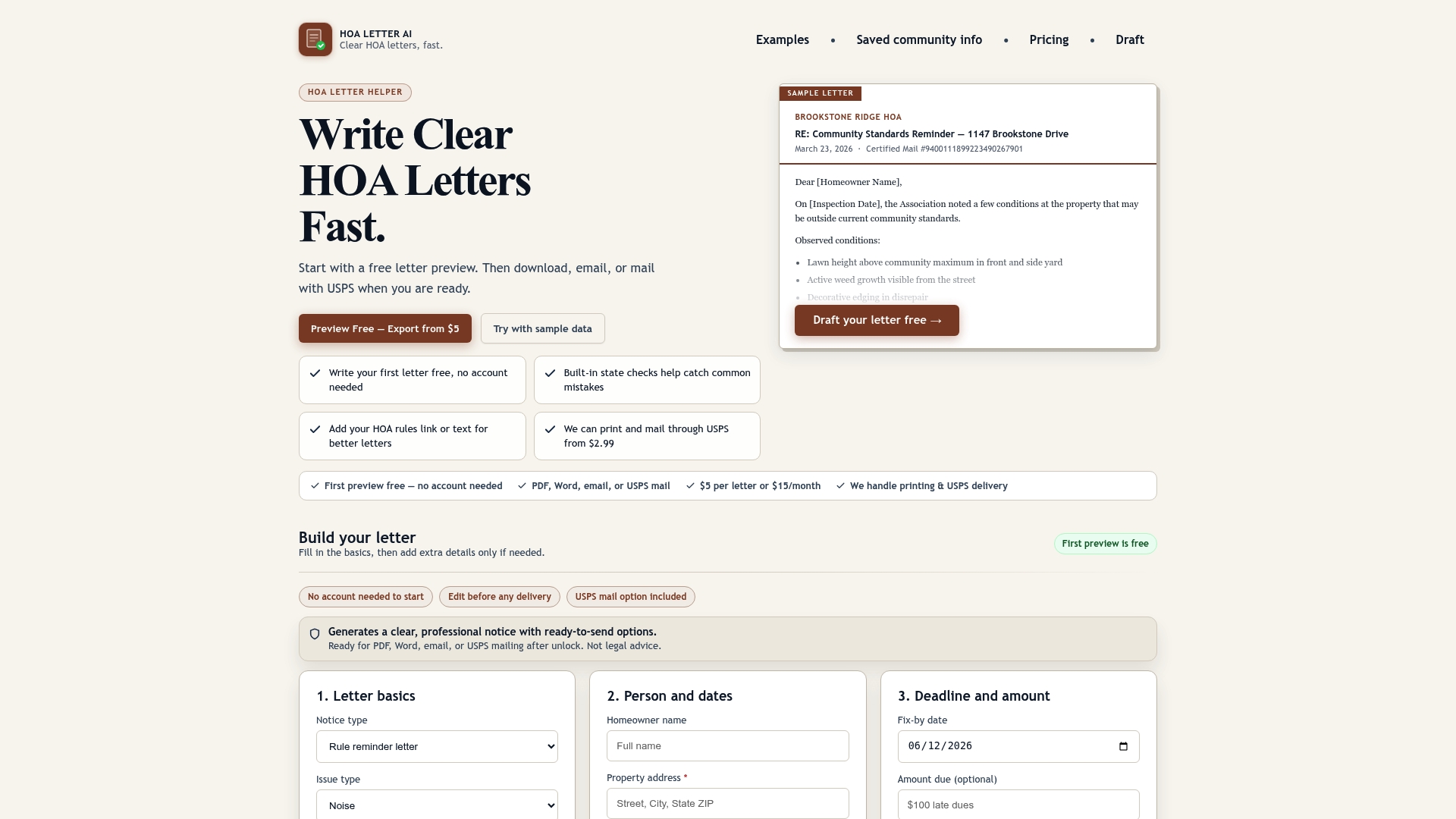
Homeowners can generate an editable response letter for $5 on the same pricing page. For background before you start, our California violation letter requirements page and the California compliance guide lay out the rules in more detail. If you want a softer first step, the HOA warning letter template works as a courtesy notice before fines.
Common mistakes in California violation notices
- Using an outdated fine amount. Schedules written before June 30, 2025 may exceed the cap.
- Labeling instead of describing. “Landscape violation” tells the owner nothing. “Dead turf across the front yard, observed on a stated date” does.
- Skipping the cure language. Since the amendment, the owner’s cure right belongs in the process from the start.
- Relying on a door hanger or newsletter. These are not individual delivery under §4040.
- Missing the 14-day decision notice. A fully correct hearing can still be undone by a late decision.
- Treating a tenant like an owner without checking. If the governing documents allow penalties against tenants and the board intends to fine one, the hearing notice has to go to the tenant too. Have counsel review before acting.
Our article on writing effective violation notices for HOA boards goes deeper on tone and structure, and a calm, rule-cited example shows the finished product.
FAQ
How many days’ notice must a California HOA give before a violation hearing?
At least 10 days before the board meeting at which discipline or a damage charge will be considered. The notice must be delivered personally or by an individual-delivery method under Civil Code §4040. Count from delivery, and allow for mail time.
Is the maximum HOA fine in California really $100?
For an ordinary violation, the cap is the lesser of the HOA’s distributed schedule amount or $100 per violation, under §5855 as amended effective June 30, 2025. A higher amount requires a written finding, made in an open meeting, that the violation may adversely affect health or safety. Late fees and interest cannot be added to the penalty.
Can I avoid a fine by fixing the problem?
Yes, in most cases. If you cure the violation before the meeting, the board may not impose discipline. If the fix will take longer than the notice period, a financial commitment to cure has the same protective effect. Get both the fix and the commitment in writing.
What if I disagree with the board after the hearing?
You can request internal dispute resolution under Civil Code §5910. Put the request in writing and keep copies of the notice, your evidence and the decision. For larger disputes, consult a California community-association attorney.
Does the notice have to cite the rule I allegedly broke?
The statute’s minimum is a description of the alleged violation, the meeting details and your right to attend. Attorneys recommend citing the specific provision as well, because it lets you check whether the rule applies. A notice without a citation is easier to challenge on fairness grounds.
Sources
- California Civil Code, Division 4, Part 5 (official code text, including §§4040, 5855, 5910)
- It’s All in the Details, Hughes Gill Cochrane Tinetti
- Notice of Violation and Hearing, Los Angeles community-association law office
- Notice of Hearing Part Two, Epsten, APC