
Start with a short Tier 1 courtesy notice that cites the exact CC&R section and gives a clear cure deadline. That single move resolves most violations before anyone talks about fines. The letter needs a date, the homeowner’s name and address, the specific rule being cited, an objective description of what your board observed, a cure deadline, the consequences the board is actually authorized to impose, and instructions for appeal or hearing rights if your governing documents or state requires them.
- Cite the exact CC&R article or section, not a general reference to “the rules.”
- Describe the violation with dates and, ideally, a photo, rather than a subjective label like “messy yard.”
- Give a real deadline, not “as soon as possible.”
- Name only the consequences the board can lawfully enforce.
- Include contact information and appeal instructions.
The templates below give you copy-ready language for each of these pieces, organized by violation type and escalation tier.
Key Takeaways
Effective HOA warnings work because they cite the exact rule, describe the violation objectively, set a specific cure deadline, and only threaten consequences the board can legally enforce.
| Point | Details |
|---|---|
| Start with Tier 1 | Send a courtesy notice citing the exact CC&R section with a clear, specific cure deadline. |
| Match the deadline to the fix | Use short windows (7–14 days) for easy fixes, longer ones (30+ days) for permit or contractor work. |
| Document everything | Keep photos, certified mail receipts, and inspection logs in one file per address. |
| Escalate on a published ladder | Move from courtesy notice to formal notice to fine to hearing on a consistent, predictable timeline. |
| Check state law before fining | Confirm hearing rights and fine caps against your state’s statutes before imposing penalties. |
Table of Contents
- Examples of Effective HOA Warnings: What Separates Them From the Rest
- Copy-Ready Templates by Violation Type and Tier
- How the Escalation Ladder Should Actually Work
- Getting the Tone Right Without Sounding Like a Threat
- Where State-Aware Templates and a Completeness Checker Fit In
- Essential Templates, Enforcement Guides, and State-Law Resources
- What Most Boards Get Backwards About Warning Letters
- Sources
Examples of Effective HOA Warnings: What Separates Them From the Rest
An effective warning letter does one job: it gives the homeowner everything they need to fix the problem without a phone call, and it gives the board a paper trail that holds up if the case ever reaches a hearing or a courtroom. Most letters that fail do so because they are either too vague to act on or promise consequences the board cannot legally enforce.
Here’s what separates a defensible letter from a shaky one:
- Exact citation, not a paraphrase. Quote the CC&R article or section number directly (“Section 4.2(b) prohibits storage of trailers, boats, or unregistered vehicles in driveways for more than 48 hours”). A vague reference to “community standards” gives a homeowner nothing to contest and nothing to fix.
- Objective description with evidence. Note the date you observed the violation, and attach a photo whenever possible. “Overgrown landscaping” is an opinion. “Grass exceeding 12 inches, observed May 3 and May 10” is a fact.
- A specific, reasonable deadline. Ten days works for a trash can left at the curb. Thirty or more days makes sense for anything requiring a contractor or a permit, like removing an unapproved fence.
- Consequences the board can actually impose. If your CC&Rs cap fines at $100 or require a hearing before any fine, say that, and nothing more.
- Trackable delivery and a documented file. Certified mail with a return receipt is the simplest way to prove notice was sent and received.
- Hearing or appeal rights, spelled out clearly when your state or governing documents require them, as The HOA Guide notes in its rundown of what a legally sound violation letter includes.
Pro Tip: Keep a running log of every notice sent, by address and date. If a homeowner ever claims the board singled them out, that log is your best evidence that enforcement was applied evenly.
Copy-Ready Templates by Violation Type and Tier
Tiered templates, moving from a friendly reminder to a formal notice to a final warning, resolve most issues before a fine ever gets discussed, according to the tiered workflow outlined by Preserve HOA. Below are bracketed starting points for the five violation types boards deal with most often.
Landscaping
- Tier 1 (courtesy): “We noticed the lawn at [address] has grown beyond the height allowed under [CC&R Section]. Please trim by [date, 10–14 days out]. No action is needed beyond the cure; this is a friendly reminder.”
- Tier 2 (formal): “This is a formal notice regarding continued noncompliance with [CC&R Section] observed on [date]. Please cure by [date, 14 days]. Failure to comply may result in [authorized consequence].”
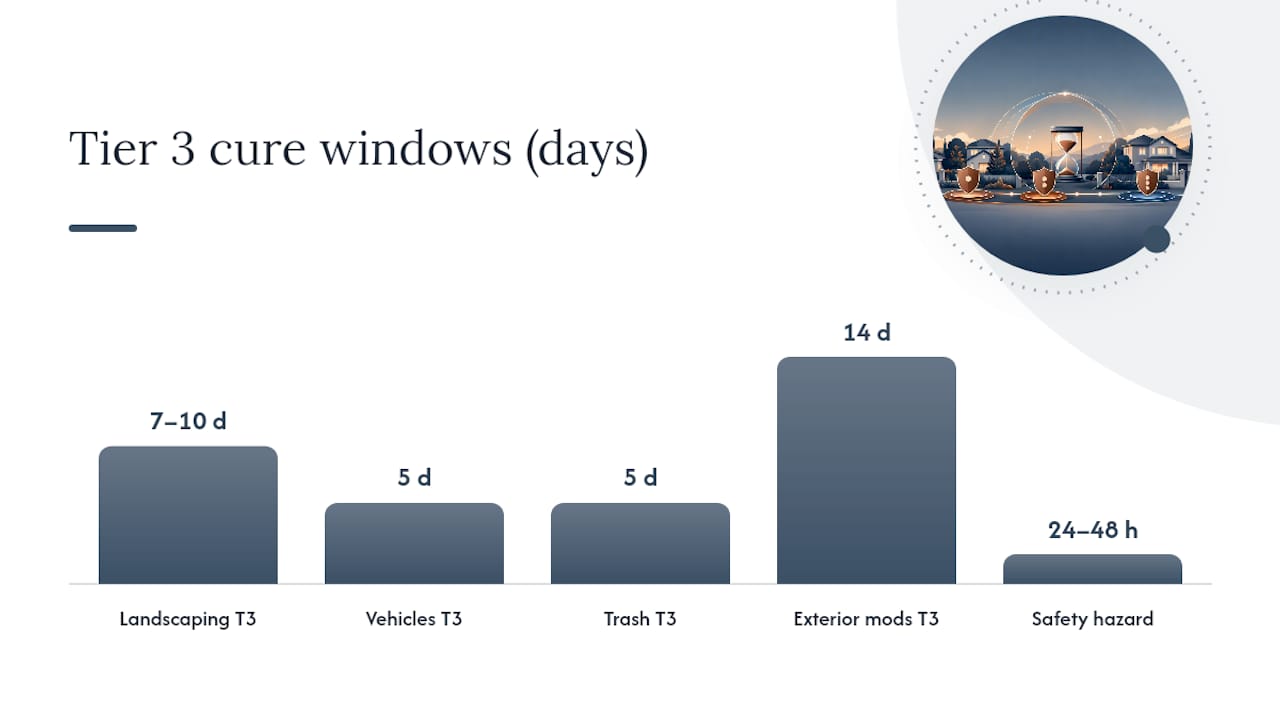
- Tier 3 (final): “This is a final notice before [fine/hearing] as authorized under [CC&R Section]. Cure deadline: [date, 7–10 days]. You have the right to request a hearing under [governing document/state statute] before any fine is imposed.”
Vehicles and parking
- Tier 1: friendly note citing the exact parking restriction, 7 to 10 day cure window.
- Tier 2: formal notice referencing the prior letter’s date, 10 day cure window.
- Tier 3: final notice before towing or fine, 5 day cure window, hearing rights stated.
Trash and storage
- Tier 1: courtesy reminder, cite pickup schedule and storage rule, 5 to 7 day cure.
- Tier 2: formal notice with photo reference, 10 day cure.
- Tier 3: final notice before fine, 5 day cure.
Exterior modifications
- Tier 1: courtesy notice flagging the unapproved change, 30 day cure window since removal or retroactive approval often needs contractor coordination.
- Tier 2: formal notice with architectural review committee contact info, 30 day cure.
- Tier 3: final notice before fine or forced removal, 14 day cure, appeal rights spelled out.
Noise and pet complaints
- Tier 1: courtesy note referencing the specific complaint date and rule, no fixed cure since behavior change is immediate.
- Tier 2: formal notice logging repeat incidents with dates, 10 day compliance window.
- Tier 3: final notice before fine or hearing.
Two situations change these defaults. Safety hazards, like a blocked fire lane or exposed wiring, skip the extended cure period entirely: give notice and a 24 to 48 hour window instead. Anything requiring a permit or contractor, like a roofline change or a retaining wall, deserves a longer runway, often 30 days or more. In every template, keep the language factual: describe what you observed, cite the exact line from your CC&Rs in brackets, and note what to document (photo, date, witness) before sending.
How the Escalation Ladder Should Actually Work
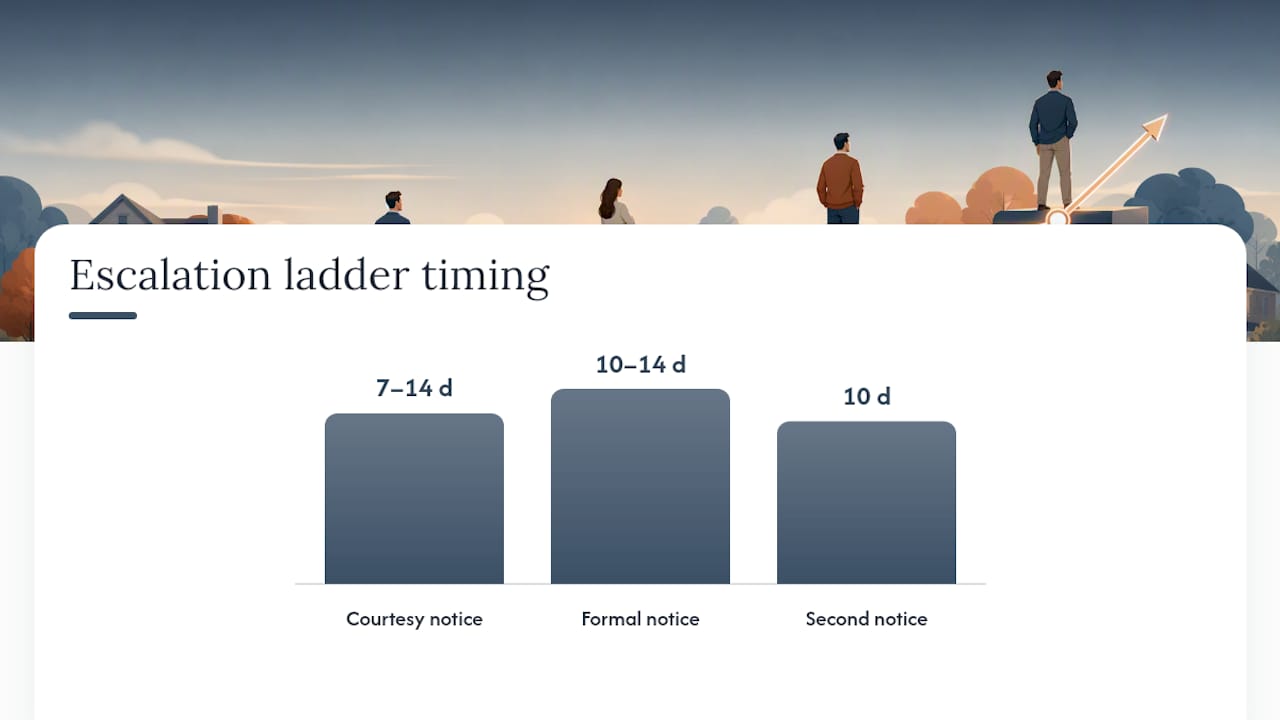
A published, graduated process protects the board against claims of selective enforcement more than any single letter ever will, according to GavelHouse’s enforcement guide. The ladder typically runs five stages, though the windows should flex based on severity.
| Stage | Suggested window | What to document |
|---|---|---|
| Courtesy notice | 7–14 days | Date observed, photo, CC&R citation |
| Formal notice | 10–14 days after cure deadline passes | Certified mail receipt, prior notice date |
| Second notice or fine | 10 days after formal notice deadline | Inspection log, fine schedule reference |
| Pre-fine hearing | Per governing docs or state law | Meeting minutes, homeowner response |
| Legal remedies | After hearing, if unresolved | Full case file, attorney correspondence |
- Accelerate the timeline for safety hazards; extend it for repairs needing permits or contractors.
- If enforcement has been inconsistent in the past, pass a board resolution, send a community-wide notice, and allow a 30 to 60 day grace period before restarting formal enforcement, a reset method detailed by LiniVis.
- Keep every certified mail receipt and photo in a single owner file, organized by address.
Getting the Tone Right Without Sounding Like a Threat
Objective language and an assumption of good intent increase voluntary compliance and cut down on letters that escalate unnecessarily. The goal is a letter that reads like a neighbor pointing something out, not a lawyer issuing a threat.
Do:
- Stick to observable facts and dates.
- State the cure and the deadline in the same sentence.
- Include a direct contact for questions.
Don’t:
- Threaten a fine or lien your CC&Rs don’t authorize.
- Use words like “disgraceful” or “your neighbors are complaining” — it invites a fight, not a fix.
A few lines worth stealing: “We’re writing to bring a matter to your attention, not to cause alarm.” “Section [X] requires…” “Please complete the correction by [date].” “If uncorrected, the board may [authorized action].” “Contact us at [phone/email] with any questions.” Log every homeowner reply, even a phone call, in the same file as the letter itself.
Pro Tip: A scanned copy of the sent letter, filed next to the certified mail receipt, is the single easiest recordkeeping habit that holds up if a case ever goes to hearing.
Where State-Aware Templates and a Completeness Checker Fit In
State statutes can cap fines, require hearings, or set minimum notice periods, and getting that wrong is how boards end up with an unenforceable fine, as ManageCasa’s rules and regulations guide points out. HOA Letter AI builds that context into the drafting process instead of leaving it to guesswork.
- State-aware templates adjust cure periods and required language based on where the property sits.
- A notice-completeness checker flags missing elements, like an absent hearing-rights clause, before the letter goes out.
- USPS mailing integration creates a trackable delivery record without a separate trip to the post office.
The smartest way to use a tool like this is as the drafting layer inside a process your board has already adopted, not as a replacement for board approval. Draft with the HOA warning letter template, route it through your board’s sign-off process, and file the sent copy the same way you would any other official notice. Property management teams handling multiple communities can standardize this across every address using reusable community profiles and per-manager pricing.
Essential Templates, Enforcement Guides, and State-Law Resources
- The HOA Guide’s violation letter template for the core elements every letter needs.
- Preserve HOA’s tiered letter examples for friendly-to-final letter progression.
- ManageCasa’s HOA rules guide for how state law shapes notice and fine authority.
- HOA Letter AI’s state law guide for cure periods, hearing rights, and fine caps by state.
What Most Boards Get Backwards About Warning Letters
Most boards treat the warning letter as the punishment. It isn’t. It’s the offer of a fix, and the research on this is pretty consistent: courtesy-first notices resolve the overwhelming majority of violations without any escalation at all. The letters that end up in disputes almost never fail because the board was too lenient. They fail because someone wrote “please clean up your yard” instead of citing Section 4.2(b) and a date.
The conventional advice tells boards to sound firm. I’d argue the opposite matters more: sound specific. A vague threat invites an argument. A specific citation with a real deadline invites a fix, because there’s nothing left to dispute.
If I had to pick one thing boards underrate, it’s the file. Not the letter, the file behind it. Certified mail receipts, timestamped photos, and a log of every notice sent by address are what actually protect a board when someone claims they were treated unfairly. Write the letter well. Then prove you sent it.
Sources
- Free HOA Violation Letter Template | The HOA Guide
- Polite violation letters / tiered templates — Preserve HOA
- HOA Rules and regulations guide | ManageCasa