
A formal warning letter is the official written notice from a homeowners association that identifies a specific rule violation and sets a deadline for the resident to correct it before further enforcement action begins. This document is not a fine or a punishment. It is the first formal step in a required legal process that protects both the board’s authority and the homeowner’s rights. Understanding what a formal warning letter means, what it contains, and how to respond correctly can prevent costly escalation for everyone involved.
What does a formal warning letter mean in HOA enforcement?
A formal warning letter is an official notification that a specific community rule has been violated, and it carries a compliance period of 7–30 days with no financial penalties attached at this stage. That distinction matters. The letter signals that the board has documented the violation and is giving the homeowner a structured opportunity to fix it before fines or hearings enter the picture.
The term “formal warning letter” is the common phrase used by homeowners and residents. In community association management, the recognized industry term is a violation notice or compliance notice. Both phrases describe the same document. Using the precise term helps when referencing governing documents, state statutes, or legal correspondence.

The letter’s legal weight is significant. Under statutes such as California Civil Code § 5855 and Florida Statute 720.305, a properly issued violation notice is a required precondition before any fine or lien can be enforced. Skip this step, and the entire enforcement action can be voided in court.
What is included in a formal warning letter?
Every enforceable violation notice contains specific elements. Missing even one can undermine the board’s legal position.
- Homeowner’s name and property address. The letter must identify the correct party and property without ambiguity.
- Description of the violation. The notice states observable facts only. “A recreational vehicle is parked in the driveway” is correct. “You are being a bad neighbor” is not.
- Citation of the governing document. The exact section of the CC&Rs, bylaws, or rules and regulations that the homeowner has violated must appear in the letter.
- Cure deadline. The letter specifies the exact date by which the violation must be corrected, typically within a 7–30 day window.
- Consequences of non-compliance. The letter explains what happens next if the issue is not resolved: a hearing notice, fines, or other enforcement steps.
- Contact information. The homeowner needs a clear way to reach the board or management company with questions or to confirm compliance.
The tone of the letter is as important as its content. Warning letters should be factual and neutral on purpose, focusing strictly on observable facts and rule citations. Accusatory or emotional language gives homeowners grounds to claim harassment and weakens the board’s legal standing.
Pro Tip: Draft the violation description as if a stranger reading it could identify the exact problem without visiting the property. That level of specificity protects the board and leaves no room for dispute.
How does the formal warning letter fit into the HOA enforcement process?
The violation notice sits at a specific point in a graduated enforcement sequence. Boards that skip steps or apply them inconsistently expose themselves to legal challenges.
The standard enforcement ladder follows this order:
- Courtesy notice. An informal reminder, often sent by email or door hanger, alerting the homeowner to a potential issue before it becomes a formal matter.
- Formal warning letter (violation notice). The official written notice with a cure deadline, governing document citation, and notice of consequences. This is the critical first step in the due process sequence required before fines can be legally imposed.
- Pre-fine hearing notice. If the violation is not corrected by the cure deadline, the homeowner receives notice of a hearing where they can present their case to the board.
- Fine imposition. After the hearing, the board may impose fines according to the association’s fine schedule.
- Continued enforcement. Persistent violations can lead to additional fines, suspension of privileges, or in serious cases, a lien on the property.
The table below shows how each stage differs in terms of financial impact and homeowner rights.
| Enforcement Stage | Financial Penalty | Homeowner Right to Respond |
|---|---|---|
| Courtesy notice | None | Informal correction |
| Formal warning letter | None | Cure within deadline |
| Pre-fine hearing notice | None yet | Formal hearing |
| Fine imposition | Yes | Appeal process |
| Lien or legal action | Yes, plus costs | Legal defense |
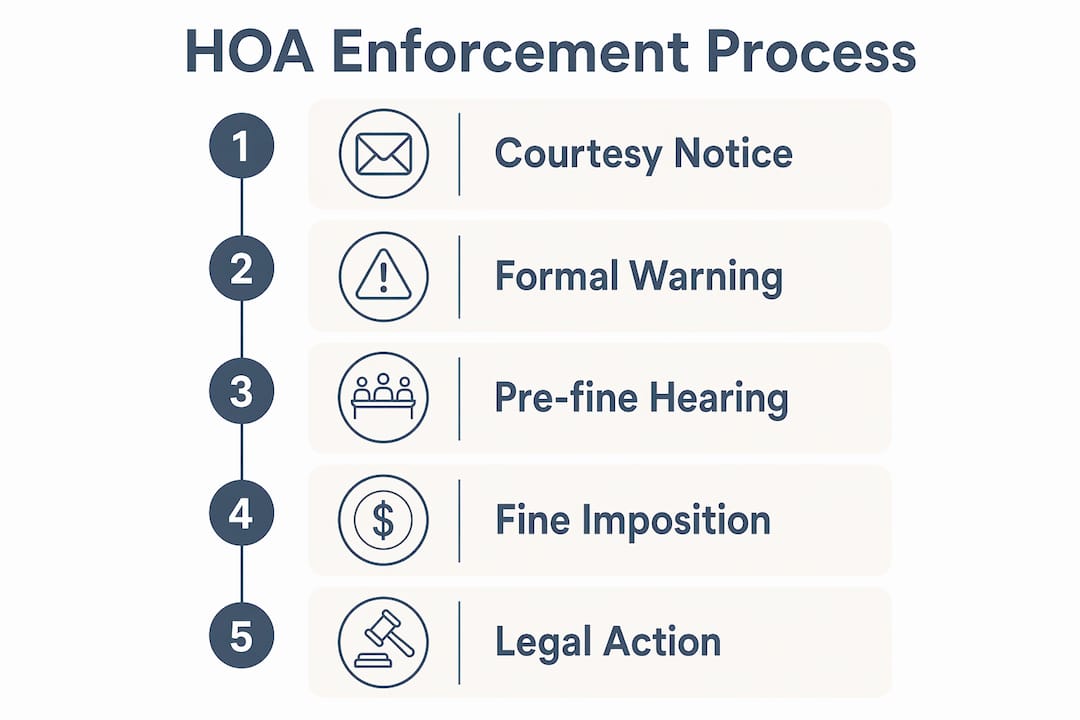
The cure deadline in the warning letter is the trigger for escalation. Meeting it stops the process entirely. Missing it moves the case to the next stage automatically.
What should homeowners do after receiving a formal warning letter?
Receiving a violation notice does not mean you are in serious trouble. It means the clock has started. The right response, taken quickly, resolves most situations before they escalate.
- Read the letter carefully. Identify the specific violation cited, the governing document section referenced, and the exact cure deadline.
- Correct the violation promptly. If the issue is straightforward, fix it immediately and document the correction with dated photographs.
- Communicate with the board or management company. If you need more time or believe the notice was issued in error, contact the HOA in writing. Prompt communication often prevents hearings or penalties.
- Request a hearing or extension if needed. Most associations allow homeowners to request additional time or contest a notice. Check your governing documents for the process.
- Keep records of everything. Save the original letter, your written response, any photos of the corrected violation, and all correspondence with the board.
Common mistakes homeowners make include ignoring the letter entirely, responding verbally instead of in writing, or assuming the issue will resolve itself. None of those approaches work. A written response creates a paper trail that protects you if the dispute escalates.
Pro Tip: Use a violation response template to structure your reply. A clear, calm, written response that acknowledges the notice and confirms your corrective action is the single most effective way to close the matter.
What are common misunderstandings and legal risks around warning letters?
The most widespread misunderstanding is that a formal warning letter is a punishment. It is not. A well-written warning letter is a documented chance to fix the issue, protecting both the board and the homeowner legally. Treating it as an attack creates unnecessary conflict and often leads to outcomes that are worse for both sides.
Boards face real legal risk when letters are vague, emotional, or inconsistently applied. Inconsistent or vague warnings risk legal exposure and can make enforcement actions unenforceable. A homeowner who receives a notice for a violation that the board has ignored in other units has a strong selective enforcement defense.
A formal warning letter that uses accusatory language, omits the specific rule citation, or applies standards unevenly does not just fail to resolve the violation. It hands the homeowner a legal argument and undermines the board’s authority in every future enforcement action.
State statutes add another layer of risk. Under laws like California Civil Code § 5855 and Florida Statute 720.305, the formal warning letter is essential evidence in any legal challenge. An incomplete notice, one missing the cure deadline or the specific rule citation, can void subsequent fines or liens entirely. Boards that rely on informal or poorly drafted notices often discover this problem only after a homeowner contests a fine in court.
The public-record-adjacent nature of HOA enforcement documents also matters. In many states, violation records can be disclosed during property sales or legal proceedings. A letter that reads as biased or unprofessional reflects on the association’s governance and can affect property values and community trust.
Key takeaways
A formal warning letter is the required first step in HOA enforcement, and its legal accuracy determines whether all subsequent enforcement actions will hold up.
| Point | Details |
|---|---|
| Definition of formal warning letter | An official violation notice with a cure deadline of 7–30 days and no financial penalty at this stage. |
| Required letter elements | Must include the specific violation, governing document citation, cure deadline, and next enforcement steps. |
| Enforcement ladder position | The warning letter comes after a courtesy notice and before any hearing or fine can be legally imposed. |
| Homeowner response | Correct the violation promptly, document it, and communicate in writing to stop escalation. |
| Legal risk for boards | Vague, emotional, or inconsistently applied letters can void fines and expose the association to discrimination claims. |
Why the tone of a warning letter matters more than most boards realize
After years of watching HOA enforcement disputes play out, the pattern I see most often is not a homeowner who refuses to comply. It is a homeowner who felt attacked by the letter and decided to fight back on principle. The violation itself, often something minor like an unapproved paint color or a trash bin left out a day too long, becomes secondary to the perceived insult.
The research backs this up. Emotional or accusatory letters give grounds for harassment claims and undermine HOA authority. But beyond the legal risk, there is a practical reality: a homeowner who feels respected is far more likely to fix the problem and move on. A homeowner who feels targeted is far more likely to lawyer up.
Boards that treat the warning letter as a transparency tool rather than a weapon get better compliance rates and fewer disputes. The letter should read like a factual memo, not a complaint. When I review letters that have led to formal disputes, the language almost always contains one of three problems: vague violation descriptions, missing rule citations, or an accusatory tone that a neutral reader would find unreasonable.
My recommendation to every board is simple. Write the letter as if a judge will read it. Because eventually, one might.
— Blake
Hoaletterai makes compliant warning letters faster and easier
Drafting a violation notice that meets state legal requirements, cites the right governing document section, and strikes a neutral tone is harder than it sounds. Most boards get it wrong at least once before they develop a reliable process.
Hoaletterai is built specifically for this problem. The HOA violation letter generator walks boards through each required element, applies state-specific language automatically, and produces a letter that is ready to review and send in minutes. For boards that need to understand the legal requirements behind the notice, the HOA violation letter laws by state resource covers notice requirements and fine rules across all 50 states. Fewer errors in the letter mean fewer disputes down the road.
FAQ
What does a formal warning letter mean in an HOA?
A formal warning letter, also called a violation notice, is the official written notification that a homeowner has violated a community rule. It includes the specific violation, the governing document citation, and a deadline to correct the issue, typically 7–30 days, with no financial penalty at this stage.
Does a formal warning letter go on your record?
HOA violation notices are part of the association’s enforcement records and may be disclosed during property sales or legal proceedings in many states. Resolving the violation before the cure deadline typically closes the matter without further record of escalation.
What happens if you ignore a formal warning letter?
Missing the cure deadline in a formal warning letter triggers the next enforcement step, which is usually a pre-fine hearing notice. After the hearing, the board can impose fines according to the association’s schedule.
How should a homeowner respond to a formal warning letter?
Correct the violation promptly, document it with dated photographs, and send a written response to the board confirming the correction. If you need more time or believe the notice is in error, request a hearing or extension in writing.
Can a poorly written warning letter void an HOA fine?
Yes. Under statutes like California Civil Code § 5855 and Florida Statute 720.305, an incomplete or improperly issued violation notice can void subsequent fines or liens. The letter must include the specific violation, the rule citation, and a cure deadline to be legally enforceable.