
Written warnings are the single most important early-stage enforcement tool an HOA board has. They preserve the board’s right to enforce rules, create the admissible record needed for fines and hearings, and resolve most violations before escalation ever becomes necessary. Without a written warning on file, a fine can be challenged, a lien can fail, and a board can find itself accused of selective enforcement with nothing to show in its defense.
The practical benefits stack up fast:
- Document the facts. A written warning captures the date, the observable violation, and the rule citation before memories fade.
- Set a cure deadline. Giving homeowners a specific window to correct the issue is both fair and legally required in many states.
- Trigger statutory timelines. Many state statutes require written notice before fines can be imposed. Skipping it restarts the clock, or worse, voids the fine entirely.
- Reduce selective-enforcement risk. A consistent paper trail shows the board treats every homeowner the same way.
- Protect property values. Communities with documented, consistent enforcement maintain standards that keep home values stable.
Pro Tip: Send the first written notice via a method you can prove: certified mail, email with read receipt, or a delivery log. The delivery record matters as much as the letter itself if the case ever reaches a hearing.
Table of Contents
- Why written warnings matter in the HOA enforcement sequence
- What to include in an effective, enforceable written warning
- How tone, clarity, and timing affect compliance
- When to use courtesy, formal, and final warnings
- A pre-issue checklist to avoid common legal pitfalls
- Key Takeaways
- The part boards get wrong most often
- HOA Letter AI makes state-compliant written warnings faster to draft and deliver
- Useful sources and further reading
Why written warnings matter in the HOA enforcement sequence
Most HOA enforcement follows a graduated ladder, and written warnings sit at the critical first formal step. RealManage describes issuing a written warning as the point where informal observation becomes official record. Skip it, and every step above it becomes legally fragile.
Here is how the standard sequence runs:
- Courtesy notice — An informal, friendly reminder. No fine, no formal record. Resolves the majority of issues.
- Formal written warning / violation notice — The first official document. Cites the rule, states the facts, sets a cure deadline.
According to Effortless HOA’s enforcement guidance, a friendly first contact resolves an estimated 70–80% of violations before they ever reach the formal warning stage. That number makes a strong case for leading with a courtesy notice whenever the violation is minor and the homeowner has no prior history.
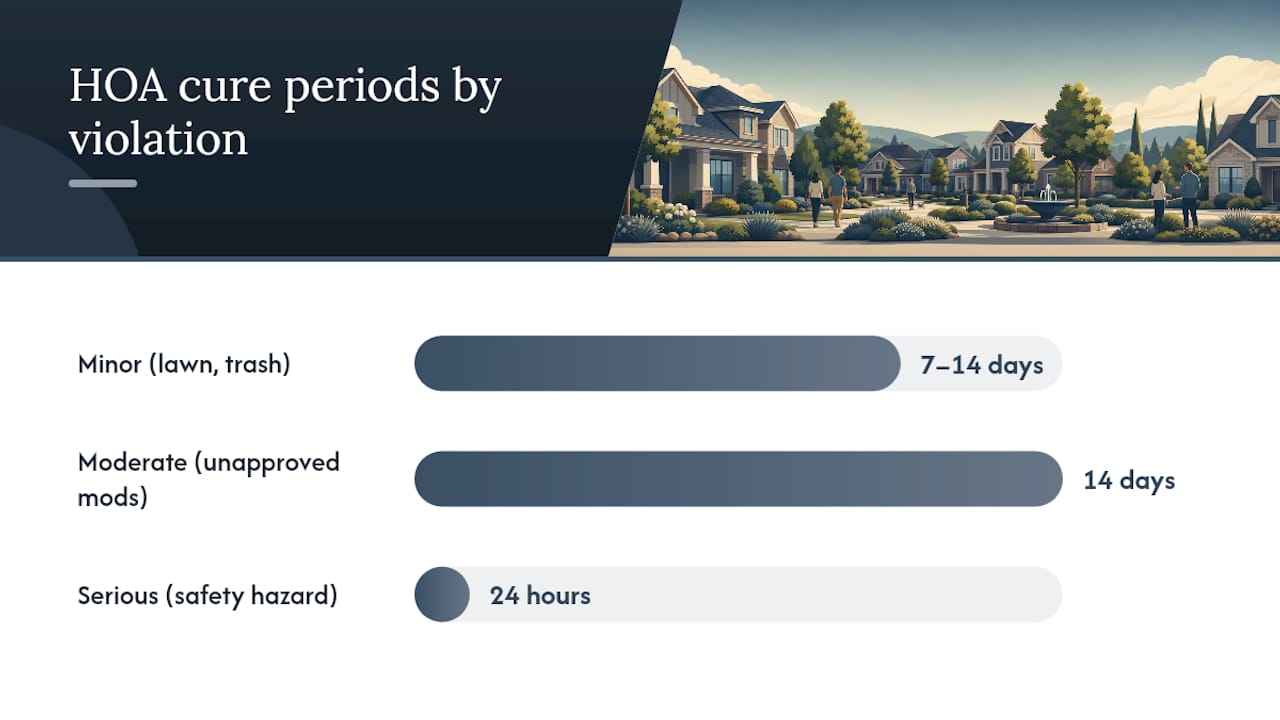
Typical cure periods by violation type:
| Violation Category | Common Cure Period | Notes |
|---|---|---|
| Minor (lawn, trash bins) | 7–14 days | Most CC&Rs and state statutes use 14 days as the default |
| Moderate (unapproved modifications) | 14 days | May require contractor work; allow reasonable time |
| Serious (safety hazard, structural) | 24 hours | Shorter periods justified; document urgency in writing |
| Ongoing / repeat violation | Per policy | Prior notices must be on file before escalating |
The Ridge Owners Association’s published enforcement policy uses a 14-day compliance period as its standard, with reduced fines available for prompt cure and a defined appeal timeline. That kind of published, consistent policy is exactly what courts look for when an enforcement action is challenged.
Skipping steps or applying them inconsistently creates two specific legal risks. First, a homeowner can raise a selective-enforcement defense, arguing the board enforced the rule against them but not against neighbors with identical violations. Second, a waiver defense can arise when the board has historically ignored a violation and then suddenly enforces it without warning. Both defenses can void fines and expose the association to fee awards.
What to include in an effective, enforceable written warning
Vague warnings fail. A notice that says “your yard is not in compliance” gives the homeowner no clear target and gives the board no defensible record. KindHOA’s step-by-step guidance and SHRM’s written-warning best practices both converge on the same principle: specificity is what makes a warning enforceable.
Every written warning should contain these elements:
- Date of the notice (not the date of the violation, though that goes in the body)
- Homeowner name and property address
- Exact rule or CC&R citation (section number, article, and the rule text or a direct quote)
- Observable facts with dates (“On June 3, 2026, a trash bin was observed at the curb at 4:00 PM, more than 24 hours after the scheduled collection”)
- Required corrective action stated plainly (“Please remove the bin to an enclosed storage area”)
- Clear cure deadline (“by June 17, 2026”)
- Next steps if uncured (“Failure to cure by the deadline may result in a fine of $[amount] per the Association’s fine schedule and a hearing notice”)
- Delivery method noted on the file copy
What to keep in the enforcement file:
| File Item | Why It Matters |
|---|---|
| Copy of the notice | Proves content of the warning |
| Delivery receipt or tracking | Proves the homeowner received it |
| Photographs with timestamps | Establishes the observable facts |
| Prior notices (if any) | Shows pattern and rules out first-offense defense |
| Board or manager notes | Captures context not in the letter itself |

Avoid language that draws legal conclusions (“you are in violation of the law”) or expresses frustration (“this is unacceptable”). Stick to observable facts. The goal is a letter that reads like a field report, not a complaint.
Pro Tip: Keep the language boring on purpose. A calm, procedural tone signals professionalism and is far harder to attack in a hearing than an emotional one. If a sentence sounds like it belongs in an argument, cut it.
How tone, clarity, and timing affect compliance
The assume-good-intent principle is not just a nicety. It is a practical compliance strategy. Most homeowners who receive a violation notice are not defiant; they either did not know about the rule or forgot. A notice that treats them as a reasonable adult who simply needs a reminder gets a very different response than one that reads like an accusation.
Do:
- Use a neutral, factual tone throughout
- Name the specific rule and the specific conduct
- Give a realistic cure deadline that accounts for what the fix actually requires
- Offer a contact name and number for questions
Don’t:
- Use language like “you have repeatedly failed” on a first notice
- Reference what neighbors think or say
- Speculate about intent (“it appears you deliberately…”)
- Include more detail about potential penalties than the current step requires
Timing matters too. A courtesy notice sent within a day or two of the observed violation lands while the issue is still fresh and fixable. Waiting three weeks signals that the board is not watching closely, which undermines the notice’s credibility when it finally arrives. For safety-related violations, skip the courtesy stage entirely and go straight to a formal written warning with a short cure period.
Pro Tip: When possible, have the property manager, not a board member, sign the notice. A board member who lives in the community and signs enforcement letters can be perceived as personally motivated, which invites bias challenges at hearings. A manager’s signature keeps the process institutional.
When to use courtesy, formal, and final warnings
Choosing the right notice type for the situation is as important as writing it well. Using a formal warning for a first-time minor offense can feel punitive and damage community relations. Using a courtesy notice for a repeat violation signals that the board is not serious. Match the notice to the stage.
Choosing the right notice:
- Courtesy notice: — First offense, minor violation, no prior history. Friendly tone, no fine threat, short cure period.
Sample language by notice type:
| Notice Type | Sample Opening Language |
|---|---|
| Courtesy notice | “This letter is a friendly reminder that the CC&Rs require trash bins to be stored out of public view except on collection day. As of [date], your bin was observed at the curb. Please return it to enclosed storage by [date]. No fine is being assessed at this time.” |
| Formal violation notice | “On [date], the Association observed [specific conduct] at [address], in violation of Section [X] of the CC&Rs. You are required to [corrective action] by [cure deadline]. Failure to cure by that date may result in a fine of $[amount] per the Association’s fine schedule and a notice of hearing.” |
| Final warning | “This is your final notice regarding the violation of Section [X] described in our letter dated [prior notice date]. The cure deadline of [prior deadline] has passed without correction. A hearing has been scheduled for [date] at [time]. You may attend to present your position. A fine of $[amount] will be assessed if the violation is not cured before the hearing date.” |
Delivery method should match the notice type. A courtesy notice can go by email or first-class mail. A formal violation notice and final warning should go by certified mail, and the tracking number should be logged in the enforcement file. When state law requires a specific delivery method, follow it exactly. For state-specific mandatory language and delivery requirements, the HOA violation letter template guide covers common state variations and what to add.
A pre-issue checklist to avoid common legal pitfalls
Running through a short checklist before sending any written warning catches the errors that most often void enforcement actions. Boards that skip this step are the ones that end up in hearings defending process failures instead of the underlying violation.
| Checklist Item | Why It Matters |
|---|---|
| Confirm the CC&R rule text | Citing the wrong section or a rule that does not exist in the governing documents is fatal |
| Check enforcement history | Has this rule been enforced before? Inconsistency invites selective-enforcement claims |
| Document observable facts only | Opinions and legal conclusions weaken the notice and invite disputes |
| Set a consistent cure deadline | Use the same period for the same violation type across all homeowners |
| Record the delivery method | Certified mail, email, or hand delivery — log it before you send |
| Confirm hearing rights | Many states require a pre-fine hearing opportunity; include the notice if required |
| File everything immediately | Enforcement files should be complete before the cure period expires |
Common legal traps that boards fall into: citing a rule that the association has never enforced against anyone else, sending a notice without a cure deadline, and failing to provide a hearing opportunity before imposing a fine. Gavel House’s due-process guide and McCabe, Trotter & Beverly’s fine-policy analysis both flag these as the most common reasons enforcement actions fail.
Boards that have paused enforcement for a period should send a community-wide reset notice before resuming active enforcement. This reduces waiver defenses and gives all homeowners fair warning that the rules are being actively applied again.
Pro Tip: Maintain a central violations log that tracks every notice sent, the delivery method, the cure deadline, and the outcome. Require any board member who reported the violation to recuse themselves from the hearing panel. Both practices protect the board from bias claims and make the enforcement record far easier to defend.
Key Takeaways
Written warnings are the foundation of every defensible HOA enforcement action: without them, fines can be voided, liens can fail, and boards lose the paper trail that proves consistent, fair enforcement.
| Point | Details |
|---|---|
| Written warnings preserve enforceability | A documented notice is the required first step before fines, hearings, or liens in most states. |
| Core content is non-negotiable | Every notice must include the rule citation, observable facts with dates, a cure deadline, and the next enforcement step. |
| Sequence and consistency matter | Skipping steps or applying rules unevenly exposes the board to selective-enforcement and waiver defenses. |
| Tone drives voluntary compliance | A calm, factual notice resolves an estimated 70–80% of violations without escalation. |
| HOA Letter AI speeds up the process | HOA Letter AI generates state-aware, template-driven notices with built-in delivery tracking and CC&R citation support. |
The part boards get wrong most often
Most boards understand that written warnings matter. Where they go wrong is in treating the notice as a formality rather than a legal document. A letter that says “your yard needs attention” is not a written warning. It is a suggestion. And when that homeowner later disputes a $500 fine, the board has nothing to stand on.
The other mistake is inconsistency. A board that sends formal notices to three homeowners for the same violation but ignores a fourth has handed that fourth homeowner a selective-enforcement defense on a silver platter. Courts take this seriously. So do state statutes in California, Florida, and Texas, where enforcement uniformity is either explicitly required or heavily implied by the reasonableness standard courts apply.
What actually works is boring and procedural: the same template, the same cure period, the same delivery method, every time, for every homeowner. No exceptions for neighbors you like, no shortcuts when you are busy. The boards that never lose enforcement hearings are not the ones with the best lawyers. They are the ones with the best files.
The common HOA letter writing mistakes guide covers the drafting errors that most often undermine otherwise valid enforcement actions, and it is worth a read before your next notice goes out.
HOA Letter AI makes state-compliant written warnings faster to draft and deliver
Drafting a written warning that holds up takes more than a blank Word document. You need the right rule citation, the right cure period for your state, the right delivery method, and a file that proves you followed every step. HOA Letter AI was built specifically for that workflow.
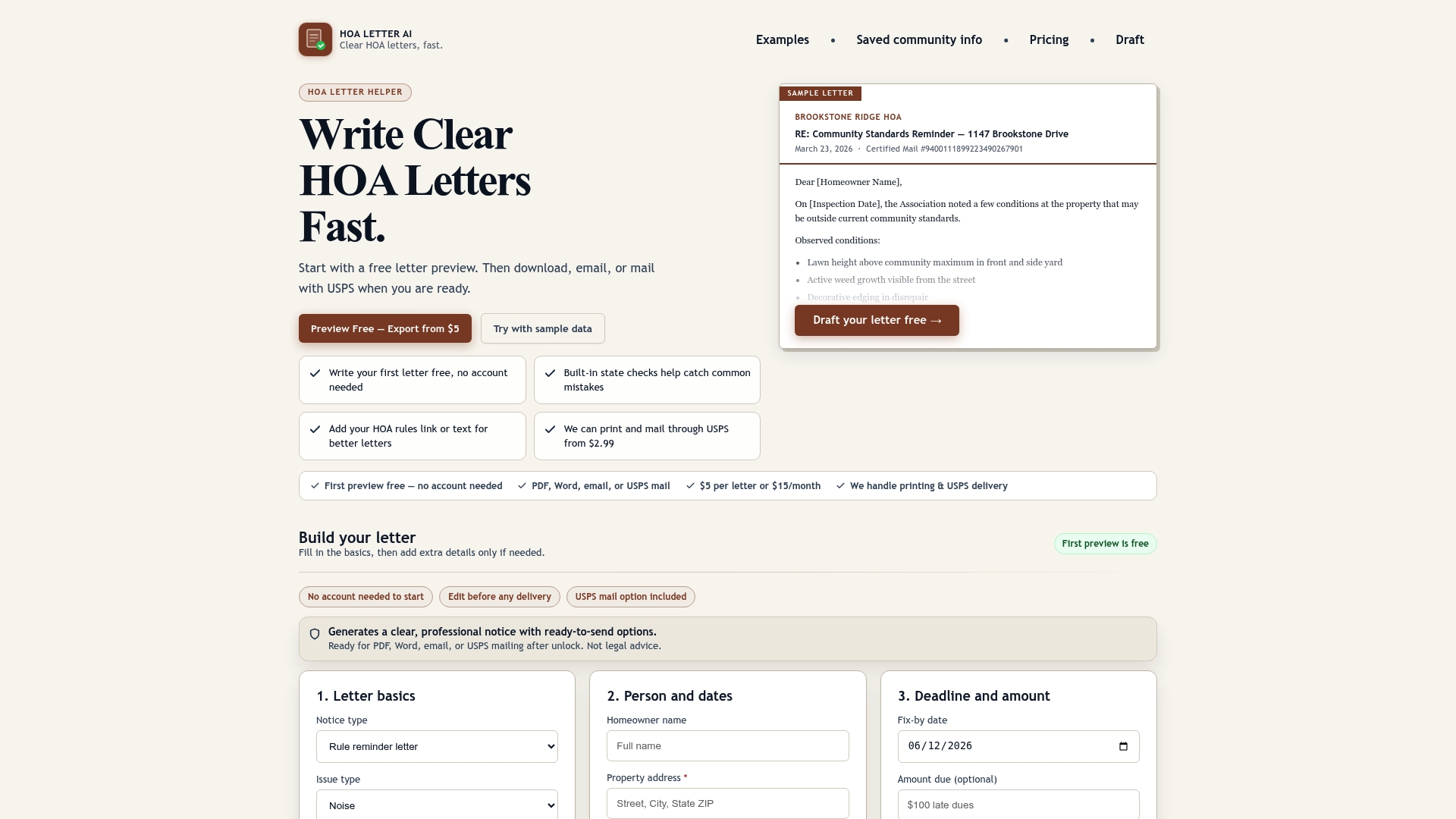
Boards and property managers use HOA Letter AI to generate notices that pull in state-specific mandatory language, cite CC&R sections directly, and flag missing elements before the letter goes out. The USPS mailing integration handles certified delivery without a trip to the post office, and every notice is logged automatically so your enforcement file is complete from day one. Homeowners can use it too: a one-time fee generates a formal response letter with the right structure and evidence framing.
Check your state’s notice requirements and start drafting your first state-compliant warning at HOA Letter AI’s state law guide, or go straight to the violation letter generator for a free preview before you commit.
Useful sources and further reading
The sources below are the primary references behind this guide. Each one covers a specific part of the enforcement process.
| Source | What It Covers | Best Used For |
|---|---|---|
| KindHOA: How to Write an HOA Violation Notice | Step-by-step notice drafting, content checklist, documentation tips | Essential elements and template drafting |
| RealManage: Community Rule Enforcement | Enforcement ladder, written warning as first formal step | Enforcement sequence and board process |
| McCabe, Trotter & Beverly: HOA Fine Policies | Fine schedule drafting, policy consistency, legal risk | Legal enforceability and fine policy |
| Gavel House: Due Process and Fines | Pre-fine hearing requirements, graduated notice sequence | Due process and hearing rights |
| Ridge Owners Association Enforcement Policy | Published policy with 14-day cure periods, fine classes, appeal timelines | Model policy language and structure |
| Effortless HOA: Violation Enforcement Guide | Courtesy notice effectiveness, consistency as enforcement defense | Tone, sequencing, and compliance rates |
| HUD FHEO | Federal fair housing obligations that apply to HOA enforcement | Fair housing compliance check |
| SHRM: 13 Ways to Improve Written Warnings | Specificity, timeliness, consistency, avoiding legal conclusions | Drafting best practices adapted for HOA notices |
This article provides general information about HOA enforcement practices and is not legal advice. Notice requirements, cure periods, and fine procedures vary by state and by your association’s governing documents. Confirm your specific obligations with a licensed HOA attorney or your state’s relevant statutes before issuing formal enforcement notices.