
The simplest compliant HOA escalation sequence runs four stages: courtesy notice, formal violation notice with a cure deadline, pre-fine hearing notice, and then fine or collection action if your state allows it. Most boards can resolve the majority of violations before reaching stage three.
Before escalating past the courtesy stage, confirm three things:
- Delivery method: Many states require certified or verified mail for formal notices. Texas Property Code §209.006 mandates written notice by certified or verified mail before enforcement actions, including specific content about the violation, amounts due, cure dates, hearing rights, and SCRA military protections.
- Cure period: The notice must give the owner a reasonable, calendar-specific deadline to fix the problem.
- Hearing rights: Owners must receive written notice of their right to a hearing before fines are imposed.
Before suspending privileges or assessing fines, many state statutes require detailed notice content and a genuine opportunity to cure — including specific language about hearing rights and Servicemembers Civil Relief Act (SCRA) protections for active-duty military residents.
Key Takeaways
A compliant HOA escalation sequence runs four stages: courtesy notice, formal violation notice with a cure deadline, pre-fine hearing notice, and fine or collection action — and every formal notice must confirm delivery method, cure period, and hearing rights before escalating.
| Point | Details |
|---|---|
| Four-stage sequence | Courtesy → formal notice with cure deadline → pre-fine hearing notice → fine or collection. |
| Delivery method matters | Certified or verified mail is required by many state statutes; first-class mail alone rarely satisfies formal notice requirements. |
| Curable vs. uncurable | Curable violations require a cure period before fines; uncurable violations still require notice and hearing rights. |
| Objective escalation triggers | Set a specific dollar threshold and missed-deadline count before referring to collections or counsel to avoid selective-enforcement claims. |
| HOA Letter AI | Generates state-aware notices with built-in checks, CC&R citation fields, and USPS mailing integration; preview free, unlock from $19. |
Table of Contents
- What do examples of escalation letter sequences look like for HOAs?
- What legal elements must every HOA notice include?
- Curable vs. uncurable violations: why the distinction matters
- Recommended timelines, cure periods, and cost considerations
- Copy-paste template snippets for each notice stage
- Which delivery methods satisfy statutory proof requirements?
- What records should boards keep, and for how long?
- When should boards refer matters to counsel or collections?
- What boards consistently get wrong about enforcement letters
- HOA Letter AI produces state-aware notices in minutes
- Sources
What do examples of escalation letter sequences look like for HOAs?
Three sequences cover nearly every enforcement scenario. Pick based on severity, violation type, and your state’s minimum requirements.
Short sequence (about one to two weeks, urgent or safety violations)
- Formal violation notice with a 7-day cure deadline, sent by certified mail
- Follow-up inspection on day 8
- Notice of fine if uncured, citing your published fine schedule
Use this for safety hazards (broken fence near a pool, blocked fire lane) or violations your CC&Rs classify as immediate. Skip the courtesy notice only when your governing documents explicitly allow it for safety issues.
Standard sequence (most violations, about one to one and a half months total)
- Courtesy notice — informal, friendly, no fine threat (days 1–3)
- Formal violation notice with a 21-day cure deadline, sent by certified mail (day 7)
- Pre-fine hearing notice sent at least 10 days before the hearing date
- Hearing, then fine imposition if the board upholds the violation
A defensible enforcement sequence starts with a courtesy notice, moves to a formal notice with a cure deadline, then a pre-fine hearing notice, and only then imposes fines. Skipping steps is the most common procedural error boards make, and it can void fines entirely.
Strict sequence (repeat offenders, continued noncompliance) with typical cure deadlines and hearing timelines
- Courtesy notice (if not already sent)
- Formal violation notice with a 14-day cure deadline, certified mail
- Interim inspection on day 15
- Pre-fine hearing notice with escalating daily fine schedule attached
- Hearing and fine imposition, with fines accruing daily until cured
- Collection referral once unpaid fines cross your board’s objective threshold
Reserve the strict sequence for owners with documented prior violations or who ignored a standard sequence. Your published fine schedule must support the daily fine amounts — without a published schedule, fine amounts are more vulnerable to challenge as arbitrary.
What legal elements must every HOA notice include?
A notice that omits required elements can void the entire enforcement action. Every HOA violation notice should cite the exact covenant or rule, state observable facts with a date, give a clear cure deadline, explain next steps, and include photos and a delivery log.
Mandatory checklist for every formal notice:
- Date of the notice and date(s) of the observed violation
- Owner name and property address as they appear on association records
- Specific observable facts (what was seen, when, with photo reference numbers)
- Exact CC&R section or rule violated (e.g., “Section 4.3 of the Declaration”)
- The required corrective action stated in plain terms
- A calendar cure deadline (not “within 30 days” — write the actual date)
- Delivery method and confirmation that the address matches association records
- Hearing rights: owner’s right to request a hearing, deadline to request it, and contact information
- SCRA notice: a statement that active-duty military members may have additional rights
- Amount due if a fine is already assessed, and the fine schedule reference
Texas §209.006 is one of the more detailed state statutes, but California, Florida, and other states impose their own requirements — published fine schedules, caps on daily fines, or specific hearing notice timings. Check your state’s HOA notice rules before setting amounts or timelines.
Pro Tip: When referencing a prior notice in a follow-up letter, include the prior notice date and certified mail tracking number. Some states have six-month repeat-notice windows — if the same violation recurs within that window, you may not need to restart the full sequence, but you do need to reference the original notice explicitly.
Curable vs. uncurable violations: why the distinction matters
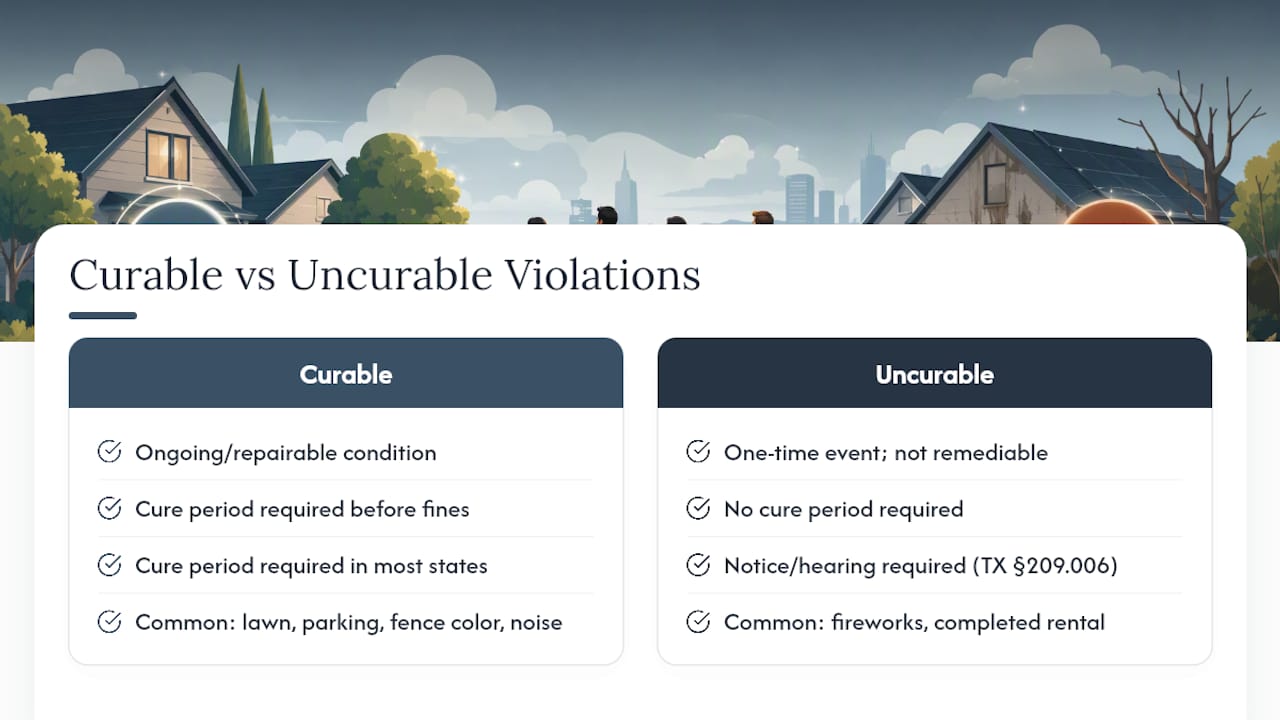
The violation type determines whether a cure period is required at all.
Curable violations are ongoing or repairable conditions the owner can fix: overgrown lawn, unauthorized parking, a fence painted the wrong color, persistent noise from a tenant. These require a cure period before fines can be assessed in most states.
Uncurable violations are one-time events that cannot be undone: a past short-term rental that already occurred, fireworks set off on July 4th, property damage from a single incident, or a one-time noise event that has already ended.
For uncurable violations, Texas §209.006 distinguishes the notice requirements — a cure period is not required when the violation cannot be remedied, but the owner must still receive notice and hearing rights before a fine is imposed.
Common curable examples: parking violations, lawn maintenance, ongoing noise, unapproved exterior modifications, pet leash violations.
Common uncurable examples: a single fireworks incident, a completed unauthorized rental, one-time property damage, a past construction violation that has since been corrected (but the owner still owes a fine for the period of noncompliance).
Getting this classification wrong has real consequences. Assessing fines immediately on a curable violation without a cure period — or giving a cure period for an uncurable one when your documents don’t require it — both create procedural vulnerabilities.
Recommended timelines, cure periods, and cost considerations
Sample cure periods by sequence type:
State law may require a minimum cure period regardless of your sequence. Where a statute specifies 30 days, that floor overrides your internal timeline.
Unpaid fines escalate to late fees, collection costs, and potentially liens — and in some jurisdictions, foreclosure. State rules on foreclosure for fines-only debts vary significantly; confirm your state’s limits before placing a lien.
Cost factors boards often underestimate:
- Certified mail costs several dollars per piece plus postage
- Staff or manager time to draft, log, and track each notice
- Hearing administration (scheduling, minutes, board time)
- Attorney review for complex or contested matters
Publishing a fine schedule before enforcement begins reduces disputes and keeps costs predictable. Boards that skip this step spend more time defending fine amounts than collecting them.
Copy-paste template snippets for each notice stage
Adapt these to your community’s name, CC&R citations, and state requirements. Bracketed fields are placeholders.
Courtesy notice: Formal violation notice: Pre-fine hearing notice: Notice of fine: Final demand/collection notice: A complete library of state-aware HOA templates covers each of these stages with built-in CC&R citation fields and state-specific language prompts.
Pre-send checklist:
- Community rule or CC&R section confirmed and cited correctly
- Photos attached with timestamps
- Owner address verified against association records
- Delivery method selected and logged
- Prior notice dates and tracking numbers referenced (if applicable)
- SCRA language included in formal notices
Which delivery methods satisfy statutory proof requirements?
Certified mail with return receipt requested is the most widely accepted method in state HOA statutes. USPS Registered Mail offers a higher security chain of custody but is slower and more expensive. First-class mail alone rarely satisfies statutory requirements for formal enforcement notices.
Boards should document every step and keep a paper trail to defend fines and suspensions. A delivery file for each notice should include:
- Postage receipt with date
- USPS tracking number and screenshot of delivery confirmation
- Signed return receipt (green card) when required
- Timestamped inspection photos referenced in the notice
- Copy of the notice as sent
- Any portal or email copies sent as supplemental (not as the primary method)
Pro Tip: Log every delivery detail into the association’s enforcement ledger the same day you mail the notice. A spreadsheet with columns for notice date, tracking number, delivery confirmation date, and cure deadline takes five minutes to maintain and saves hours in a dispute.
Some states permit electronic notice when the owner has opted in writing. If your community allows it, keep the opt-in record and send electronic copies as a supplement to, not a replacement for, certified mail unless your state statute explicitly authorizes electronic-only delivery.
What records should boards keep, and for how long?
A complete enforcement file for each violation should contain:
- All notices sent (courtesy, formal, hearing, fine, collection), with dates
- Certified mail receipts and delivery confirmations
- Timestamped inspection photos
- Inspection logs with inspector name and date
- Owner communications (emails, letters, portal messages)
- Hearing request, minutes, and board decision
- Fine ledger entries
- Attorney correspondence, if any
Retain enforcement files until the violation is fully resolved, then keep them for at least 3–7 years depending on your state’s statute of limitations for contract and collection actions. Store records in a secure cloud system with a local backup. When sharing records in response to an owner request or legal discovery, redact personal information unrelated to the specific enforcement matter.
When should boards refer matters to counsel or collections?
Objective triggers protect boards from claims of selective enforcement. Boards should adopt objective escalation triggers — a specific number of days past the cure deadline, a dollar threshold for unpaid fines — and a published policy stating when matters go to collections or counsel.
Practical decision points:
- After two missed cure deadlines with documented notices: refer to the board for a formal hearing decision.
- After $500–$1,000 in unpaid fines (or whatever threshold your governing documents set): refer to a collections attorney or agency.
- After repeated violations despite a completed standard sequence: consider privilege suspension if your CC&Rs allow it, with proper notice.
- Before placing a lien or initiating foreclosure: consult an HOA attorney. Many states prohibit or restrict foreclosure for fines-only debts.
Unpaid fines can lead to liens and, in some jurisdictions, foreclosure — but state rules vary significantly. Never place a lien or refer for foreclosure without confirming your state’s specific requirements and your governing documents’ authority to do so.
Litigation is a last resort. Attorney fees and court costs often exceed the fine amount in dispute. A well-documented graduated process, with clear objective triggers, gives you the strongest position if a matter does reach an attorney or a judge.
What boards consistently get wrong about enforcement letters
Most enforcement disputes don’t start with a bad policy. They start with a skipped step, a vague deadline, or a missing delivery receipt.
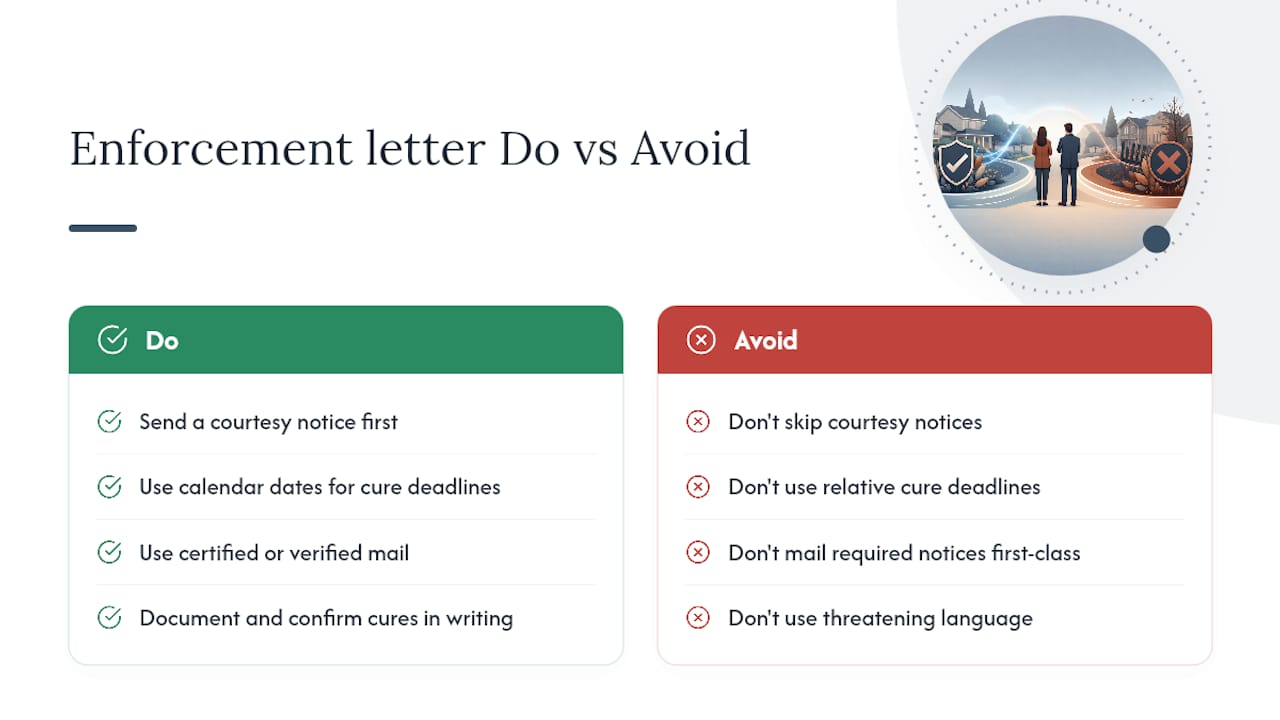
The three procedural mistakes that generate the most disputes: skipping the courtesy notice entirely (which puts owners immediately on the defensive and removes a low-cost resolution opportunity), writing cure deadlines as relative timeframes (“within 30 days”) instead of calendar dates, and mailing formal notices by first-class mail when state law requires certified or verified mail.
Tone matters more than most boards expect. A notice that reads like a threat produces a defensive response. A notice that reads like a factual record of an observed condition, with a clear path to resolution, produces compliance. The difference in wording is small: “You are in violation and must correct this immediately” versus “Our inspection on [Date] noted [specific condition] at your property. The corrective action required under Section X.X is [specific action], due by [Date].”
The courtesy notice is the most underused tool in HOA enforcement. A brief, non-accusatory first contact resolves a significant share of minor violations before they require formal action. Boards that skip it to save time often spend more time managing disputes and hearings than they would have spent sending the initial friendly note.
De-escalation after a notice is issued is also possible. If an owner contacts the manager after receiving a formal notice and commits to a cure date, document that conversation, confirm it in writing, and note it in the enforcement file. A written acknowledgment from the owner that they received the notice and intend to cure by a specific date strengthens your record and often resolves the matter without a hearing.
HOA Letter AI produces state-aware notices in minutes
Drafting compliant notices from scratch takes time boards and managers don’t have. HOA Letter AI generates state-aware violation letters with built-in checks for mandatory language, CC&R citation fields, and cure period requirements specific to your state.
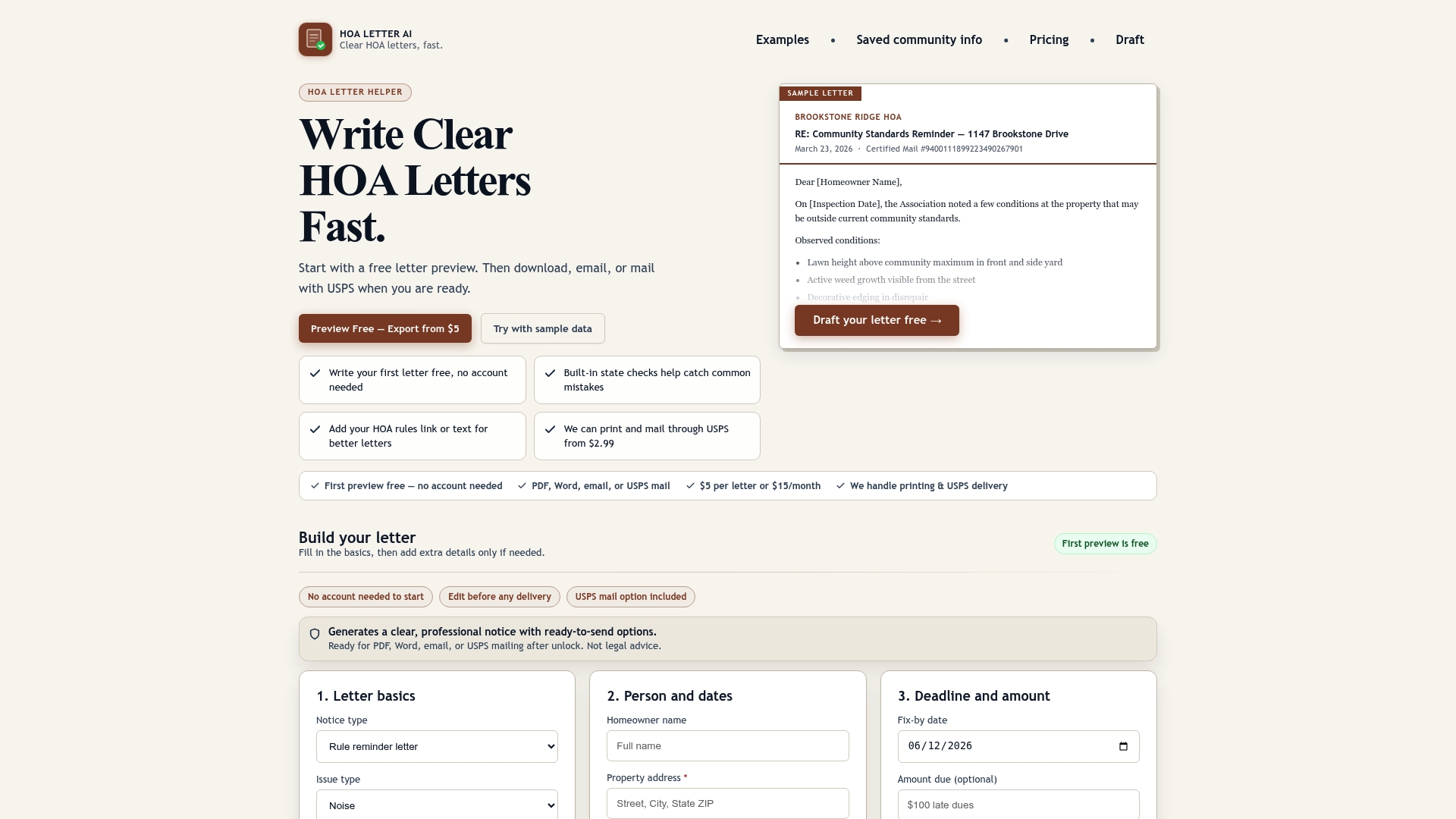
The HOA violation letter generator walks you through each required field, flags missing elements before you send, and gives you a one-page preview so you can confirm the notice is complete. USPS certified mail fulfillment is available as an add-on, so you can send a compliant, tracked notice without leaving the platform. Property management teams get reusable community profiles; individual boards pay per letter with no subscription required.
Preview any letter free. Unlock and send starting at $19.
Sources
- HOA and Condominium Due Process Requirements for Fines - LegalClarity
- How to Write an HOA Violation Notice (Step-by-Step) | KindHOA
- Writing Violation Notices: A Complete Guide for HOA Boards - Hoa Management
This article provides general information about HOA enforcement practices and is not legal advice. Confirm your state’s specific notice requirements and consult a qualified HOA attorney before placing liens, initiating foreclosure, or handling complex enforcement matters.
This article is general information, not a substitute for advice from a qualified lawyer. Consult a qualified legal professional about your own circumstances before acting on anything here.
Recommended
- HOA Collection Letters: A Respectful, Step-by-Step Reminder Sequence | HOA Letter AI
- HOA Enforcement Letter Step by Step: 2026 Board Guide | HOA Letter AI
- HOA Letter AI — HOA Violation Letter Generator (State-Compliant)
- How to Write an HOA Violation Letter (With a Calm, Rule-Cited Example) | HOA Letter AI