
Yes, the Fair Housing Act applies to HOA letters, and courts treat written notices as evidence of intent or unequal treatment. The single most important compliance step is writing neutral, factual language and applying it in the same way to every resident. That means citing the specific governing-document provision, documenting what you observed, and treating any accommodation request as urgent. HUD and the DOJ provide guidance to help boards get the wording and process right.
TL;DR:
- HOAs must use neutral, factual language and consistently apply notices to all residents to avoid fair housing violations.
- Disparate treatment and impact can both trigger liability, making uniform procedures and documentation essential for protection.
- Accommodation requests require timely written acknowledgment and verification of functional needs, without demanding medical diagnosis or history.
- Using standardized templates, state-aware language, and maintaining complete case files significantly reduce the risk of formal complaints.
- Automated tools and templates that adjust for state-specific rules help ensure notices remain compliant and consistent across all HOA communications.
HOA Letter AICreate Clearer HOA Compliance LettersDraft professional notices with guided writing, state-specific context, community rules, built-in checks, and a one-page preview.Create a compliance letter
Table of Contents
- At-a-Glance Fair Housing Checklist for HOA Letters
- How the Fair Housing Act Applies to HOAs
- Wording That Creates Risk (And How to Fix It)
- Drafting Rules and Templates That Hold Up
- State Rules Change Your Notice Timing and Language
- Handling Accommodation Requests Without Creating Liability
- Why Consistency Beats Good Intentions
- Draft Compliant Notices Without Guessing at the Wording
- Where to Verify the Rules Yourself
- Sources
- FAQ
At-a-Glance Fair Housing Checklist for HOA Letters
Before any notice goes out, run it against these five checks. Skipping even one is how a routine violation letter turns into a fair housing complaint.
- Tone: Keep language neutral and factual. No accusatory adjectives, no assumptions about intent.
- Citation: Reference the exact CC&R or rule section, plus the specific facts (dates, locations, photos).
- Consistency: Use the same template and timeline for every resident with the same violation.
- Accommodation flags: Escalate any request tied to a disability, religious practice, or family need immediately, even if the homeowner never uses the words “reasonable accommodation.”
- Records: Log how and when the notice was delivered, and keep any homeowner reply on file.
That last point matters more than most boards realize. A defensible case file includes the notice itself, proof of delivery, homeowner responses, and internal notes on why the board decided what it decided. Missing any piece weakens your position if a complaint ever gets filed.
How the Fair Housing Act Applies to HOAs
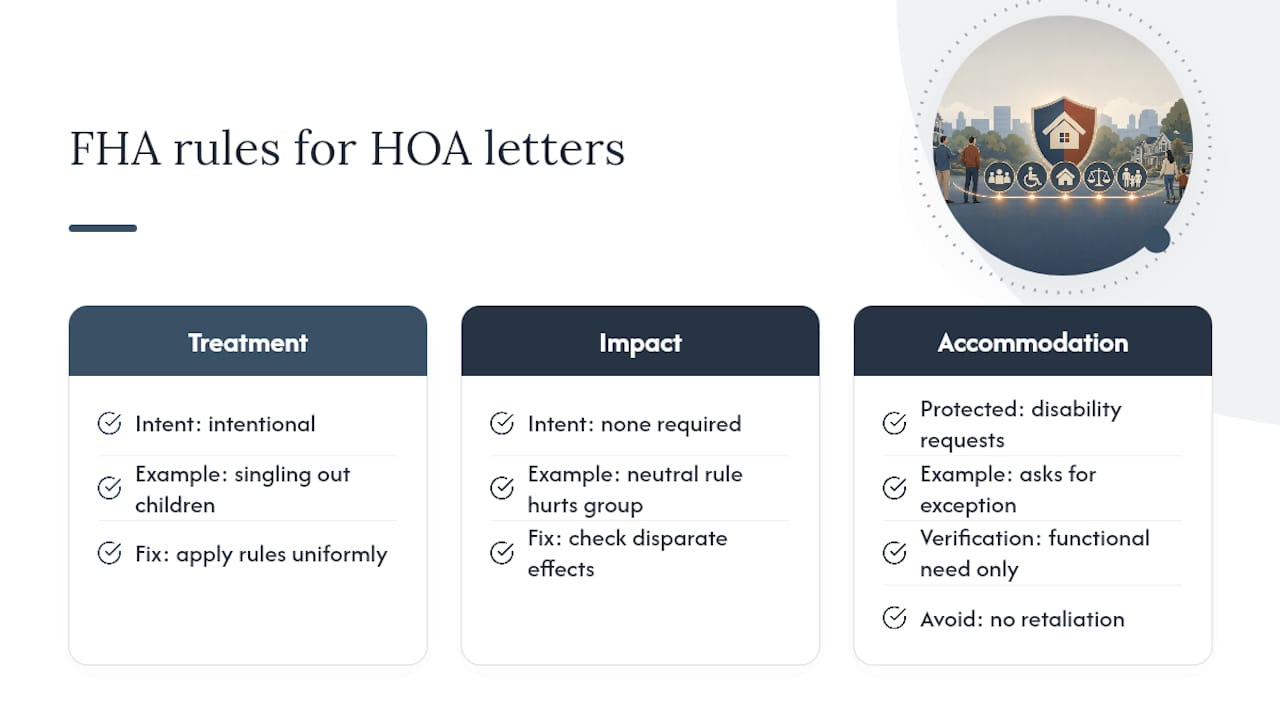
HOAs count as housing providers under federal law, which means the Fair Housing Act’s protected classes (race, color, national origin, religion, sex, familial status, and disability) apply to every notice a board sends. A letter can become Exhibit A in a discrimination case in two different ways.
Disparate treatment is intentional and obvious: singling out a resident’s kids as “loud children” while a childless neighbor’s noise complaint gets a generic warning. Disparate impact is subtler. A facially neutral rule, enforced unevenly or worded in a way that lands harder on one group, can still violate the FHA even without any discriminatory intent behind it. Uniformity is your best defense against both.
Reasonable accommodation requests deserve special care. A homeowner does not need to cite the FHA by name or use legal terms. If someone asks for an exception to a rule because of a disability, that’s a protected request the moment it’s made. Boards can ask for verification of the functional need, but not a diagnosis or medical file. And once a resident files a complaint, retaliating with faster enforcement or harsher letters creates a separate, independently actionable claim under the DOJ’s retaliation protections.
Wording That Creates Risk (And How to Fix It)
Most fair housing problems in HOA letters don’t come from malice. They come from sloppy, emotional, or inconsistent phrasing that a lawyer can later frame as evidence of bias. A few common patterns and their safer rewrites:
- Risky: “You must remove that animal now or face fines.” Safer: “Our records show an animal at [address] on [date]. Please confirm by [date] whether this is an assistance animal or a pet.”
- Risky: “Your children need to stop playing in the common area.” Safer: “Community rules restrict unsupervised use of the pool area after 8 p.m. Please review Section [X] of the CC&Rs.”
- Risky: “This is the third time your family has caused a disturbance.” Safer: “This is the third documented noise complaint at this address on [dates]. Section [X] requires resolution within [timeframe].”
Notice the pattern: the safer version names dates, sections, and actions, and drops the adjectives entirely. Emotional language (“disturbance,” “constantly,” “again”) reads as intent when a lawyer pulls it into a complaint file. So does timing. If one resident gets a 30-day cure period and another gets 10 days for the identical violation, that gap is exactly what disparate treatment claims are built on.
Pro Tip: Write every notice as if a judge will read it out loud in six months. If a sentence would sound accusatory read aloud, replace the adjective with a fact.
Drafting Rules and Templates That Hold Up
A notice that survives scrutiny follows the same four-part structure every time, regardless of who’s receiving it:
- Factual lead. State exactly what was observed, when, and where.
- Governing-document citation. Point to the specific CC&R or rule section, not a vague reference to “community standards.”
- Corrective action and cure period. Name the fix required and the deadline, using the same window you’d give anyone else for that violation.
- Contact for questions. Give the homeowner a clear way to respond, ask questions, or request an accommodation.
Boards that let different volunteers freelance their own tone are the ones most exposed here. One industry template guide recommends locking in a small set of templated openers and closers so staff can only customize predetermined fields, not the tone of the letter itself. A homeowner who’s been on the board for a decade and one who moved in last month should get letters that read identically in structure and warmth.
Keep every notice, delivery receipt, and homeowner reply in a single case file per unit. That habit alone resolves most disputes before they escalate. A warning letter template built around this structure removes most of the guesswork for volunteer board members who aren’t lawyers.
Pro Tip: Train new board members to recognize accommodation requests even when they’re informal. “My mom can’t use the stairs” is a reasonable accommodation request. Treat it that way from the first email.
State Rules Change Your Notice Timing and Language
Federal law sets the floor, but states set the specifics, and the gaps are bigger than most boards assume. Cure periods before fines can kick in range widely by state, some states mandate exact language or a specific notice format, and fine caps per violation vary enough that a letter compliant in one state can be unenforceable in another.
Before sending anything, check your state’s specific HOA notice requirements. California, for instance, has its own layered requirements around notice content and hearing rights that trip up boards using generic templates. When state rules are unclear or contradict your governing documents, loop in HOA counsel before the letter goes out, not after a resident challenges it.
Handling Accommodation Requests Without Creating Liability
Acknowledge every accommodation request in writing within a few days, and set an internal deadline for a decision so requests don’t quietly stall. What you can ask for is narrower than most boards assume.
- Request verification tied to the functional limitation and the need for the specific change, not a diagnosis or medical history.
- Document every step: the request, what was asked for in return, what was provided, and the board’s reasoning.
- Apply the same evaluation process to every request so no resident can point to inconsistent handling.
- If the board denies a request, put the rationale in writing and offer a reasonable alternative when one exists.
HUD’s guidance on assistance animals is the clearest reference point here: boards cannot demand medical records, only proof of the functional need and the connection to the requested accommodation.
Why Consistency Beats Good Intentions
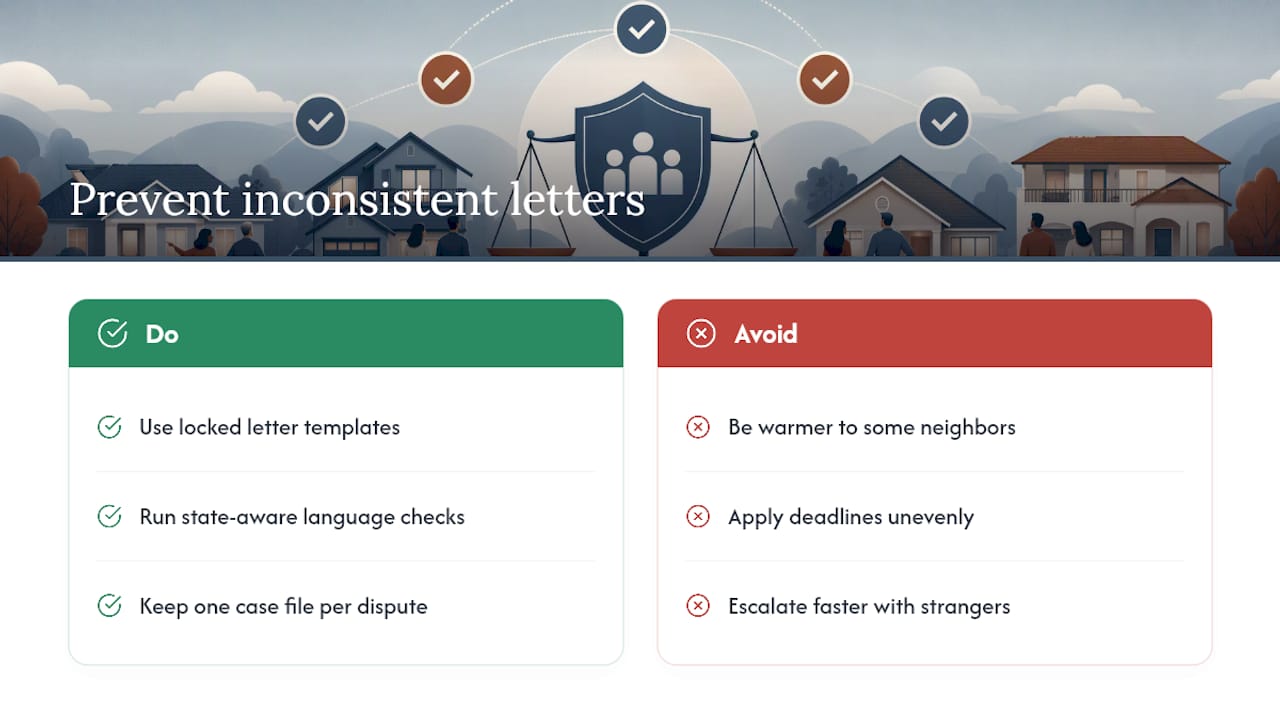
Most HOA fair housing complaints don’t start with a board that meant harm. They start with a board that was inconsistent, warmer in tone toward neighbors they liked, faster to escalate against residents they didn’t know well, looser with deadlines for some and rigid for others. That gap is what a plaintiff’s attorney builds a case around, and it’s almost always unintentional.
The fix isn’t more legal knowledge. It’s removing the variables that let inconsistency creep in: locked templates, state-aware language checks, and a single case file per dispute. Boards that adopt that structure report fewer disputes escalating into formal complaints, not because they got better at law, but because the letters stopped giving anyone a reason to compare notes.
— Blake
Draft Compliant Notices Without Guessing at the Wording
There are tools built to support neutral phrasing, correct governing-document citation, and consistent timing, generated automatically instead of left to whoever’s drafting the letter that week.
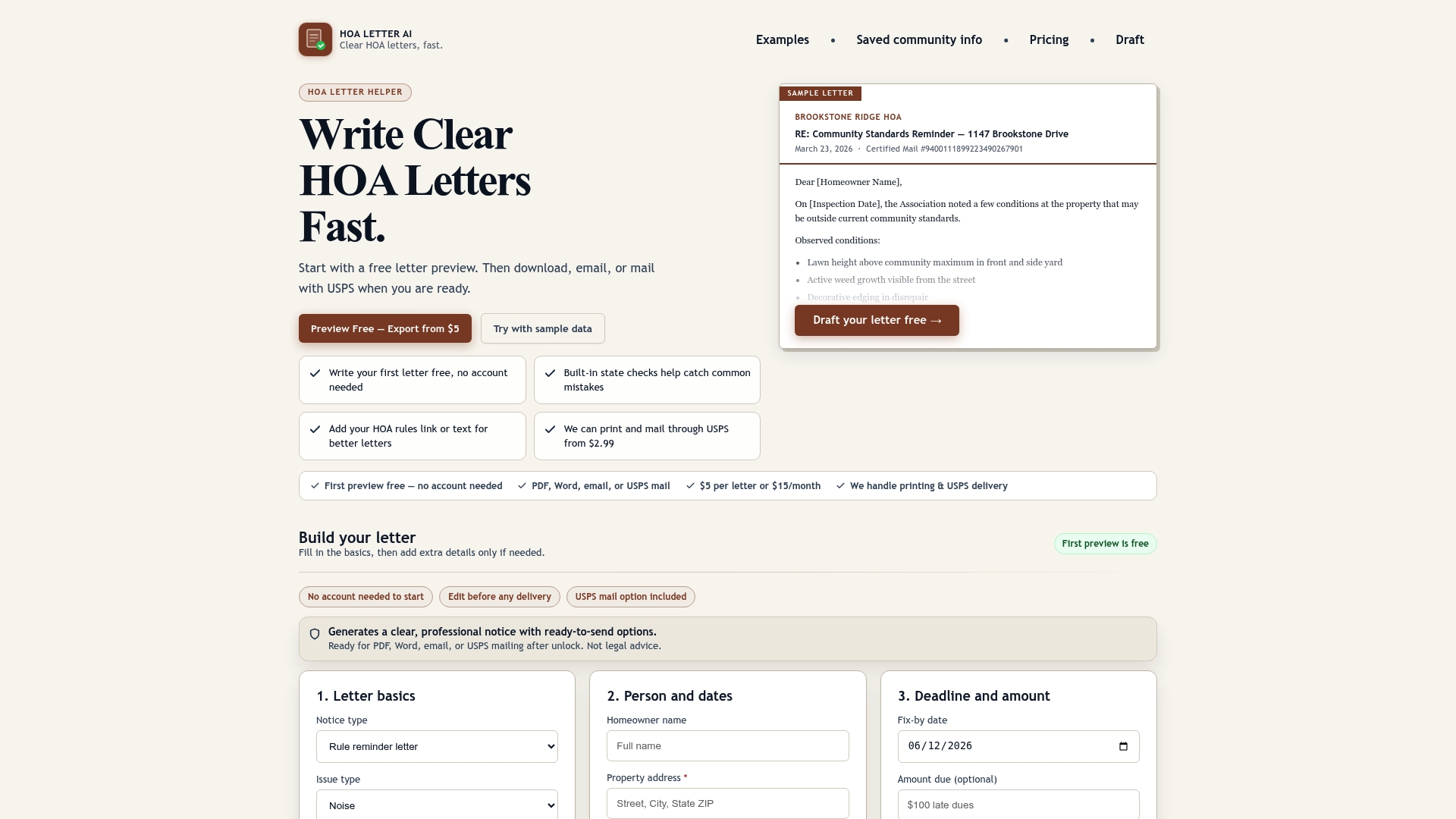
The tool includes state-aware sample letters that adjust for your state’s cure periods and required language, a notice-completeness checker that catches missing citations or vague phrasing before you hit send, and branded templates your whole board can use so tone never varies by author. Add USPS mailing directly from the platform and you’ve got delivery proof built into your case file automatically. Start with the HOA warning letter template to see the structure in action, check your state’s specific notice rules before your next mailing, or review pricing built for property management teams running unlimited letters every month.
Where to Verify the Rules Yourself
For primary legal guidance, consult HUD’s Fair Housing Act overview and enforcement priorities, and the DOJ’s Fair Housing Act summary. Check your state’s HOA notice and fine rules before finalizing any letter.
This article is general information, not a substitute for advice from a qualified lawyer. Consult a qualified legal professional about your own circumstances before acting on anything here.
Sources
FAQ
What Are Examples of Fair Housing Violations in HOA Letters?
Common examples include singling out a resident’s children in noise complaints, demanding medical details for an accommodation request, using harsher language or shorter deadlines for some residents than others for the same violation, and retaliating against someone who filed a complaint with faster enforcement.
Can an HOA Be Sued for Discrimination?
Yes. HOAs are housing providers under the Fair Housing Act, and homeowners can file complaints with HUD, sue in federal court, or, in some cases, prompt DOJ action if a pattern of discrimination emerges.
What Is the Penalty for Violating the Fair Housing Act?
Penalties vary by case and can include monetary damages to the affected homeowner, civil penalties, and injunctive relief requiring the HOA to change its policies; the DOJ outlines the range of remedies available under federal law.
What Must Be Proved in a Fair Housing Complaint?
A complainant generally must show they belong to a protected class, that they experienced an adverse action (denial, unequal enforcement, or harassment), and that the HOA’s conduct was connected to that protected characteristic rather than a neutral, consistently applied rule.
Does Using a Template Protect an HOA From Fair Housing Claims?
A well-built, state-aware template reduces risk significantly by enforcing neutral language and consistent timing, but it doesn’t eliminate liability entirely. The board still has to apply the same rules the same way to every resident, every time.