
A valid HOA compliance or violation letter needs eight things: who sent it, who it’s addressed to, the specific rule that was broken, evidence supporting the claim, the cure being demanded, a firm deadline, the consequences of missing it, and a way to respond. If any of those eight are missing or vague, you have grounds to question the notice before you comply or pay a dime.
Every legitimate demand should point back to your community’s CC&Rs, cite whatever state statute governs notice (Florida’s Fla. Stat. §720.305 is a common example), and come from an identifiable board or property manager, not an anonymous form letter. The moment a letter lands in your mailbox, three things matter more than anything else: confirm the cited rule actually exists in your governing documents, mark the deadline on a calendar, and keep proof of when and how the letter arrived.
Immediate action checklist:
- Verify the cited rule appears in your CC&Rs or bylaws, word for word.
- Calendar the response deadline the day you receive the letter, not the day you plan to reply.
- Save the envelope, postmark, or delivery confirmation as proof of when the notice arrived.
- Check whether the letter mentions a hearing or appeal right, and note that separately.
- Decide within 48 hours whether you agree, dispute, or need more information before responding.
Key Takeaways
A legally sound HOA letter always names the rule broken, the evidence behind it, a firm deadline, and a way to respond, and skipping the deadline is the single biggest risk for either side.
| Point | Details |
|---|---|
| Check the eight required elements | Sender, recipient, rule citation, evidence, cure, deadline, consequences, and response method must all appear. |
| Respond before the deadline | Even a clarification request can pause fine accrual and creates a protective written record. |
| Verify your state’s rules | Deadlines and hearing rights vary by state, commonly 10 to 30 days; confirm yours before acting. |
| Watch for escalation red flags | Liens, denied hearings, or selective enforcement mean it’s time to consult counsel. |
| Use a state-aware tool for your letters | HOA Letter AI builds completeness checks and state-specific language into every generated letter and response. |
Table of Contents
- Core Elements Every HOA Compliance Letter Should Include
- What to Verify Before You Act on a Letter
- How Homeowners Should Evaluate and Respond
- Best Practices for Boards Drafting Compliance Letters
- Score Any Letter With This One-Page Rubric
- Two Annotated Samples: Violation Notice and Response
- When to Escalate to Mediation or an Attorney
- How HOA Letter AI Helps You Get It Right the First Time
- Where to Look Next for Verification
- Sources
Core Elements Every HOA Compliance Letter Should Include
A demand letter that skips any of its required parts is weaker than it looks, and both boards and homeowners benefit from knowing exactly what belongs in one. According to LegalClarity’s breakdown of HOA demands, a proper letter includes a precise description of the issue, a reference to the governing document provision, the required corrective action, a clear deadline, and the consequences for inaction. Miss one of those and the letter becomes harder to enforce and easier to dispute.
Here’s what each required element looks like in practice:
- Sender identification: “This notice is issued by the Board of Directors of Maple Ridge HOA” rather than an unsigned printed page.
- Recipient identification: The homeowner’s name and property address, not just “Resident at [address].”
- Rule citation: “Section 4.2 of the CC&Rs prohibits parking commercial vehicles in driveways” rather than “your vehicle violates community rules.”
- Description of the violation: “A commercial box truck was observed parked in the driveway on March 3, 6, and 9” instead of “ongoing parking issues.”
- Evidence: Dated photos, inspection logs, or a ledger entry showing the balance owed.
- Requested cure: “Remove the vehicle from the driveway” or “Pay the outstanding balance of $340.”
- Deadline: A specific calendar date, not “promptly” or “as soon as possible.”
- Consequences: “Failure to cure by the deadline may result in a $50 fine and referral to the association’s attorney.”
- Hearing or appeal rights: A statement of whether and how the homeowner can request a hearing.
- Contact information and signature: A named contact, phone or email, and an authorized signature.
Warning letters and formal violation letters aren’t the same thing, and boards that blur the line create confusion. CondoControl notes that a warning letter is typically a gentle first reminder, while a formal violation notice follows repeated or serious issues and should cite the specific rule along with a firm cure deadline.
Pro Tip: Boards get better compliance with neutral, factual language than with scolding tone. “The fence height exceeds the 4-foot limit in Section 6.1” gets a faster, calmer response than “residents continue to ignore clear community standards.”
What to Verify Before You Act on a Letter
Notice timelines, hearing rights, and required disclosure language differ by state, and a letter that’s valid in Texas might miss a required element in California. Response windows commonly run 10 to 30 days, depending on state law and the association’s own governing documents, according to LegalClarity. Some states also grant HOA assessment liens a limited “super-priority” status ahead of the mortgage, which means a financial demand can escalate faster than homeowners expect.
Before you accept a letter at face value, run these checks:
- Pull your CC&Rs and locate the exact provision the letter cites, in full.
- Confirm the board followed its own bylaw procedures for issuing notice (many require a specific delivery method).
- Search your state’s HOA statute for required notice language, hearing periods, and lien procedures.
- If the letter involves money owed, request a copy of the association ledger showing your account history.
- Note whether the deadline given matches or falls short of your state’s minimum notice period.
Pro Tip: If a letter references a financial balance, always request the underlying ledger in writing before you pay. Boards occasionally apply late fees or interest incorrectly, and a written record request creates a paper trail if you need to dispute the charge later.
If the letter mentions a lien, foreclosure, or attorney referral, that’s the point to consult counsel rather than handle it solo. State rules on this topic vary enough that a general guide can’t substitute for advice specific to your situation.
How Homeowners Should Evaluate and Respond
1. Verify the claim. Check the cited rule against your CC&Rs before you do anything else. If the rule doesn’t exist as described, say so in writing immediately.
2. Gather evidence. Collect photos, receipts, dates, or witness accounts that support your position, whether you’re disputing the violation or documenting that you’ve already cured it.
3. Draft a written response. Address every point the letter raised: confirm or dispute the facts, explain any context, and state clearly whether you’re curing the issue or contesting it.
4. Request a hearing if you disagree. CondoControl’s guidance recommends attending any scheduled hearing and appealing if the outcome still seems wrong. Requesting a hearing before the deadline often pauses fine accrual while the matter is reviewed.
5. Send it by certified mail with return receipt. This creates delivery proof that holds up if the dispute escalates. A tracked email works only if your governing documents explicitly permit electronic notice.
A response template should hit these points in order:
- Reference the original letter’s date and violation number, if one was assigned.
- State plainly whether you agree, disagree, or need clarification.
- Attach or describe your supporting evidence.
- State your requested outcome (dismissal, extension, hearing, or payment plan).
- Close with your contact information and the date.
Responding before the deadline, even just to request clarification, dramatically lowers the odds that a fine snowballs into a lien, and a written record protects you if the association tries to escalate later.
Best Practices for Boards Drafting Compliance Letters
Boards that write clear, neutral letters get faster compliance and fewer disputes. The pattern that works: cite the exact governing-document language, attach date-stamped evidence, spell out the remediation steps, offer a hearing or appeal path, and skip adjectives like “blatant” or “repeated disregard” that read as accusatory rather than factual.
1. Confirm board authority. Check that the board has the power to issue the specific fine or demand under your governing documents.
2. Cite the exact provision. Quote the CC&R or bylaw section number, not a paraphrase.
3. Attach evidence. Include dated photos or ledger printouts with every notice.
4. Calculate the deadline correctly. Match it to your state’s minimum notice period, not a generic internal policy.
5. Offer a clear path to respond. State how, where, and by when the homeowner can request a hearing.
For architectural review requests specifically, KindHOA’s board guide recommends publishing a submission checklist, logging each application date, and holding incomplete submissions rather than denying them outright, with decisions typically issued within 30 to 45 days of a complete submission.
- Publish a written submission checklist for architectural requests.
- Log every application by date received.
- Cite CC&Rs directly in every decision letter.
- Standardize letter templates so tone and content stay consistent across cases.
Pro Tip: Owner correspondence sent to the board is often treated as part of the association record and may be reviewable by other owners in many states. Publish only what’s necessary to resolve a specific question. Releasing every letter can chill participation or expose someone to harassment.
Score Any Letter With This One-Page Rubric
Grade a letter against these ten elements, marking each Present, Partial, or Missing.
| Element | What to Check |
|---|---|
| Sender identification | Named board or manager, not anonymous |
| Recipient identification | Correct name and property address |
| Rule citation | Specific section number from CC&Rs or bylaws |
| Violation description | Dates and specifics, not vague language |
| Evidence | Photos, logs, or ledger entries attached |
| Requested cure | Concrete action or payment amount |
| Deadline | Specific calendar date |
| Consequences stated | Fine amount or next step named |
| Hearing/appeal rights | Process explained, if applicable |
| Contact and signature | Named contact and authorized signature |
Add up how many elements score Present. A score of 8 to 10 means the letter is legally sound; comply or respond as needed. A score of 5 to 7 means something’s missing; send a written request for clarification before you act. A score of 0 to 4 means the letter has real gaps; gather your evidence and consider requesting a formal hearing or appeal.
Whatever you decide, keep a dated copy of the letter and your delivery proof. That record is worth more than any argument you could make later without it.
Two Annotated Samples: Violation Notice and Response
Sample A: HOA violation notice
Every required element is present here: sender, recipient, citation, evidence date, cure, deadline, consequence, and a way to respond. That’s the standard to aim for.
Sample B: Homeowner response
The response preserves appeal rights by requesting a hearing, references specific counter-evidence, and asks for written confirmation, which becomes part of the record if the dispute continues.
Editing notes for boards: tighten any sentence with “immediately” or “must comply at once” into a specific date. Editing notes for homeowners: always attach your own evidence rather than just disputing the board’s claim verbally.
When to Escalate to Mediation or an Attorney
Certain warning signs mean it’s time to stop handling a dispute alone. Watch for a lien or foreclosure threat, fines that keep arriving despite documented compliance, a board that denies a hearing request outright, or enforcement that seems to target you while ignoring identical violations by neighbors.
- A lien has been filed or threatened against your property.
- Fines continue accruing after you’ve submitted proof of compliance.
- The board denies or ignores a written hearing request.
- Enforcement appears selective compared to similar violations elsewhere in the community.
- The dispute involves several months of unpaid assessments, which in some states can trigger super-priority lien status ahead of your mortgage.
Start with the lowest-cost option first: request a direct meeting with the board, or ask about internal dispute resolution if your governing documents include one. Many disputes resolve at this stage without ever needing outside help. If the dollar amount is large, a lien has been recorded, or foreclosure is mentioned, that’s the point to bring in an attorney. Some homeowners also start with free or low-cost options like a state HOA ombudsperson office or local legal aid before paying for full representation.
Whatever path you take, preserve every letter, email, and certified mail receipt before anyone else gets involved. A complete paper trail is the single strongest asset you can hand an attorney or mediator.
Author’s Perspective: Balancing Enforcement With Fair Process
The letters that cause the least damage to a community aren’t the toughest ones. They’re the clearest ones. A notice that cites the exact rule, attaches real evidence, and gives a homeowner an honest path to respond does more to protect an HOA’s authority than a stack of vague warnings ever will. Boards that skip the details aren’t being efficient; they’re creating disputes they’ll have to fight later, usually with worse documentation than if they’d done it right the first time.
What I’d like to see more of is boards treating clarity as a form of respect rather than a legal chore. A homeowner who understands exactly what’s expected, and by when, is far more likely to comply without a fight. That’s not a soft position. It’s the practical one. Reducing escalation isn’t about going easy on rule violations; it’s about making the rules and the process so clear that disagreement has nowhere to hide.
How HOA Letter AI Helps You Get It Right the First Time
Most of the disputes covered above trace back to one root cause: a letter missing a required element, or a homeowner unsure how to respond without a paper trail. HOA Letter AI closes that gap on both sides. Boards get state-aware templates with built-in checks for mandatory language, so a notice can’t go out missing a deadline, a citation, or a signature line.
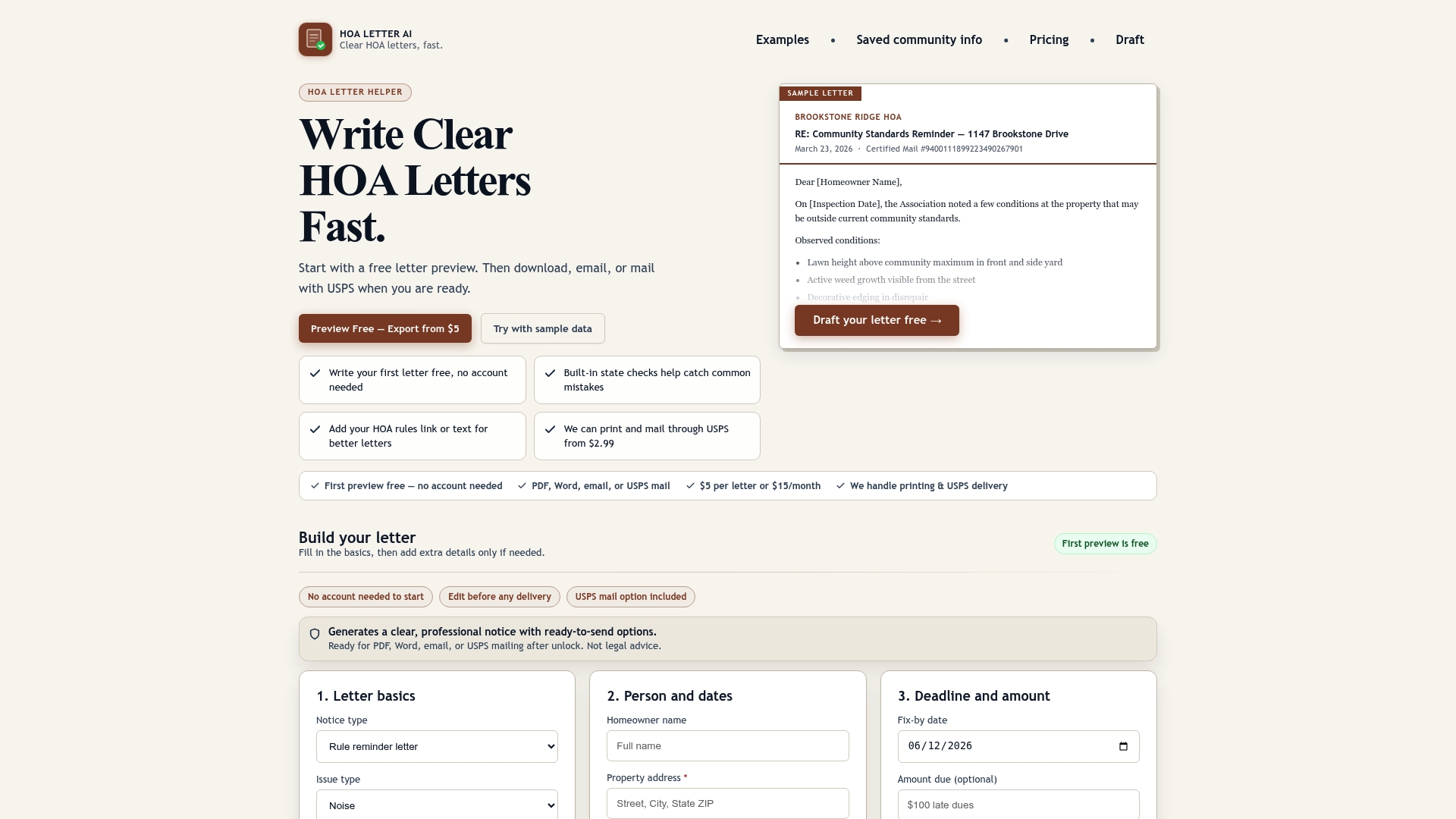
For boards, the workflow starts with a standardized letter template built around your community’s rules, run through a completeness check before it’s sent, then delivered through integrated USPS mailing so there’s a tracked record from day one. Property managers handling multiple communities can reuse saved profiles instead of rebuilding a letter from scratch every time. For homeowners, the response letter generator walks you through building a proper written reply, complete with the evidence references and hearing request language covered in this guide, for a one-time $19 fee.
If you’ve received a notice and aren’t sure it’s even valid, start by checking it against a real state-compliant warning letter template to see what a complete version should look like, then generate your response before your deadline passes.
Where to Look Next for Verification
Start with your community’s own governing documents: the CC&Rs and bylaws spell out the rules boards can enforce and the procedures they must follow. Your state’s HOA statute, searchable through your state legislature’s website, will confirm notice periods, hearing rights, and lien procedures that override or supplement what’s in your CC&Rs.
Meeting minutes and the association ledger are your next stop, especially for financial demands. Request them in writing and keep a copy of the request itself. Most states require associations to produce records within a set number of days once asked.
For letter formats you can actually copy from, look at sample violation and response templates built around the same checklist covered in this guide. Save a copy of every letter you send or receive, along with delivery confirmation, in a single folder. That habit costs nothing and solves most disputes before they start.
This article is general information, not a substitute for advice from a qualified lawyer. Consult a qualified legal professional about your own circumstances before acting on anything here.
Sources
- How to respond to an HOA violation letter
- What Is an HOA Demand and How Should You Respond? - LegalClarity
- How to Handle HOA ARC Requests (Board Guide)