
An HOA compliance confirmation letter is the board’s written record that a homeowner fixed a violation, or the homeowner’s own written request asking the board to confirm the file is closed. The moment you send or receive one, do three things: verify the cited rule actually appears in the CC&Rs or bylaws, calendar the deadline, and save proof of delivery. Skip any of those and you’re exposed if the matter ever escalates.
TL;DR:
- Verify that the cited rule in a compliance letter matches the actual CC&R or bylaws, and confirm deadlines and proof of delivery before acting.
- Include all required elements in the letter: sender and signer info, homeowner and property details, specific rule citation, observed facts, deadline, and response instructions.
- Use certified mail with return receipt for delivery and keep a detailed, indexed file with all correspondence, photos, and inspection notes for enforceability.
- Ensure compliance and homeowner response letters are clear, specific, and attach relevant evidence, especially if fines have been reversed or settled.
- Follow a strict enforcement sequence, document every step, and avoid vague language or missed deadlines to prevent disputes and uphold legal defensibility.
HOA Letter AIDraft Clearer HOA Compliance LettersCreate professional notices with guided drafting, state-specific context, community rules, built-in checks, and delivery options.Create a compliance letter
Table of Contents
- What Belongs in an HOA Compliance Confirmation Letter?
- What to Verify Before You Act on a Compliance Letter
- How Boards Should Send and Document Every Confirmation Letter
- Sample Letters: Board Confirmation and Homeowner Response
- When to Escalate: Hearings, Fines, and Liens
- Best Practices That Prevent Selective Enforcement Claims
- What Homeowners Should Do When a Letter Arrives
- Why Most Enforcement Disputes Come Down to Bad Drafting
- Draft State-Aware Letters Without Starting From Scratch
- Where to Go for Deeper State-Law Research
- Sources
What Belongs in an HOA Compliance Confirmation Letter?
Every valid letter, whether it confirms a cure or requests one, needs the same skeleton. Miss a piece and you invite a challenge, either from a homeowner who claims the notice was defective or from a judge who agrees with them. A checklist commonly used across HOA template resources lays out eight required elements that separate an enforceable letter from a shaky one.
Here’s what has to be on the page:
- Sender and signatory: Full name of the association, the board member or manager signing, and direct contact information.
- Recipient and property identifier: Homeowner’s legal name and the property address or lot/unit number exactly as it appears in HOA records.
- The exact rule citation: Quote or closely paraphrase the specific CC&R section, bylaw, or rule violated. Not “landscaping standards” in general. Section 7.3(b), or whatever number governs.
- Observed facts: What was seen, when, and how. A date, a brief description, and a photo reference beat a paragraph of adjectives.
- The cure or confirmation requested: State plainly what needs to happen or, in a confirmation letter, what already did happen.
- A firm deadline: A specific date, not “promptly” or “as soon as possible.”
- Consequences limited to what the documents authorize: Fines, hearing referral, or lien only if the CC&Rs and state law actually permit them for this violation.
- Response instructions: How to reply, who to contact, and how to request a hearing if one applies.
A state-aware violation letter template can pre-fill most of this, which matters more than it sounds. Boards that draft from scratch every time tend to drop the cure deadline or forget the hearing-rights line, and both omissions get exploited during a dispute.
Attachments matter as much as the letter body. Include the photo evidence, any prior notices sent for the same or related violations, and a copy of the specific CC&R page. If the letter confirms compliance rather than requesting it, attach the inspection note that closed the file and state whether any fine was reversed.
The signature block should include the date signed, the signer’s title (board president, property manager, etc.), and a line confirming the method of delivery. That last detail sounds minor. It isn’t. If a homeowner later disputes ever receiving the notice, the signature block is often the first thing an attorney checks.
Pro Tip: Keep the observed-facts section to one or two neutral sentences. “Trash bins visible from the street on 3/14 and 3/17, per attached photos” holds up far better in a hearing than “resident continues to blatantly disregard community standards.”
What to Verify Before You Act on a Compliance Letter
Not every letter that lands in a mailbox is airtight, and not every letter a board sends should go out unchecked. Before you act, in either direction, run through a short verification pass.
Start with the governing documents themselves. Pull the actual CC&Rs, bylaws, or rules document and find the cited section. If a letter references “Article 5” but your recorded CC&Rs only go up to Article 4, that’s not a technicality. It’s a defect that can void the notice.
Next, check state notice and hearing requirements. Many states require the homeowner get notice and a real opportunity to be heard before a fine gets imposed, and the specifics vary widely by state. A state-by-state breakdown of HOA notice and fine rules is worth bookmarking, because a letter that skips a mandatory hearing-rights disclosure can be unenforceable even if the underlying violation is real.
Watch for these red flags:
- No specific rule citation, just a general reference to “community standards.”
- No named sender or a signature that doesn’t match anyone on record.
- Enforcement against one homeowner for something the board has ignored elsewhere in the community.
- A deadline that’s already passed by the time the letter arrives, which suggests a mailing delay or backdating issue.
If you spot one of these problems, don’t ignore the letter and don’t just comply blindly either. Request written clarification, in writing, and ask the board to confirm the cited section and the delivery date. That written request itself becomes useful documentation if the dispute continues. Selective enforcement claims are among the easiest for a homeowner’s attorney to make and among the hardest for a board to defend without a clean file.
How Boards Should Send and Document Every Confirmation Letter
Delivery method decides whether your letter holds up later. Certified mail with return receipt requested is the standard recommendation because it creates proof of delivery that matters the moment anything escalates to a hearing or a court filing. Pair it with a first-class copy and an email copy where the homeowner has consented to electronic notice, since a bounced certified letter with no backup leaves you with nothing.
Build the violation file the same way every time:
- File the return receipt as soon as it comes back, with the date noted.
- Attach dated photos from the original inspection and any follow-up inspections.
- Log inspection notes naming who inspected, when, and what they observed.
- Keep copies of every prior notice tied to the same violation, including courtesy notices.
- Index the closed file by address and violation type so it’s retrievable fast during a resale or estoppel request.
Retention periods vary by association bylaws and state law, but many boards keep violation files for as long as the homeowner owns the property, plus a buffer of several years after resale. That habit pays off directly: associations that maintain a single, complete violation packet, letter, delivery proof, photos, and inspection notes, resolve more cases before a hearing is ever needed and face fewer appeals. A record retention guide for HOA files is a good reference point if your association doesn’t already have a written retention schedule.
Sample Letters: Board Confirmation and Homeowner Response
Two letters do most of the work in a compliance cycle: the board’s confirmation that a violation was cured, and the homeowner’s request to close the file. Both are short. Both need specific language to actually protect the party sending them.
Sample A: Board Confirmation of Compliance
Dear [Homeowner Name],
This letter confirms that the violation cited in our notice dated [original notice date] regarding [specific CC&R section and violation description] has been cured as of our inspection on [cure confirmation date]. No further action is required at this time.
[Optional clause: Any fine assessed in connection with this violation in the amount of $[X] has been reversed / remains due and payable by [date].]
Your file for this matter is now closed. Please retain this letter for your records, including for any future resale or estoppel request.
Sincerely, [Board member name and title]
The optional fine clause matters more than it looks. A confirmation letter that stays silent on outstanding fines creates confusion during closings, when a title company or buyer’s attorney asks for a clean estoppel statement and the file shows an unresolved balance nobody flagged. A confirmation letter that explicitly states whether fines were reversed avoids that dispute entirely.
Sample B: Homeowner Response Confirming Cure
Dear [Board/Management Company],
I am writing regarding your notice dated [date] concerning [specific violation cited, referencing the same CC&R section]. I have corrected the issue as of [date], as documented in the attached photos.
I request written confirmation that this matter is resolved and that my file is closed. If any fine was assessed, please confirm whether it has been reversed given the cure documented here.
Please respond within [reasonable timeframe, e.g., 14 days]. Thank you for your attention to this matter.
Sincerely, [Homeowner name and address]
A few fill-in fields show up in almost every version of these letters: the original notice date, the exact rule citation, the cure date, and a firm response window. Keep a short checklist on hand covering those four fields plus attachments (photos, prior notices, the original letter) and you can turn either sample into a finished letter in minutes rather than starting from a blank page. Templates for specific violation types, landscaping, trash, parking, and unauthorized modifications, follow the same structure with different cure language plugged in.
When to Escalate: Hearings, Fines, and Liens
Escalation only works if each step is documented and each step respects the homeowner’s procedural rights. Skip a step and even a legitimate violation can turn into a legal liability for the association.
- Courtesy notice. Informal, often not required by statute, but useful as a first documented contact.
- Formal violation letter. Cites the rule, sets a cure deadline, and states possible consequences.
- Hearing notice. Required in many states before any fine takes effect, giving the homeowner a real chance to be heard.
- Fine assessment. Only after the hearing (or a documented waiver of the hearing right) and only in amounts the CC&Rs authorize.
- Cease-and-desist letter. Sent after repeated notices, listing every prior notice, citing CC&R authority for the demand, and setting a final deadline before fines, liens, or attorney referral.
- Lien or attorney referral. The last step, reserved for unresolved fines or ongoing violations, and typically requiring board approval documented in meeting minutes.
Before a board records a lien, check that every prior step is documented in the file: original notice, delivery proof, hearing notice and outcome, and the specific CC&R authority for the lien itself. A step-by-step enforcement guide can help boards keep the sequence straight, since skipping the hearing step is one of the most common reasons enforcement actions get overturned.
Homeowners facing a pending hearing or lien should gather the same materials: every notice received, photos showing the cure or the disputed condition, and a written timeline. If a fine or lien amount seems disproportionate to the violation, or if the board never offered a hearing, that’s worth raising directly, and worth consulting an attorney about if the dollar amount is significant.
Best Practices That Prevent Selective Enforcement Claims
Consistency is the best defense a board has. Adopt one template and one approval workflow for every violation letter, and document any exception in board minutes so it doesn’t look arbitrary later. An enforcement checklist for board members keeps that process repeatable instead of dependent on whoever happens to be drafting that week.
A few habits matter most:
- Keep inspection logs consistent across the whole community, not just the properties that draw complaints.
- Use neutral, factual language in every letter, never accusatory or emotional phrasing.
- Limit stated consequences strictly to what the CC&Rs and state law actually authorize.
- Close every file cleanly once a cure happens, and document any fine reversal in writing.
Repeated best-practice guidance across HOA template resources comes back to the same point: complete files and consistent enforcement are what protect a board when a homeowner alleges they were singled out.
Pro Tip: Run a quarterly audit comparing violation letters sent against the inspection log. If one street or one type of violation gets flagged far more often than others with no explanation, fix that before a homeowner’s attorney finds it for you.
What Homeowners Should Do When a Letter Arrives
- Verify the citation. Pull your CC&Rs and confirm the section referenced actually exists and applies.
- Calendar the deadline immediately, and photograph the current condition of whatever’s cited.
- Preserve the letter and envelope, since postmark dates matter if delivery timing is ever disputed.
- Send a written confirmation of cure once fixed, referencing the original notice date and attaching photos.
- Request a hearing if you disagree with the violation or the fine, and bring your photos, prior correspondence, and a copy of the relevant CC&R section. Consult an attorney if a lien or a large fine is on the table.
A fence violation walkthrough shows how this plays out for one of the most commonly disputed violation types.
Why Most Enforcement Disputes Come Down to Bad Drafting
Most compliance disputes I’ve looked into don’t hinge on whether the violation was real. They hinge on whether the letter that documented it was written well enough to survive a challenge. Boards lose more hearings to vague cure language and missing deadlines than to homeowners actually being in the right.
Clear cure language cuts hearing volume because it removes the ambiguity that homeowners exploit, intentionally or not. A deadline that says “correct by March 15” leaves no room for argument. “Promptly” invites one.
Three things every board should adopt this week: a locked template with mandatory fields, a rule requiring a specific CC&R citation on every letter, and a file-closing step that states fine status in writing every single time.
— Blake
Draft State-Aware Letters Without Starting From Scratch
Writing a defensible compliance confirmation letter by hand means cross-checking your CC&Rs, confirming your state’s notice rules, and remembering every field a hearing officer might scrutinize. This is built into the drafting process itself, so boards and homeowners don’t have to rebuild the checklist from memory every time a violation comes up.
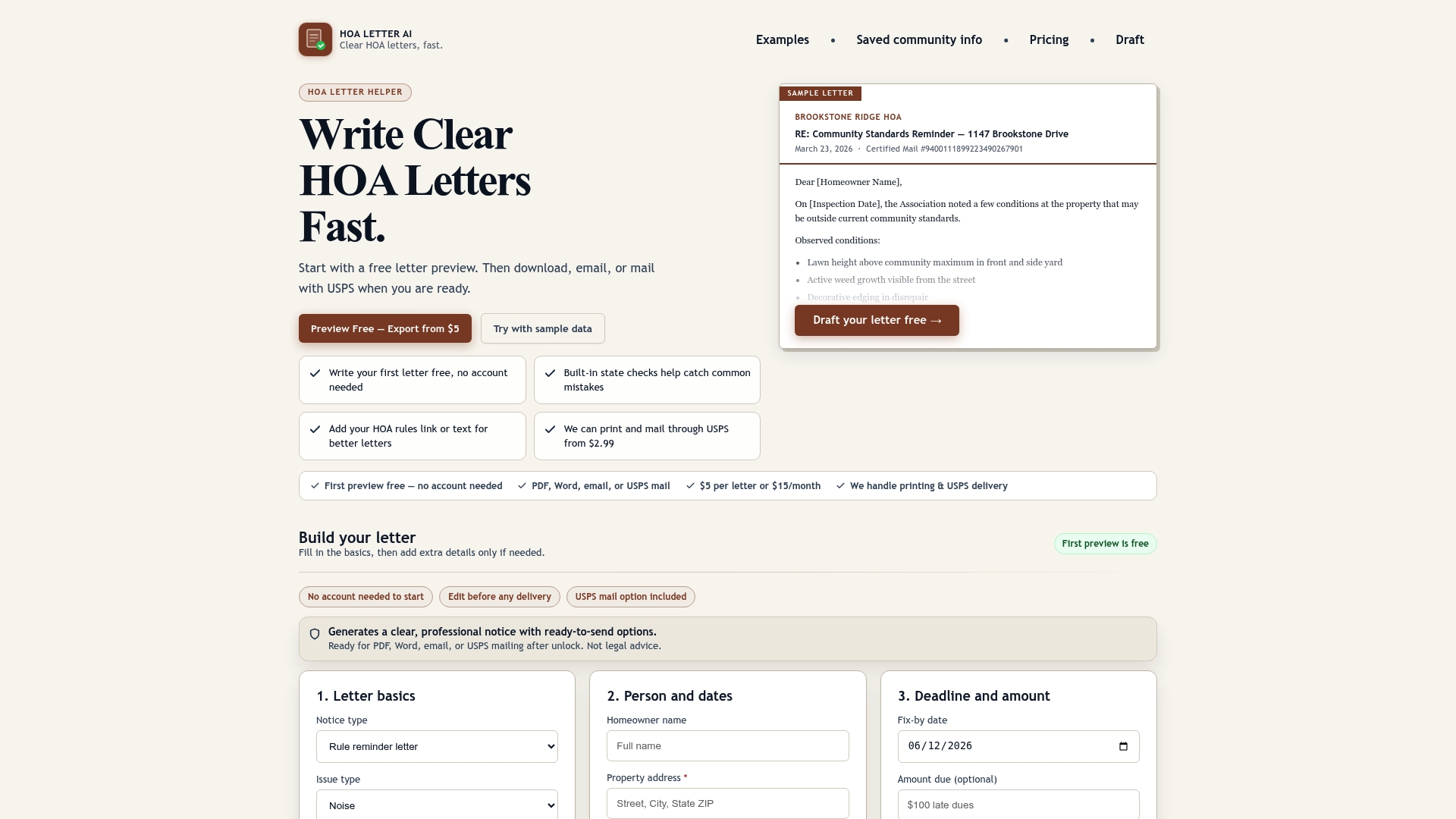
The tool offers guided drafting with state-aware templates covering common violation types, including landscaping, trash, parking, and unauthorized modifications, plus a one-page preview before sending. Property management teams can save community profiles to streamline drafting, and individual users can generate single letters. Automated checks help catch missing deadlines and rule citations before sending, and mailing integration supports certified delivery to simplify proof-of-delivery.
Start with the free letter preview to see exactly what a state-compliant confirmation letter looks like for your situation, or check the management team pricing if your board handles enforcement across multiple properties.
Where to Go for Deeper State-Law Research
- State notice and fine rules by state
- Estoppel deadlines and fee caps
- HOA solar approval documentation
Sources
- HOA violation letter template — The HOA Guide
- HOA cease and desist letter template — The HOA Guide
- Hoa Estoppel Letter Template - US