
HOA due process in the United States requires fair notice, a real opportunity to be heard, and an impartial decision before a board can impose fines or suspend privileges. It protects homeowners from arbitrary enforcement and requires boards and property managers to follow a consistent, documented procedure. If you’ve received a violation notice, check its contents and deadlines against your governing documents right away.
TL;DR:
- A violation notice must include specific details such as the rule violated, penalty, cure instructions, and hearing information, delivered via certified mail for legal validity.
- A formal hearing offering the homeowner a chance to present evidence is essential; skipping this step can invalidate enforcement actions.
- Enforcement timelines typically progress from informal contact to formal notice, cure period, hearing, and then collection or appeal, with most missteps occurring during notice or hearing procedures.
- State laws vary widely, requiring homeowners to verify compliance with local statutes, CC&Rs, and proper procedures to avoid procedural defects.
- Standardized notices using templates and legal guidance tools like HOA Letter AI can significantly reduce procedural errors and litigation risks.
Table of Contents
- What Due Process Requires: Substantive vs. Procedural Protections
- The HOA Enforcement Timeline: From Complaint to Penalty
- What Makes an HOA Violation Notice Legally Defensible?
- How Do HOA Hearings Work, and Who Decides the Outcome?
- Does HOA Due Process Change by State?
- What Should You Do After Receiving an HOA Violation Notice?
- Fines, Liens, and Foreclosure: What’s the Real Risk?
- When Should You Involve a Lawyer?
- How HOA Letter AI Helps Reduce Due Process Mistakes
- Fair Enforcement Keeps Communities Livable
- Draft a Notice That Holds Up Before You Send It
- Sources
What Due Process Requires: Substantive vs. Procedural Protections
Due process in an HOA setting splits into two categories, and confusing them is where a lot of disputes start. Substantive due process asks whether a rule itself is fair: is it reasonably related to protecting property values, applied consistently, and free of discrimination? Procedural due process asks whether the board followed the right steps in enforcing that rule, regardless of whether the rule itself is reasonable.
A board that bans a specific homeowner’s landscaping style while ignoring identical setups elsewhere has a substantive problem. A board that fines someone without ever sending written notice has a procedural one. Courts and Davis-Stirling’s due process framework treat both as grounds to challenge enforcement.
Common defects fall into a few buckets:
- Rules enforced selectively against certain homeowners but not others
- Fines imposed with no written notice or citation to a specific governing document
- Decisions made by someone with a personal stake in the outcome
- Penalties that bear no reasonable connection to protecting the community
The HOA Enforcement Timeline: From Complaint to Penalty
Most enforcement actions move through a predictable sequence, and knowing where you are in it tells you what the board owes you next.
- Informal contact. A manager or board member flags the issue, often by a phone call or a friendly note.
- Courtesy notice. A written heads-up describing the issue, usually with no penalty attached yet.
- Formal violation notice. Cites the specific rule, states the proposed fine, and sets a cure period.
- Cure period. Typically 10 to 30 days, depending on your state statute and CC&Rs.
- Hearing. The homeowner presents their side before a board or committee.
- Written decision. The outcome, with reasoning, delivered in writing.
- Collection or appeal. Fines get billed, or the homeowner pursues further remedies.
The most common fatal misstep is skipping straight from courtesy notice to fine, with no formal hearing offered in between. That single gap is enough to unravel an otherwise legitimate enforcement action.
What Makes an HOA Violation Notice Legally Defensible?
A notice that looks official isn’t automatically valid. LegalClarity’s breakdown of HOA fine requirements lists five elements that need to appear, and missing even one creates an opening to challenge the whole action.
- A specific, factual description of the violation, not a vague reference to “ongoing issues”
- The exact governing-document provision allegedly broken
- The proposed penalty amount or consequence
- Cure instructions with a clear deadline
- Hearing date, time, and location, if a hearing is part of the process
Delivery method matters as much as content. Certified mail with return receipt creates a paper trail that protects both sides; a note taped to a door does not. Boards using the HOA hearing notice template can standardize this without missing a required field.
Pro Tip: If a notice cites “community standards” instead of a specific CC&R section or bylaw number, that’s a red flag worth raising before the hearing even happens.
How Do HOA Hearings Work, and Who Decides the Outcome?
A hearing gives the homeowner a real chance to present their side before a decision-maker who hasn’t already made up their mind. That’s the whole point, and it’s where a lot of enforcement actions fall apart.
- Homeowners generally have the right to present evidence, call witnesses, and respond directly to the alleged violation
- Some associations use an independent fining committee instead of the full board, which can reduce bias if a board member has a personal conflict
- Anyone with a direct stake in the dispute should recuse themselves from voting
- Minutes and a written decision should follow, documenting what was decided and why
- Legal counsel isn’t always guaranteed a seat at an HOA hearing, but homeowners can usually request the association’s governing documents, prior enforcement records, and meeting minutes to prepare
Ask for the hearing procedure in writing before you show up. If the board can’t produce one, that’s telling.
Does HOA Due Process Change by State?
Statutory floors vary widely, and your CC&Rs sit on top of whatever your state requires. California’s Davis-Stirling Act, Texas’s Property Code chapter on owners’ associations, and Virginia’s POAA all set different notice and hearing rules, so the same violation can play out on a different timeline depending on where the property sits.
- California requires Internal Dispute Resolution (IDR) to be invoked in writing, and the HOA must participate once a homeowner formally requests it
- IDR limits when an association can file certain civil actions, but it doesn’t automatically pause internal hearings or fines already in motion
- Many disputes also require mediation before litigation under state ADR statutes
- Check your state’s specific violation letter laws alongside your CC&Rs, since the stricter of the two standards usually controls
Don’t assume your neighbor’s experience in another state applies to yours.
What Should You Do After Receiving an HOA Violation Notice?
The steps you take in the first few days shape how strong your position is at the hearing.
- Read your CC&Rs and bylaws immediately to confirm the cited provision actually applies to your situation.
- Calendar every deadline in the notice, including the cure period and hearing date.
- Photograph or document the condition in question before it changes.
- Request association records: prior notices, meeting minutes, and the enforcement policy itself.
- Decide whether curing the violation quietly is smarter than fighting it. Sometimes it is.
- If you need more time, request a continuance in writing rather than missing the hearing entirely.
- Draft your response using a structured appeal template rather than an informal email, so nothing gets left out.
Fines, Liens, and Foreclosure: What’s the Real Risk?
Penalties escalate in stages, and each one raises the stakes. A typical progression runs from fines to suspension of amenities or voting rights, then to liens against the property, and in some states, foreclosure as a last resort. Understanding the HOA fine schedule your association uses helps you see how close you actually are to serious consequences.
Procedural defects can undo all of it. Insufficient notice, a skipped hearing, or a biased decision-maker are recognized grounds for voiding a fine or blocking collection entirely.
- Appeal within the association first, using its own internal process
- Pursue IDR or mediation where your state or CC&Rs require it
- Challenge enforcement in court if the association ignored its own procedures
When Should You Involve a Lawyer?
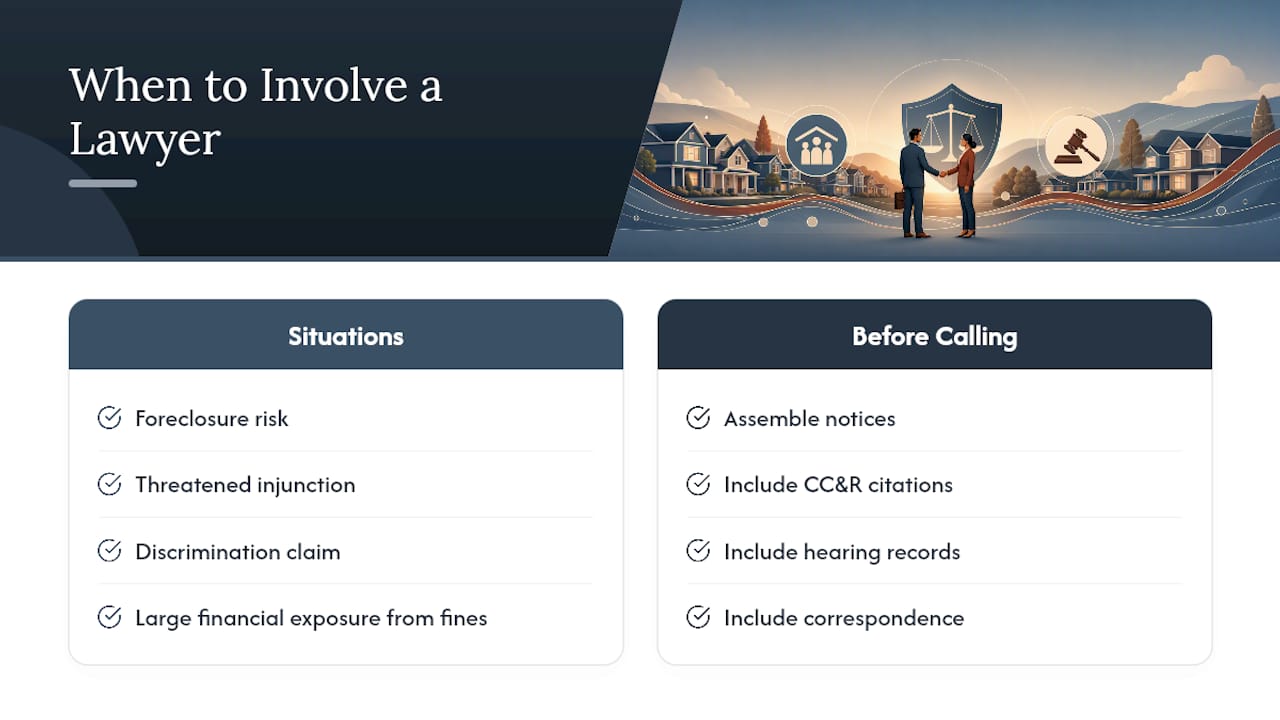
Most disputes resolve through the association’s internal process or mediation, but a few situations call for counsel immediately: foreclosure risk, a threatened injunction, a discrimination claim, or exposure to fines large enough to matter financially. Before you call an attorney, pull together your notices, CC&R citations, hearing records, and any correspondence into one packet. That single step saves most of the first consultation and often the retainer cost that comes with it.
How HOA Letter AI Helps Reduce Due Process Mistakes
Standardized, state-aware notices catch a lot of the errors that unravel enforcement later. HOA Letter AI’s state-by-state legal guidance shows that boards using templates with built-in rule citations and completeness checks produce fewer defective notices and face less post-enforcement litigation risk.
The platform inserts the correct CC&R citation, checks for required fields like cure instructions and hearing details, and offers USPS delivery so you have proof of service on record. Homeowners can preview a tailored response letter before committing to anything, and boards get a violation process workflow that mirrors the legal sequence courts actually expect to see.
Fair Enforcement Keeps Communities Livable
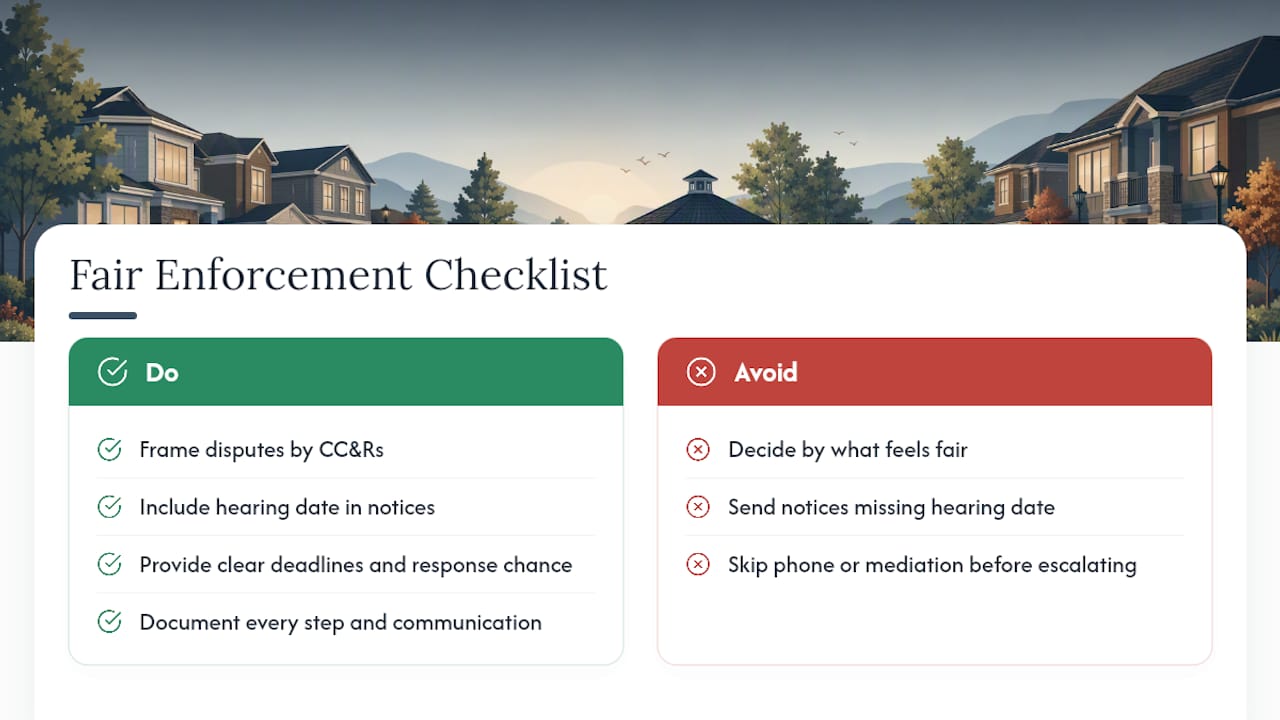
Enforcement power in an HOA comes from a contract, not from any government authority, and that distinction matters more than most boards realize. Framing every dispute around what the CC&Rs actually say, rather than what feels fair in the moment, keeps both sides honest.
I’d rather see a board send a slightly awkward but complete notice than a polished one missing a hearing date. Homeowners deserve clear deadlines and a real chance to respond, and boards that document everything protect themselves just as much as the residents they’re enforcing against. When a rule can be cured with a phone call or a mediation session, take that path before escalating.
— Blake
Draft a Notice That Holds Up Before You Send It
Skipping a required field on a violation notice is how boards end up defending enforcement actions instead of resolving them. HOA Letter AI gives you a faster, lower-error path than drafting from scratch or copying an old template that might not match your state’s current rules.
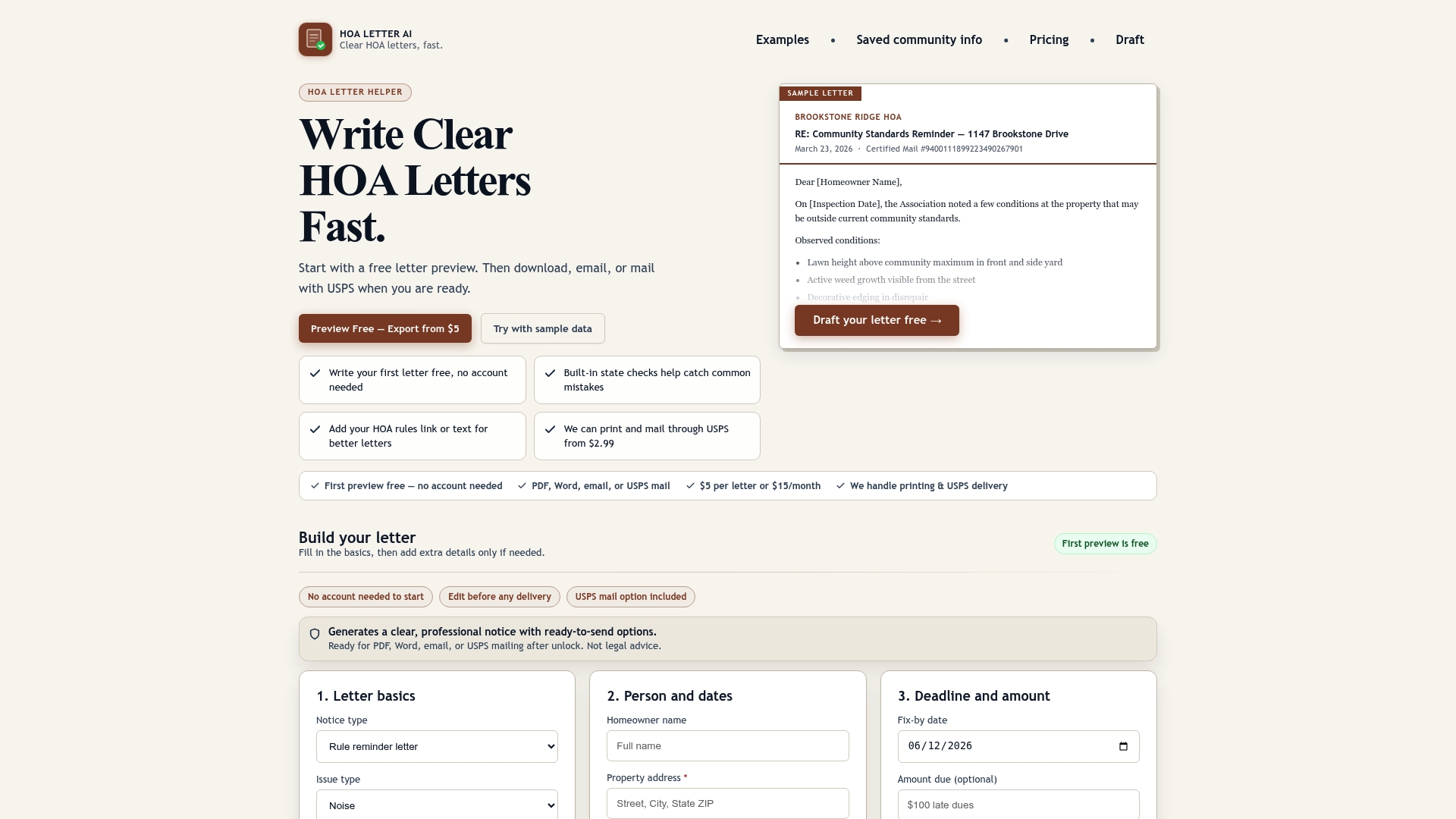
Start with the HOA warning letter template to preview exactly what a compliant courtesy notice looks like before penalties escalate. The tool checks for the citation, cure instructions, and hearing details that boards routinely leave out, and pulls in state-specific rules automatically. Property managers handling multiple communities can use unlimited letters for $15 a month, while individual boards can unlock a single letter without a subscription. Preview a letter now and see exactly what your notice needs before it goes out the door.
This article is general information, not a substitute for advice from a qualified lawyer. Consult a qualified legal professional about your own circumstances before acting on anything here.
Sources
- Due Process in Disciplinary Actions — Davis‑Stirling
- HOA and condominium due process requirements for fines — LegalClarity
- HOA rules enforcement — HOA Start