
Do not repaint, and do not throw anything away: photograph your home’s current condition today and put your compliance request in writing. Ask the board to confirm, in writing, exactly which governing document or palette number it relied on, along with any committee minutes or denial letter. Then ask for written confirmation of your deadline, and request an extension if a full repaint is required.
TL;DR:
- Treat not in harmony as a design dispute, but deteriorated condition or visible wear as maintenance; pending committee review is not a denial.
- Compare a physical paint chip with the siding in natural daylight from at least two angles; screen images can distort color, and timestamps preserve evidence.
- Keep your reply to one page and include the governing document citation, work details, receipts, dated photos, and a specific request for a written response.
- Florida limits exterior appearance rules to authority stated or implied in the declaration, while Utah requires notice, an open forum, and adopted criteria before enforcement.
- If denied, request written minutes and verify quorum before appealing or seeking mediation, especially when the board cites an unpublished standard or refuses a written response.
HOA Letter AIWrite a Clear Paint Compliance LetterHOA Letter AI combines guided drafting, state-specific context, community rules, and built-in checks to help create clear paint-compliance letters.Create a compliance letter
Table of Contents
- What an HOA paint color letter usually means and when a board issues one
- Exactly what to include in your HOA paint color response letter
- How to request clarification and collect the right evidence
- Timelines, committee approvals, and statutory limits to watch for
- Step-by-step workflow from receipt to formal reply
- When to appeal, negotiate, or hire help
- Authoritative guidance and sample letter approach from HOA Letter AI
- A note on staying procedural and calm
- Get your paint color response letter drafted and ready to send
- FAQ
- Sources
What an HOA paint color letter usually means and when a board issues one
A paint color letter almost always falls into one of two buckets: a design violation or a maintenance issue. Design violations happen when a homeowner painted without design review board (DRB) approval, chose a shade outside the approved palette, or never submitted an application at all. Maintenance notices are different: they flag peeling, fading, mildew, or chalking paint, regardless of color.
The wording tells you which one you’re facing:
- “Not in harmony with the community” usually signals a palette or design dispute.
- “Deteriorated condition” or “visible wear” points to a maintenance complaint.
- “No record of application” means the board believes you skipped the approval step.
- “Pending committee review” means a decision hasn’t been finalized yet, so don’t assume denial.
Reading the exact phrase matters because your response strategy, and the evidence you gather, depends on which category applies.
Exactly what to include in your HOA paint color response letter
A useful response letter gives the board no excuse to ignore you and no vague ground to stand on. Structure it the same way every time:
- Your identification: full property address, lot or account number, and your contact information.
- The notice reference: the date of the letter you received and any citation or case number printed on it.
- A direct request for the citation: ask which CC&R section, design guideline, or palette number the board relied on.
- A description of the work: scope of the job, date completed, paint brand and color name or code, and contractor name if applicable.
- Supporting attachments: receipts, paint can labels, and contractor invoices referenced in the letter.
- Photo evidence: dated photos of the finished work alongside physical color chips, not screenshots.
- A statement of intent: note that you will submit a formal DRB application if the board confirms one is required.
- A specific closing request: ask for a written response within a set window, such as a reasonable written response window, and state what you’re asking for (approval, clarification, or withdrawal of the notice).
Each numbered item does a job: it narrows the dispute to facts the board must address on paper rather than in conversation.
Pro Tip: Keep the letter under one page. Boards and property managers respond faster to a single, organized page than to a long narrative.
If you’d rather not draft this from scratch, a homeowner response letter template walks through the same structure with fillable fields for each section above.
How to request clarification and collect the right evidence
Screen colors lie. Monitor calibration, lighting, and compression all shift how a paint color reads on a phone or laptop, so a physical color chip from the paint store is the only reliable comparison tool. Ask the store to pull the exact chip for your paint code, not a close visual match.
To document fairly:
- Photograph the chip held directly against the siding in natural daylight, never under porch lights or at dusk.
- Take at least two angles and note the time of day in your records.
- Keep the paint can label, the contractor’s invoice, and the date the work was finished.
- Send your clarification request by certified mail or a timestamped email so you have proof of delivery.
Community paint-request processes often build in real review time. One homeowners association’s paint request form specifies a typical processing period for paint request forms and notes that physical color samples may be requested, which shows why written timelines matter more than verbal assurances.
Always ask for the committee’s minutes or a written denial. A verbal “no” carries little weight if a dispute escalates.
Timelines, committee approvals, and statutory limits to watch for
Most design review committees operate on a stated review window, often a stated review window, though the exact period depends on your governing documents. Track the date you submitted any application and the date you received a response, because missed windows can work in your favor.

Statutory limits also matter. In Florida, §720.3035 restricts an association’s authority over exterior appearance to what the declaration specifically states or reasonably implies, so a board citing a rule outside the declaration may be overreaching. In Utah, design-criteria guidance under §57-8a-217 requires notice, an open forum, and delivery of adopted criteria before a board can enforce a new or amended palette.
Common procedural weaknesses include:
- No written denial, only a verbal statement.
- A committee that didn’t have quorum when it voted.
- A palette or guideline that was never published or distributed to homeowners.
Step-by-step workflow from receipt to formal reply
Work through this in order, and don’t let any step slip past its window.
- Day 1 to 3: Photograph the current condition of your home, save the original notice exactly as received, and send a written clarification request asking for the specific citation and any committee minutes.
- Day 4 to 14: Collect color chips, receipts, and contractor invoices. Draft your formal response letter and submit any required DRB application, keeping timestamps on every submission.
- If denied: Request the written minutes behind the denial, confirm the committee had proper quorum, and consider mediation or a formal appeal if the denial still lacks a clear citation.
- Throughout: Keep a simple log of certified mail receipts, email timestamps, photo metadata, and every document you submit.
A 2026 guide to responding to HOA compliance notices covers this same timeline in more depth if your notice involves fines or a hearing date.
When to appeal, negotiate, or hire help
Some disputes resolve with one clear letter. Others need outside help, especially when:
- The board cites a standard that isn’t written anywhere in your governing documents.
- The committee skipped a required step, like quorum or published notice.
- The fine is disproportionate to the alleged violation.
- Compliance would require an expensive full repaint you believe isn’t justified.
Mediation or an administrative appeal usually starts with a written request to the board, followed by a scheduled hearing where you present your evidence. Many states or local bar associations list community mediation services. For most paint disputes, a clear, state-aware written appeal resolves the issue faster and at far lower cost than hiring an attorney, and it’s worth exhausting that route first.
Authoritative guidance and sample letter approach from HOA Letter AI
We built our homeowner response tool around the exact gaps that cause letters to fail: missing citations, vague evidence lists, and formatting that buries the actual request. The drafting flow prompts for the governing document section a board cited, checks that your evidence list is complete, and produces a one-page preview before you send anything.
- State-aware wording that matches the statute or design guidance relevant to your notice.
- Built-in prompts that won’t let you skip the citation request or evidence section.
- A one-page preview so you see exactly what the board will receive.
- Optional USPS mailing is available for certified delivery.
Pro Tip: A complete letter answers three questions on one page: what citation applies, what evidence supports your position, and what response you’re requesting by when.
A good outline mirrors the structure we covered above: identification, notice reference, citation request, work description, attachments, and a dated closing request. Our homeowner response letter resource walks through a full annotated version.
A note on staying procedural and calm
The homeowners who come out ahead in these disputes are rarely the loudest ones. They’re the ones who put everything in writing, kept their tone flat, and let the paper trail do the arguing.
A calm, documented letter resolves far more paint disputes than an angry phone call ever does, and it costs you nothing but a little patience.
— Blake
Get your paint color response letter drafted and ready to send
Once you have your photos, chips, and receipts together, turning them into a letter the board has to answer is the last step. Choose a low-cost one-time letter option an individual response, and our homeowner response product walks you through the same citation-request structure covered above.
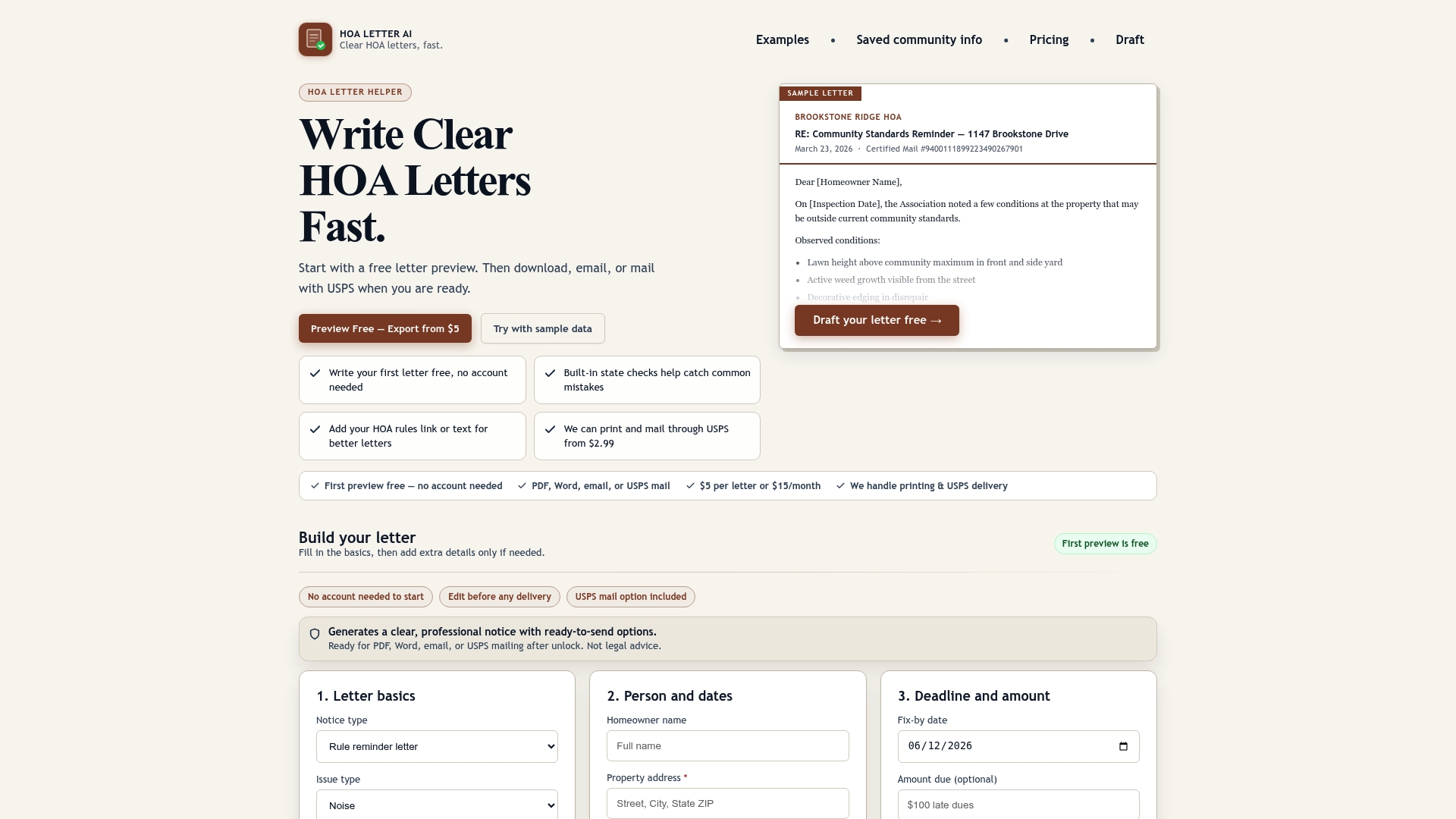
- A one-time $5 letter for a single notice, no subscription required.
- A dedicated homeowner response option built for exactly this kind of dispute.
- Property manager teams handling multiple units can use the Self-serve board lane or the PM lanes instead.
A paid letter service makes sense when your dispute is about missing citations or unclear standards; legal counsel becomes worth the cost when a board refuses to respond in writing at all. Start with our pricing page to see which option fits your situation.
FAQ
What are the HOA paint color rules?
Paint color rules come from your community’s CC&Rs or a separately published design guideline referenced in those covenants. In Florida, a board’s authority to regulate exterior appearance is limited to what the declaration specifically states or reasonably implies, under §720.3035.
Can an HOA tell you what color to paint your house?
Yes, when the authority to regulate color is written into the governing documents or a properly adopted design guideline. Utah’s design-criteria process requires notice and an open forum before a board can adopt or amend those standards, so ask for the specific document behind any color requirement.
What color is replacing gray in 2026?
Sherwin-Williams named Universal Khaki SW 6150 as its Color of the Year for 2026, pointing to a shift toward warmer, earthy neutrals. If your community references current design trends when reviewing palettes, this shade is a useful benchmark to raise in conversation.
Can you give Home Depot a hex code for paint?
Paint stores typically match colors from a physical chip, a sample can, or a known brand code rather than a hex value, since hex codes are a screen-color format and don’t translate reliably to physical paint pigment. Bring the original paint can label or request a color chip in person for an accurate match.
What happens if the HOA denial has no written citation?
A denial without a specific citation to a CC&R section or palette number is a procedural weakness you can raise directly. Courts, including in Lake Charleston Maint. Ass’n, Inc. v. Farrell, have examined whether committees followed proper procedure and issued denials in writing, so ask the board to produce the exact standard it relied on.
Sources
Florida’s §720.3035 sets the outer limit on an HOA’s authority over exterior appearance. Utah’s design-criteria guidance spells out the notice and adoption steps a board must follow. Sherwin-Williams’ 2026 Color of the Year page offers a current industry reference point for palette discussions, and the Lake Charleston case shows how courts weigh procedural failures in enforcement disputes.
- Color of the Year 2026, Universal Khaki SW 6150 | Sherwin-Williams
- Chapter 720 Section 3035 - 2023 Florida Statutes - The Florida Senate
- Commerce
- Lake Charleston Maint. Ass’n, Inc. v. Farrell, 16 So. 3d 182 (Fla. 4th DCA 2009)