
Every HOA violation letter needs the property address plus an explicit “Lot/Unit [#]” or the full legal description, right near the top, along with a case ID. This single line does more legal work than almost anything else in the notice: it proves you’re citing the correct parcel and gives you an auditable paper trail. A checklist and ready-to-use templates follow below.
TL;DR:
- Including the lot or legal description and case ID near the top of the violation letter is essential for legal validation and record-keeping.
- Verify property details like lot number, owner name, and legal description using deed records, assessor’s data, and GIS parcel viewers before mailing notices.
- Certified mail provides an auditable proof of delivery, critical for enforcement and defending against homeowner disputes.
- Accurate, state-aware drafts you review with consistent case IDs and precise property descriptions prevent procedural dismissals or legal challenges.
- Using standardized templates with built-in checks reduces clerical errors and speeds up enforcement while maintaining legal and procedural integrity.
Table of Contents
- What Fields Belong in Every HOA Violation Letter?
- How Do You Find and Verify a Lot Number Before You Mail?
- Sample Wording That Puts the Lot Number Where It Belongs
- Delivery, Proof of Service, and What Happens If Nothing Changes
- What Do CC&Rs and State Law Require Before You Mail?
- The Small Mistakes That Get Notices Thrown Out
- Why the Lot Number Field Deserves More Attention Than It Gets
- Draft State-Compliant Letters Without the Guesswork on Lot Numbers
- Sources
What Fields Belong in Every HOA Violation Letter?
A violation letter isn’t a warning shot fired into the dark. It’s a record that has to hold up if a homeowner challenges it or a case ends up in front of an arbitrator. That means every field earns its place.
Here’s what belongs in the letter, every time:
- Homeowner name and mailing address, matched exactly to the owner-of-record shown in county or assessor files.
- Property address plus “Lot/Unit [#]” or the complete legal description, since the lot-and-block string is the identifier actually recorded on the deed and title.
- Case ID, inspection date, and the exact CC&R or rule section you’re citing, not a paraphrase of it.
- Corrective action, a firm cure deadline, and the delivery method, along with a phone number or email for questions.
- Proof-of-service fields: date mailed, tracking number, signed receipt if applicable, and where the file lives.
Miss the lot number or get it wrong, and you’ve handed the homeowner a procedural argument that has nothing to do with whether they actually broke a rule.
How Do You Find and Verify a Lot Number Before You Mail?
Most boards already have the lot number sitting in a file they’ve never opened. Before you search anywhere else, check the original deed, the closing or title paperwork, or the most recent property tax bill. All three typically list the lot, block, and subdivision as a short string, something like “Lot 12, Block 5, Meadowbrook Estates.”
If none of those documents are on hand, work through this sequence:
- Search the county assessor’s online property lookup using the owner’s name or the street address.
- Open the county’s GIS parcel viewer and click the parcel polygon. This usually surfaces the lot number, the assessor’s parcel number (APN), and the recorded legal description in one screen.
- If the online records are incomplete, request the plat map or the original recorded deed from the county recorder’s office.
- Cross-check the APN, the plat map, and the assessor’s record against each other before the letter goes out.
Some older or rural properties were never subdivided into numbered lots. If the deed uses a metes-and-bounds description instead, copy that description verbatim into the notice and note the recording book and page number.
Pro Tip: GIS parcel viewers are especially useful when you don’t have a clean address to search. Click the parcel itself and the lot number, APN, and legal description usually populate automatically, even for properties with confusing or duplicated street numbering.
Sample Wording That Puts the Lot Number Where It Belongs
The government sample violation letter format used by many counties, including St. Louis County’s template, lists inspection date, violation description, required compliance date, and a signature line. That structure translates cleanly into HOA notices at every severity level.
An initial courtesy notice might read: “RE: Property at 142 Birchwood Lane, Lot 12, Block 5, Meadowbrook Estates. This is a courtesy notice regarding a violation observed on [date]. Please correct the issue by [date, typically 10 to 14 days out].”
An official violation notice needs more precision: “Case ID: MB2026-0347. RE: 142 Birchwood Lane, Lot 12, Block 5, Meadowbrook Estates. This notice cites Article 4, Section 2 of the CC&Rs. Corrective action must be completed by [date, often 7 to 10 days from mailing].”
A final notice or hearing letter adds delivery and process language: “This notice is being sent via certified mail. A hearing has been scheduled for [date] to address the continued violation at Lot 12, Block 5.”
- Metes-and-bounds properties should have their legal description quoted exactly as recorded, followed by the deed book and page number for verification.
- One notice builder commonly used by boards recommends this three-tier ladder, but every cure period still needs to match your own CC&Rs and state statute before you send anything.
Delivery, Proof of Service, and What Happens If Nothing Changes
Certified mail earns its cost the moment fines or a hearing become possible. It creates a delivery record that stands up if a homeowner claims they never received the notice, which is often the first defense raised in a contested case.
Every mailing should log five things:
- Inspection date and case ID
- Date mailed and delivery method
- Tracking number
- Signed receipt, if certified mail was used
- File location for the physical or digital record
Cure periods vary by severity and by document. Courtesy notices commonly run about two weeks, official notices about one week, and final notices carry a scheduled hearing date instead of a simple deadline. None of those numbers are universal. They only work if your CC&Rs and state law actually support them.
If the violation isn’t cured, the standard escalation ladder runs: second notice, then a final notice with a hearing date, then a hearing outcome, and only then fines or liens if your governing documents allow it.
What Do CC&Rs and State Law Require Before You Mail?
Templates are a starting point, not a substitute for your own governing documents. Before you send anything beyond a courtesy notice, confirm what your CC&Rs and enforcement policy say about cure periods and hearing procedures, and check whether your state imposes its own statutory notice requirements on top of that.
A missing or incorrect lot number or legal description isn’t a cosmetic error. It’s the kind of procedural defect that can get a fine dismissed or a notice thrown out entirely, because it puts the board’s evidence that it targeted the correct parcel into question.
When ownership is disputed, a legal description is ambiguous, or a homeowner challenges the notice on procedural grounds, that’s the point to bring in legal counsel rather than push forward on a template alone.
The Small Mistakes That Get Notices Thrown Out
Most unenforceable notices don’t fail because of the violation itself. They fail because of a clerical mismatch that a homeowner’s attorney catches in five minutes.
- Always add the phase, section, or block identifier when your subdivision has one, since lot numbers frequently repeat across different phases of the same development.
- Verify the owner-of-record in assessor files before mailing, and make sure that name matches your case file exactly.
- Keep case IDs consistent across every mailing and log entry tied to the same violation.
- Have a second person on the board or management team review any final or hearing-stage letter before it goes out.
Pro Tip: If your community has more than one phase, treat “Lot 12” as meaningless on its own. There’s likely a Lot 12 in Phase 1 and another in Phase 3, and only the block or phase identifier tells you which one you’re actually citing.
Why the Lot Number Field Deserves More Attention Than It Gets
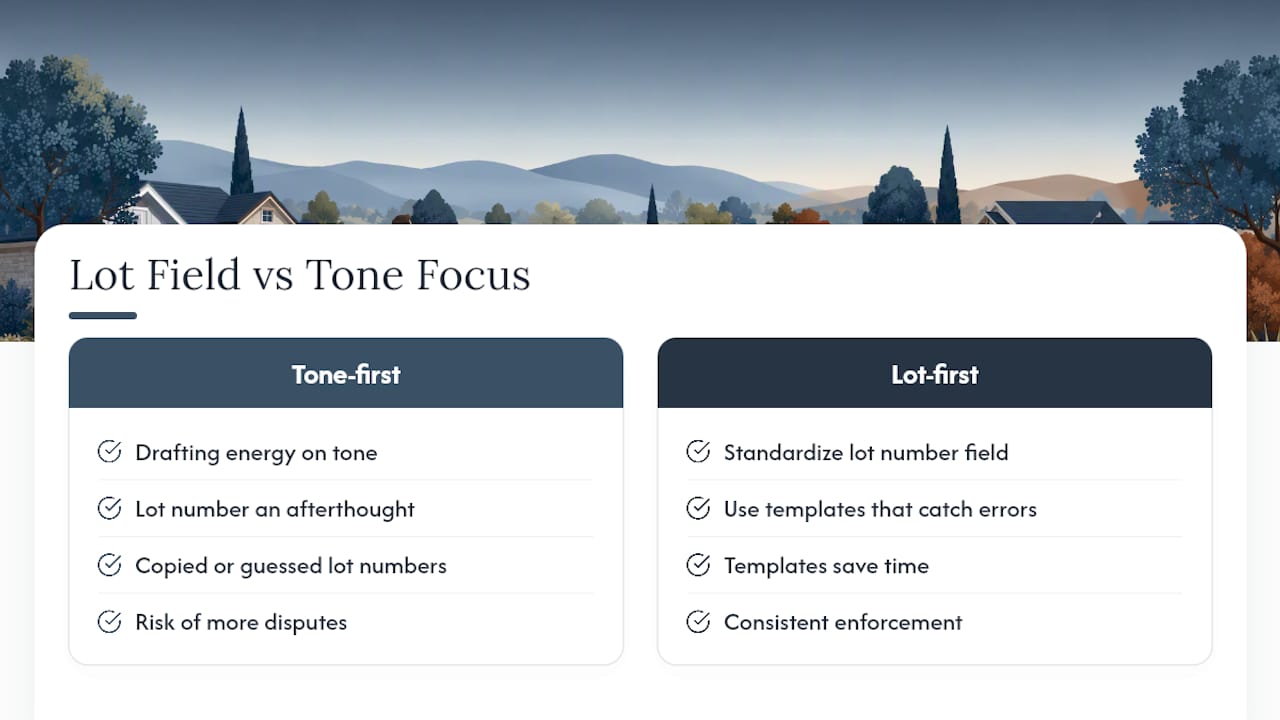
Boards spend most of their drafting energy on tone, worried about sounding too harsh or too soft. The lot number gets an afterthought, copied from an old letter or guessed from a mailbox number. That’s backwards. Standardizing this one field across every notice cuts disputes and speeds up resolution more than any amount of careful wording ever will.
Templates matter for the same reason. They don’t just save time. They catch the error before it goes in the mail, and that keeps enforcement consistent without souring relationships with residents who are, after all, still your neighbors.
— Blake
Draft State-Compliant Letters Without the Guesswork on Lot Numbers
The letter drafting tool builds the lot-number and legal-description field directly into guided drafting, so it’s never an afterthought bolted onto a finished letter. The tool runs state-specific checks against your notice before you send it, flags missing mandatory language, and generates a one-page preview so you can confirm the case ID, cure deadline, and property description all line up before anything goes out.
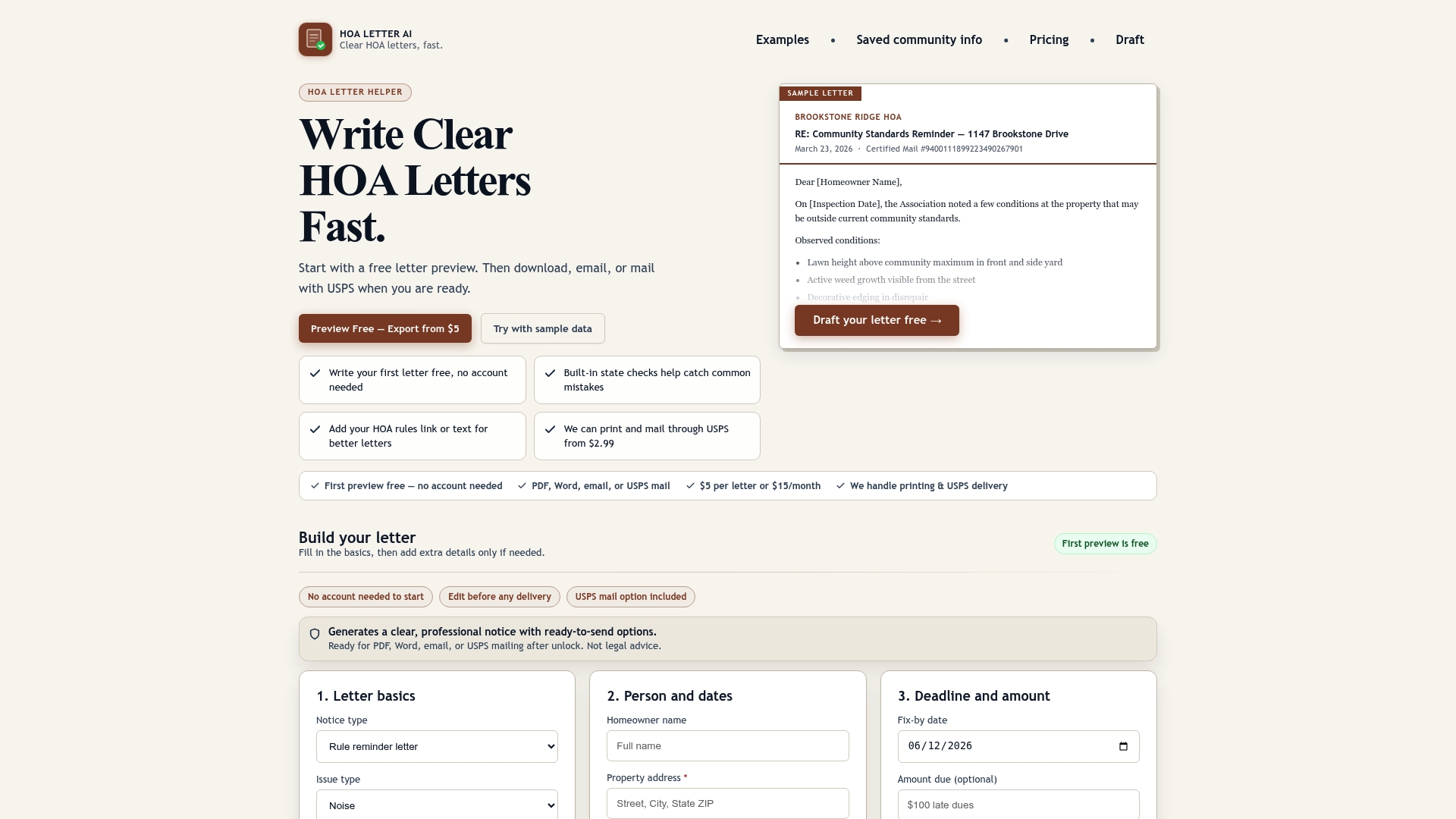
Once the letter is ready, you can add proof-of-service fields and send it through USPS mailing with tracking, creating the same kind of auditable record a certified mail receipt provides. If you’re ready to send your next notice, start with the HOA warning letter template for a courtesy notice, or check your state’s specific notice and fine rules on the HOA violation letter laws page before you draft an official or final letter.
Sources
- Sample Violation Letter:
- The lot and block system: how subdivisions are legally described
- HOA Violation Letter Template — Free Notice Builder | KindHOA