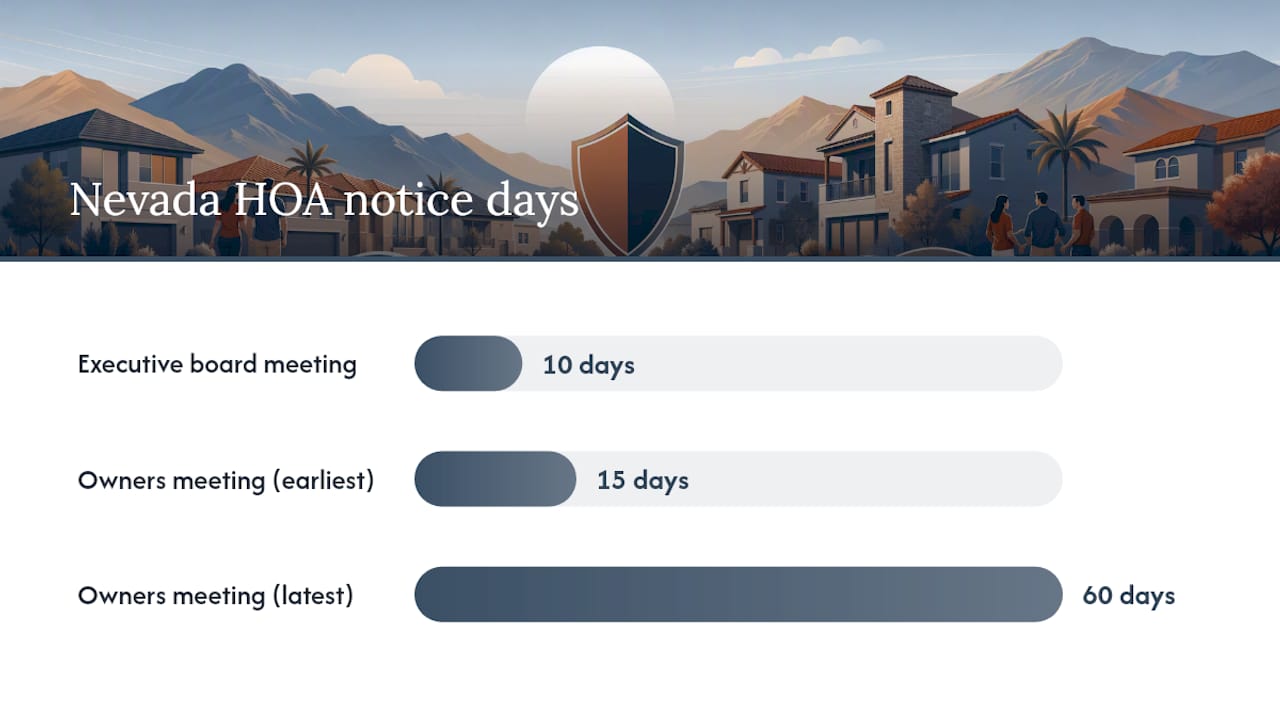
Nevada HOA notice requirements come from NRS Chapter 116, and the single most important rule is this: notices must go to the mailing or email address each owner has designated in writing, on a schedule that ranges from 10 days for board meetings to 15 to 60 days for owners’ meetings. Violation and fine notices need even more detail, including a proposed cure, a fine amount, and a hearing date. Miss any of these pieces and a board’s action can be challenged or undone.
TL;DR:
- Notices must be sent to the owner’s designated address within specific timeframes: 10 days for board meetings and 15 to 60 days for owners’ meetings and elections, with bylaws potentially requiring longer periods.
- Delivery methods acceptable under Nevada law include mail, email, hand delivery, and inclusion in a regularly issued community newsletter, with documentation necessary to defend notices later.
- Violation notices require detailed descriptions, specific cure instructions, exact fine amounts, hearing details, and photographic evidence, all sent within a reasonable period after discovering the violation.
- Meeting agendas must list specific items, be available before the meeting, and last-minute changes should be avoided unless properly noticed, especially for significant decisions.
- Emergency meetings can only skip standard notice if the situation was genuinely unforeseen and urgent, with detailed documentation of the occurrence and alternative notice methods.
HOA Letter AIDraft Clearer Nevada HOA NoticesCreate professional compliance letters with guided drafting, state-specific context, community rules, built-in checks, and delivery options.Create a compliance letter
Table of Contents
- Nevada HOA Notice Requirements for Meetings and Elections
- How to Notify Your HOA and How Your HOA Must Notify You
- What Nevada Requires in Violation and Fine Notices
- Agenda Requirements and What Owners Can Say at Meetings
- Emergency Meetings and When Standard Notice Doesn’t Apply
- Owner Rights to Minutes, Recordings, and Meeting Records
- Notice of Sale and Lien Enforcement Rules Under NRS 116
- A Practical Compliance Checklist for Nevada Boards
- The Mistakes That Get Nevada Boards Into Trouble
- Draft Nevada-Compliant Notices Faster With HOA Letter AI
- Sources
- FAQ
Nevada HOA Notice Requirements for Meetings and Elections
Nevada law does not treat every gathering the same way, and boards that assume one notice period fits every meeting are setting themselves up for a challenge. The timeline depends entirely on what kind of meeting is happening.
- Executive board meetings. NRS 116.31083 requires at least 10 days’ notice before a regular executive board meeting, along with an agenda that spells out what will be discussed.
- Units’ owners meetings. The Nevada Real Estate Division’s guidance on association meetings sets the window at not less than 15 days and not more than 60 days before the meeting date. That 45-day spread gives boards room to coordinate logistics, but it also means a notice sent 61 days out is just as defective as one sent 14 days out.
- Elections. Ballot mailing and election notice timing generally follows the same 15 to 60 day framework that governs owners’ meetings, since elections are typically conducted at or in connection with an annual meeting. Boards running contested elections should build in extra lead time for ballot printing, candidate statements, and any required run-off procedures rather than mailing at the last permissible moment.
Bylaws can push these numbers higher, and when they do, the bylaws win. Nevada’s statutory periods are floors, not ceilings. If your governing documents call for 20 days’ notice on board meetings instead of the statutory 10, you’re bound by the stricter standard your own community adopted. Boards sometimes assume the NRS deadline is a hard ceiling because it’s the number everyone quotes, but a well-drafted set of bylaws often asks for more.
The consequences of getting this wrong are not theoretical. A meeting held on defective notice can result in decisions that are later invalidated. Real estate columnist Barbara Holland has pointed out that Nevada courts and disgruntled owners take meeting notice seriously, and boards that skip the formal notice step even for a “quick” quorum discussion put every decision from that gathering at legal risk. If an owner later challenges a special assessment or a rule change on the grounds that notice was short by three days, the board is on defense, not offense.
Pro Tip: Build your notice calendar backward from the meeting date, not forward from “whenever we get around to it.” Mark the earliest and latest legal send dates for owners’ meetings on a shared calendar so nobody on the board has to do mental math under deadline pressure.
How to Notify Your HOA and How Your HOA Must Notify You
The delivery method matters just as much as the timing, and Nevada law gives boards more flexibility here than most people expect. NRS 116.31068 lays out exactly which delivery channels count as legally sufficient notice.
- Mail or email sent to the address the owner has specifically designated in writing.
- Hand delivery to the unit or to the owner directly.
- Delivery through the U.S. Postal Service or a commercial delivery service.
- Inclusion in a community newsletter, when the newsletter is a regular and reliable channel.
- Any other method “reasonably calculated to provide notice” when the owner hasn’t designated an address at all.
That last category is the safety net. If an owner never bothers to file a mailing or email address with the association, the board isn’t stuck. It just has to act reasonably, which typically means falling back to the address on file for tax or deed records and documenting that choice.
Owners control their own destiny here more than they realize. The law puts the burden on the owner to designate (and update) an address in writing, and the board’s job is to keep that designation on file and actually use it. If an owner moves and never notifies the association, the association is not required to track them down through other means. This is one of the more common sources of friction in Nevada communities: an owner claims they never received a notice, and the board discovers the owner simply never updated the mailing address after a move.
Documentation is what separates a defensible notice process from a shaky one. Keep a dated log of every notice sent, the delivery method used, and any bounce backs, return-to-sender mail, or failed email deliveries. Practical guidance from HOA law commentary makes clear that when a delivery attempt fails, a documented good-faith effort is often what protects the board later, even if the owner never actually received the notice in hand. Certified mail receipts, email delivery confirmations, and a dated posting log with photos all count as evidence that the board did what the law required.
What Nevada Requires in Violation and Fine Notices
This is where Nevada notice law gets the most specific, and it’s also where boards run into trouble most often. NRS 116.31031 sets a detailed content standard for any notice that precedes a fine, and skipping even one element can void the fine down the line.
A legally sufficient violation notice must include:
- A detailed description of the alleged violation, not a vague reference to “rule violations.”
- The specific cure the owner needs to complete to resolve the issue.
- The proposed action, including the exact fine amount the association intends to impose.
- The date, time, and location of the hearing where the owner can contest the violation.
- A photograph of the violation, when one can reasonably be taken.
Generic language like “your property is not in compliance with community standards” doesn’t meet this bar. The board has to say what the violation is, in enough detail that the owner could actually cure it without calling the management company to ask what happened. “Trash cans stored in the driveway between pickup days, visible from the street, in violation of CC&R Section 4.2” is a defensible notice. “Cluttered yard” is not.
Timing matters on both ends of this process. Send the notice within a reasonable window after the violation is discovered, since a fine notice issued three months after the fact for something already resolved looks punitive rather than corrective. On the other end, give the owner enough runway before the hearing date to actually prepare a response or gather evidence. A hearing scheduled 48 hours after the notice goes out invites a challenge on procedural grounds alone.
Before any violation notice goes out, run it against this checklist:
- Does it cite the specific CC&R or rule provision being violated, along with the NRS 116.31031 authority for the fine process?
- Does it describe the violation in specific, observable terms rather than general language?
- Does it state the exact fine amount, not a range or “up to” figure?
- Does it include the hearing date, time, and physical or virtual location?
- Is a photograph attached, dated, and clearly tied to the property in question?
- Was it sent to the owner’s designated address, using a permitted delivery method?
Boards drafting these notices from scratch every time tend to drop details under time pressure. A violation notice checklist built into your process, rather than reinvented for each incident, closes most of the gaps that lead to successful owner appeals.
Agenda Requirements and What Owners Can Say at Meetings
Nevada law treats the agenda as part of the notice itself, not a separate courtesy. Under NRS 116.31083, the agenda has to accompany the meeting notice and give owners a real sense of what’s coming.
- List specific agenda items, not catch-all phrases like “old business” or “general discussion” that give owners no way to know what’s actually being decided.
- Make copies available to any owner who requests one, and post the agenda where the community can reasonably access it before the meeting.
- Preserve owner speaking rights. Owners generally have the right to address the board on agenda items during the meeting, though the board can set reasonable time limits per speaker to keep the meeting moving.
- Reserve executive session properly. Personnel matters, pending litigation, and certain contract negotiations can move into executive session, but routine board business can’t be shuffled there just to avoid owner scrutiny.
Last-minute agenda changes create real exposure. If the board adds a significant item, like a special assessment vote, to the agenda after the notice has already gone out, that addition may not be legally noticed at all. Owners who show up expecting to discuss landscaping and instead find the board voting on a $50,000 assessment have a legitimate procedural complaint. When something urgent comes up after the agenda has been finalized, the safer move is almost always to table it for the next properly noticed meeting rather than tack it on.
Emergency Meetings and When Standard Notice Doesn’t Apply
Nevada does carve out an exception for genuine emergencies, but it’s narrower than most boards assume. The Nevada Real Estate Division’s meeting guidance defines an emergency meeting as one convened to address circumstances that could not have been reasonably foreseen and that require immediate board attention, think a burst water main flooding common areas or storm damage threatening structural safety, not a scheduling inconvenience or a board member’s travel plans.
When standard notice truly is impracticable, the board can substitute hand delivery or posting notice in the common elements instead of the usual mailed or emailed notice. This is a narrow substitution, though, not a blanket exemption from notifying owners at all.
Document everything if you go this route. Write down what the emergency was, why standard notice wasn’t practical, exactly how and when the alternate notice was posted or delivered, and what action the board took as a result. If a fire sprinkler system fails on a Friday night and the board authorizes emergency repairs over the weekend, a short memo memorializing the timeline protects the board if an owner later questions why the usual 10-day notice didn’t happen. Boards that treat every inconvenient decision as an “emergency” to skip notice requirements are the ones that end up explaining themselves to a judge.
Owner Rights to Minutes, Recordings, and Meeting Records
Owners in Nevada have a statutory right to see what happened at a meeting, and the association can’t make that right prohibitively expensive to exercise. Nevada Real Estate Division guidance on unit owner rights spells out exactly how this works.
- Owners can request minutes, a summary of minutes, or an audio recording of a meeting in electronic format at no charge.
- If electronic format isn’t available, paper copies are capped at 25 cents per page for the first 10 pages and 10 cents per page after that.
- Associations should respond to record requests within a reasonable time frame rather than letting them sit unanswered for weeks.
- Boards should retain minutes, agendas, and any recordings in an organized, dated system so a records request doesn’t turn into an afternoon of searching through old email threads.
An organized retention system does double duty. It protects the board legally, since well-kept minutes are often the best evidence that proper notice and proper process were followed, and it cuts down the friction of records requests that otherwise turn into disputes. A simple shared drive with folders by meeting date and a master log linking each record to its statutory basis solves most of this with very little overhead.
Notice of Sale and Lien Enforcement Rules Under NRS 116
Lien enforcement carries the strictest notice standard in Chapter 116, and for good reason: it can end with an owner losing their home. Nevada Real Estate Division training materials on governing documents and NRS 116 walk through the procedural steps associations and their agents must follow before a lien sale can proceed.
- Publish notice of sale according to the statutory publication schedule, generally in a newspaper of general circulation, so the sale is publicly discoverable, not just mailed quietly to the owner.
- Send certified or registered mail to the owner’s address of record, giving them formal, trackable notice of the pending sale.
- Post notice on the unit itself, when applicable, so anyone physically at the property sees that a lien sale is pending.
- State the exact amount necessary to satisfy the lien as of the sale date, not an estimate or a balance from an earlier statement, along with clear warning language about what the sale means for the owner’s title.
- Confirm who is authorized to serve notice. This is typically the association’s collection agent or attorney, and the chain of authority should be documented in case the sale is challenged later.
A checklist matters more here than almost anywhere else in this guide, because a lien sale that gets challenged on procedural grounds can unwind months of collection effort. Before any notice of sale goes out, confirm the publication run satisfies the statutory schedule, confirm certified mail was actually sent and not just drafted, confirm the unit posting happened if required, and keep proof of service for every step. A missing certified mail receipt or a publication that ran one day short of the requirement is exactly the kind of defect that gets a sale voided.
A Practical Compliance Checklist for Nevada Boards
Getting Nevada HOA notice requirements right consistently comes down to process, not memory. Building the same sequence into every notice removes the guesswork that leads to missed deadlines or incomplete content.
- Identify the governing statute first. A board meeting notice, a violation notice, and a lien notice each answer to a different section of NRS 116, so start by naming which one applies.
- Confirm the owner’s designated address against your current records before drafting anything, since a notice sent to an outdated address doesn’t count as delivered even if it was technically mailed.
- Compile every mandatory content element the statute requires for that notice type, whether that’s a hearing date and fine amount or a publication schedule and lien payoff figure.
- Choose a permitted delivery method and stick to it consistently across the community rather than mixing methods case by case.
- Document proof of service the moment the notice goes out, not weeks later when someone asks for it.
- Retain the notice, the delivery proof, and any related minutes in one organized file tied to the underlying statute.
A short sample of the kind of language that belongs in a violation notice looks like this: “Pursuant to CC&R Section 4.2 and NRS 116.31031, you are notified that [specific violation] was observed on [date] at [address]. To cure this violation, you must [specific action] by [date]. Failure to cure may result in a fine of $[amount]. A hearing is scheduled for [date, time, location] at which you may present evidence.” That’s a fragment, not a finished letter, but it shows the level of specificity the statute expects.
This is exactly the kind of drafting where a state-aware tool earns its keep. The platform builds Nevada-specific notice requirements into its letter drafting flow, offers a one-page preview before anything goes out, and includes an optional USPS mail fulfillment step so boards have a delivery record without a separate mailing process. None of that replaces legal counsel for a genuinely contested case, but for the routine work of getting notice content and timing right the first time, it removes a lot of the manual checking boards otherwise do by hand.
Pro Tip: Keep a standing folder of “notice fragments,” the specific statutory language and mandatory elements for violation notices, meeting notices, and hearing notices, so nobody on the board is drafting from memory when a deadline is tight.
The Mistakes That Get Nevada Boards Into Trouble
The errors that sink boards in Nevada are rarely dramatic. They’re small procedural gaps that compound. A meeting notice sent nine days instead of 10. A fine notice missing the exact dollar amount. An informal hallway conversation between three board members, a quorum, that counted as a meeting under the law and never got noticed at all.

Barbara Holland’s reporting on Nevada HOA disputes makes a point worth repeating: any gathering where a quorum discusses association business is a meeting in the eyes of the law, whether or not anyone called it one. Boards that treat casual quorum conversations as harmless are creating exposure they don’t realize exists.
The fix isn’t more legal review on every letter. It’s a boring, consistent process: a centralized notice log tracking every notice by statute and date, template language pulled from statute rather than rewritten from memory each time, and a mandatory address-change form so owners can’t later claim they never got the chance to update their contact information. Conservative, well-documented compliance wins disputes that clever legal arguments after the fact usually cannot.
— Blake
Draft Nevada-Compliant Notices Faster With HOA Letter AI
Reading through NRS Chapter 116 for every notice you send is not a realistic workflow for a volunteer board or a property manager juggling a dozen communities. HOA Letter AI is built for exactly that gap: it embeds Nevada’s notice rules into the drafting process itself, so the mandatory content, timing flags, and delivery options are already built into the letter instead of something you have to look up each time.
For a board handling a single violation, the $5 letter option gets a compliant notice drafted and previewed without a subscription. Homeowners who need to respond to a notice they’ve received can generate a formal reply through the same pricing page. Boards that want an ongoing solution can use the Self-serve board lane for regular notice volume, while property managers running multiple Nevada communities have PM Starter and PM Pro plans, plus a 30-day PM Pilot for teams that want to test the workflow before committing. Every plan includes an optional USPS mail add-on starting at $2.99 per letter, so you get a delivery record without setting up a separate mailing process.
Whether you’re drafting a violation notice, a meeting notice, or an election mailing, the state-aware checks flag missing hearing dates, fine amounts, or address details before the letter goes out. Start with the Nevada-specific law page to see how your community’s notices map to NRS Chapter 116, then draft your next notice through the platform. This is a drafting aid, not a substitute for legal counsel on a contested or high-stakes matter.
Sources
For the statutory text itself, go straight to NRS 116.31068 on notice to unit owners, NRS 116.31083 on executive board meeting notice, and NRS 116.31031 on fine procedures. The Nevada Real Estate Division’s brochure on association meetings and its presentation on governing documents and NRS 116 explain how the statutes apply in practice. If a notice dispute escalates, the Nevada Real Estate Division’s main site lists complaint procedures and the Ombudsman program for common interest communities.
- NRS 116.31083 — Meetings of executive board; notice
- Understanding association meetings — Nevada Real Estate Division brochure
FAQ
What are the new HOA laws for 2026 in Nevada?
Nevada’s core notice framework under NRS Chapter 116, including the 10-day executive board meeting notice and the 15 to 60 day owners’ meeting window, remains the controlling standard. Boards should always check the current text of NRS 116 directly, since the legislature reviews common interest community statutes regularly.
Who regulates HOAs in Nevada?
The Nevada Real Estate Division oversees common interest communities in the state, including complaint intake and an Ombudsman program for disputes between owners and associations. Nevada Revised Statutes Chapter 116 is the governing law the division enforces.
What are the HOA rules in the USA?
HOA notice and governance rules vary significantly by state, since there’s no single federal HOA law. In Nevada specifically, NRS Chapter 116 sets the notice timing, delivery methods, and fine procedures that associations must follow, and other states have their own separate statutes.
What documents can I request from my HOA in Nevada?
Nevada owners can request minutes, meeting summaries, and audio recordings, and associations must provide these in electronic format at no charge. If only paper copies are available, the association can charge up to 25 cents per page for the first 10 pages and 10 cents per page after that.
How do I properly notify my HOA of an address change in Nevada?
Submit your updated mailing or email address to the association in writing, since NRS 116.31068 requires the board to use whatever address you’ve designated. Keep a copy of that written notice yourself, since disputes over undelivered notices often come down to whether the address change was actually documented.
How much does HOA Letter AI cost for drafting a notice?
A single letter through HOA Letter AI starts at $5, and homeowner response letters are available at the same rate. Boards and property managers with ongoing needs can choose the Self-serve board lane or the PM Starter and PM Pro plans for higher volume.