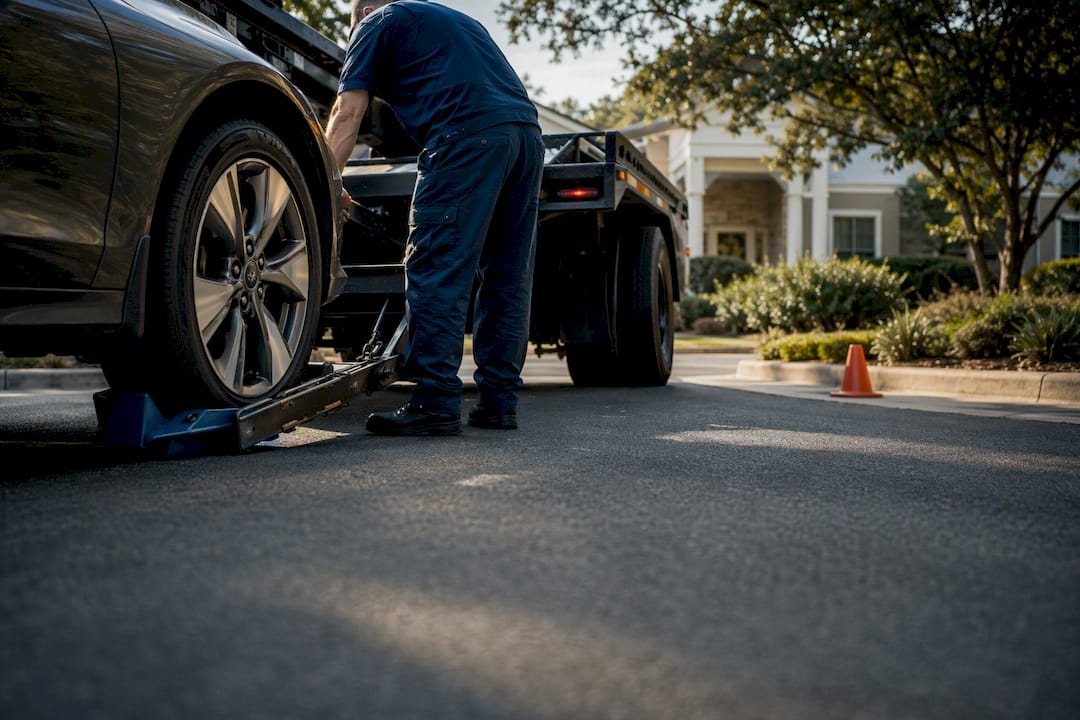
An HOA usually cannot tow a vehicle without meeting some notice requirement, but the exact rule depends on which state you’re in, your local ordinance, and what your community’s CC&Rs actually promise. California’s Vehicle Code typically sets a notice window of several days for certain violations; Florida requires specific posted signage instead. There is no single national standard, so boards drafting a towing notice need state-aware templates, and homeowners need to check three layers of rules before assuming a tow was illegal.
TL;DR:
- Towing authority depends on state laws, local ordinances, and community CC&Rs, meaning rules vary widely and must be checked carefully.
- Most lawful tows require clear notice through signage, windshield tags, mail, or law enforcement contact, with timelines ranging from 24 hours to several days.
- Immediate towing exceptions apply only in safety hazard situations, such as blocking fire lanes or obstructing driveways, with no notice needed.
- Homeowners should document the towing event, request authorization, and verify notices and law enforcement involvement if disputing the tow.
- Boards should implement standardized, written towing policies aligned with legal requirements and keep detailed records to minimize disputes.
HOA Letter AICreate Clearer Towing NoticesDraft professional compliance letters with state-specific context, community rules, built-in checks, and delivery options in one guided workflow.Create a compliance letter
Table of Contents
- When Can an HOA Lawfully Tow a Vehicle?
- What Notice Methods and Timelines Actually Apply
- What Should Homeowners Do Immediately After a Tow?
- How Should Boards Design a Defensible Towing Policy?
- What Templates and Tools Help With Compliant Notices?
- A Practical Take on Fair Towing Enforcement
- How HOA Letter AI Helps You Send Compliant Towing Notices
- Statutes and Resources Worth Bookmarking
- Sources
- FAQ
When Can an HOA Lawfully Tow a Vehicle?
The property where the car sits determines almost everything. An HOA generally has towing authority over common areas it owns or controls, like guest parking lots or clubhouse spaces. It has far less authority over a homeowner’s own driveway, and none at all over a public street unless a local ordinance specifically grants it enforcement power there.
That authority also has to exist on paper. If the community’s recorded CC&Rs and adopted rules never granted the board towing power, a tow ordered under that board’s name can be challenged as unauthorized, regardless of how reasonable the violation seemed. Boards sometimes assume unwritten “common sense” authority. Courts generally do not.
A handful of situations let a tow happen without any advance warning, because the statutes treat them as immediate hazards rather than ordinary violations:
- A vehicle blocking a fire lane or emergency access route
- A car parked in another resident’s clearly assigned or numbered space
- A vehicle obstructing a driveway, dumpster access, or required turning radius
- Cars abandoned in a way that creates a safety hazard
Outside those narrow exceptions, most towing situations fall under a notice requirement of some kind.
What Notice Methods and Timelines Actually Apply
Notice usually shows up in one of a few concrete forms: entrance signage meeting statutory size and wording requirements, a windshield tag placed on the specific vehicle, a mailed notice to the registered owner, or a call to local law enforcement before or after the tow.
Timelines vary sharply by state. California’s rule applies to certain parking violations under Vehicle Code §22658, giving the owner several days to move the vehicle before towing becomes lawful. Some jurisdictions use a shorter 24-hour window for less severe violations, and a handful allow immediate towing, with no advance notice at all for hazards like blocked fire lanes.
Statistic Callout: Florida’s signage law doesn’t set a fixed notice period the way California’s does. It works differently, by requiring signs to meet specific size and placement standards under Florida Statute 715.07, so posted signage itself functions as the ongoing notice.
A lawful tow authorization typically requires:
- A named manager or board member’s signature authorizing the specific tow
- The statutory or CC&R ground cited for the removal
- A timestamp and photo record of the violation
- Confirmation the tow company notified law enforcement where required
What Should Homeowners Do Immediately After a Tow?
Getting your car back matters, but documenting what happened matters just as much if you plan to dispute the tow later.
- Ask for the written tow authorization. Request the specific document the HOA or tow company used to justify the removal, including which statute or rule they cited.
- Photograph everything you can. Signage, the space where your car sat, any windshield notice, and timestamps all matter if the tow gets challenged.
- Call local law enforcement. Many statutes require the towing company to notify police within a tight window; confirming that happened (or didn’t) is often decisive.
- Reclaim the vehicle and demand receipts. Get copies of the authorization, the towing invoice, and any notice that was posted or mailed.
- Consider legal advice if the paperwork doesn’t add up. Analyses of statutory towing remedies, including the MBK Chapman fact sheet on California HOA towing law, note that unlawful removals can trigger damages or penalty recovery where the statute provides for it.
Pro Tip: Save every document the moment you get your car back. Tow disputes are won or lost on paperwork, and towing companies aren’t always eager to hand over authorization records after the fact.
How Should Boards Design a Defensible Towing Policy?
A defensible policy starts with a written towing rule tied directly to your state’s statute and your recorded CC&Rs, published where every owner can find it. That single step eliminates most “I didn’t know” disputes before they happen.
From there, standardize your process:
- Use one consistent notice template for every tow, not ad hoc wording from whoever is on duty that week
- Require a board or manager sign off in writing before any tow proceeds
- Put an indemnity clause in the towing vendor contract, shifting liability back to the tow company for its own procedural mistakes, a step HOAleader’s towing guidance flags as commonly overlooked
- Keep every notice, authorization, photo, and law-enforcement call in one auditable file
| Policy element | Why it matters |
|---|---|
| Written policy tied to statute and CC&Rs | Prevents unauthorized tows and unclear enforcement |
| Standardized notice template | Keeps wording and timelines consistent across every case |
| Manager or board sign-off | Creates a documented decision point before removal |
| Vendor indemnity clause | Shifts liability for the tow company’s own errors |
| Auditable recordkeeping | Protects the board if a tow gets challenged later |
Clear signage and well-maintained common areas also help notice actually get seen. If your lot’s visual clutter makes signage hard to spot, a driveway and grounds cleaning service can be part of keeping enforcement visible and fair.
What Templates and Tools Help With Compliant Notices?
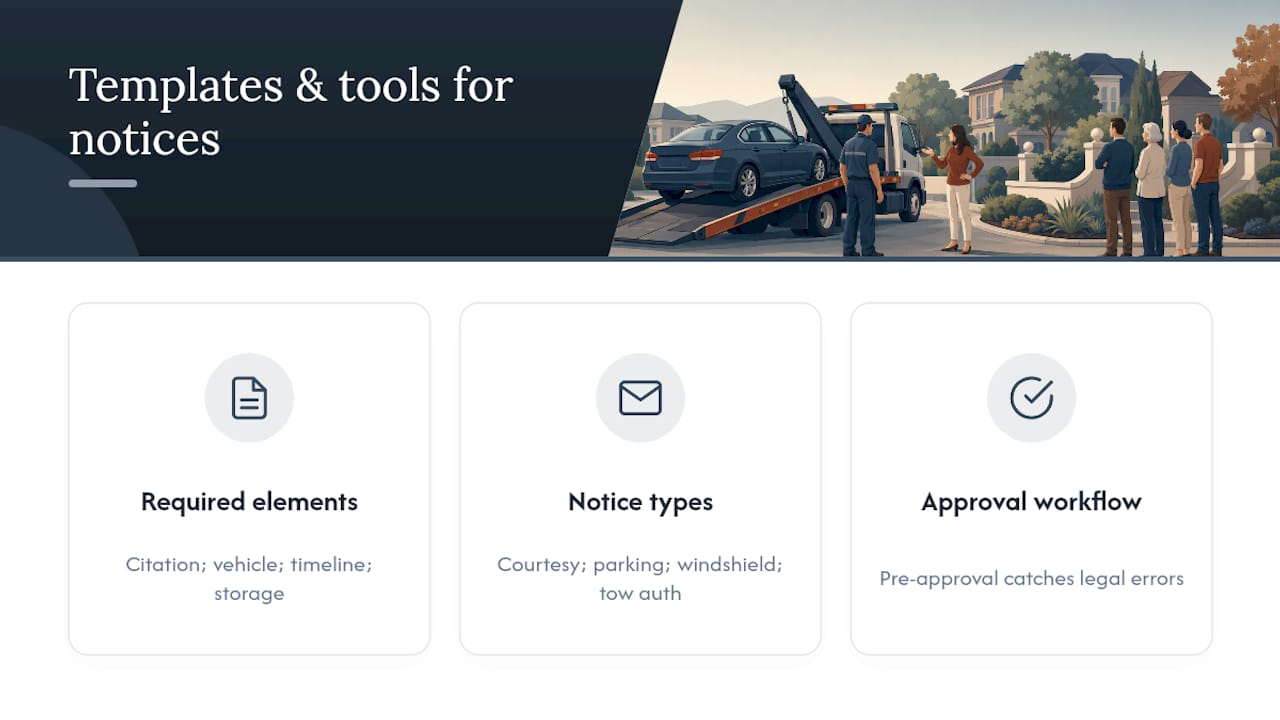
A state-compliant towing notice needs a few fixed elements: the statute or CC&R citation authorizing the tow, a clear vehicle description, the notice timeline that applies, and where the vehicle will be stored.
Most communities end up using a small set of notice types: a courtesy warning before escalation, a parking-violation notice, a windshield tow warning, and the tow authorization itself. Running each through an approval workflow, rather than letting one person draft and send at will, catches mistakes before they become legal exposure.
HOA Letter AI builds state-aware templates for exactly this, including a parking violation letter and a warning letter template with built-in checks for mandatory language, so boards aren’t guessing at what a valid notice needs to say.
A Practical Take on Fair Towing Enforcement
Most towing disputes trace back to inconsistency, not bad intent. Boards that use one standardized notice, post clear signage, and require a second set of eyes before authorizing a tow avoid the vast majority of complaints and lawsuits entirely.
— Blake
How HOA Letter AI Helps You Send Compliant Towing Notices
Writing a towing notice from scratch means guessing at statute language, signage wording, and timeline requirements, and getting any one of them wrong can void the entire tow. HOA Letter AI gives you state-aware warning and parking-violation templates built around the citations your state actually requires, so you’re not reconstructing Vehicle Code language or Florida signage rules from memory.
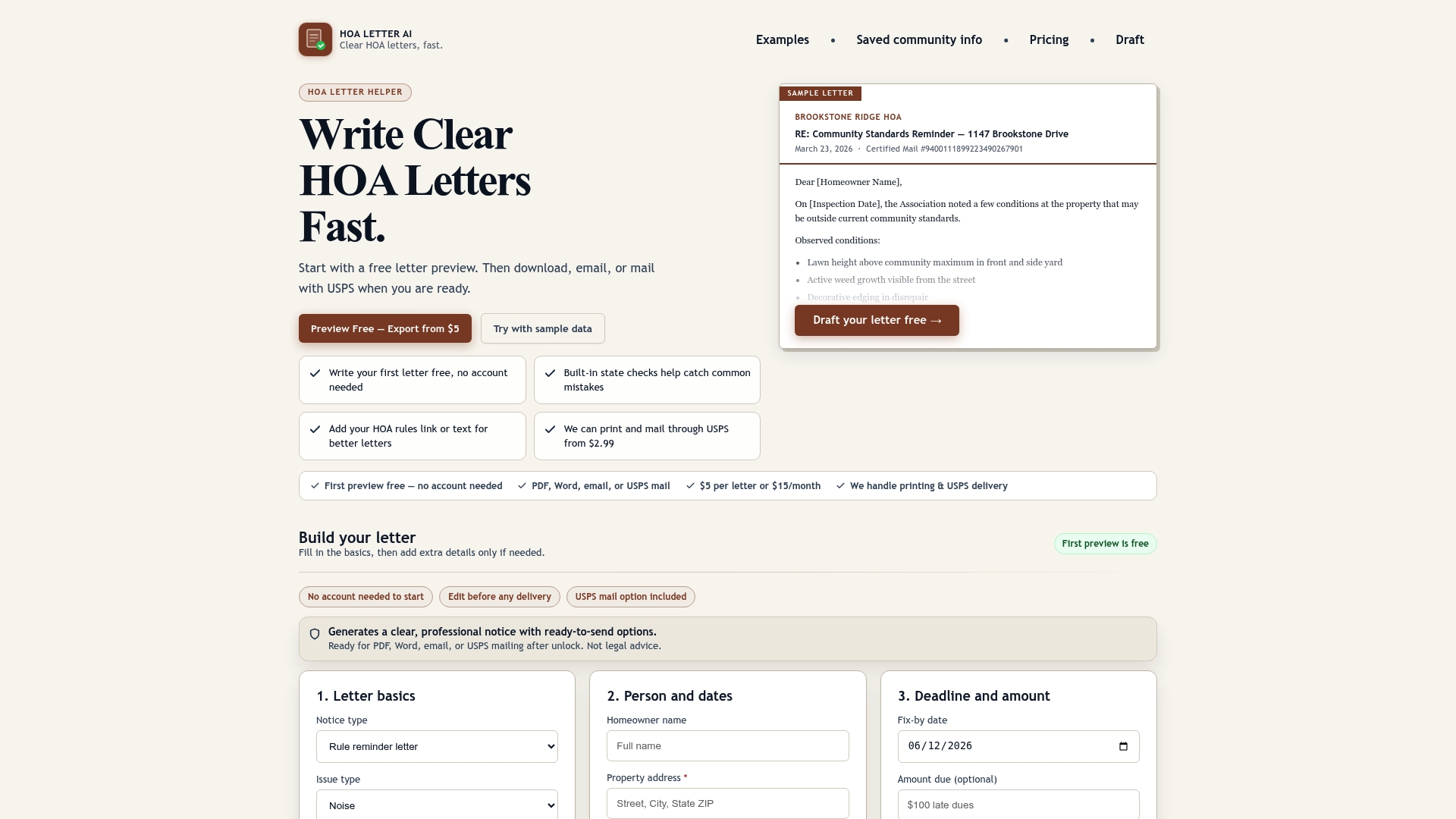
For a single board handling one situation, the $5 letter option lets you generate and preview a notice before paying anything. Property management teams handling multiple communities can use PM Starter or PM Pro for recurring template access across an entire portfolio. Need a paper trail proving the notice was actually delivered? Add optional USPS mailing starting at $2.99 so you have a mailing record alongside your authorization file. Draft your next 96-hour notice, get manager sign-off, and save the record in one pass.
Statutes and Resources Worth Bookmarking
Check California Vehicle Code §22658, Florida Statute 715.07, and your community’s state-specific HOA notice rules. Save a copy of your recorded CC&Rs before disputing any tow.
Sources
There is no single nationwide HOA towing notice period. What controls a specific tow is a layered check across three sources, and skipping any one of them is where most disputes start.
Layer one: state statute. Start with your state’s private-property towing law. California Vehicle Code §22658 allows removal under specific grounds, including a 96-hour notice period after a parking violation, immediate removal for safety hazards, and mandatory written notice to the registered owner plus law enforcement. Florida Statute 715.07 takes a different approach, requiring posted tow-away signage that meets exact size and placement rules before a tow from private property is valid.
Layer two: local ordinance. Cities and counties can layer additional requirements on top of state law, like stricter signage placement or mandatory police notification windows.
Layer three: CC&Rs and rules. An association’s own governing documents can promise more than state law requires, and boards are held to whatever they promised. Guidance from Echo makes clear that when CC&Rs set a stricter notice procedure than the statute demands, the association has to follow its own stricter rule.
Before acting on either side of a dispute, verify:
- MBK Chapman: California HOA towing law fact sheet
- HOAleader: HOAs and parking — what boards should know about towing
FAQ
Can I Sue an HOA for Towing My Car?
Yes, if the tow violated the controlling statute, local ordinance, or your community’s CC&Rs, you may have grounds for a claim. Statutory remedies can include recovery of towing fees or damages, as outlined in analyses of California’s towing law, but the specific remedy depends on your state’s statute.
Can an HOA Tow My Car Without Notice in California?
Only in limited situations. California Vehicle Code §22658 generally requires either posted signage or a 96-hour notice period after a parking violation, though safety hazards like blocked fire lanes can be towed immediately without advance warning.
Can an HOA Tow My Car From My Driveway in Florida?
Generally no, an HOA’s towing authority under Florida Statute 715.07 applies to common areas and lots it controls, not to an owner’s private driveway, unless the community’s CC&Rs specifically extend that authority. Check your recorded governing documents to confirm what your association actually controls.
What Is the 80% Towing Rule?
If you’ve heard this term locally, check your specific state statute and municipal ordinance rather than relying on the informal label.
What Should a Board Include in a Towing Notice Template?
A compliant notice should cite the specific statute or CC&R provision authorizing the tow, describe the vehicle, state the applicable notice timeline, and list where the vehicle will be stored. HOA Letter AI’s warning letter template builds these elements in automatically, based on your state’s requirements.