
Yes, an HOA can issue a commercial vehicle violation letter, but only if recorded CC&Rs or adopted rules actually cover the vehicle in question. If you’re a board member, check the exact rule citation and photograph the violation with a date stamp before sending anything. If you’re the homeowner who got the notice, check that same CC&R section against your vehicle before you assume you’re in the wrong.
TL;DR:
- HOAs can issue vehicle violation letters only if the recorded CC&Rs or rules clearly define and include the specific commercial vehicle in question.
- Enforceability depends on the precision of language, consistency in application, and adherence to state laws, which may override CC&R restrictions.
- Violation notices must include specific details like observation date, exact rule citation, required cure actions, and a firm deadline to be legally solid.
- Respondents should reply in writing before the cure deadline, requesting evidence if disputing fact or law, and avoid informal contacts to create proper records.
- Florida’s recent legal changes protect certain work vehicles, so associations must check state statutes before enforcing bans on vehicles that meet new legal definitions.
HOA Letter AIDraft Clearer HOA Compliance LettersCreate professional notices with guided drafting, state-specific context, community rules, built-in checks, and a one-page preview.Create a compliance letter
Table of Contents
- When Can HOAs Lawfully Restrict Commercial Vehicles?
- How Do You Check Your CC&Rs for Vehicle Restrictions?
- What Should a Commercial Vehicle Violation Letter Include?
- How Should a Homeowner Respond to a Violation Letter?
- What Do State Laws Say About HOA Commercial Vehicle Rules?
- What Do Enforcement Best Practices Look Like in Practice?
- Draft State-Aware Violation Letters Without the Guesswork
- Sources
- FAQ
When Can HOAs Lawfully Restrict Commercial Vehicles?
An HOA’s authority to police what parks in your driveway comes from one place: the recorded covenants, conditions, and restrictions the owner agreed to at closing, plus any rules the board adopted under the authority those documents grant. No CC&R language, no enforcement power. That sounds obvious, but it’s the single most common mistake boards make. A rule the board invented last year that isn’t tied to recorded authority is much easier to challenge than one baked into the original declaration or a properly ratified amendment.
Clear definitions make or break enforceability. Governing documents that specifically define “commercial vehicle” by weight, signage, equipment, or plate type hold up far better than vague language like “no unsightly vehicles.” California HOA guidance compiled by Davis-Stirling notes that courts generally uphold these restrictions when the rules are clear and enforcement is consistent, particularly where aesthetics are the stated concern.
State law adds another layer, and it can override even well-drafted CC&Rs. Florida’s legislature amended §720.3075 through HB 1203, effective July 1, 2024, specifically to stop associations from banning certain work vehicles that don’t meet the state’s legal definition of a commercial motor vehicle, a change covered in more detail below. Other states have their own quirks, and a board that ignores them is asking for a lawsuit.
Jurisdiction matters too. An HOA generally has no authority over a public street, only over private roads, common areas, and individual lots within its recorded boundary. A truck parked on a public street outside the community’s control usually falls outside the association’s reach entirely, even if it’s covered in ladder racks and logos.
Common commercial-vehicle red flags boards typically cite include:
- Visible business signage, logos, or lettering on the exterior
- Ladder racks, tool boxes, or exposed equipment mounted to the vehicle
- Gross vehicle weight or physical size exceeding a stated threshold
- Commercial license plates or DOT numbers displayed on the vehicle
- Trailers, generators, or attached machinery parked alongside the vehicle
Selective enforcement is where boards get themselves in real trouble. If the association lets three landscaping trucks slides but cites the fourth homeowner, that inconsistency becomes the homeowner’s best legal argument and the board’s biggest liability. Courts and arbitrators tend to punish associations that enforce rules against some residents while ignoring identical situations elsewhere in the neighborhood.
How Do You Check Your CC&Rs for Vehicle Restrictions?
Before a board sends a letter, or a homeowner drafts a response, someone needs to actually read the governing documents word for word. Skipping this step is how associations end up rescinding fines and issuing embarrassing apologies.
- Pull the recorded declaration and any amendments. Search for the exact section addressing vehicles, parking, or “commercial” activity, and note the amendment date, since older declarations sometimes predate language that newer amendments override.
- Look for an actual definition. Some CC&Rs spell out “commercial vehicle” with weight limits or signage criteria. If yours doesn’t, check the rules and regulations for supplemental language, since boards often clarify vague covenant terms through adopted policy.
- Confirm the enforcement procedure the documents require. Most declarations specify a notice period, a cure deadline, and hearing rights before any fine takes effect, and skipping a required step can void the entire enforcement action.
- Cross-check state statutes for conflicts. A rule that was perfectly enforceable five years ago may now run into new state protections, as Florida owners discovered in 2024.
- Flag anything ambiguous for legal review. If the CC&Rs and state law seem to contradict each other, that’s a job for the association’s attorney, not a board vote at the next meeting.
Pro Tip: Keep a one-page summary of your community’s actual vehicle rules, in plain English, pinned inside the board’s shared files. It saves everyone from re-reading forty pages of legal text every time a new violation notice needs to go out.
Industry commentary from AMG makes a point worth repeating: many declarations were written decades before ladder-rack pickup trucks and branded work vans became the norm for self-employed tradespeople. Boards operating on that older language are enforcing gray areas, not black-and-white rules, and that gray area is exactly where disputes fester. A short, board-approved vehicle policy appendix that spells out prohibited features, tied back to the recorded authority, closes most of those gaps without a full CC&R amendment.
What Should a Commercial Vehicle Violation Letter Include?
A violation letter that skips even one of the core elements below hands the homeowner an easy way to challenge it, and hands the board a weaker case if the dispute ever reaches a hearing or a courtroom. The goal isn’t to sound intimidating. It’s to create a factual record that would survive scrutiny from a judge who has never seen your community before.
The essential elements
- Date of the letter and the date(s) the violation was actually observed.
- Owner name and property address, matched exactly to association records.
- The specific factual observation, described neutrally: what vehicle, what feature triggered the violation, where it was parked.
- The exact CC&R or rule citation, quoted directly rather than paraphrased.
- The required corrective action, stated plainly (move the vehicle, remove signage, park in an approved area).
- A specific cure deadline, given as a calendar date, not “within a reasonable time.”
- Consequences of noncompliance, including fine schedules or further escalation.
- Hearing rights, with instructions on how and when to request one.
- Signature block, naming the sender and their authority (board member, management company, committee).
Guidance from KindHOA frames this the same way: cite the rule, state the facts with a date, set a cure deadline, and explain what happens next. Skip the rule citation and you’ve written a complaint, not an enforceable notice.
Evidence that actually holds up
Photos matter more than most boards realize, but only if they’re done right. Take one wide shot showing the vehicle in context (driveway, street, unit number visible) and one close-up of the specific violating feature, like signage or a ladder rack, with a visible timestamp. Keep an inspector’s written note logging the date, time, and observer. And always keep proof of delivery, whether that’s a certified mail receipt, a signed portal confirmation, or an email read receipt, because a letter nobody can prove was received is a letter that didn’t legally happen.

The escalation ladder
Most defensible enforcement programs use three tiers, and jumping straight to tier three is a common overreach that erodes trust in the board.
| Stage | Tone | Typical content |
|---|---|---|
| Courtesy notice | Friendly, informational | Brief description of the issue, informal request to correct, no fine mentioned |
| Official notice | Firm, factual | Rule citation, cure deadline, warning of possible fine |
| Final notice | Formal, procedural | Fine amount or schedule, hearing rights, next enforcement step |
AllPropertyManagement’s template guidance backs this up: a neutral, respectful tone on the first notice resolves the overwhelming majority of these situations before they ever reach a hearing.
Sample wording you can adapt
Courtesy notice snippet: “During a recent community walkthrough, we noticed a vehicle displaying commercial signage parked at [address]. Section [X] of the Community Rules asks that vehicles meeting this description be parked in the designated area. We’d appreciate your help resolving this by [date] and are happy to answer questions.”
Official notice snippet: “This letter serves as official notice that the vehicle at [address], observed on [date] and documented in the attached photograph, violates Section [X] of the Declaration of Covenants, Conditions, and Restrictions, which prohibits [exact rule language]. Please correct this by [specific calendar date]. Failure to do so may result in a fine of $[amount] per the Association’s fine schedule.”
Homeowner response snippet (accepting and curing): “Thank you for the notice dated [date]. I will relocate the vehicle referenced by [date] and confirm completion in writing.”
A parking-specific starting point, including guest, street, RV, and boat scenarios, is available through HOA Letter AI’s parking violation letter template, which already builds in most of the elements above.
How Should a Homeowner Respond to a Violation Letter?
Getting a violation letter doesn’t mean you have to accept it at face value, but it does mean the clock is running. Read the cure deadline first, then decide which of three paths fits your situation.
- If the notice is accurate, respond in writing before the deadline with a clear plan and a completion date. A simple, documented “I’ll fix this by Friday” response closes most cases without a fine ever being issued.
- If you’re disputing the facts, request the exact rule text the board is citing and ask what evidence supports the claim. You’re entitled to see what they’re relying on.
- If you believe a state law protects your vehicle, such as Florida’s work-vehicle protections discussed below, ask the board in writing to explain its legal basis for the notice and request a hearing before any fine is finalized.
Pro Tip: Never respond by phone or in a hallway conversation only. Put your response in writing, even a short email, so there’s a dated record showing you engaged with the notice instead of ignoring it.
Sample contesting response: “I received the notice dated [date] regarding an alleged commercial vehicle violation. My vehicle, a [make/model], does not display commercial signage and is registered as a personal vehicle. I’m requesting the specific rule citation and any photographic evidence supporting this notice, and I’d like to schedule a hearing if this matter proceeds.”
More detail on structuring a full reply, including timelines and what to attach, is available in HOA Letter AI’s guide to responding to an HOA compliance notice.
What Do State Laws Say About HOA Commercial Vehicle Rules?
Florida gives boards and homeowners the clearest recent example of a state stepping in to limit HOA authority. HB 1203, effective July 1, 2024, amended §720.3075 to stop associations from prohibiting certain work vehicles from being kept on an owner’s own lot, so long as the vehicle doesn’t meet Florida’s statutory definition of a commercial motor vehicle. In plain terms, a landscaper’s pickup with a small trailer hitch might be protected, while an actual box truck or dump truck likely isn’t. Boards enforcing older, broader “no commercial vehicles” language need to check whether their rule now conflicts with this statute.
That said, Florida’s rule isn’t a national standard. Other states handle this differently, and some have no comparable statute at all, so a Florida-specific protection tells you nothing about enforceability in Texas or Ohio.
- Confirm whether your state has passed anything similar to HB 1203 before assuming a work vehicle is automatically exempt.
- Treat any apparent conflict between state statute and CC&R language as a legal-review question, not a board-vote question.
- Pause active enforcement, including pending fines, until counsel issues a written opinion when a statute might override your governing documents.
HOA Letter AI’s state law reference tracks notice requirements and fine rules by state, which is a faster starting point than searching statute databases cold.
What Do Enforcement Best Practices Look Like in Practice?
Most disputes over commercial vehicles trace back to one root cause: vague rules paired with inconsistent enforcement, as explained in Short Term Rental Compliance for Owners and Families. A board that adopts a clear, one-page vehicle policy, listing prohibited signage, equipment, and size thresholds, and gets it formally ratified, closes off most of the ambiguity that fuels these fights. That policy should be coordinated with legal counsel, especially in states where recent statutory changes might narrow what the association can restrict.

Recordkeeping is the other half of the equation. A defensible violation file has dated photos, delivery receipts for every notice sent, and hearing minutes if the matter escalated. Boards that keep this consistently, for every vehicle violation and not just the contentious ones, are the boards that win selective-enforcement challenges. That consistency is also where a tool like HOA Letter AI earns its place: state-aware templates cut down on missing elements, and built-in delivery tracking means the association has proof of service without someone digging through a filing cabinet six months later.
The AMG commentary referenced earlier makes a broader point that applies to any board managing decades-old governing documents: rules written before ladder-rack trucks and branded vans became standard equipment for tradespeople need updating, not just enforcing. Clarify the language before you cite it.
— Blake
Draft State-Aware Violation Letters Without the Guesswork
There are software tools that provide faster and more reliable alternatives to drafting these letters from scratch in a word processor, integrating state-specific context and built-in checks for elements that hold up: rule citation, dated facts, cure deadline, and hearing rights.
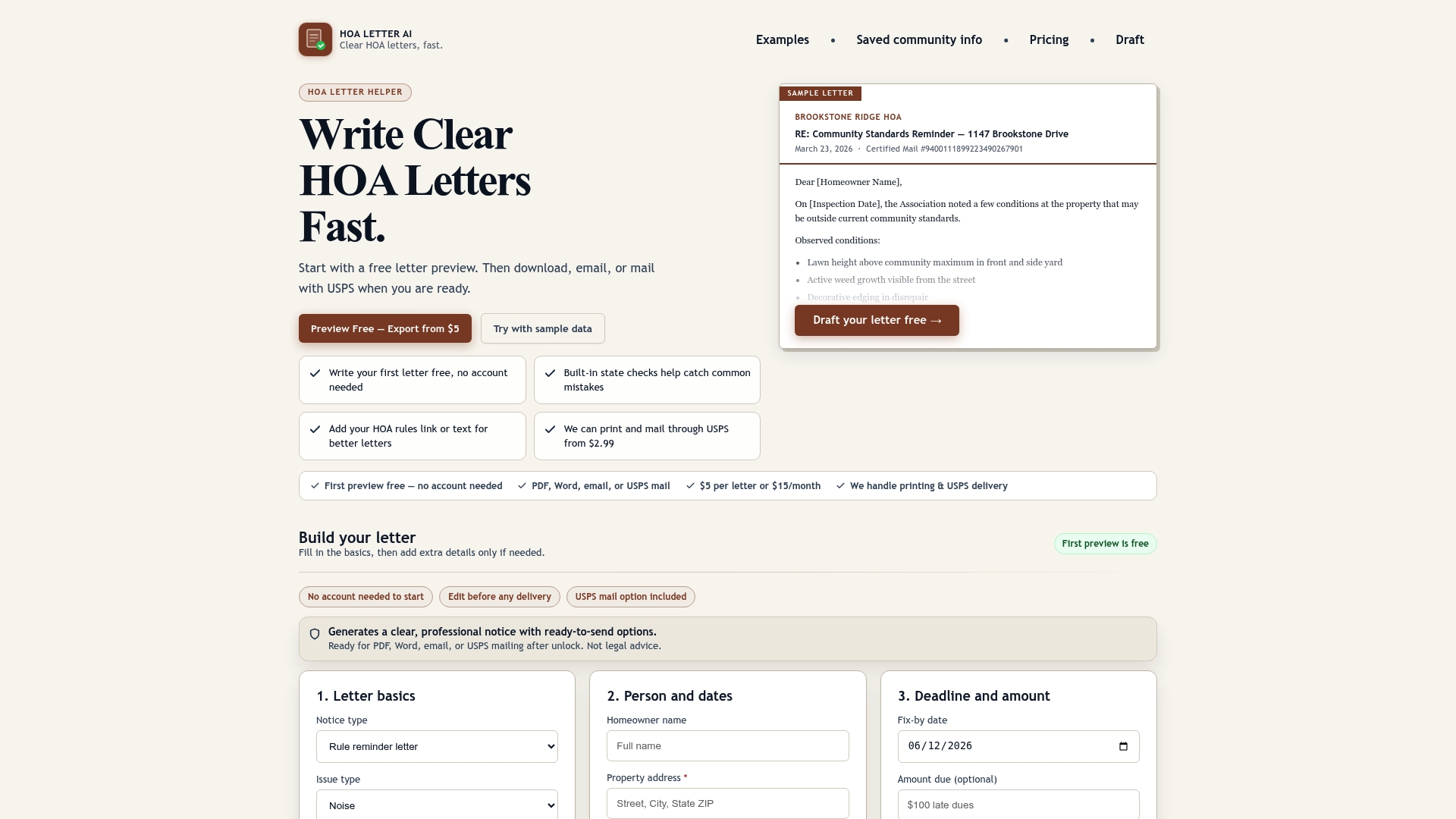
If you need to send a courtesy notice before fines even come into play, the HOA warning letter template builds that first-tier notice in minutes, with a free one-page preview before you commit to sending anything. Attach your dated photos, generate the letter, and send it through the built-in mail delivery option so you have a certified record without a separate trip to the post office. Property managers juggling multiple communities can review the state law reference alongside board packages, and teams sending high volumes of notices can check the pricing page for unlimited monthly letters. Start by previewing your next notice for free and see whether it already meets your state’s requirements.
Sources
This article draws on Florida’s legislative amendment to §720.3075, California HOA guidance from Davis-Stirling, and violation-letter template guidance from KindHOA, AllPropertyManagement, and The HOA Guide. Always verify current statutes and consult association counsel for decisions specific to your community.
- Davis-Stirling: Trucks & Recreational Vehicles (Commercial Vehicles guidance)
- How to write an HOA violation notice: Free template (KindHOA)
- Writing a Friendly HOA Violation Letter (Template) | AllPropertyManagement
FAQ
Are commercial vehicles allowed in Florida HOAs?
It depends on the vehicle. Florida’s HB 1203 amendment to §720.3075, effective July 1, 2024, protects certain work vehicles that don’t meet the state’s commercial motor vehicle definition, but larger trucks that do meet that definition can still be restricted.
How do you write an HOA violation letter?
Cite the exact CC&R or rule, state the observed facts with a date, attach photo evidence, set a specific cure deadline, explain the consequences of noncompliance, and include instructions for requesting a hearing, following the structure outlined by KindHOA.
How should you respond to an HOA violation letter?
Respond in writing before the deadline: confirm you’ll cure the issue with a completion date, or request the specific rule citation and evidence if you’re disputing the claim, and ask for a hearing if fines are involved.
What happens if you get a letter from the HOA?
You typically have a set cure period, defined in your governing documents, to correct the issue before fines or further action begin; check your CC&Rs for the exact deadline and hearing rights rather than assuming a fine is automatic. HOA Letter AI’s guide to responding to a compliance notice walks through the full timeline step by step.