
Tracking compliance letter responses is the process of documenting, monitoring, and following up on every notice your HOA sends until the issue is fully resolved. Without a consistent system, boards lose visibility into which homeowners have responded, which deadlines have passed, and which cases need escalation. The industry term for this practice is compliance response management, and it covers everything from delivery confirmation to audit trail documentation. Boards that treat it as a formal process, not an afterthought, resolve violations faster and face far fewer disputes.
What tools and systems are best for tracking compliance letter responses?
The right tool depends on your volume and your board’s capacity. A small HOA with a handful of annual violations can manage with a well-structured spreadsheet. A larger community with dozens of open cases needs something more.
Delivery confirmation is the foundation of any tracking system. IRS procedural guidance requires using registered or certified mail with carrier tracking to secure proof of delivery, because agencies do not confirm receipt status on your behalf. That principle applies directly to HOA compliance mail. If you cannot prove a letter arrived, you cannot enforce a deadline.
Automating certified mail processing eliminates human error and produces court-defensible proof of mailing. That matters when a homeowner disputes receiving a notice or when a case escalates to a hearing.

The table below compares three common tracking approaches by feature category.
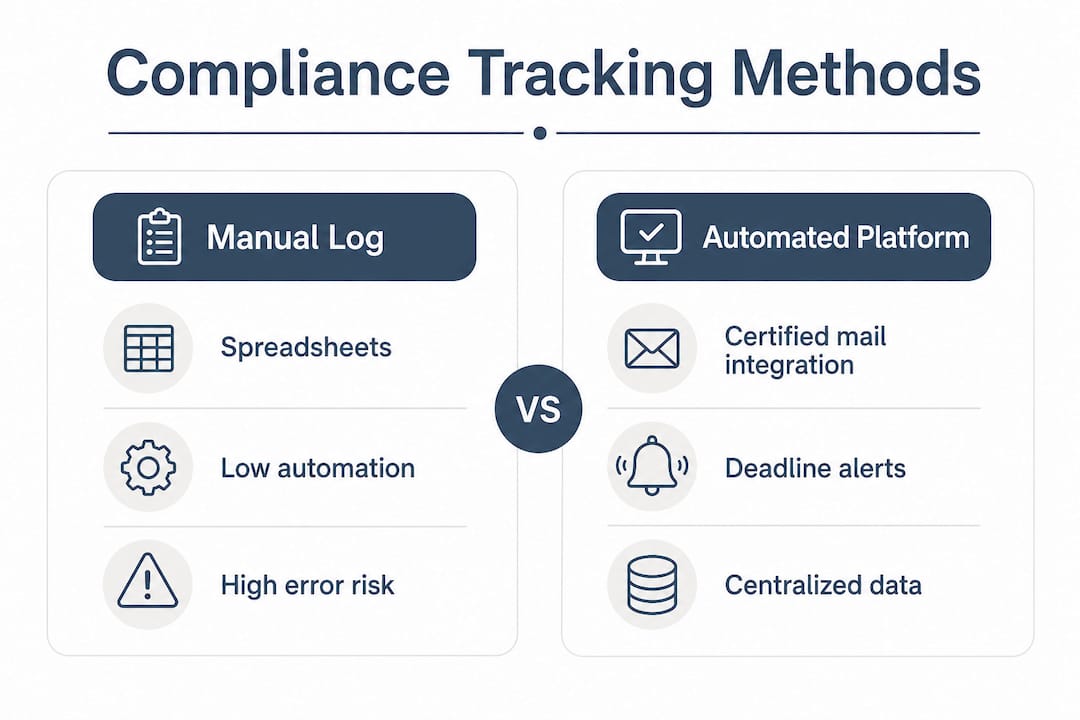
| Feature category | Manual log (spreadsheet) | Certified mail system | Automated compliance platform |
|---|---|---|---|
| Delivery confirmation | No | Yes, physical receipt | Yes, electronic proof |
| Deadline alerts | Manual reminders | None | Automated alerts |
| Audit trail | Partial, error-prone | Limited | Full, timestamped log |
| Escalation triggers | Manual | None | Automated |
| Cost | Low | Moderate | Moderate to high |
Pro Tip: Automate at least one step, even if you use a spreadsheet for everything else. Setting a calendar alert tied to each letter’s response deadline cuts missed deadlines significantly.
A centralized repository is the other non-negotiable. Siloed tracking, where one board member holds delivery records and another tracks responses, creates gaps that undermine your credibility in a dispute. Every letter, every delivery receipt, and every response must live in one place.
How to establish an organized workflow for monitoring compliance letter responses
A repeatable workflow removes guesswork from compliance response management. The steps below reflect standards used in regulated industries, adapted for HOA use.
- Log the letter immediately on the send date. Record the homeowner’s name, address, violation type, letter date, and the method of delivery. This is your baseline record.
- Confirm delivery using trackable mail. Registered mail and certified mail both provide electronic proof. Link that proof directly to the original letter record. Linking delivery confirmation to compliance records eliminates delivery blind spots and reduces unnecessary follow-up.
- Set a response deadline. Standard HOA compliance timeframes vary by state, but 30 days is a widely used benchmark. Corrective action plans in regulated industries carry a 30-day completion window to maintain credibility. Use that same logic for HOA violations. For data breaches or sensitive matters, HIPAA breach notifications require a 60-day response deadline tracked from the date of discovery.
- Assign a responsible board member. Every open case needs one owner. That person checks the log weekly and flags cases approaching the deadline.
- Log every response received. Record the date received, the content of the response, and whether it satisfies the violation. Attach any photos, written statements, or repair receipts the homeowner provides.
- Update the status clearly. Use simple labels: Open, Response Received, Under Review, Resolved, or Escalated. Ambiguous status labels cause confusion during board meetings.
- Close or escalate on the deadline date. If no response arrives by the deadline, escalate immediately per your board’s enforcement policy.
Pro Tip: Write your escalation policy before you need it. Define exactly what happens on day 31: a second notice, a fine, or a hearing notice. Boards that decide this in advance act faster and more consistently.
Maintaining a unified log that links original letters, response submissions, and verification evidence is the single most important structural decision you can make. A single source of truth connecting all documents prevents the siloed tracking that weakens audit credibility. Review your compliance letter formatting standards regularly to make sure every letter you send includes the information homeowners need to respond correctly.
What are common challenges in compliance letter response tracking?
Most tracking failures come from the same small set of problems. Recognizing them early lets you fix the process before a dispute exposes the gap.
Missed deadlines from manual tracking. Manual tracking creates “operational blindness,” where due dates slip because no one receives an automatic alert. A spreadsheet with no reminder system is only as reliable as the person checking it.
Delivery blind spots. Confirming that a letter reached a mailbox is not the same as confirming the homeowner read and understood it. Delivery tracking confirms mailbox delivery but not content review. Linking your delivery confirmation directly to your compliance record closes that gap and reduces unnecessary re-mailing.
Siloed tracking across board members. When different people track different parts of the same case, data becomes inconsistent. One board member marks a case resolved while another is drafting a second notice. Siloed tracking weakens response quality and audit credibility. A shared log with a single status field fixes this immediately.
Incomplete audit trails. Regulators and hearing officers want to see who reviewed a response, what decision was made, and when. Failing to log those decisions creates a gap that looks like negligence. Audit trails of the compliance monitoring process are frequently reviewed during disputes and formal hearings.
Here are four corrections boards can apply right now:
- Move all open cases to a shared document or platform that every board member can access.
- Add a “Decision Log” column to your tracking sheet that records who reviewed each response and what action followed.
- Set a recurring weekly calendar event for the responsible board member to review all open cases.
- Archive closed cases with all supporting documents attached, not just a status label.
How does technology improve compliance letter tracking and monitoring?
Technology does not replace good process. It makes good process easier to maintain consistently. Automated compliance monitoring ensures timely control updates and evidence collection in ways that manual methods cannot match at scale.
The core benefit is visibility. A dashboard that shows every open case, its current status, and its deadline date gives board members a real-time picture of the community’s compliance health. Without that view, boards react to problems. With it, they prevent them.
Automated alerts are the second major gain. When a response deadline is three days away, the system notifies the responsible board member. When a deadline passes with no response logged, the system triggers an escalation flag. That removes the human variable from the most failure-prone step in the process.
Electronic proof of mailing is the third. Court-defensible proof of mailing from automated certified mail systems withstands subpoena better than manual logs. If a homeowner challenges a fine in a hearing, you present a timestamped electronic record, not a handwritten note.
| Technology feature | What it does | Why it matters for HOAs |
|---|---|---|
| Automated deadline alerts | Notifies board member before due date | Prevents missed response windows |
| Electronic proof of mailing | Timestamped delivery confirmation | Court-defensible documentation |
| Centralized case dashboard | Single view of all open cases | Eliminates siloed tracking |
| Escalation triggers | Auto-flags overdue responses | Speeds up enforcement action |
| Audit trail logging | Records all decisions and reviews | Supports hearing and dispute defense |
For HOA boards that want to understand the legal framework before choosing a tool, reviewing HOA violation letter laws by state gives you the notice requirements and fine rules that your tracking system must support.
Key Takeaways
Effective compliance response management requires a unified log, delivery proof, clear deadlines, and automated alerts working together as a single system.
| Point | Details |
|---|---|
| Use trackable delivery methods | Certified or registered mail provides court-defensible proof that a letter was delivered. |
| Set a 30-day response deadline | A 30-day window is the standard benchmark for corrective action in compliance workflows. |
| Centralize all case records | One shared log linking letters, responses, and decisions prevents siloed tracking errors. |
| Automate deadline alerts | Automated reminders remove the human variable from the most failure-prone step. |
| Log every decision made | Recording who reviewed a response and what action followed protects the board in disputes. |
Why disciplined tracking is the difference between enforcement and chaos
I have seen HOA boards spend months in disputes that a single well-kept spreadsheet would have ended in a week. The homeowner claims they never received the letter. The board cannot produce a delivery receipt. The case collapses. That is not a legal problem. It is a documentation problem.
The boards that handle compliance well share one habit: they treat every letter as the start of a case file, not the end of a task. From the moment a letter goes out, they are building a record. Delivery confirmation, response date, decision made, follow-up sent. Every step logged, every document attached.
What I find most underappreciated is the value of cross-functional collaboration. The best-run boards I have observed include the property manager, at least one board member, and a legal advisor in the same tracking loop. Not in every conversation, but in the same system. When a dispute reaches a hearing, everyone pulls from the same record. There are no contradictions, no missing pieces.
Automation is not a luxury for large communities. Even a small board with 50 homes benefits from a system that sends one automatic reminder when a deadline is approaching. That one reminder prevents the most common failure in compliance tracking: the case that everyone assumed someone else was watching.
The boards that resist building a formal tracking process usually cite time as the reason. The irony is that disputes caused by poor tracking consume far more time than the system would have required to maintain.
— Blake
Hoaletterai makes compliance letter management easier
HOA boards spend real time writing, sending, and following up on compliance letters. Hoaletterai cuts the time spent on the writing and sending steps so boards can focus on tracking and resolution.
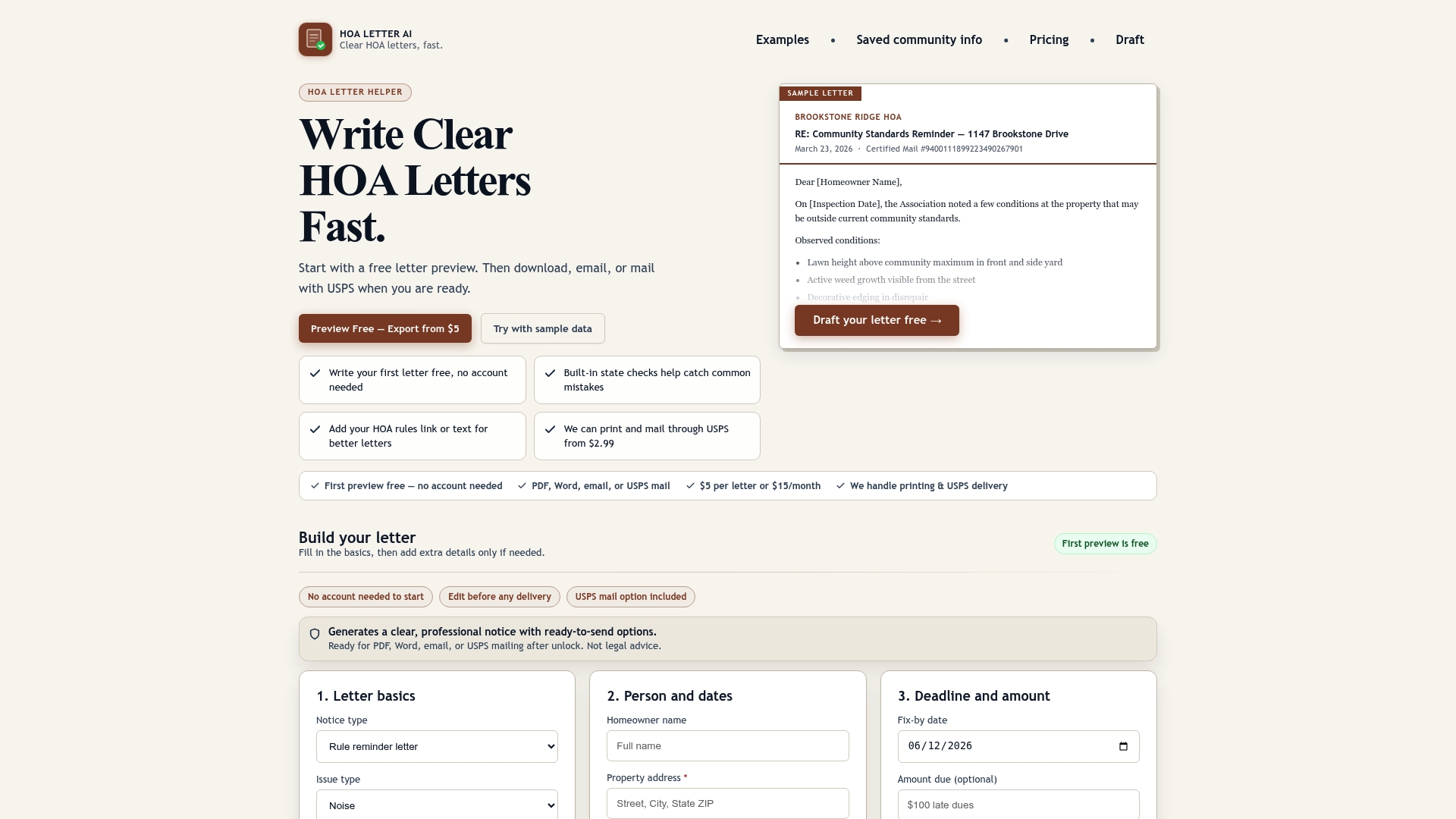
Hoaletterai generates state-compliant violation letters in minutes, with built-in formatting checks and USPS mailing options that create a delivery record from the start. Every letter includes the clear language homeowners need to understand what is required and when. That clarity reduces the back-and-forth that slows down resolution. Boards can also use the HOA violation letter generator to preview letters before sending, catching errors before they become disputes. For boards that want to understand the legal requirements behind every notice they send, the HOA laws by state resource covers notice requirements and fine rules across all 50 states.
FAQ
What is compliance letter response tracking?
Compliance letter response tracking is the process of documenting delivery, monitoring deadlines, and logging homeowner responses for every compliance notice an HOA sends. The goal is a complete audit trail from the date the letter goes out to the date the issue is resolved.
How long should homeowners have to respond to a compliance letter?
Thirty days is the standard benchmark for corrective action responses in compliance workflows. Some states set specific timeframes by law, so boards should check their state’s HOA violation notice requirements before setting deadlines.
Why is certified mail important for HOA compliance letters?
Certified mail provides proof of delivery that agencies and courts accept as evidence. Without it, a homeowner can claim they never received a notice, and the board has no way to counter that claim.
What happens if a homeowner does not respond by the deadline?
The board should follow its written escalation policy, which typically means issuing a second notice, scheduling a hearing, or initiating a fine. Boards that define this policy in advance act faster and more consistently than those that decide case by case.
How do I avoid gaps in my compliance tracking audit trail?
Log every decision, not just every letter. Record who reviewed each response, what action was taken, and when. Audit trails that capture the full review process are the records most frequently examined during formal disputes and hearings.
Recommended
- Responding to an HOA Compliance Notice: 2026 Guide | HOA Letter AI
- Why HOA Letters Require Response: Protect Your Rights | HOA Letter AI
- HOA Landscaping Violation Response Letter (State-Compliant HOA Letter) | HOA Letter AI
- HOA Noise Complaint Response Letter (State-Compliant HOA Letter) | HOA Letter AI