
In Utah, homeowners association boards must follow specific statutory notice timelines. The two that carry the most legal weight: 15 days’ notice before adopting a rule change, and 30 calendar days’ notice before filing a nonjudicial foreclosure. Before drafting anything, confirm what your governing documents require, update your registration contact information, and start documenting exactly how and when you deliver every notice.
TL;DR:
- Utah HOAs must give at least 15 days’ notice before considering rule changes and distribute the final version within 15 days of adoption.
- Nonjudicial foreclosure requires a 30-day certified mail notice with statutory content, and layered notices are viewed more favorably under scrutiny.
- Owners can request notice by mail at any time, and associations must honor these requests, documenting delivery methods to ensure compliance.
- Virtual or hybrid meeting notices must specify access platforms, login details, and participation methods to avoid defects.
- Proper recordkeeping, including delivery logs and documented notice procedures, is critical to defend against procedural challenges and avoid invalidating actions.
HOA Letter AIDraft Clearer Utah HOA NoticesCreate professional compliance letters with guided drafting, state-specific context, community rules, built-in checks, and delivery options.Create a compliance letter
Table of Contents
- What Are Utah HOA Notice Requirements at a Glance?
- Meeting Notice Rules for Boards and Members
- How Do You Change HOA Rules Under Utah Law?
- Collections, Liens, and Nonjudicial Foreclosure Notices
- What Delivery Methods Count as Fair and Reasonable?
- Registration, Renewal, and Recordkeeping Rules
- Building a Practical Notice Timeline and Content Checklist
- Do Emergency Meetings Follow Different Notice Rules?
- What Happens if an HOA Fails to Give Proper Notice?
- Should Virtual and Hybrid Meetings Get Special Notice Language?
- Reduce Disputes by Adopting Conservative Notice Practices
- How HOA Letter AI Helps Boards Send Compliant Notices
- Key Utah Statutes and Advisory Opinions to Bookmark
- Sources
- FAQ
What Are Utah HOA Notice Requirements at a Glance?
Utah HOA notice requirements come from a mix of statute and governing documents, and the deadlines vary depending on what the notice is for. Here’s the checklist boards and property managers actually used to stay compliant.
- Rule changes: 15 days’ notice before the board meeting where the rule will be considered; distribute the adopted rule within 15 days of the vote, per Utah Code §57-8a-217.
- Board meetings: Owners who submit a written request are entitled to short notice before that specific meeting.
- Member meetings: Governing documents typically set a 10-day minimum, though associations often extend this voluntarily.
- Delinquency and lien enforcement: The lien itself is automatic once the declaration is recorded, but enforcement steps require fair and reasonable notice to the owner.
- Nonjudicial foreclosure: 30 calendar days’ notice before filing, delivered by certified mail with statutory content, under §57-8a-303.
- Owner mail requests: Any owner can demand notice by mail in writing, and the association has to honor it going forward.
The enforcement-sensitive steps are the ones tied to money: liens and foreclosure. Advisory opinions from the state Ombudsman’s office show that regulators scrutinize procedural timing on these notices closely, even when the underlying debt is undisputed. Registration deadlines matter too. Annual HOA registration renewal is now required, and missing it can complicate everything from payoff requests to dispute resolution.
Meeting Notice Rules for Boards and Members
Utah splits meeting notice into two tracks: board meetings and member meetings, and the rules differ depending on who’s attending and why.
For board meetings, the default rule doesn’t require formal advance notice to every owner. But if an owner submits a written request to receive notice of board meetings, the association must give that owner at least 48 hours’ notice before each one. That’s a low bar, but it’s one the association frequently misses because they don’t track who has asked. Once an owner makes that request, it needs to go into your records permanently, not just for the next meeting.

Member meetings work differently. Most governing documents set a minimum of 10 days’ advance notice, and many require up to 60 days for annual meetings involving elections or budget votes. Check your bylaws first. Utah law generally lets associations set their own timeline for member meetings, provided it meets or exceeds any statutory floor, so a stricter internal rule always wins over a looser one.
A compliant meeting notice should include:
- The date, time, and physical location of the meeting.
- The agenda items to be discussed, particularly anything requiring a vote.
- Instructions for remote or electronic access, if the meeting will be hybrid or virtual.
- A statement clarifying whether attendance is required for voting eligibility.
Document delivery every time. If you emailed a notice, save the send confirmation. If you mailed it, keep the certificate of mailing or tracking number. When electronic access is offered, disclose the platform and login method in the notice itself, not in a follow-up message. Boards that treat this as a formality tend to be the ones fielding Ombudsman complaints a year later.
How Do You Change HOA Rules Under Utah Law?
Utah Code §57-8a-217 lays out a specific sequence for adopting or amending community rules, and skipping a step can void the change even if the board’s intent was reasonable.
- Give 15 days’ notice to homeowners before the board meeting where the proposed rule will be considered. The notice should describe the proposed change in enough detail that an owner can meaningfully respond.
- Allow homeowner comment at the noticed meeting. Advisory Opinion 2026-03 confirms this comment period is not optional. The board has authority to adopt rules, but only after giving owners a real chance to weigh in at that meeting.
- Adopt the rule by board vote, following whatever quorum and voting procedures your bylaws specify.
- Distribute the final rule within 15 days of adoption. This is a separate deadline from the pre-meeting notice, and boards sometimes confuse the two.
- Track the 60-day disapproval window, if your governing documents give homeowners the right to petition against a rule after it’s adopted. Some declarations set this mechanism up; others don’t, so check yours specifically.
If your CC&Rs or bylaws impose a longer notice period or a broader comment process than the statute requires, follow the stricter one. Utah’s baseline is a floor, not a ceiling, and governing documents routinely add requirements on top of it.
Collections, Liens, and Nonjudicial Foreclosure Notices
An association’s lien for unpaid assessments in Utah is automatic once the declaration is recorded. The board doesn’t need to file a separate document to create the lien, but enforcing it is a different matter entirely, and that’s where notice requirements get strict.
Before an association pursues nonjudicial foreclosure, Utah Code §57-8a-303 requires at least 30 calendar days’ notice to the lot owner. That notice has to follow a statutory form and be delivered by certified mail. This isn’t a suggestion. Miss the 30-day window, use the wrong delivery method, or omit required content, and the foreclosure can be challenged on procedural grounds regardless of whether the owner actually owes the money.
Advisory Opinion 2026-30 offers a useful data point here: the Ombudsman’s office found that certified mail combined with a prior email notification met the “fair and reasonable” standard for a collection notice in the circumstances presented. That’s not a blanket rule for every case, but it signals that layered notice, meaning more than one delivery method used together, tends to hold up better under scrutiny than a single method alone.
Key notice steps in a typical delinquency escalation:
- Initial delinquency notice: Informal, often by email, stating the amount owed and due date.
- Formal demand or lien notice: Fair and reasonable delivery, often certified mail plus email.
- Pre-foreclosure notice: 30 calendar days, certified mail, statutory content required.
- Tenant payment redirect: If the property is rented, the association can send the owner a 15-day notice of intent to redirect rent payments; if unresolved, a follow-up notice to the tenant can require rent to be paid directly to the association until the debt is satisfied.
The tenant redirect mechanism catches boards off guard because it involves a third party who has no direct relationship with the association. Get the 15-day owner notice right first. Skipping straight to the tenant notice without it undermines the whole process.
What Delivery Methods Count as Fair and Reasonable?
Utah statutes don’t mandate one single delivery method for most notices. Instead, the standard is “fair and reasonable,” which gives boards flexibility but also creates ambiguity that advisory opinions have had to fill in case by case.
Certified mail has consistently been treated as reasonable, including in combination with email under Advisory Opinion 2026-30. Governing documents or the Utah Revised Nonprofit Corporation Act can authorize specific delivery methods, like email as the default. But any owner can override that by submitting a written request demanding notice by mail, and once they do, the association has to honor it for every future notice to that owner.
Practical proof of delivery to keep on file:
- Certified mail return receipts (the green card or its digital equivalent).
- Email delivery and read receipts, where your system logs them.
- Postal tracking numbers for anything sent by mail.
- Screenshots or printouts of notices posted to a resident portal or community bulletin.
- Board minutes documenting when and how a notice was authorized and sent.
Pro Tip: Keep a running log of every owner who has requested mail delivery, separate from your general contact list. When that request gets buried in an email inbox instead of a dedicated file, boards end up sending electronic notices to someone who’s entitled to paper, which can undo an otherwise valid enforcement action.
Registration, Renewal, and Recordkeeping Rules
Utah now requires associations to renew their HOA registration annually, and recent legislative updates expanded what that registration has to include. The required fields cover the association’s basic information, board chair contact, property manager contact, a payoff contact person, and a disclosure statement addressing reinvestment or administrative fees.
Outdated registration information has shown up repeatedly in Ombudsman disputes, particularly when a homeowner tries to get a payoff statement and can’t reach anyone listed on file. That’s a preventable problem. Update your registration through the Utah HOA Registry whenever your management contact or board chair changes, not just once a year at renewal.
Records worth keeping and how long:
- Mailing and delivery logs: At least three years, longer if a dispute is pending.
- Adopted rules and amendment history: Permanently, or for the life of the governing documents.
- Board and member meeting minutes: At least seven years.
- Financial and assessment records: At least seven years, per typical association practice.
The Ombudsman’s office generally won’t review alleged procedural defects that are more than a year old at the time a request is filed, so timely recordkeeping isn’t just good practice. It’s often the only way to defend a decision after the fact, per guidance on requesting an advisory opinion.
Building a Practical Notice Timeline and Content Checklist
A working timeline turns statutory deadlines into concrete actions your board can actually follow without re-reading the code every time.
- 60+ days before a rule vote: Draft the proposed rule and circulate it internally for board review.
- 15 days before the meeting: Send formal notice to all homeowners describing the proposed rule change.
- At the meeting: Open the floor for homeowner comment before the board votes.
- Within 15 days after adoption: Distribute the final rule text to every homeowner.
- For delinquencies: Send an initial notice, escalate to certified mail if unpaid, then observe the 30-day window before initiating foreclosure.
Each notice type needs specific content. A rule-change notice should cite the governing section being amended and the statutory basis under §57-8a-217. A collection notice should state the exact amount owed, the date it became due, and the association’s payoff contact. A foreclosure notice must follow the statutory form under §57-8a-303 without shortcuts.
Customize every template to match your own CC&Rs and bylaws, since Utah’s statutory minimums are a floor, not a script. Avoid language that overstates the board’s authority or threatens consequences the governing documents don’t actually support. Overreach in a notice can undercut enforcement just as badly as missing a deadline.
Do Emergency Meetings Follow Different Notice Rules?
Emergency meetings operate under a shortened notice standard, but “emergency” has to mean something real, not just an inconvenient scheduling gap. Most governing documents define an emergency as a situation posing an immediate threat to health, safety, or the association’s finances, something a normal notice period genuinely could not accommodate.
For a true emergency, boards can typically act with far less advance notice than the 48 hour or 10 day minimums that apply to regular meetings, sometimes calling a meeting with only a few hours’ warning if circumstances demand it. Even then, the association should still attempt reasonable notice given the timeframe, whether that’s a phone call, a mass text, or a same-day email, and should document why the emergency designation applied.
The risk with emergency meetings isn’t usually the shortened timeline itself. It’s boards using “emergency” loosely to sidestep the comment period required for rule changes or to rush a vote that could have waited two weeks. Advisory opinions and courts tend to look skeptically at emergency designations used to avoid statutory notice rather than respond to a genuine, time-sensitive threat. If a board calls an emergency meeting, minutes should specify the exact nature of the emergency and why standard notice wasn’t feasible. That record becomes the association’s defense if the decision is ever challenged later.
What Happens if an HOA Fails to Give Proper Notice?
A notice defect doesn’t just create paperwork problems. It can invalidate the underlying action, even when the board’s substantive decision was entirely reasonable.
For rule changes, a rule adopted without proper 15-day notice or without a genuine comment opportunity can be challenged and struck down, forcing the board to restart the entire process. For collections and liens, improper notice can delay or block enforcement entirely. A nonjudicial foreclosure filed without the required 30-day notice, correct statutory content, or certified-mail delivery under §57-8a-303 is vulnerable to being set aside, regardless of whether the homeowner actually owes the assessment.

Homeowners have a formal path to challenge notice failures: filing a request for an advisory opinion with the Utah Department of Commerce’s Office of the Homeowners’ Association Ombudsman. These opinions aren’t binding court judgments, but they carry real weight in later litigation and often shape how associations adjust their practices going forward. Boards that lose an advisory opinion on procedural grounds typically face the cost of redoing the entire process, on top of any legal fees from a dispute that could have been avoided with a properly timed notice.
The Ombudsman’s office generally won’t hear complaints about defects older than one year, which cuts both ways. It gives associations some finality, but it also means homeowners need to act fast if they believe a notice was mishandled.
Should Virtual and Hybrid Meetings Get Special Notice Language?
Yes. Utah law allows associations to hold meetings electronically or in a hybrid format, but the notice has to disclose exactly how owners can participate, not just that a meeting is happening.
A notice for a virtual or hybrid board or member meeting should specify the platform being used, the login or dial-in information, and whether voting can occur remotely or requires physical presence. If only some owners can access the technology, the association should address how those owners can still participate meaningfully, whether through a call-in option or a paper ballot alternative. Leaving this vague is one of the more common notice defects boards create for themselves.
Document delivery of the access information the same way you’d document delivery of the notice itself. If the login link changes or the platform goes down before the meeting, send a follow-up notice with corrected information and log that separately. Boards sometimes treat the technical logistics as an afterthought distinct from the “real” notice, but if the access information itself was faulty, it can undermine the validity of the entire meeting, since owners who couldn’t log in were effectively denied notice in any usable form.
Reduce Disputes by Adopting Conservative Notice Practices
The boards that avoid Ombudsman complaints aren’t the ones with the cleverest legal reading of Utah Code. They’re the ones who default to the stricter standard every time there’s ambiguity: certified mail over email alone for anything involving money, documented delivery for every notice type, and a habit of rereading governing documents after each legislative session rather than assuming last year’s process still applies.
Reconcile your bylaws with the statute after every update, not just when a dispute forces you to. Use the same notice template every time so gaps show up immediately, and treat your registration and records like evidence, because eventually they will be.
— Blake
How HOA Letter AI Helps Boards Send Compliant Notices
HOA Letter AI gives Utah boards and property managers a faster way to draft the kind of state-aware notices this article just walked through, without starting from a blank page every time a rule changes or an assessment goes delinquent.
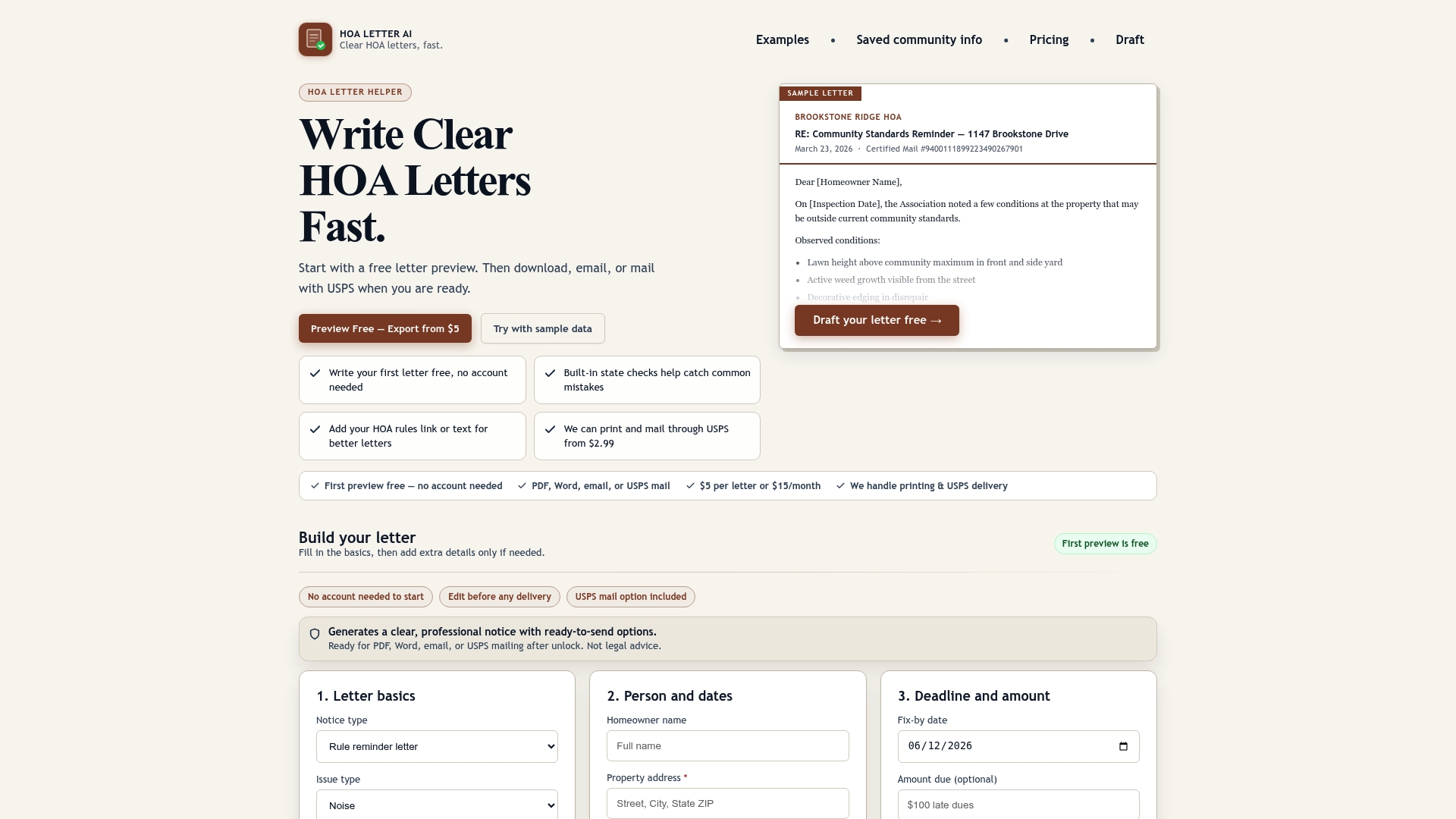
The platform builds guided drafting into every letter, with state-specific context baked in so a rule-change notice or a pre-foreclosure notice reflects the timelines that actually apply in Utah. Built-in checks flag missing mandatory language before you send anything, and every letter gets a free one-page preview so you can catch problems before they become a procedural defect an Ombudsman opinion picks apart later. Individual boards and homeowners can generate a single letter for $5, while property management teams handling multiple communities get more out of the PM Starter or PM Pro plans, which support reusable community profiles across an entire portfolio. When a notice needs to go out by certified mail, the optional USPS mailing integration handles delivery and gives you the tracking record you’ll want on file. Start with a free preview on your next notice and see whether the mandatory-language checks catch something your current template misses.
Key Utah Statutes and Advisory Opinions to Bookmark
These are the primary sources behind the notice rules covered above, worth saving for your board’s reference folder.
- Community rights and responsibilities — Utah Department of Commerce overview of §57-8a-217 rule notice rules.
- Utah Code §57-8a-303 — nonjudicial foreclosure notice requirements.
- Advisory Opinion No. 2026-30 — fair and reasonable delivery standard.
- Advisory Opinion No. 2026-03 — rule adoption and comment process.
- Utah Code Title 57, Chapter 8a — Community Association Act.
Sources
- Community rights and responsibilities (Utah Department of Commerce — HOA guidance)
- Advisory Opinion No. 2026-30 (Office of the Homeowners’ Association Ombudsman, Utah Department of Commerce)
- Utah Code §57-8a-303 (Part 3: Collection of assessments)
FAQ
What Are the New HOA Laws for 2026 in Utah?
Recent legislative updates require associations to renew their HOA registration annually and to include additional required fields, such as a payoff contact and a disclosure statement on reinvestment or administrative fees. Boards should confirm their registration reflects current board and manager contact information rather than waiting until the next renewal cycle.
Who Regulates HOAs in Utah?
The Utah Department of Commerce’s Office of the Homeowners’ Association Ombudsman oversees HOA disputes and issues advisory opinions on issues like notice compliance and rule adoption. Homeowners can request an advisory opinion directly through that office when they believe an association mishandled a procedural requirement.
What Are the General Rules for HOAs in the United States?
HOA rules vary significantly by state, but most require some form of advance notice for rule changes, board and member meetings, and assessment collection actions. Utah’s framework, with its 15-day rule notice and 30-day foreclosure notice, is more specific than many states, which makes reviewing your own state’s statute essential before assuming a national standard applies.
How Can a Homeowner Get Out of an HOA in Utah?
Leaving an HOA in Utah generally isn’t possible unless the property itself is removed from the community through a formal process like de-annexation, which typically requires association and often municipal approval. Most homeowners are bound to HOA membership because it runs with the property deed, so selling the property is usually the practical way out rather than opting out individually.
What Should a Utah HOA Meeting Notice Include?
A compliant meeting notice should list the date, time, location, and agenda items, along with access instructions if the meeting is virtual or hybrid. Owners who have requested notice of board meetings in writing are entitled to at least 48 hours’ notice before each one.
How Much Does It Cost to Generate a Compliant HOA Notice?
HOA Letter AI offers single-letter drafting for $5, with a free preview before you commit to unlocking the full letter. Property managers handling multiple communities can use the PM Starter or PM Pro plans for recurring, higher-volume notice drafting.