
A readable HOA violation letter is defined as a written notice that clearly identifies the rule broken, states the required corrective action, sets a firm deadline, and explains the consequences of inaction. Understanding why homeowners need readable violation letters goes beyond preference. Clear notices are the difference between a homeowner who fixes a problem within the deadline and one who ignores the letter out of confusion, leading to fines, hearings, and legal costs. Reviews of over 60 empirical studies confirm that plain language in official notices reduces confused inquiries and administrative burden. That finding applies directly to HOA communications, where vague letters routinely generate the exact conflicts they were meant to prevent.
***
Why homeowners need readable violation letters to resolve issues fast
A readable violation letter functions as a decision aid, not just a warning. Clear, actionable notices help homeowners understand exactly what happened, what to do, and by when, reducing the friction that turns minor violations into prolonged disputes. That framing matters because most homeowners receiving a violation letter are not repeat offenders. They are people who missed a rule, often unintentionally, and need a clear path to fix it.

Plain language removes the guesswork. When a letter says "your fence exceeds the 6-foot height limit in Section 4.3 of the CC&Rs, and you must reduce it to 6 feet by March 15, 2026," a homeowner knows exactly what to do. When a letter says "your property is not in compliance with community standards," the homeowner does not know what to fix, which rule applies, or how urgent the situation is. That ambiguity breeds defensiveness and delay.
Structured information hierarchy matters just as much as word choice. A well-formatted letter places the violation description first, the required action second, and the deadline third. Treating notices as action guides rather than vague warnings decreases conflict and empowers homeowners to act independently. The practical result is fewer phone calls to the HOA office, fewer disputes, and faster resolution.
Q1 2026 case studies show that readable, contextual legal communication produces 8% fewer disputes and 30% fewer basic clarification support tickets. For an HOA board managing dozens of violations per quarter, that reduction is significant. For a homeowner, it means less stress and a faster path back to good standing.
Pro Tip: *When you receive a violation letter, read it with a pen in hand. Underline the specific rule cited, circle the deadline, and write down the exact corrective action. That three-step process turns any letter into a personal checklist.*
***
What makes an HOA violation letter legally compliant and effective
Legal compliance and readability are not competing goals. A letter that meets state law requirements and uses plain language achieves both at once. Effective HOA violation notices must include the date, owner information, specific rule citations, a description of the observed violation, a cure deadline, consequences for noncompliance, and contact instructions for disputes.
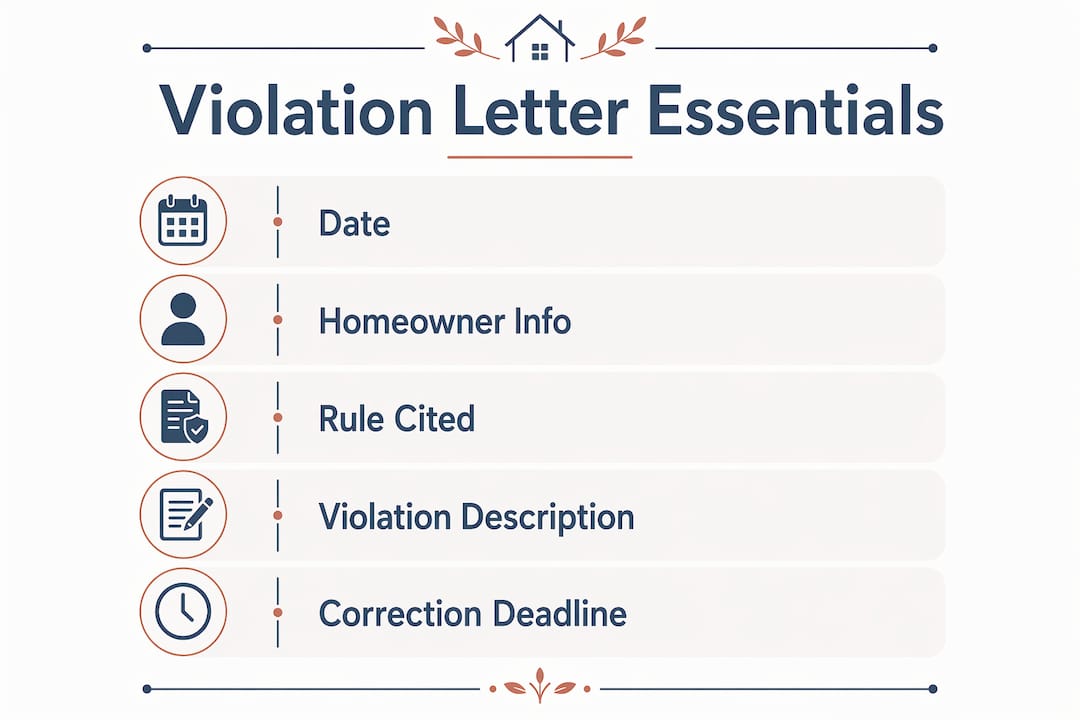
California Civil Code § 5855 is a concrete example of how state law shapes letter requirements. California HOAs must provide written notice of a violation, offer a hearing opportunity, and follow specific timelines before imposing fines. Missing any required element does not just weaken the letter. Missing required notice elements can void fines entirely and escalate conflict into costly legal challenges. That is why the content of a violation letter is a legal matter, not just a communication preference.
A compliant and readable violation letter typically follows this sequence:
- Courtesy notice. A friendly first contact identifying the issue and requesting voluntary correction within a set timeframe, usually 14–30 days.
- Formal violation notice. A written notice citing the specific governing document section, describing the observed violation with date and details, and stating the cure deadline.
- Hearing scheduling notice. If the violation is unresolved, a written invitation to a hearing that outlines the homeowner's right to present their case before any fine is imposed.
- Fine notice. A formal notice of the penalty amount, the basis for the fine, and the payment deadline, issued only after the hearing process is complete.
Tone shapes how homeowners receive the letter. A firm but respectful tone signals that the HOA is enforcing rules consistently, not targeting individuals. Accusatory language, such as "you have repeatedly ignored community standards," triggers defensiveness and reduces the chance of voluntary compliance. The goal is correction, not confrontation.
| Letter element | Why it matters |
|---|---|
| Specific rule citation (e.g., CC&Rs Section 4.3) | Gives the homeowner a verifiable basis for the violation |
| Observed violation with date | Creates a factual record and removes ambiguity |
| Cure deadline | Sets clear expectations and prevents delay |
| Consequences of noncompliance | Motivates timely action without threatening tone |
| Hearing rights and contact info | Satisfies legal requirements and builds trust |
***
Common pitfalls in HOA violation letters that confuse homeowners
Poor letter writing does not just frustrate homeowners. It undermines enforcement, invites legal challenges, and creates more administrative work for the board. Missteps in tone, missing legal information, or vague instructions directly weaken a letter's enforceability. The most common errors follow a predictable pattern.
- Vague violation descriptions. Phrases like "your yard is unsightly" or "your vehicle is a nuisance" describe opinions, not violations. A letter must state the specific rule and the specific observed condition.
- Missing deadlines or inconsistent cure periods. One letter giving 14 days and another giving 30 days for the same violation type signals selective enforcement, which is a legal liability.
- Overly harsh tone. Letters that read like legal threats push homeowners toward attorneys rather than toward compliance. Firm language and threatening language are not the same thing.
- No contact information for disputes. A homeowner who disagrees with a violation has a right to respond. Omitting contact details or hearing procedures leaves them with no legitimate outlet, which escalates conflict.
- Failure to cite governing documents. A letter that does not reference the CC&Rs, bylaws, or rules and regulations gives the homeowner no way to verify the basis for the notice.
Accessibility principles reinforce this point. Clear formatting, simple layouts, and plain language are not just stylistic choices. They are functional requirements that help a diverse range of homeowners, including those with limited English proficiency or reading difficulties, understand and act on notices. A letter that only some homeowners can parse is not an effective enforcement tool.
Pro Tip: *Before sending any violation letter, read it aloud as if you are the homeowner receiving it for the first time. If you cannot identify the specific violation, the required action, and the deadline within 30 seconds, the letter needs revision.*
***
How homeowners can use violation letters to resolve issues effectively
Receiving a violation letter does not have to be a stressful experience. A well-written notice gives you everything you need to resolve the issue quickly and move on. The process is straightforward when you approach the letter as a checklist rather than an accusation.
- Identify the cited rule. Find the specific CC&Rs section or community rule referenced in the letter. Pull out your governing documents and read that section in full. Understanding the rule helps you confirm whether the violation description is accurate.
- Define the exact corrective action. The letter should state precisely what you need to do. If it says "remove the basketball hoop from the driveway," that is your task. If the required action is unclear, contact the HOA manager using the contact information in the letter and ask for written clarification.
- Note the deadline and act early. Deadlines in violation letters are firm. Mark the date on your calendar and aim to complete the correction at least three days before the deadline. That buffer gives you time to document the fix and notify the HOA.
- Document your correction. Take dated photographs of the corrected condition. Send a written confirmation to the HOA, referencing the original letter and the date of correction. This creates a record that protects you if a dispute arises later.
- Request a hearing if you disagree. Every homeowner has the right to contest a violation before fines are imposed. Use the contact information in the letter to request a hearing in writing. Bring your governing documents, photographs, and any relevant correspondence to the hearing.
You can find response letter templates that help you communicate with your HOA board in a clear, professional tone. A written response that references the original letter, states your corrective action, and confirms the completion date is far more effective than a phone call. It creates a paper trail and demonstrates good faith.
***
Key Takeaways
Readable HOA violation letters reduce disputes, protect homeowners' rights, and give boards enforceable records because clarity, legal compliance, and respectful tone work together to produce faster voluntary correction.
| Point | Details |
|---|---|
| Clarity drives compliance | Plain language and structured formatting help homeowners act quickly without follow-up calls. |
| Legal elements are non-negotiable | Missing rule citations or hearing rights can void fines and trigger legal challenges. |
| Tone determines cooperation | Firm but respectful language produces correction; accusatory language produces conflict. |
| Documentation protects both sides | Homeowners should photograph corrections and confirm in writing to create a clear record. |
| Readable letters reduce administrative burden | Fewer confused inquiries and disputes mean less work for boards and less stress for homeowners. |
***
Why clear letters are the foundation of fair HOA communities
After years of watching HOA disputes unfold, the pattern is consistent. The violations that escalate into hearings, attorney letters, and small claims court are almost never about the original infraction. They are about a homeowner who felt blindsided, disrespected, or confused by a letter that gave them no real path forward.
A violation letter that reads like a legal threat, without a specific rule citation or a clear deadline, does not motivate compliance. It motivates defensiveness. The homeowner stops thinking about fixing the fence and starts thinking about whether the HOA is treating them fairly. That shift in focus is expensive for everyone.
What I have found is that homeowners are generally willing to comply when they understand what is being asked of them. The letter is the HOA's one chance to make that ask clearly. When boards invest in readable, well-structured notices, they spend less time on follow-up calls, fewer evenings in hearings, and less money on legal fees. That is not a soft benefit. It is a measurable operational outcome, as the 8% reduction in disputes documented in 2026 case studies confirms.
Homeowners should expect readable, fair notices. If a letter you receive does not cite a specific rule, state a clear corrective action, or explain your hearing rights, you are entitled to ask for clarification in writing. That request is not confrontational. It is exactly what the process is designed to support. You can review HOA violation letter laws by state to understand what your board is legally required to include in any notice sent to you.
> *— Blake*
***
Hoaletterai makes compliant, readable violation letters simple
Drafting a violation letter that is legally compliant, clearly written, and appropriately toned is harder than it sounds. Hoaletterai removes that difficulty by generating professional violation notices that include state-specific language, governing document references, and structured formatting built for clarity.

Boards and homeowners can use the HOA violation letter generator to produce a complete, reviewable notice in minutes, without legal expertise. Every letter includes the required elements for your state, a one-page preview before sending, and optional USPS mailing. For homeowners who want to understand what a compliant letter looks like, the free HOA letter templates library covers violation notices, fine notices, warning letters, and more. Clear communication should not require a law degree.
***
FAQ
What should a readable HOA violation letter include?
A readable HOA violation letter must include the date, the homeowner's name and address, the specific rule violated with a governing document citation, a description of the observed violation, a cure deadline, consequences for noncompliance, and contact information for disputes or hearings.
Can a vague violation letter void an HOA fine?
Yes. Missing required notice elements, such as a specific rule citation or hearing rights disclosure, can void fines and expose the HOA to legal challenges, particularly in states like California with strict notice requirements under Civil Code § 5855.
How do I respond to an HOA violation letter I disagree with?
Request a hearing in writing using the contact information in the letter. Bring your governing documents, dated photographs, and any relevant correspondence to the hearing to present your case before any fine is imposed.
Why do unclear violation letters lead to more disputes?
Vague letters leave homeowners uncertain about what to fix and whether the enforcement is fair. That uncertainty shifts attention from correction to conflict. Plain language notices reduce confused inquiries and the administrative burden that follows.
How long do I have to fix a violation after receiving a letter?
Cure deadlines vary by HOA and state law, typically ranging from 14–30 days for a first notice. The deadline must appear clearly in the letter. If it does not, contact your HOA manager in writing to request the specific date before taking any corrective action.