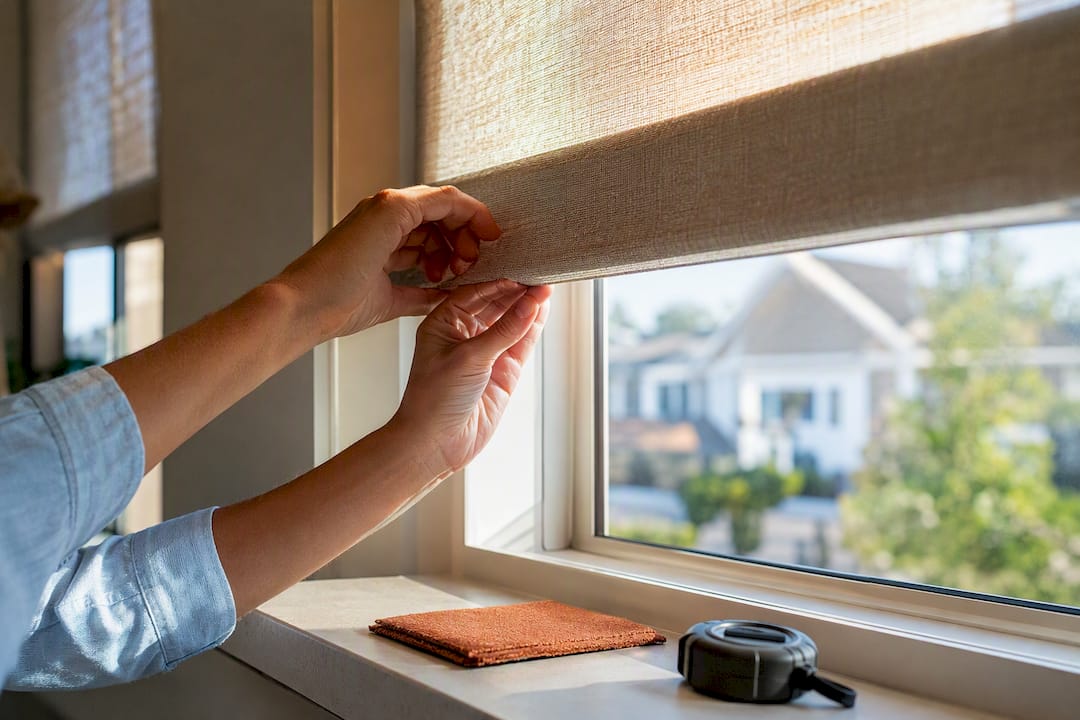
Yes. Most HOAs can regulate window coverings visible from the street or common areas, but that authority comes from your governing documents, not general aesthetics preference. Before you buy anything, pull your CC&Rs and architectural guidelines, confirm the approval procedure and wait for written sign-off. Sample letter templates and state-specific rules can cut weeks off that process.
TL;DR:
- Most HOA approval processes are faster when submitting complete applications with detailed product specifications, photos, swatches, and contractor information upfront.
- Exterior-facing liner colors must typically be neutral, and clear submission of external photos and swatches greatly improves approval chances.
- Response deadlines often trigger automatic approval if missed, so follow up in writing after the stipulated period without a reply.
- Verbal approvals from board members are not legally binding; written approval is necessary for enforceability and future reference.
- HOAs can only regulate visible window treatments from public areas, and many protections exist for medical needs or state-specific laws that override aesthetic rules.
HOA Letter AICreate Clearer HOA Approval LettersDraft professional compliance letters with guided writing, state-specific context, community rules, built-in checks, and a one-page preview.Create your HOA letter
Table of Contents
- Which Governing Documents Control Your Window Covering HOA Letter
- What HOA Rules Actually Say About Window Coverings
- How the HOA Approval Process and Timeline Actually Work
- What to Include in Your Window Covering HOA Letter
- If You Get a Denial or Violation Notice, Do This First
- What Boards Cannot Lawfully Do About Your Windows
- Sample Letter Templates You Can Adapt Right Now
- Common Mistakes Homeowners Make (And the One Fix That Prevents Most of Them)
- How HOA Letter AI Makes This Whole Process Faster
- Sources
- FAQ
Which Governing Documents Control Your Window Covering HOA Letter
Your CC&Rs, bylaws, and architectural guidelines (sometimes bundled into a separate “design guidelines” packet) are where window covering authority actually lives. Board resolutions passed after the original CC&Rs were recorded can also modify or tighten these rules, so check meeting minutes from the last two or three years, not just the founding documents.
Search these documents for a handful of specific terms before you do anything else:
- “Window” or “window treatment” or “window covering”
- “Exterior-facing” or “visible from”
- “Uniformity” or “uniform appearance”
- “Architectural review” or “architectural committee”
- Any deadline language near “respond” or “decision”
That last search matters more than most homeowners realize. Many architectural review provisions include a response-deadline clause: if the committee doesn’t act within a set number of days, some governing documents treat your application as automatically approved by default. Finding that clause can change your entire strategy, but it only protects you if you follow up in writing to create a paper trail showing the deadline passed.
That written record is the real point here. If a board member tells you over the phone or in the hallway that your shades “should be fine,” that conversation means nothing once that person leaves the board or the property management company changes. Written approval survives leadership turnover. A verbal nod does not, and boards routinely deny knowledge of conversations that were never documented.
What HOA Rules Actually Say About Window Coverings
Most boards aren’t policing your interior decor. They’re policing what the neighborhood sees from the sidewalk, and that distinction shapes almost every rule you’ll encounter.
Liner color is the big one. The overwhelming majority of HOAs require the exterior-facing side of any blind, shade, or curtain to be white, off-white, or a neutral tone, regardless of what color or pattern you choose for the room-facing side. This single rule resolves more disputes than any other, because it lets homeowners have the interior they want while keeping the street-facing appearance consistent.
By the numbers: Installation vendors report that submissions including a photo of the treatment from the outside, an exterior-facing swatch, and clear mounting specs get approved faster and more often than bare-bones requests, according to guidance from Worldwide Shades.
Beyond liner color, expect rules on:
-
Materials and finish — vinyl mini-blinds may be banned in favor of cellular shades or wood blinds in some communities
-
Visible hardware — cassette headrails and side channels that show from outside are frequently restricted or require paint-matching
-
Reflective or metallic surfaces, which many boards flag regardless of color
“Uniformity” rarely means identical products on every unit. It usually means a consistent exterior appearance, meaning color and general style, not brand or exact slat width. Temporary fixes trigger the most violations: foil on windows, sheets pinned over glass, or bedsheet curtains during a move almost always draw a notice, even when they’re meant to last a week.
How the HOA Approval Process and Timeline Actually Work
Getting to “yes” faster is mostly about submitting a complete package the first time. Boards deny incomplete applications far more often than they deny compliant ones.
- Gather your materials first. Pull the architectural review form if one exists, product spec sheet, exterior-facing photos of the proposed treatment (even a manufacturer mockup helps), a physical or digital swatch, exact window measurements, contractor name and license info if you’re hiring installation, and your intended installation date.
- Choose your submission channel deliberately. A resident portal or email creates a timestamp automatically. If neither exists, use certified mail so you have proof of delivery and a date the clock started.
- Ask for a receipt confirmation. A one-line reply saying “received, under review” is enough to establish that your application entered the process on that date.
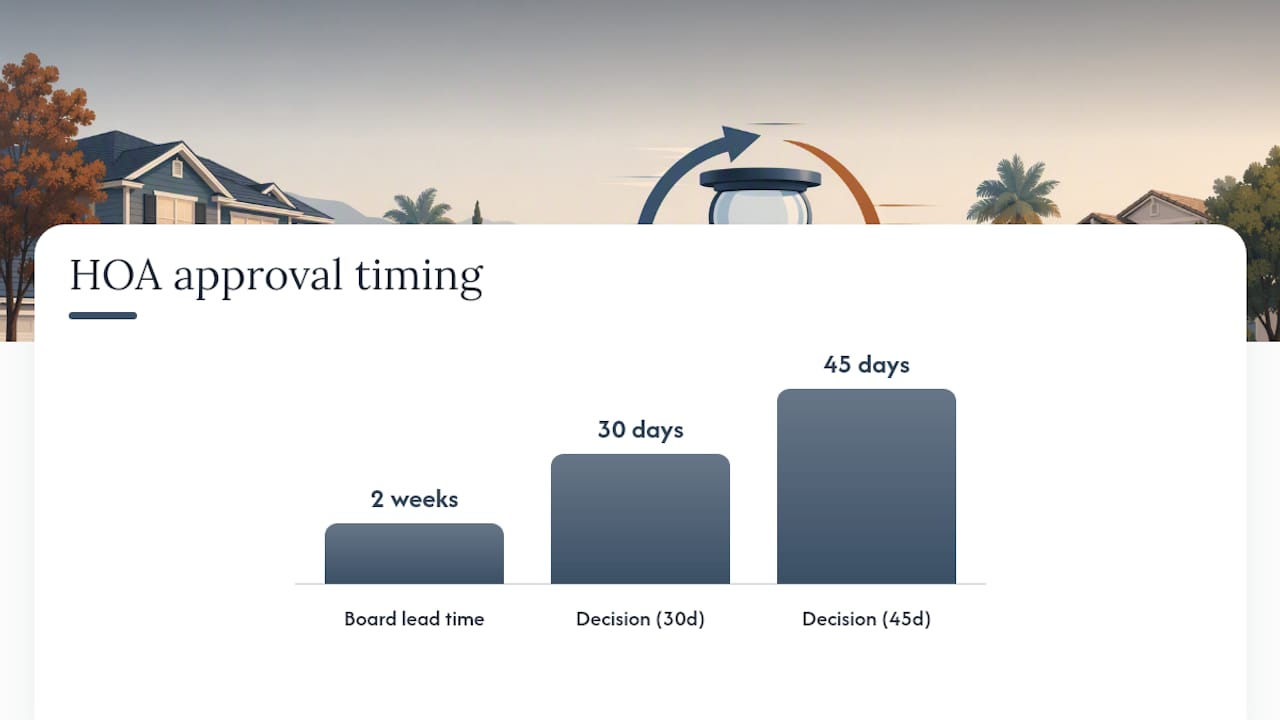
- Know your board’s meeting cadence. Monthly boards typically need submissions at least two weeks ahead of the next meeting. Submitting the week of a meeting almost guarantees you’ll wait another full cycle.
- Track the response deadline. If your governing documents specify 30 or 45 days for a decision, mark that date and follow up in writing the day after it passes if you’ve heard nothing.
Pro Tip: File your submission the same day you photograph the current window condition. That “before” photo becomes valuable evidence later if a dispute over selective enforcement ever comes up.
If you hear nothing past the deadline, don’t assume approval and start installing. Send a short written follow-up referencing the specific clause and date, and request confirmation in writing either way.
What to Include in Your Window Covering HOA Letter
A strong approval request or response letter isn’t long. It’s specific. Boards approve or deny based on whether they can picture the exact product on your exact window, so vague descriptions (“new white blinds”) get more follow-up questions than a letter with real detail.
Build your letter around these blocks:
- Header data: your name, unit or address, date, and any notice or application reference number if you’re responding to an existing letter
- Product facts: manufacturer, model number, dimensions, and a written description of the exterior-facing color, with a physical or photographed swatch attached
- Installation details: contractor name and license (if applicable), proposed installation window, and whether you or a professional will mount it
- Governing-document citation: the specific CC&R or guideline section your request satisfies
- A polite closing requesting written approval and providing your preferred contact method
Here’s a compact version of the core paragraph you can adapt:
I am requesting architectural approval to install [product name/model] on [window location]. The exterior-facing side is [color/finish], consistent with Section [X] of the community’s architectural guidelines regarding uniform appearance. A swatch and product photo are attached. Installation is proposed for [date], performed by [contractor name/license, if applicable]. Please confirm written approval or advise of any additional requirements at your earliest convenience.
Keep the tone neutral and factual. Letters that read as adversarial, even when the homeowner has a legitimate grievance, tend to slow committees down rather than speed them up. For a homeowner who wants this drafted without starting from a blank page, HOA Letter AI’s free templates cover this exact letter type with placeholder fields already built in.
If You Get a Denial or Violation Notice, Do This First
A denial or violation notice isn’t the end of the process. It’s the start of a new one, and how you respond in the first week matters more than what happens after.
- Read the notice completely and note every deadline. Cure periods and hearing-request windows are usually short, sometimes 10 to 14 days, and missing one can forfeit your right to dispute.
- Preserve evidence immediately. Photograph your current window covering, the date, and if possible, similar installations elsewhere in the community that appear to violate the same rule without enforcement.
- Confirm the board followed its own procedure. Many states require written notice and an opportunity to be heard before a fine is valid, and procedural defects like a missing cure period are among the most common grounds homeowners win on.
- Request a hearing in writing if your governing documents allow one, and reference the specific procedural section you’re invoking.
- Document selective enforcement carefully. If three other units have similar coverings and were never cited, that pattern is a legitimate defense, but only if you can show dates and comparable circumstances, not just an impression.
- Consider proposing a compromise in the same letter, such as a compliant liner swap, rather than only disputing the violation outright.
- If the issue involves a medical need, such as cooling equipment or light sensitivity, evaluate whether a reasonable-accommodation request under the Fair Housing Act applies before escalating further.
What Boards Cannot Lawfully Do About Your Windows
HOA authority has real limits, and knowing them changes how you write a dispute letter.
Boards generally can only regulate what’s visible from common areas or the street. Interior-only choices, like the color of the fabric facing your living room, are typically outside HOA jurisdiction unless that choice somehow affects the exterior appearance too.
Procedural protections vary significantly by state. Notice periods, fine caps, and hearing requirements differ from state to state, so check your state’s specific rules rather than assuming a national standard applies. HOA Letter AI maintains a state-by-state summary of notice and fine rules that’s worth reviewing before you write a dispute letter.
Reasonable-accommodation protections add another layer entirely:
- Under the Fair Housing Act, homeowners with documented medical needs can sometimes require accommodation even when a covering or device would otherwise violate aesthetic rules
- Portable cooling devices have gained specific statutory protection in some states. Oregon passed a law in 2022 preventing blanket HOA bans on window AC units when tied to health needs, showing that state law can override HOA aesthetic preference entirely
- Property managers handling accommodation requests should review ADA obligations that extend beyond just physical access modifications
Retroactivity rarely helps homeowners who installed something before a rule existed. Most governing documents grandfather in prior installations, but only if you can prove the installation predates the rule change with dated photos or old approval records.
Sample Letter Templates You Can Adapt Right Now
Every letter below assumes you’ll swap in your specific details. Attach a swatch, a photo, and spec sheet to all three.
Approval request (new window covering): Reference the product, exterior color, dimensions, contractor, and installation date. Cite the specific architectural guideline section your product satisfies. Close by requesting written confirmation.
Denial dispute: Open by acknowledging the notice date and stated reason. Cite the procedural section requiring notice and hearing rights. Include your evidence of comparable installations if selective enforcement applies.
I received your notice dated [date] regarding [violation]. I respectfully request a hearing under Section [X] of the governing documents. I have attached photographs of similar installations at [addresses] that appear to remain in compliance status, and I ask the board to review this matter in light of consistent enforcement.
Reasonable-accommodation request: State the accommodation needed and reference the Fair Housing Act. List supporting documentation, typically a physician’s note describing the medical need and why the standard rule creates a hardship.
For a starting point rather than a blank page, HOA Letter AI’s violation letter template walks through the procedural citations most boards expect to see.
Common Mistakes Homeowners Make (And the One Fix That Prevents Most of Them)
Most window covering disputes trace back to three habits: accepting a verbal “sounds fine,” submitting an incomplete package, and installing before written approval arrives. The single fix that prevents most of this: attach an exterior-facing swatch photo and send everything through the HOA portal or certified mail, so approval exists in writing from day one. Do that, and most disputes never happen.
— Blake
How HOA Letter AI Makes This Whole Process Faster
Writing a compliant letter from scratch, especially one that needs to cite the right state procedural rules, eats an evening you probably don’t have. HOA Letter AI is built for exactly this gap: guided drafting that walks you through the approval request, dispute, or accommodation letter step by step, with state-aware checks built in so you’re not guessing which notice language your state actually requires.
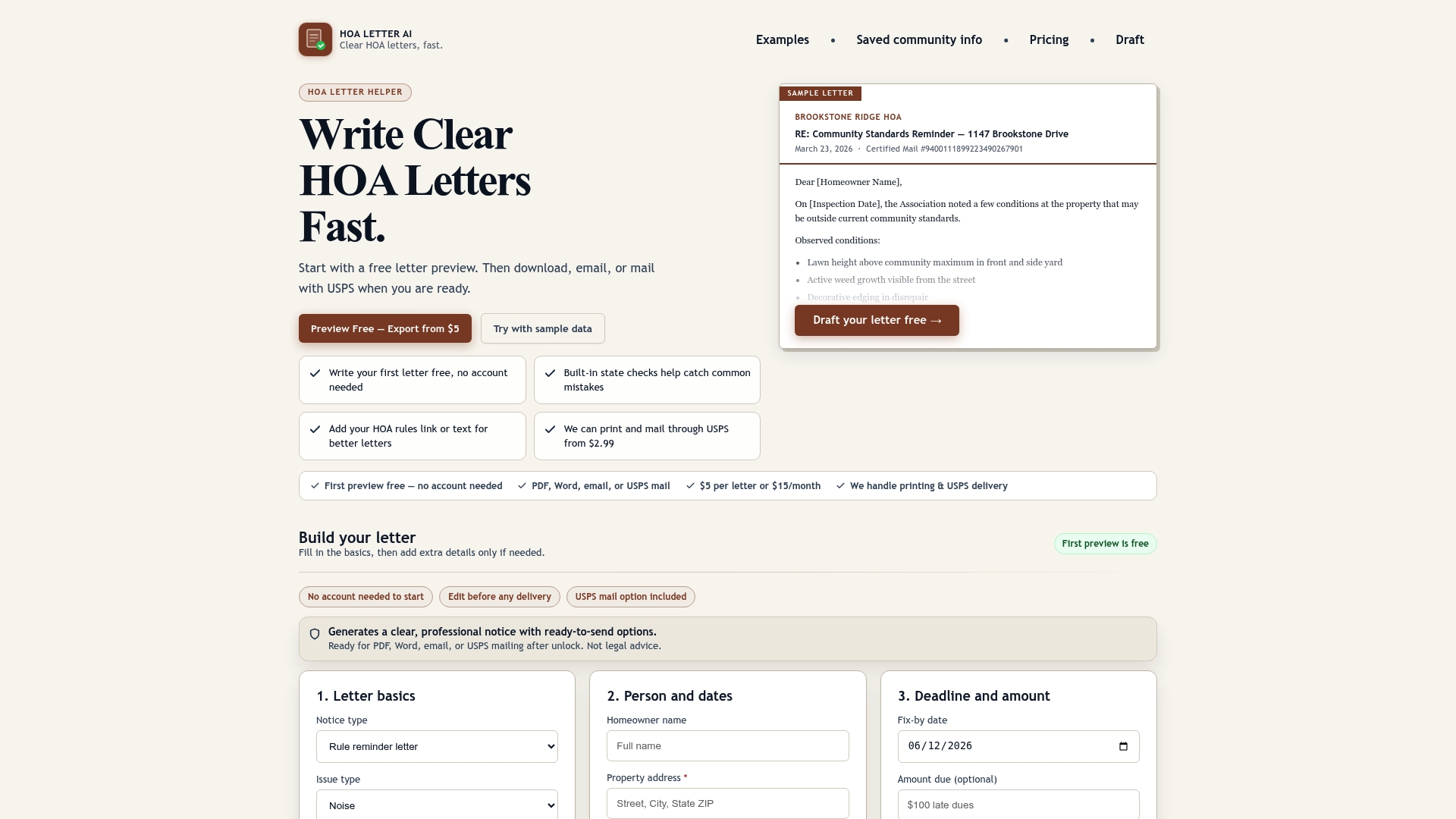
You get a one-page preview before anything gets sent, so you can check the letter reads the way you want it to. If you need to create a mailed, dated record rather than an email, optional USPS mailing is available directly from the platform starting at $2.99. Homeowners writing a one-time response letter pay a flat $5 through the pricing page, while property managers handling multiple communities can use the PM Starter or PM Pro plans, both detailed on the property managers page.
Whether you’re drafting a quick approval request, disputing a denial, or putting together an accommodation letter, starting with templates and reviewing state-specific requirements can help ensure your letter is complete before submission.
Sources
For deeper procedural detail, review Window Décor’s approval guide, the liner and uniformity rules from Worldwide Shades, and state-specific notice and fine procedures. Complex disputes involving fines, liens, or accommodation denials should go to a real estate attorney familiar with your state’s HOA statutes.
- Window Shades in a Condo or HOA: Approval, Uniformity, and Liner Rules
- Be aware of time constraints in HOA architectural review provisions
- Why homeowners association banning window air conditioning units is controversial
FAQ
Does HOA Coverage Extend to Window Replacement?
Typically no. Most HOAs regulate the appearance of window coverings and, in some cases, window frames or glass on the exterior, but they generally don’t cover repair or replacement costs unless your CC&Rs specifically assign that expense to the association.
What Happens If You Get a Violation Letter From Your HOA?
Read the notice for the specific rule cited and the deadline to respond or cure the issue, then gather evidence and respond in writing before that deadline passes. A notice-completeness checker can help you confirm your response letter includes everything the board is likely to expect.
What Are the Most Common HOA Violations?
Landscaping upkeep, unapproved exterior modifications, and non-compliant window coverings rank among the most frequently cited violations, largely because they’re the most visible from the street.
Is a Landlord Required to Provide Window Coverings?
Requirements vary by state and lease terms, so check your local landlord-tenant law; some jurisdictions require basic privacy coverings while others leave it to the lease agreement.
Can My HOA Ban Window Air Conditioning Units?
Many HOAs restrict window AC units for appearance reasons, but some states now protect portable cooling devices tied to documented medical needs from blanket bans, so check your state’s specific statute before assuming a ban is absolute.