Cite it like this: Declaration of Covenants, Conditions & Restrictions for [Community Name], recorded [date], [County] County [Recorder/Clerk], [Book/Page or Reception/Instrument No.], Article [X], § [Y]. That single line carries everything a clerk, a judge, or a homeowner needs to find the exact rule you’re enforcing.
A legal-style version reads: Woodbridge Homeowners Ass’n Decl. of Covenants, Conditions & Restrictions, recorded in the late 1990s, Denver County, Colo., Reception No. 1998041207, art. VI, § 6.2. A plain-language version for a homeowner letter reads: “Section 6.2 of the CC&Rs (recorded with Denver County in 1998) requires trash cans stored out of view.”
Pro Tip: Use the recorder reference (book/page or instrument number) when a citation needs legal force. Use a URL when you just want the homeowner to click and read.
Key Takeaways
A defensible CC&R citation always pairs a recorded-instrument reference (book/page or instrument number, county, recording date) with a precise article or section pinpoint.
| Point | Details |
|---|---|
| Use the recorder reference for legal force | Book/page or instrument number plus county and recording date is the canonical, citable source. |
| Add a URL for convenience only | Online links help homeowners access rules fast but shouldn’t replace the recorder reference in a filing. |
| Match style to audience | Use Bluebook or ALWD for legal filings and Chicago style for board letters and homeowner notices. |
| Always pinpoint the exact section | Article, section, and paragraph numbers prevent disputes over which rule applies. |
| HOA Letter AI builds citations in | The platform inserts recorder references and pinpoints into state-aware templates so letters go out with fewer citation errors. |
Table of Contents
- What Is the Correct CC&R Citation Format?
- What Elements Make Up a Complete CC&R Citation?
- Which Citation Style Should You Use: Bluebook, ALWD, or Chicago?
- How Do You Cite CC&Rs Found Online or Pinpoint a Specific Section?
- How Do You Find and Cite a Recorded Declaration by County?
- How Should a Citation Appear in an HOA Violation or Notice Letter?
- How Does HOA Letter AI Help With CC&R Citations?
- A Note on Precision From Blake
- Get Every Citation Right Without Retyping the CC&Rs
- Frequently Asked Questions
- Sources
What Is the Correct CC&R Citation Format?
There’s no single mandatory CC&R citation format the way there’s a mandatory format for a Supreme Court brief, but four templates cover nearly every situation a board or manager faces.
Template 1 (formal legal/Bluebook-style): [Community] Decl. of Covenants, Conditions & Restrictions, recorded [Month Day, Year], [County] County, [State], [Book __, Page __ or Instrument/Reception No. __], art. [X], § [Y].
Template 2 (ALWD-friendly, practical legal writing): [Community] CC&Rs (recorded [Date], [County] Recorder, Instrument No. [__]), Art. [X], Sec. [Y].
Template 3 (Chicago/non-legal letter): [Community] CC&Rs, § [Y] (recorded [Date]).
Template 4 (short administrative citation for notices): CC&Rs § [Y].
Six quick examples, each labeled by use:
- Legal brief, book/page format: Sunridge Estates Decl., recorded in the early 1990s, Maricopa County, Ariz., Bk. 3402, Pg. 118, art. IV, § 4.3.
- Legal brief, instrument number: Sunridge Estates Decl., recorded in the early 1990s, Maricopa County, Ariz., Instr. No. 91-234567, art. IV, § 4.3.
- Amendment citation: First Amendment to Sunridge Estates Decl., recorded in the mid-2000s, Maricopa County, Ariz., Instr. No. 04-887712, § 2.
- Section pinpoint, board resolution: CC&Rs art. VII, § 7.1(b) (fencing standards).
- Online copy citation: Sunridge Estates CC&Rs § 4.3, https://sunridgehoa.org/documents/ccrs.pdf (accessed early 2026).
- Short inline citation, violation notice: (see CC&Rs § 4.3, recorded Instr. No. 91-234567).
What Elements Make Up a Complete CC&R Citation?
Four elements do the real work in any CC&R citation, and skipping one is the most common way a notice gets challenged.
- Instrument identifier: either a book and page number (older recordings) or an instrument/reception number (most modern county systems). This is the fingerprint a recorder’s office uses to pull the exact document.
- Recording office: the county, plus state, where the declaration was recorded. Communities that span county lines need this specified, not assumed.
- Recording date: establishes which version of the CC&Rs governs, especially important when amendments have layered on top of the original declaration.
- Internal pinpoint: the article, section, or paragraph number that actually contains the rule.
A pinpoint citation is just the part of the document, article and section, or paragraph, that tells the reader exactly where to look instead of “somewhere in the CC&Rs.”
Pro Tip: When you expect the recipient to want fast access, list the recorder reference for legal weight AND a URL for convenience. Belt and suspenders costs you one extra line.
Which Citation Style Should You Use: Bluebook, ALWD, or Chicago?
Match the style to the room the document will be read in. Court filings and legal memoranda expect the Bluebook (20th edition), the standard most litigators default to. ALWD’s Guide to Legal Citation covers similar ground with slightly more forgiving rules and tends to show up in practical legal writing and paralegal training. Chicago Manual of Style (16th edition and later) governs non-legal writing, board manuals, and homeowner correspondence, according to the same USCCR reference guide.
Core differences that trip people up:
- Bluebook and ALWD italicize case names and treat recorded instruments similarly to statutes, with a heavier emphasis on precise reporter or recorder identifiers.
- Chicago style favors readable prose citations, often folding the recorder reference into a sentence rather than a formal citation block.
- Case citations generally need the parties’ names, a retrieval ID, court and year when relevant, and a pinpoint, a structure Cornell’s Legal Information Institute applies broadly across legal citation practice, including how medium-neutral and parallel citations function for both print and electronic sources.
- The University of Chicago’s Maroonbook offers a third academic option, useful if your board’s attorney prefers its typeface conventions and short-form rules like “id.” for repeat citations.
Style choice comes down to audience, not preference: a judge wants Bluebook discipline, a homeowner wants a Chicago-style sentence they can actually read in one pass.
Local court rules sometimes override all three guides. If a citation is headed for litigation, check with your association’s attorney before finalizing the format.
How Do You Cite CC&Rs Found Online or Pinpoint a Specific Section?
Online copies and recorded originals call for different citation habits.
Do:
- Include the URL plus an access date for any administrative letter or courtesy notice.
- Use the recorder reference, not the URL, whenever the citation might end up in a legal filing or hearing record.
- Pull paragraph numbers straight from the official PDF when the document has them, rather than estimating.
Don’t:
- Rely on a website snapshot alone to prove enforceability. Websites change; recorded instruments don’t.
- Cite a page number from a PDF viewer that doesn’t match the document’s own internal numbering.
A pinpoint like Article VI, Section 6.2, ¶ 3 tells a homeowner exactly where to look. When both a recorder reference and a URL are available, cite the recorder reference first and the URL second, in the same line, so the reader gets legal weight and quick access together.
How Do You Find and Cite a Recorded Declaration by County?
CC&Rs exist as recorded instruments held by the county Clerk and Recorder, and the strongest citation always traces back to that office rather than a photocopy or a management company’s PDF.
- Search the county recorder’s online index by the community’s name or the original grantor.
- Note the instrument number or book/page listed in the index; that number is what makes the citation retrievable.
- Request a certified copy if the citation might be challenged or used in a hearing.
Colorado offers a clean example: state law defines a declaration under § 38-33.3-205, which lists what a recorded declaration must contain, and confirms that HOAs must share the recorded document with community members on request.
- Recorder offices vary by state; some call it a Clerk and Recorder, others a Register of Deeds.
- Communities spanning more than one county need the county named every time, not just once.
Pro Tip: Always name the county in your citation, even for a single-county HOA. It costs three words and removes any doubt about which recorder’s office holds the record.
How Should a Citation Appear in an HOA Violation or Notice Letter?
A citation belongs immediately after the rule it supports, either inline or as a short parenthetical, never buried in a footnote a homeowner won’t read.
Short citation lines that work well in letters:
- Courtesy notice: “Per CC&Rs § 4.3 (recorded Instr. No. 91-234567), please store trash containers out of street view.”
- Violation notice with cure period: “This is a violation of CC&Rs Article IV, Section 4.3. Please correct the condition within 14 days of this notice.”
- Hearing invitation: “You are invited to a hearing regarding the alleged violation of CC&Rs § 4.3, as described above.”
- Board resolution language: “Pursuant to authority granted under CC&Rs Article VII, the Board adopts the following architectural guideline…”
- Quote the exact CC&R language rather than paraphrasing it. Paraphrase invites disputes over what the rule actually says.
- Attach the cited page or section if you’re sending a printed letter.
- If the rule comes from a board-adopted amendment or architectural guideline, cite the amendment’s own recording reference alongside the original declaration.
A notice missing its exact CC&R reference is one of the more common reasons homeowners successfully push back on enforcement.
How Does HOA Letter AI Help With CC&R Citations?
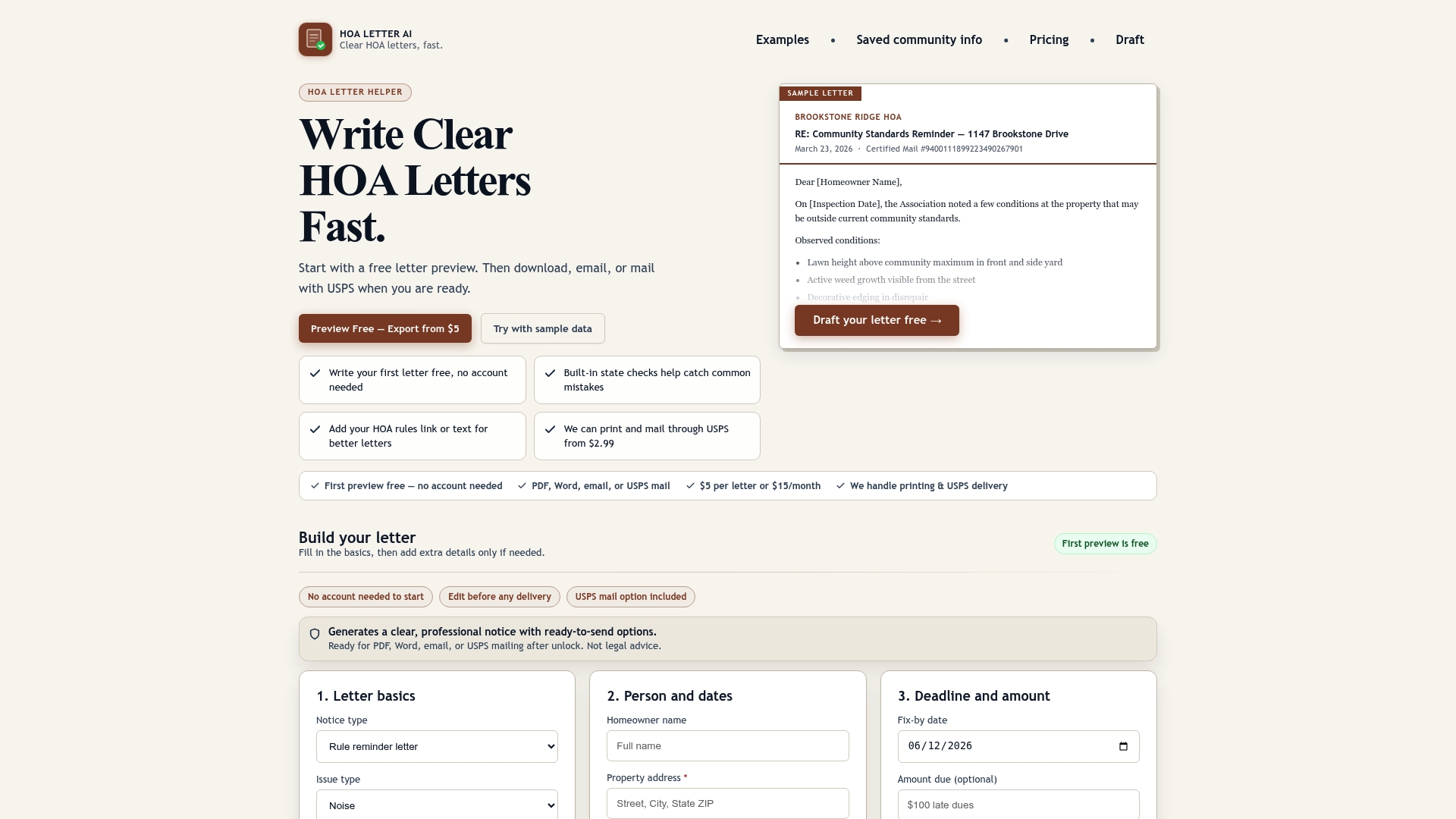
HOA Letter AI builds recorder-reference fields and article/section pinpoints directly into its drafting flow, so a citation doesn’t get typed from memory. The platform adds state-aware context, checks for language a notice legally needs, and offers copyable templates for warning and violation letters.
- Boards can batch courtesy notices that all cite the same recorded section correctly, every time.
- Homeowners can draft a response letter that cites the identical CC&R section the board referenced, keeping the paper trail consistent.
- Every draft gets a one-page preview before it goes out, catching a missing pinpoint before it becomes a mailed letter.
A Note on Precision From Blake
Vague citations are the single biggest reason enforcement letters get contested, not the underlying rule itself. I’ve seen boards lose credibility over a missing section number more often than over the substance of the violation. Cite the recorder reference, the date, and the exact section every time, and most disputes never get the chance to start.
Get Every Citation Right Without Retyping the CC&Rs
HOA Letter AI gives boards and homeowners a faster path to a correctly cited letter than drafting one from a blank page and hoping the section number is right. The platform pulls state-specific requirements and lets you drop in the recorder reference and pinpoint directly into a ready-made structure.
Three concrete advantages over drafting from scratch:
- Fewer citation errors: built-in checks flag a missing recording date or section number before the letter goes out.
- State-aware templates: the guidance adjusts to your state’s notice and fine rules instead of a generic form.
- Faster turnaround: a batch of courtesy notices with consistent citations takes minutes, not an afternoon.
Start with the HOA warning letter template to see how a properly cited notice looks before you draft your next one, or check your state’s specific notice and fine rules if you’re not sure what your CC&Rs require before enforcement.
Frequently Asked Questions
Is there one official CC&R citation format everyone must use? No single mandated format exists outside court rules. Most boards use a recorder reference plus a section pinpoint, then adjust the style (Bluebook, ALWD, or Chicago) to fit the audience.
Do I need the county recorder’s reference for a routine courtesy notice? Not always. A short citation like “CC&Rs § 4.3” works for a first courtesy notice. Save the full recorder reference for formal violation notices or anything that might reach a hearing.
What’s the difference between a book/page reference and an instrument number? Book/page identifies where the document sits in older physical recording ledgers. Instrument or reception numbers are the digital-era equivalent most counties use now. Either works as long as it matches your county recorder’s current index.
Can I just link to my HOA’s website instead of citing the recorded declaration? For a quick homeowner notice, yes. For anything that might be legally contested, cite the recorded instrument directly since website copies can change or go offline.
Sources
- HOA Center Advisory: A Quick Guide to Governing Documents | Division of Real Estate
- § 2-200 Case Citations and related sections | Legal Information Institute (Cornell Law)
- USCCR Quick Reference Guide
- The Maroonbook — University of Chicago Law Review (v92)
- What are covenants, conditions, and restrictions (CC&Rs)? | Nolo