
HOA letters reference CC&Rs because these recorded covenants are the legally binding foundation for every enforcement action a board takes. CC&Rs, short for Covenants, Conditions, and Restrictions, are the governing documents that establish community rules and grant the HOA authority to enforce them. Without citing a specific CC&R section, a violation notice lacks legal standing. Understanding why hoa letters reference cc&rs protects you whether you sit on the board or just received a letter in the mail.
What are CC&Rs and why do they matter in HOA governance?
CC&Rs are the highest-ranking documents in an HOA’s internal governance structure. They sit above bylaws, board resolutions, and community rules. When a conflict exists between a bylaw and a CC&R provision, the CC&R wins.

These documents are recorded with county officials and “run with the land.” That phrase has a specific legal meaning: the rules bind every owner, including buyers who never read the documents before closing. You agreed to CC&Rs the moment you purchased your home, whether or not anyone handed you a copy.
CC&Rs typically cover a defined set of topics:
- Land use restrictions: What you can and cannot build, park, or operate on your property
- Maintenance obligations: Minimum upkeep standards for lawns, exteriors, and common areas
- Architectural standards: Rules governing paint colors, fencing, additions, and modifications
- Pet and nuisance rules: Restrictions on animals, noise, and activities that affect neighbors
- Assessment authority: The HOA’s right to collect dues and impose fines
Amending CC&Rs is deliberately difficult. Amendments typically require a supermajority vote, often 67% or more of all owners. That high threshold protects homeowners from boards making arbitrary rule changes. It also means that when a CC&R section appears in your violation letter, it reflects a stable, community-approved standard rather than a policy invented last month.
The governing document hierarchy places state statutes at the top, followed by CC&Rs, then bylaws, and finally board resolutions. Any enforcement letter that cites a lower-ranking document in conflict with a CC&R can be legally invalid. That hierarchy is exactly why boards must cite CC&Rs specifically, not just general community rules.
Why must HOA letters reference specific CC&R sections in violation notices?
Citing a specific CC&R section is not a formality. It is a legal requirement in most states before a board can impose fines, suspend amenity access, or place a lien on a property.
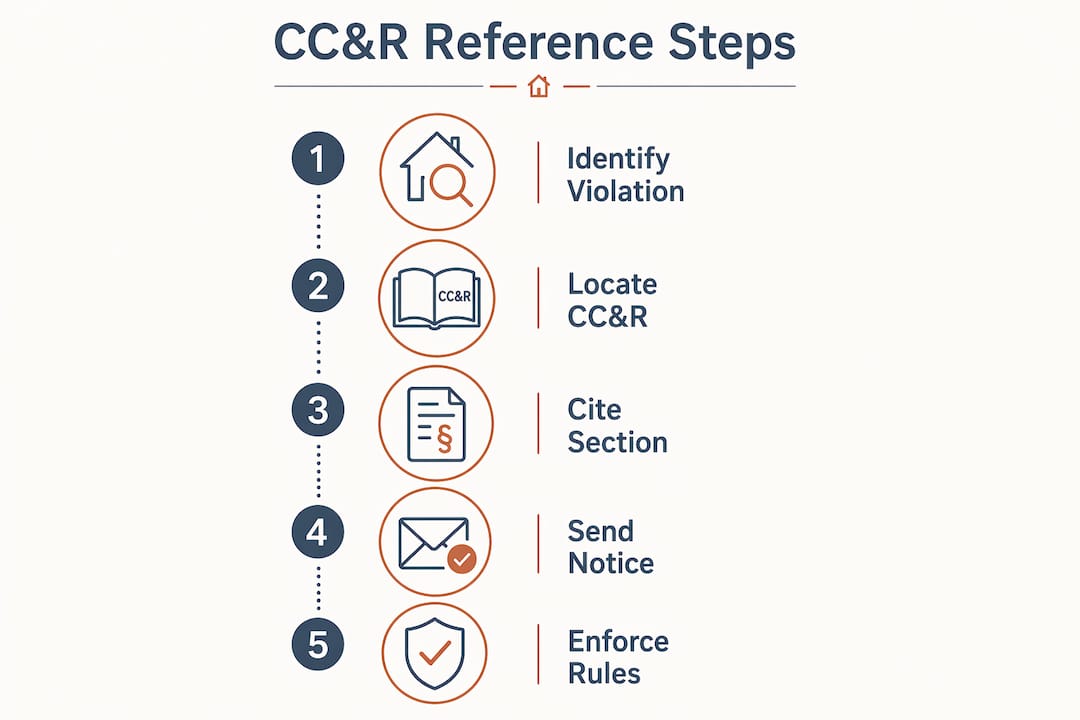
Proper written notice with CC&R references is a prerequisite for legal enforcement actions. Skipping that citation does not just weaken the letter. It can make the entire enforcement action unenforceable in court.
A properly structured HOA violation letter includes these elements in order:
- Homeowner’s name and property address: Identifies the specific party and location
- Date of the observed violation: Establishes the timeline for the enforcement record
- Description of the violation: A factual, specific account of what was observed
- Exact CC&R section number: The precise provision being violated, not a paraphrase
- Correction deadline: Standard cure periods are often 7–14 days for initial notices
- Consequences for non-compliance: What happens next if the violation is not corrected
- Contact information: How the homeowner can respond or request a hearing
Each element serves a purpose. The CC&R citation tells the homeowner exactly which rule applies. The deadline gives them a fair chance to comply. The consequences section explains the enforcement steps the board is authorized to take under those same CC&Rs.
Pro Tip: If a violation letter you receive does not include a specific CC&R section number, request that the board provide one in writing before you take any corrective action. A letter without that citation may not be legally enforceable.
Boards that omit CC&R citations also create a paper trail problem. If a homeowner disputes the fine and the case reaches a hearing or court, the board needs documentation showing that proper notice was given. A letter that references only vague “community standards” without a governing document citation gives the board very little to stand on.
How does referencing CC&Rs protect both homeowners and HOA boards?
CC&R citations in violation letters protect both sides of the enforcement relationship. The protections are different but equally real.
For homeowners, a cited CC&R section gives you something concrete to verify. You can pull up the actual document, read the provision, and confirm whether the alleged violation matches the rule as written. Homeowners have no obligation to comply with unenforceable or misapplied rules absent proper CC&R authority. That is a meaningful right, and it only works if the letter tells you which rule applies.
For boards, consistent CC&R citations build a defensible enforcement record. Boards that consistently reference specific CC&Rs minimize claims of selective or arbitrary enforcement. If every letter for a fence violation cites the same CC&R section, no homeowner can credibly argue they were singled out.
Referencing CC&Rs in violation letters removes personal bias from enforcement. When the letter points to a recorded rule rather than a board member’s opinion, the enforcement becomes about the document, not the person sending it. That shift from subjective to objective is what makes HOA governance function fairly over time.
The transparency benefit extends to the whole community. When homeowners see that enforcement follows written rules, trust in the board increases. When enforcement feels arbitrary or personal, disputes multiply and community relationships deteriorate. The CC&R citation is a small detail that carries significant weight in how the community perceives its leadership.
Homeowners should also know that access to governing documents is a right, not a privilege. Most states require HOAs to provide copies of CC&Rs upon request. If you have not read yours, the time to do so is before a violation letter arrives, not after.
What practical impact does CC&R referencing have on homeowners receiving HOA letters?
Receiving an HOA violation letter signals the start of a formal enforcement process. A certified HOA letter referencing CC&Rs initiates due process steps and protects the association’s ability to fine, restrict amenities, place liens, or proceed with legal action if necessary. Certified mail proves delivery, which creates a verifiable legal record.
Your response to that letter matters more than most homeowners realize. Here is how to handle it effectively:
- Read the cited CC&R section yourself. Do not rely on the board’s summary. Read the actual provision and compare it to the described violation.
- Check for accuracy. Boards occasionally misinterpret or misapply rules. Verifying the citation is your first line of defense.
- Respond in writing. If you believe the citation is incorrect, a fact-based written response citing the specific CC&R provision is more effective than an emotional argument.
- Meet the deadline if the violation is valid. Timely compliance stops the escalation process and avoids fines.
- Request a hearing if you dispute the finding. Most HOA governing documents give homeowners the right to a hearing before fines are imposed.
Pro Tip: When disputing a violation, quote the exact CC&R language in your response letter. A reply that says “Section 4.3 does not prohibit this because it states…” carries far more weight than one that says “I don’t think this is fair.”
Homeowners often underestimate the value of reviewing the cited CC&R provision themselves. Doing so can prevent unnecessary disputes and lead to a faster, better resolution for everyone involved.
How do HOA boards use CC&R references to ensure fair and consistent enforcement?
Consistent enforcement is the board’s legal and ethical obligation. Referencing CC&Rs in every letter is the mechanism that makes consistency possible.
Before issuing any violation notice, the board should verify the alleged violation against the actual CC&R text. Boards sometimes issue notices based on superficial observations without confirming the specific rule applies. That shortcut creates legal exposure and erodes homeowner trust. The enforcement letter step-by-step process for boards includes document verification as a required step, not an optional one.
The table below shows how CC&R referencing affects key enforcement outcomes:
| Enforcement practice | Impact on board and community |
|---|---|
| Citing exact CC&R section in every letter | Creates a uniform, defensible enforcement record |
| Verifying violation against CC&R text before sending | Reduces invalid notices and homeowner disputes |
| Applying the same CC&R citation for the same violation type | Prevents selective enforcement claims |
| Documenting the enforcement history with CC&R references | Supports legal action if escalation becomes necessary |
Boards that follow documented enforcement procedures anchored in CC&Rs build something more valuable than a paper trail. They build a reputation for fair governance. That reputation reduces disputes, increases voluntary compliance, and makes the board’s job easier over time.
The practical takeaway for board members is simple. Every violation letter should answer three questions before it goes out: What specific behavior is the problem? Which CC&R section prohibits it? What does the homeowner need to do and by when? If the letter cannot answer all three, it is not ready to send.
Key Takeaways
HOA letters must reference specific CC&R sections because these recorded documents are the legal foundation for every enforcement action, and omitting them can make fines and notices unenforceable.
| Point | Details |
|---|---|
| CC&Rs are the top governing document | They outrank bylaws and board rules; enforcement letters must cite them, not lower-ranking policies. |
| CC&R citations are legally required | Most states require written CC&R references before boards can impose fines, suspend amenities, or place liens. |
| Homeowners can verify every citation | Read the cited CC&R section yourself to confirm the violation is accurately described before responding. |
| Consistent citations prevent disputes | Boards that cite the same CC&R section for the same violation type avoid selective enforcement claims. |
| Cure periods are typically 7–14 days | Timely compliance after receiving a properly cited notice stops escalation and avoids additional penalties. |
Why I think most HOA disputes start with a document nobody read
After years of watching HOA enforcement play out, the pattern is almost always the same. A homeowner receives a violation letter, feels blindsided, and assumes the board is acting on personal grievance. The board, meanwhile, believes the rules are obvious. Both sides are wrong, and both sides are right.
The CC&R citation in a violation letter is not bureaucratic padding. It is the board saying: “This is not our opinion. This is the rule the community agreed to.” When boards skip that citation or use vague language, they invite exactly the kind of dispute they are trying to resolve. When homeowners ignore the cited section and respond emotionally, they lose the factual ground they actually have.
The boards I respect most treat CC&R referencing as a discipline, not a formality. They verify the rule before sending the letter. They use the same citation for the same violation every time. They make the governing documents easy to access. That consistency is what separates communities that function well from those that spend half their board meetings managing grievances.
My honest advice to homeowners: read your CC&Rs before you need them. My advice to board members: cite them every time, without exception. The letter that takes an extra five minutes to get right saves hours of dispute resolution later.
— Blake
How Hoaletterai helps boards write letters that get CC&Rs right
Writing a violation letter that correctly cites the applicable CC&R section, meets your state’s notice requirements, and holds up to legal scrutiny takes more than a word processor template.
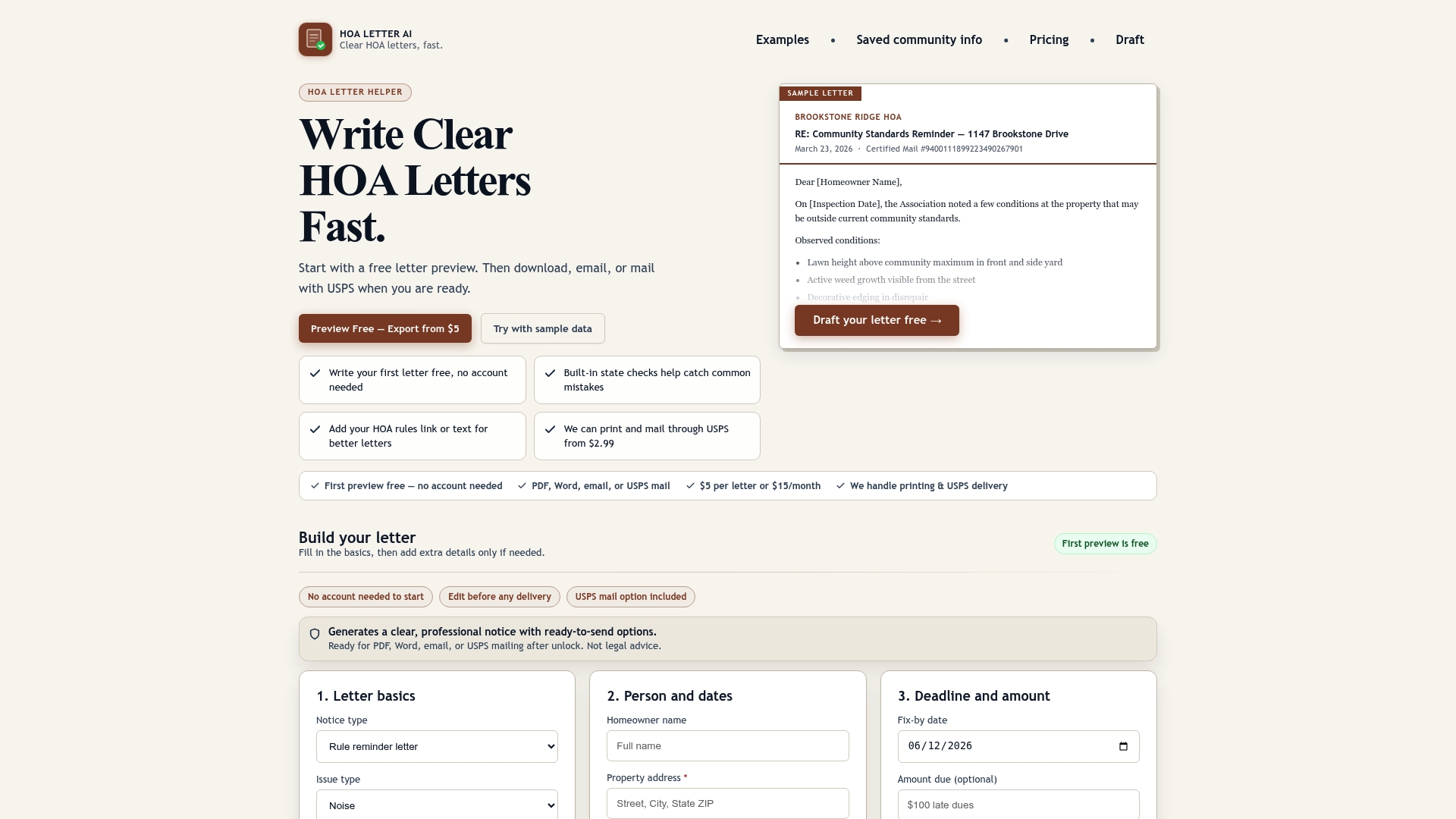
Hoaletterai builds CC&R citation support directly into its letter generation process. Boards can reference state-specific notice requirements and produce letters that include the exact elements required for legal enforceability, including governing document citations, cure periods, and enforcement consequences. The platform generates a formatted, reviewable letter in minutes and offers USPS mailing so the certified mail requirement is handled in the same step. For boards that send violation letters regularly, that combination of accuracy and speed reduces both legal risk and administrative time.
FAQ
What does it mean when an HOA letter cites a CC&R section?
It means the board is identifying the specific recorded rule that the alleged violation breaks. That citation is required for the enforcement action to be legally valid in most states.
Can an HOA fine me without referencing CC&Rs in the notice?
A notice that lacks a specific CC&R citation may be unenforceable. Most states require proper written notice with governing document references before fines, lien placements, or amenity suspensions can be imposed.
What should I do if the CC&R citation in my violation letter seems wrong?
Read the cited CC&R section yourself and compare it to the described violation. If the citation is inaccurate or misapplied, respond in writing with the exact CC&R language that supports your position.
Why are CC&Rs harder to change than regular HOA rules?
CC&Rs are county-recorded documents that typically require a supermajority vote, often 67% or more of all owners, to amend. That threshold protects homeowners from arbitrary rule changes by the board.
How does referencing CC&Rs protect the HOA board legally?
Consistent CC&R citations create a documented enforcement history that demonstrates uniform, non-discriminatory rule application. That record is the board’s primary defense against selective enforcement claims in a dispute or legal proceeding.