
Certificate of Mailing proves you handed an item to USPS on a specific date. Certified Mail proves that plus delivery or a delivery attempt, complete with tracking and often a signature. If you’re sending a notice where the mailing date is what matters, like meeting a filing deadline, a certificate is enough. If you’re sending something that could end up disputed, an HOA violation notice, a lease termination, a legal demand, use Certified Mail.
- HOA violation notice: Use Certified Mail. If the homeowner claims they never got it, you need proof it arrived, not just proof you sent it.
- Tax form with a deadline: A Certificate of Mailing often suffices, since the postmark date is what the rule cares about.
Key Takeaways
Certified Mail proves delivery or a delivery attempt with tracking and an optional signature, while a Certificate of Mailing only proves the date you mailed something.
| Point | Details |
|---|---|
| Core distinction | Certificate of Mailing proves the mailing date; Certified Mail proves mailing plus delivery or attempted delivery. |
| Legal risk | Statutes like 26 U.S.C. § 7502 and many HOA bylaws require certified or registered mail, not a plain certificate. |
| Cost difference | Certified Mail’s fee is $5.55 (effective July 12, 2026) plus postage; a Certificate of Mailing costs less but offers no tracking. |
| Preserve your record | Scan receipts, save tracking confirmations, and file the exact notice text alongside the mailing proof the same day. |
| Simplify the workflow | HOA Letter AI pairs state-aware notice drafting with mailing fulfillment, so the letter text and delivery proof stay linked from the start. |
This article is general information, not a substitute for advice from a qualified lawyer. Consult a qualified legal professional about your own circumstances before acting on anything here.
Table of Contents
- Certificate of Mailing vs. Certified Mail: What Each One Actually Records
- Comparing the Evidence: Tracking, Signatures, and Legal Weight
- What Certificate of Mailing vs. Certified Mail Costs in 2026
- When the Law Actually Requires Certified Mail
- How to Actually Send Each One
- A Quick Checklist for Choosing the Right Service
- Why Boards Choose HOA Letter AI for Notices That Need to Hold Up
- Sources
Certificate of Mailing vs. Certified Mail: What Each One Actually Records
A Certificate of Mailing is a USPS-stamped receipt showing that you deposited a piece of mail on a given date. That’s the entire function. It doesn’t track the item, confirm delivery, or tell you whether anyone ever opened the envelope. You get this through PS Form 3817 at the retail counter, and bulk mailers use PS Form 3665 for firm sheets, often submitted electronically through PostalOne! for high-volume batches. One detail catches people off guard: USPS keeps no copy of the certificate anywhere in its system. If you lose your stamped receipt, your proof of mailing evaporates entirely.
Certified Mail works differently. You get a receipt at the time of mailing, a tracking number that follows the item through the network, and a delivery record, either “delivered” or a logged attempt. Add Return Receipt and you also get a copy of the recipient’s actual signature, either the classic green card or an electronic PDF.

Neither service does anything to the letter’s contents. USPS certifies that an envelope moved through its system; it says nothing about what’s inside it, and neither service speeds up transit or insures the contents by default.
Comparing the Evidence: Tracking, Signatures, and Legal Weight
The evidence gap between these two services is the whole point of choosing one over the other. A Certificate of Mailing gives you a single static document: date and postmark, nothing more. Certified Mail gives you a live, retrievable digital trail inside USPS systems that a court, opposing counsel, or an arbitrator can independently verify months later.
- Certificate of Mailing: postmarked date only, no delivery data, no tracking, no signature.
- Certified Mail: mailing receipt, tracking history, delivery or attempt record, optional signature via Return Receipt.
Not every mail class qualifies for Certified Mail. It applies to most First-Class and Priority Mail but isn’t compatible with every package or bulk-rate category, so check eligibility before you assume it’s available for what you’re sending.
Pro Tip: Certified Mail’s tracking record stays retrievable in USPS systems long after the transaction, which matters if a dispute surfaces a year later and you need to pull evidence on demand rather than dig through a filing cabinet.
The most common misconception is that a certificate proves someone received the letter; however, understanding HOA Security Camera Rules New Jersey can help clarify proper enforcement communications and when documented notice matters. It doesn’t, it never has, and treating it as delivery proof is where a lot of HOA boards get burned in a hearing. Certified Mail isn’t expedited shipping either. It’s the exact same transit speed as the underlying mail class, with a documentation layer added on top.
What Certificate of Mailing vs. Certified Mail Costs in 2026
Certified Mail pricing is postage plus a separate service fee. As of July 12, 2026, the Certified Mail add-on fee is $5.55, charged on top of whatever postage class you’re using. A standard 1-ounce First-Class letter with a Forever stamp plus the Certified Mail fee costs more than just postage, with additional charges for services like Return Receipt.
- Certified Mail fee: $5.55 (effective July 12, 2026), added to postage.
- Certificate of Mailing fee varies depending on whether you use retail counter service, firm sheets, or electronic submission for bulk volume.
- Rates change on a set schedule, so verify current pricing against the acceptance date of your mailing, not the date you last checked.
Certificate of Mailing costs less across the board since there’s no tracking infrastructure behind it. If you’re mailing dozens of notices a month, that price gap adds up fast, which is exactly why volume and risk level should both factor into your decision, not just habit.
When the Law Actually Requires Certified Mail
This is where the stakes get real. Under 26 U.S.C. § 7502, certain IRS filings get prima facie evidence of delivery only when sent via Certified or Registered Mail, not a plain Certificate of Mailing. A postmark alone won’t satisfy that standard in a tax dispute.
HOA governing documents often use specific language, “service by certified mail” versus “proof of mailing,” and that distinction controls which service actually satisfies your bylaws. A rule referencing certified mail is not satisfied by a certificate, even if you mailed on time.
- Read your governing documents or the applicable statute word for word before choosing a service.
- Default to Certified Mail with Return Receipt whenever a notice could plausibly get contested, fines, lease terminations, legal demands.
- Reserve Certificate of Mailing for low-stakes deadline proof where nobody disputes the mailing itself, only the date.
Pro Tip: Check our state-by-state HOA notice requirements before assuming your bylaws only require “proof of mailing.” Many boards default to Certified Mail anyway, since the cost difference is minor compared to the risk of a thrown-out violation notice.
How to Actually Send Each One
- For a Certificate of Mailing: Bring your item to the counter, fill out PS Form 3817, and have the clerk postmark it. Bulk senders use PS Form 3665 firm sheets or upload electronically through PostalOne!. Keep the stamped receipt; USPS retains no backup copy.
- For Certified Mail: Get a Certified Mail label and receipt at the counter, or generate one through Click-N-Ship. Add Return Receipt if you need a signature, choosing electronic or the mailed green card.
- After mailing either one: Scan the receipt immediately, save any tracking confirmation as a PDF, and file the exact text of the letter you sent alongside it.
Pro Tip: A receipt proves nothing if it’s disconnected from the letter it belongs to. Store the exact notice language you mailed right next to the mailing evidence, not in a separate folder, so you’re not reconstructing a case from memory during a hearing.
A Quick Checklist for Choosing the Right Service
- Check your bylaws or the governing statute for the exact phrase used, “certified mail” or “proof of mailing” mean different things.
- Ask whether the recipient is likely to dispute receiving the notice; if there’s any real chance, that answer decides it.
- Decide whether you need a signature on file. If yes, add Return Receipt to your Certified Mail.
- Weigh cost against volume. Certified Mail plus Return Receipt runs more per letter, worth it for anything contestable.
For most enforcement mail, pair Certified Mail with Return Receipt. Reserve the certificate for routine, low-risk deadline mail. Either way, scan your receipt and archive it with the letter the same day you send it.
Pro Tip: Set a recurring reminder to archive mailing receipts weekly rather than as they come in. Boards that batch this task lose fewer records than boards that try to file each one individually in the moment.
A Note From Blake on Why Evidence Pairs Matter More Than Either Service Alone
I’ve seen more HOA disputes turn on missing paperwork than on the actual violation… The mailing receipt alone tells you nothing if you can’t also produce the exact letter that went with it… Pairing the two, saved together, from day one, is what actually holds up when a homeowner pushes back months later.
— Blake
Why Boards Choose HOA Letter AI for Notices That Need to Hold Up
HOA Letter AI is built for exactly the gap this article just walked through: writing a defensible notice and keeping a record of it are two separate jobs, and most boards handle them in two disconnected tools, if they handle the second one at all. HOA Letter AI closes that gap in one workflow. You draft a state-aware violation or compliance letter, review it on a one-page preview before it goes anywhere, and send it with mailing fulfillment built in, so the exact text you approved is the exact text that gets logged against your mailing evidence.
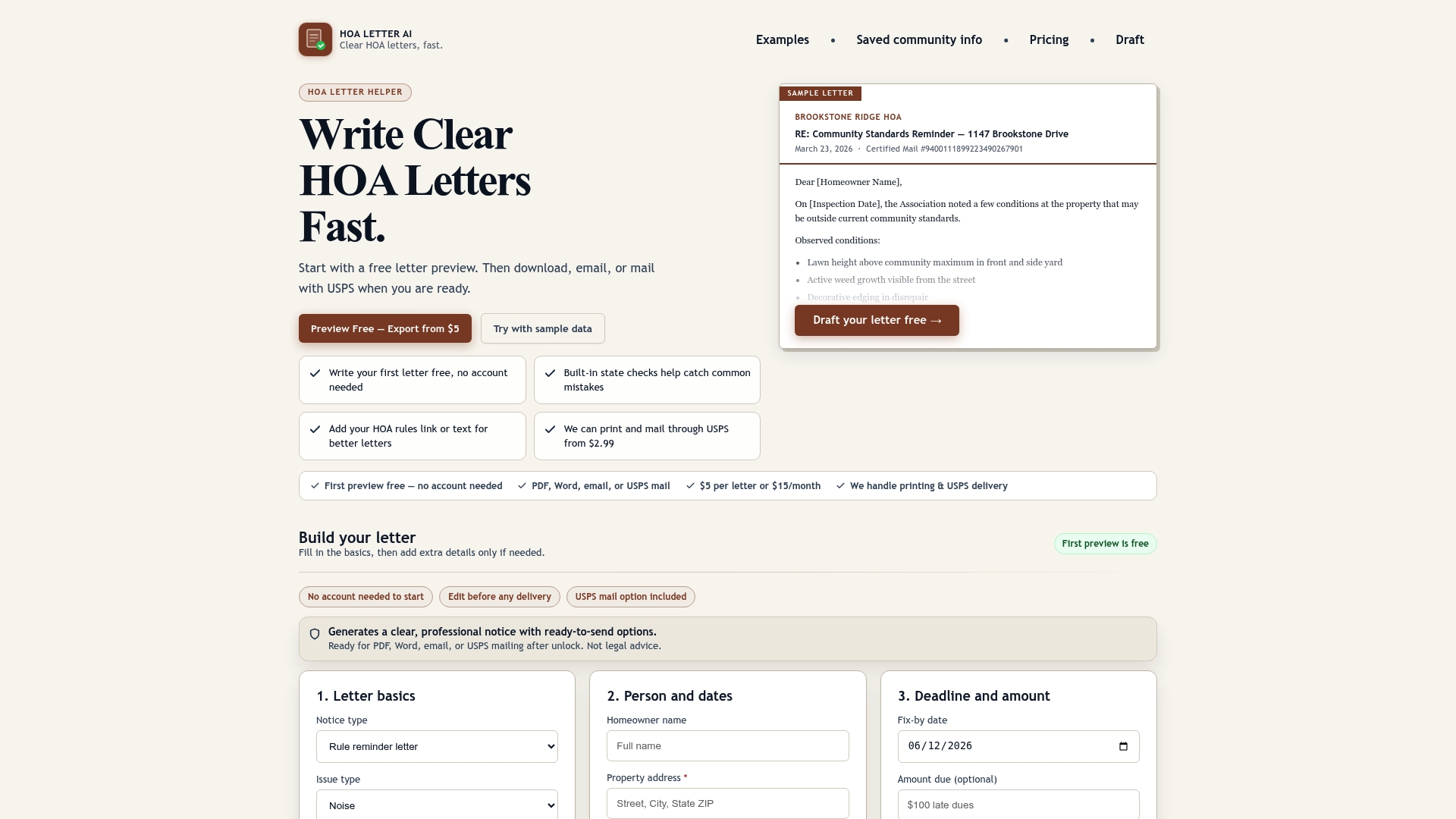
That matters because the biggest risk in enforcement mail isn’t the postage cost, it’s a board that can’t reproduce what was actually said months later when a homeowner disputes a fine. HOA Letter AI’s built-in checks catch missing mandatory language before you send, and reusable community profiles mean your next notice doesn’t start from scratch. Property managers running multiple communities can see pricing built for unlimited letters, or start with a single warning letter template to see the preview and mailing flow firsthand.