
In this context, “hoa cert” means a state-aware HOA compliance or violation notice — often delivered by certified mail when statute or your governing documents require it — used to start enforcement, document discipline, or notify a homeowner of a hearing or decision. Before you send anything, take three steps:
- Verify the governing document and applicable state rule. Pull the exact CC&R section, bylaw, or rule that supports the notice. Some states, like Texas under Property Code Sec. 209.006, require certified mail before levying fines or suspending privileges.
- Gather evidence and confirm the homeowner’s address. Use the address on the association’s official records, not a tax roll or a neighbor’s tip. Attach dated photos and inspection notes before drafting.
- Run the pre-send compliance checklist below. A procedural defect found before mailing costs minutes. One found in court costs far more.
Key Takeaways
A legally enforceable HOA certification notice requires the correct delivery method, complete required content, and contemporaneous proof of mailing — all within the statutory deadline for your state.
| Point | Details |
|---|---|
| Verify address and citation first | Use the address in association records and cite the exact CC&R or rule before drafting. |
| Match delivery method to the action | Certified mail is required by statute for fines and suspensions in states like Texas; first-class mail suits courtesy notices. |
| Document proof at time of mailing | Obtain a USPS receipt and complete an affidavit of mailing the same day the notice goes out. |
| Meet statutory deadlines | Decision notices must arrive within the statutory window — often 14 days — or the discipline can be voided. |
| HOA Letter AI | Generates state-aware notices with built-in completeness checks and USPS mailing integration, available per letter or by subscription. |
Table of Contents
- What does your pre-send HOA cert checklist look like?
- What must a Notice of Hearing include?
- What goes in a Notice of Decision — and when must it arrive?
- How do you prove delivery of an HOA notice?
- Common mistakes that void HOA notices — and how to fix them
- A repeatable workflow: draft, approve, send, document
- How state-aware templates and tools speed the process
- Why process is the real protection
- HOA Letter AI: certified-mail–ready notices without the guesswork
- Sources
What does your pre-send HOA cert checklist look like?
Run every item before you print the envelope.
- Confirm the homeowner’s full legal name and mailing address as listed in the association’s books.
- Verify the exact governing-document citation — CC&R section, rule number, or bylaw — that the violation falls under.
- Attach dated evidence: photos with metadata, inspection logs, or complaint records with dates.
- Decide the delivery method the law or your governing documents require (first-class, certified, personal delivery, or electronic if your state allows it).
- Log who approved the notice — board resolution or manager sign-off — and record the planned mailing date.
Pro Tip: Create a one-row entry in your mailing log before the envelope leaves the office. Fill in the homeowner name, address, delivery method, tracking or receipt number, and the approving party. A log entry made at the time of mailing is far stronger evidence than one reconstructed later.
A practical pre-send verification checklist recommended by HOA practice guides adds one more step: keep copies of all notices and responses in a single file, organized by homeowner and date.
What must a Notice of Hearing include?
Due-process requirements are not optional. Missing any element can invalidate the board’s discipline entirely.
Every Notice of Hearing needs:
- Date, time, and location of the hearing, or a clear explanation if it will be held in executive session.
- Recipient name and address exactly as they appear in association records.
- A statement of the allegations, including the specific CC&R or rule citation and a factual summary of incidents with inspection dates.
- The homeowner’s rights: the right to attend, present evidence, and send a representative.
- Timing compliance: many states require a minimum notice period before the hearing date, with California’s Civil Code § 5855 being one example. Sending late voids the hearing.
Sample language you can adapt: “You are hereby notified that a disciplinary hearing has been scheduled for [Date] at [Time] at [Location]. The alleged violation is [Description], in violation of [CC&R Section X.X]. You have the right to attend, present evidence, and be represented.”
Pro Tip: Post the hearing on the board’s agenda at the same time you mail the notice. An agenda posting gap is one of the most common procedural defects that homeowners raise on appeal.
What goes in a Notice of Decision — and when must it arrive?
The decision notice is where many boards lose enforcement they already earned. Deliver it too late, and a court may treat the discipline as void.
Under frameworks like California Civil Code § 5855(f), the written decision must reach the homeowner by personal delivery or first-class mail within a statutory deadline after the hearing, unless your governing documents require a shorter period. Check your state’s specific rule; the 14-day window is a common benchmark, not a universal one.
Required content:
- Date of the hearing
- The CC&R or rule citation at issue
- Whether the owner attended or was represented
- A summary of evidence the board considered
- The board’s findings of fact
- The discipline imposed (fine amount, suspension period, or other remedy)
Delivery-deadline checklist:
- Identify the hearing date and count forward to the statutory deadline.
- Assign one person to prepare and sign the decision letter within 48 hours of the hearing.
- Choose first-class mail or personal delivery (certified mail adds proof but is not always required for the decision notice).
- Log the mailing date and method in the same file as the hearing notice.
- Retain a copy of the signed letter and the mailing receipt.
A late decision notice does not just create a procedural headache. Case law cited in Davis-Stirling practice guides, including Ironwood v. Solomon, shows that courts have voided intended discipline when boards missed the statutory window.
How do you prove delivery of an HOA notice?
Delivery method determines legal weight. First-class mail creates a mailbox-rule presumption that the letter was received. Certified mail with a return receipt or electronic tracking produces stronger, court-accepted proof. Personal delivery, documented with a signed acknowledgment, is the strongest of all.
| Delivery Method | Legal Weight | Best Use Case |
|---|---|---|
| First-class mail | Mailbox-rule presumption | Courtesy notices, decision letters |
| Certified mail (USPS) | Tracking + signature proof | Fines, suspensions, liens |
| Personal delivery | Highest — signed acknowledgment | Urgent or contested matters |
| Overnight carrier | Strong — carrier tracking | Time-sensitive deadlines |
| Electronic (if permitted) | Varies by state | Where statute or CC&Rs allow |
Step-by-step mail flow for certified notices:
- Prepare the mailing log entry before sealing the envelope.
- Obtain a USPS Certificate of Mailing or certified mail receipt at the post office counter.
- Request a return receipt (PS Form 3811) or activate USPS electronic delivery confirmation.
- File an affidavit of mailing signed by the board officer or manager who sent the letter.
- Scan and store all receipts, return-receipt cards, and tracking confirmations in the homeowner’s file.
Pro Tip: Use one authoritative mailing date across every document — the log, the affidavit, and the letter itself. Conflicting dates are the first thing opposing counsel will flag.
For why documentation matters at every stage, the reasoning is straightforward: the best notice is worthless without contemporaneous proof that it was sent.
Common mistakes that void HOA notices — and how to fix them
Most enforcement failures trace back to a handful of repeatable errors.
- Wrong address. Always use the address in the association’s official records. A notice sent to a rental property’s tenant address instead of the owner’s address of record can be challenged.
- Wrong delivery method. First-class mail when the statute requires certified mail voids the action. Texas Property Code Sec. 209.006 is explicit: certified mail is required before fines or privilege suspensions unless a prior notice was given within the preceding six months.
- Missing or undated evidence. Photos without metadata, inspection notes without dates, or complaint records with no timestamps weaken every subsequent step.
- Late decision letters. A decision mailed on day 15 when the statute requires day 14 can void the fine entirely.
- Inconsistent timelines. When the hearing notice says one date and the minutes record another, the discrepancy becomes an opening for appeal.
Mitigations: run the pre-send checklist every time, keep a centralized mailing log, use affidavits of mailing for higher-stakes notices, and assign one person to sign off on delivery evidence for each notice cycle.
A repeatable workflow: draft, approve, send, document
| Step | Responsible Party | Required Artifact | Deadline |
|---|---|---|---|
| Draft notice | Manager or investigator | Signed draft with CC&R citation and evidence | Before board review |
| Internal review | Board counsel or director | Approval noted in minutes or email record | Before board vote |
| Board approval | Board secretary or manager | Motion recorded in minutes | Meeting date |
| Send notice | Assigned staff or vendor | Mailing log entry + USPS receipt | Per statutory deadline |
| Follow-up | Manager | Inspection record or hearing notice | Per cure deadline |
- Draft. Use a state-aware template. Cite the exact CC&R or rule. Attach dated evidence. The step-by-step board guide covers how to sequence this for different violation types.
- Internal review. If your association requires legal review, get it before the board votes. Record the reviewer’s sign-off.
- Board approval. Pass a formal motion or invoke delegated authority. The secretary documents approval in the minutes.
- Send. Choose the delivery method per the checklist. Capture the tracking number and receipt on the mailing log the same day.
- Follow-up. Inspect for cure by the deadline. If unresolved, proceed to hearing with the full file already assembled.
How state-aware templates and tools speed the process
A well-written violation notice includes owner identification, property address, date, a specific factual description of the violation, the governing-document citation, required corrective action, deadline, and contact information. Building that from scratch every time invites omissions.
State-aware templates pre-fill statute citations, enforce required language, and adjust timelines based on the state where the community sits. The structure of a complete notice looks like this:
- Owner name and property address
- Date of notice and violation date(s)
- Description of the violation with specific facts
- Citation to the governing document (CC&R section, rule number)
- Required corrective action and cure deadline
- Consequences if unresolved (fine schedule, hearing date)
- Contact information and response instructions
A staged enforcement approach — courtesy notice first, firmer follow-up second, final notice with fines or hearing date third — increases compliance while preserving homeowner relationships. HOA Letter AI’s free violation letter template is built around this structure, with state-specific guardrails already embedded.
For property managers running multiple communities, reusable community profiles mean you set the CC&Rs and rules once, then generate notices without re-entering the same data. The built-in completeness checker flags missing elements before you preview, so a notice never leaves the queue with a blank citation field.
Why process is the real protection
Most boards treat notice requirements as bureaucratic overhead. That framing gets expensive fast. When a homeowner challenges a fine, the first thing their attorney requests is the notice file: the letter, the mailing receipt, the hearing agenda, the decision letter, and the dates on all of them. A board that can produce that file in five minutes wins most challenges before they reach a hearing officer. A board that cannot often settles or reverses the fine just to avoid the exposure.
Rigorous notice practice is not punitive. It is fair to homeowners, who deserve to know exactly what they are accused of and what their options are. And it protects the association from the cost of re-doing enforcement that was procedurally defective the first time.
The boards that see the fewest appeals are not the ones with the strictest rules. They are the ones whose paperwork is airtight.
HOA Letter AI: certified-mail–ready notices without the guesswork
Drafting a state-aware, certified-mail–ready HOA notice by hand means tracking statute citations, formatting requirements, and delivery rules for your specific state — every time. HOA Letter AI does that groundwork for you.
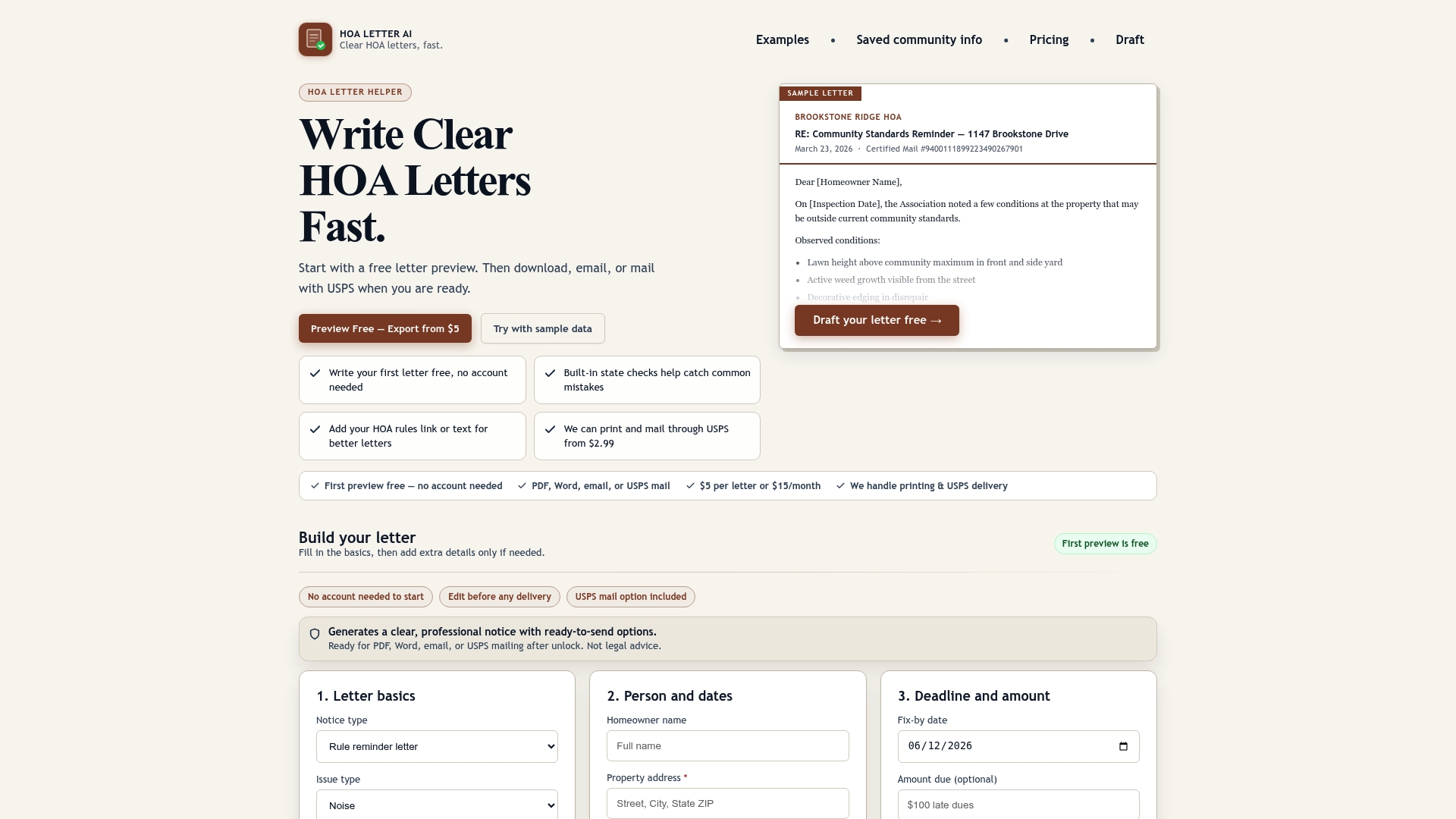
The tool generates notices with CC&R citation auto-fill, a built-in notice-completeness checker, and one-page previews before anything goes out. USPS mailing fulfillment is available as an add-on, so the letter goes from draft to postmarked without leaving the platform. Property management teams use the subscription plan and reusable community profiles to handle multiple communities without re-entering governing-document data. Individual boards and homeowners can unlock a single letter for a one-time fee, and homeowner response letters are available for $19.
Preview a state-aware warning letter template or check your state’s specific notice rules on the HOA violation laws by state page to see the guardrails built into your jurisdiction before you send the next notice.
Sources
- Texas Property Code Sec. 209.006 (Justia)
- Due process in disciplinary actions (Davis-Stirling)
- HOA notice delivery methods: rules and requirements (LegalClarity)
- Writing violation notices: a practical guide (HOA Management)
- Writing a friendly HOA violation letter (AllPropertyManagement)
This article is general information, not a substitute for advice from a qualified lawyer. Consult a qualified legal professional about your own circumstances before acting on anything here.