
Address an HOA envelope the way the post office reads it: the owner’s name on the first line, the delivery address (street, then unit) on the next, then city, state and ZIP Code, all on a uniform left margin. Put your association’s return address in the upper left. Then make sure the address you print is the one the owner has given you in writing, not just the one on the property. That second step is where most disputed notices go wrong.
This guide covers the physical layout, how to write owner names (couples, co-owners, trusts), what to do with units and condominiums, how to handle owners who live out of state, and how to collect address updates so your records hold up.
HOA Letter AICreate Clearer HOA NoticesHOA Letter AI helps boards and property managers draft professional compliance letters with state-specific context, community rules, and built-in checks.Explore HOA Letter AITL;DR
- Use a standardized block: recipient name, delivery address with unit designator, then city, state and ZIP Code, all aligned left, with the return address in the upper left.
- Name the owner as the association’s records and the recorded deed show it. Put co-owners on one line if they fit, or one per line above the street line.
- Mail to the address the owner last gave you in writing. If they gave none, the property address is generally the fallback, though state law varies.
- Ask owners to send address changes in writing, and keep every change on file with its date.
- Check your state’s notice rules and your governing documents before you choose the address and the delivery method.
Table of Contents
- The standard envelope layout for an HOA
- Writing the owner’s name
- Units, condos and buildings without a street address
- Which address to use: property or mailing address
- Out-of-state owners
- Collecting address updates
- Perspective
- Print and mail from one place
- A pre-mailing checklist
- FAQ
- Sources
The standard envelope layout for an HOA
The basics are the same as for any first-class letter. The recipient block goes in the center of the front, the return address goes in the upper left and the stamp or postage goes in the upper right. What matters for an HOA is consistency, because you will print hundreds of these and a small formatting habit repeated across a mailing is what causes returned mail.
USPS publishes its addressing standards in Publication 28. Three points from it are useful for association mail:
- All lines of the address should have a uniform left margin.
- Uppercase letters are preferred on all lines of the address block.
- Punctuation may be left out, except the hyphen in a ZIP+4 Code.
The order of the lines also matters. USPS DMM 602 sets the delivery address order for mail without a simplified address: the intended recipient’s name or other identification, then a PMB designator and number if the address is a commercial mail receiving agency box, then the street and number including any apartment number, then the city and state, then the ZIP Code where required.
A clean example for a unit owner:
JANE A SMITH AND ROBERT L SMITH
1420 WILLOW CREEK DR APT 3B
SPRINGFIELD IL 62704-1234
Your return address goes in the upper left, with the association’s legal name or the management company’s name, then the mailing address. If the association has no office, use a mailing address that actually receives mail, so a returned envelope reaches someone who will open it.
Printed or handwritten
For a board mailing a few letters, handwriting is fine if it is legible and aligned. For anything more than a handful, print the address block from your owner list. Printing keeps the margin uniform and the line order identical, and it avoids the transcription errors that creep in when someone retypes an address from a spreadsheet at the kitchen table.
Writing the owner’s name
The name line is where HOA mail differs most from ordinary mail. Wedding-invitation guides, which dominate the results for this topic, are about etiquette and titles. An HOA notice is closer to a record: the name should identify the person or entity the association has on file as the owner.
Start with the owner of record
The Educational Community for Homeowners explains that the record owner is usually defined in the CC&Rs as the owner of title at the time of notice. The association may rely on its records unless it is given proof, by way of a recorded deed, that ownership has changed. That article is written about California, where a recorded interest has priority over an unrecorded one, so check how your own state treats the question. As a working habit, though, the principle holds: build your name line from your ownership records, and update those records when a recorded deed arrives.
Couples and multiple owners
When there are several recipients, the block stays the same and only the name line changes. If two names fit on one line, put them there. If not, give each name its own line above the street line, keeping the street line directly above the city, state and ZIP Code line.
Federal agencies publish their own conventions. HUD’s rules for addressing correspondence give formats such as “Mr. and Mrs.” followed by the husband’s first and last name for a married couple, and a list of two names joined by “and” for two men or two women. These forms reflect traditional titles. For association notices we suggest the simpler route: use full names exactly as they appear in the ownership record, without honorifics, so you never guess at someone’s title or marital status.
| Situation | Name line (example) |
|---|---|
| One owner | JANE A SMITH |
| Two owners, same surname | JANE A SMITH AND ROBERT L SMITH |
| Two owners, different surnames | JANE A SMITH AND ROBERT L JONES |
| Names too long for one line | JANE A SMITH on line 1, ROBERT L JONES on line 2, street on line 3 |
| Trust | The trustee and trust name as shown on the deed |
| LLC or entity | The entity name as shown on the deed, with an attention line if you have a contact |
For a deeper walk through co-owners, see our guide to addressing HOA letters to multiple owners.
Trusts, LLCs and estates
When the owner is an entity, use the name the deed shows. Do not shorten it to the name of the person who answers the phone. If the association has a named contact for the entity, add an attention line, but keep the entity name on the first line so the notice is tied to the owner of record. If a name on your account does not match the deed, resolve it in your records before the next mailing rather than sending notices under a variant.
Units, condos and buildings without a street address
Unit numbers are the most common reason a notice reaches the wrong door. Publication 28 says the unit designator belongs at the end of the delivery address line, or on the line immediately above it if it will not fit. It also says to use the correct designator, such as APT or STE, rather than the # sign when you know it.
So these are both acceptable:
1420 WILLOW CREEK DR APT 3B
APT 3B
1420 WILLOW CREEK DR
If the second form is used, the unit line sits directly above the street line, and nothing goes between the street line and the city line.
Some condominium communities have no street address for the building. USPS guidance on apartment buildings and condominiums lets the name of the condominium stand in as the street name, with 1 as the building number if none is assigned. If your community falls into that group, confirm the exact form with your local post office before you print a full mailing.
A quick unit checklist
- Does your owner list store the unit as its own field? If it is buried in a street field, it will get dropped.
- Do the unit labels match what the post office uses (for example, 3B, not Unit Three-B)?
- For buildings with several entrances, does the street number match the entrance where the mailbox sits?
- Do you have a PMB or box number for any owner who uses a private mailbox? DMM 602 puts the PMB designator before the street line in that case.
Which address to use: property or mailing address
The envelope can be perfect and still go to the wrong place. The question is which address the owner is deemed to have given you.
Start with what the owner gave you in writing
The pattern across state laws is similar: the owner’s written designation controls, and the property address is the fallback. California is a clear example. Under Civil Code 4041, associations must solicit owners every year for their preferred and alternate delivery methods, including mailing addresses and email addresses. If an owner gives nothing, you use the last mailing address provided in writing, or the property address if there is none. A Los Angeles Times report on the same law makes the practical point: the property address counts even if the owner does not live there.

Governing documents add their own rules. The Rio del Oro CC&Rs, for example, allow notices to go to the lot’s street address or to another address the owner designates in writing. Read your own notice article before you assume a default.
State law can also override your bylaws. HOA Leader notes that state notice requirements may supersede conflicting bylaw provisions, so check state law first. Our state-by-state HOA notice laws page is a good place to start, and there are pages for California, Texas, Florida, Georgia and Louisiana.
Mail versus email
Some states let owners elect email for official notices, and some require that the owner opt in. If your association offers email, treat it as a separate, documented choice, not a replacement for the mailing address on file. We explain when email notices count in a separate guide.
Out-of-state owners
Owners who live elsewhere are not a special legal class in most places, but they are where address errors become expensive. A notice sent to an empty rental or a vacant unit can go unseen for months.
A law-firm article on notifying out-of-state condominium owners describes the general principle: owners are expected to give the association a valid contact address, and once the association has it in writing, the association should send notices there instead of to the property. The same article notes that Florida condominium associations must mail official notices to the address last furnished by the owner, and may keep using the unit address if no other was provided. In certain situations they must use the address on the deed of record.
Courts have also looked at what an association did to reach an owner. In Ptarmigan Owner Association v. Lewis Alton LLC, decided by the Montana Supreme Court in 2013, the association routinely sent bills and notices to the owner’s mailbox in Arizona. The court held that the association’s efforts to locate the owner in Montana were sufficient, and the owner could not challenge them after admitting he had been in Arizona when service was attempted. The lesson for a board is practical: a documented, consistent mailing practice to the address on file is what protects the association.

How to format an out-of-state address
The format does not change. Name, street and unit, then city, state abbreviation and ZIP Code. Two cautions:
- If the owner uses a private mailbox, DMM 602 places the PMB designator and number before the street line, so copy the address exactly as the owner supplied it.
- If the owner’s address is a foreign address, ask the post office or the owner for the correct line order for that country before you mail.
Collecting address updates
You cannot mail to the right place if owners have no easy way to tell you where that is. Clayton & McCulloh stress that the burden of keeping addresses current often shifts between owner and association depending on the state, so give owners a simple path. Ask for changes in writing, so you have a paper trail.
What an address-change form should include
- Owner name exactly as in the ownership record, and the property address and unit
- The new mailing address, and the date it takes effect
- Whether the mailing address applies to all notices or only some
- Preferred and alternate delivery methods, including an email address if your state allows email delivery
- Whether the property is owner-occupied, rented, vacant or undeveloped
- Details of any legal representative
- Signature and date
The last three items come straight from what California’s 4041 requires owners to provide each year, and the statute also says the association’s yearly request must include a simple written way to change the preferred delivery method. Even outside California, that is a sound model for a form.
A simple address-update notice
A short notice to all owners, sent once a year and again after any ownership change, can read:
Our records show your mailing address as listed on this envelope. If it is wrong, or if you want notices sent somewhere other than your property, please return the enclosed form in writing. We will use the most recent address you give us for all association notices.
Keep the wording plain and keep a copy of every mailing.
Perspective
We built our tool around one idea: a notice is only as strong as the record behind it. Most of the problems boards bring us are not about tone or fines. They are about a letter that went to the wrong name, a unit number that fell off, or an address nobody updated after a sale.
That is why we pair guided drafting with state-specific context and built-in checks, and why we let you preview a one-page letter before you pay anything. Seeing the name block, the address and the citations on one page makes errors visible before the envelope is sealed.
For property managers, we think reusable community profiles matter for the same reason: set the association’s return address, rules and formatting once, and every letter after that starts from the same correct base.
Our advice is simple. Decide your address rules once, write them down, and make every mailing follow them.
Blake
Print and mail from one place
If you would rather not build envelopes by hand, HOA Letter AI drafts the letter, previews it free with no account needed, and can mail it for you. A single letter is $5 on our pricing page, and optional USPS mailing starts from $2.99 per letter when you send from the draft page. Boards that send regularly can use the self-serve board lane at $15 per month, and management teams can look at the property manager plans, which start at $199 per month for PM Starter.
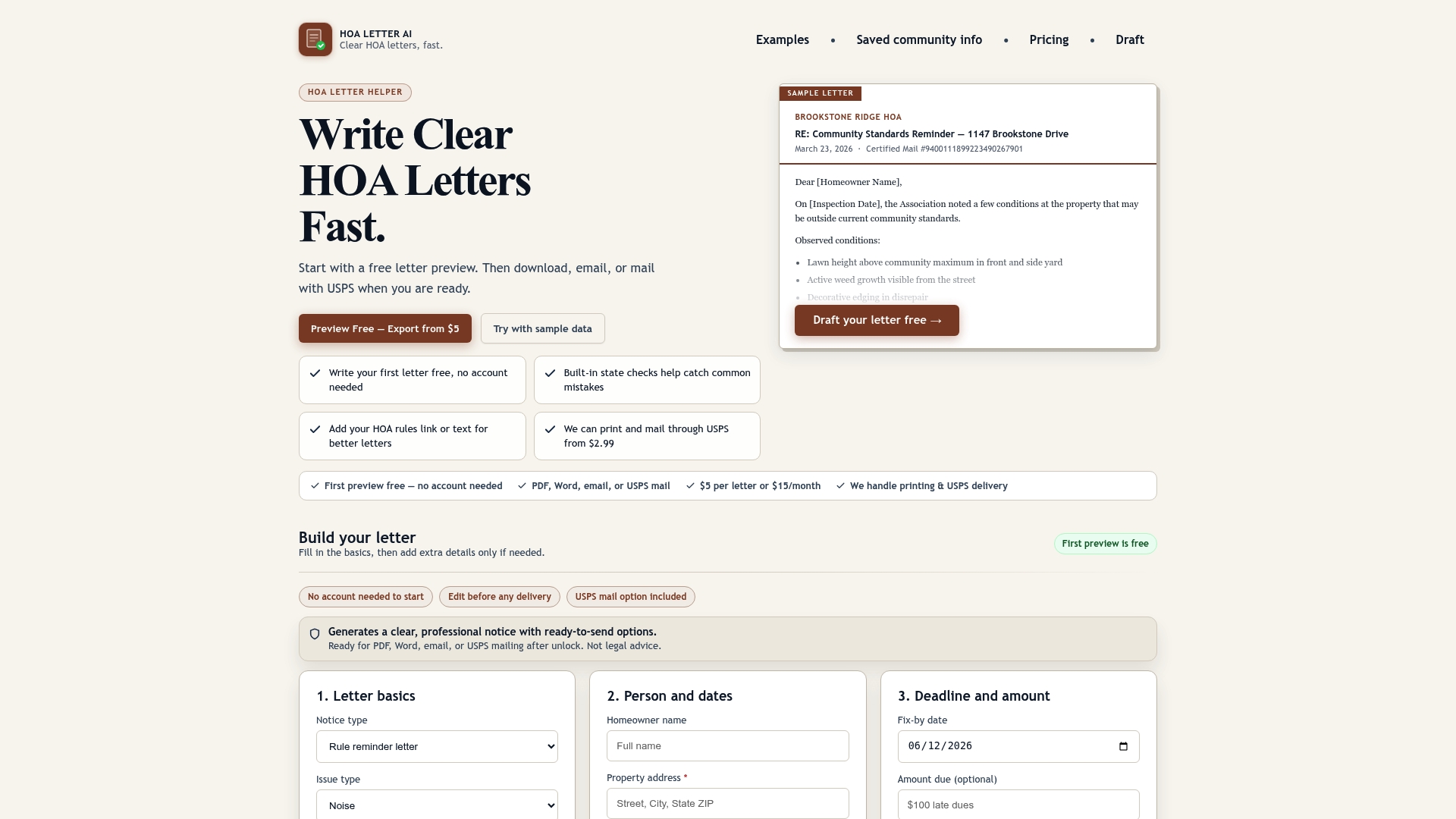
The free preview is a good place to check the name line, the unit number and the cited rule before you commit to sending. For other notice types, our free letter templates and the guide to the required elements of an HOA notice cover what goes inside the envelope.
A pre-mailing checklist
Before you seal a batch, run through this list:
- Compare the name line with the ownership record, and update any record with a new recorded deed.
- Confirm each owner’s chosen mailing address, in writing, is the one you are printing.
- Check unit designators and that the unit sits at the end of the street line or directly above it.
- Print in uppercase with a uniform left margin and no stray punctuation.
- Confirm the return address is a real place where mail is opened.
- Check your state’s notice rules and your governing documents for the required delivery method, such as certified mail.
- Keep a copy of the letter, the envelope data and the mailing proof together.
For examples of how requirements differ by state, see our state-specific legal notice examples.
FAQ
How do I address an envelope to two HOA owners?
Put both names on the first line if they fit, joined by “and”, or put each name on its own line above the street line. The street line must stay directly above the city, state and ZIP Code line. Use the names as they appear in your ownership record.
Where does the unit number go on an HOA envelope?
Put it at the end of the street line, using the proper designator such as APT rather than the # sign when you know it. If it will not fit, put it on the line directly above the street line, according to USPS Publication 28.
Should I mail to the property or to the owner’s out-of-state address?
Use the address the owner gave you in writing. If they gave none, many states and governing documents treat the property address as the default, as California’s Civil Code 4041 does. Check your own state’s law and your CC&Rs, because the rules differ by state.
How can owners tell the HOA about a new mailing address?
Ask them to do it in writing, with their name, property address, new mailing address, effective date and signature. Provide a simple form and send a reminder each year. Keep every submission on file with its date.
Sources
- USPS Publication 28, Postal Addressing Standards
- USPS DMM 602, Addressing
- USPS Publication 28, Apartment Buildings and Condominiums
- HUD, General Rules for Addressing Correspondence
- ECHO, Owner of Record
- California Civil Code 4041
- Los Angeles Times, titleholders and HOA notification
- Rio del Oro CC&Rs, Article XVI Notices
- HOA Leader, bylaws requiring certified mail notice
- Clayton & McCulloh, notifying out-of-state condominium owners
- Ptarmigan Owner Association v. Lewis Alton LLC, Montana Supreme Court