
An HOA can send official notices by email, but only to owners who have agreed to receive them that way. Consent is the rule that decides whether an email counts as legal notice or is just a friendly update. Everything else, from timing to record keeping, builds on it.
This guide covers how consent works under federal and state law, what the rules look like in California, Florida, Washington, Maryland and Louisiana, what to do about owners with no email, and how to write and document an email notice that holds up if someone disputes it. Your governing documents and your state’s statutes control, so use this as a working map and confirm the details with your association’s attorney.
HOA Letter AIhoaletterai.comDraft Clearer HOA NoticesCreate professional compliance letters with guided drafting, state-specific context, community rules, built-in checks, and delivery options.Draft an HOA noticeTL;DR
- Email is valid official notice only for owners who have opted in. Having an address on file for a directory or a one-time question is not consent.
- Keep sending paper, usually first-class mail, to every owner who has not opted in or has no email.
- Some notices, such as lien, foreclosure-related and delinquent-assessment demands, may still need certified or registered mail.
- A good email notice states the purpose, the date, time and place, the action required and the deadline, and you keep a timestamped record of each send.
- Treat owner email addresses as confidential, and verify that the person asking to opt in actually owns the lot.
Table of Contents
- Can an HOA send official notices by email?
- What counts as consent
- How the rules differ by state
- Owners who have not opted in or have no email
- What an HOA email notice should include
- Sending, documenting and protecting email notices
- Notices that may still need mail
- Draft the notice, then email or mail it
- FAQ
- Sources
Can an HOA send official notices by email?
Yes, after the individual homeowner opts in. A summary of HOA email rules notes that this is the general pattern across the country, and that some notices, including lien, foreclosure-related and delinquent-assessment demand notices, may still need certified or registered mail.
The federal backdrop is the E-SIGN Act, which as that same summary explains requires a homeowner’s affirmative consent before an association can replace paper notices with electronic records. The same affirmative-consent idea appears elsewhere in federal practice, for example in the electronic delivery consent rules for tax forms: the recipient has to agree first, and the sender has to be able to show it.
The practical distinction every board should draw is between two kinds of email:
- Official notice: a meeting notice, an assessment notice, a violation or compliance letter, a hearing notice. These carry legal consequences, so delivery must be provable.
- Casual update: a reminder about the pool opening, a newsletter, a landscaping schedule. No consent is needed to send these to people who gave you an address, though you should still respect unsubscribe requests.
If an email is the only way an owner was told about a fine hearing, and that owner never opted in, the notice can fail. That is how a perfectly reasonable board action ends up reversed. Our guide on avoiding invalid HOA notices walks through the most common ways a notice gets thrown out.
What counts as consent
The general principle across states is that an association cannot assume consent. According to the same summary, an owner giving an email for a resident directory or a one-time inquiry does not authorize official notices to that address.
A sound consent record has these parts:
- A written, signed or electronically confirmed statement from the owner that they agree to receive notices by email.
- The specific email address to use.
- The date and time of the request.
- A way to revoke consent at any time.
- Verification that the person is the titled owner of the lot.
Where several people own one lot, decide up front who must consent and where notices go. Our post on addressing HOA letters to multiple owners covers how to handle co-owners on paper, and the same logic applies to email.
How the rules differ by state
State law sets the details, and they vary more than most boards expect. Here is how several states handle consent and notice delivery.
| State | What the law says about email notice |
|---|---|
| California | Members give the association an annual written notice of their preferred delivery method. They may choose email but are not required to provide an address. |
| Florida | Electronic notice goes to members who have provided an email address or fax number and consented in writing. Membership-meeting notice must go out at least 14 days ahead. |
| Washington | Electronic notice is effective only for owners who consented in writing and designated the address to use. |
| Maryland | Requires board authorization of the method, prior written authorization from the lot owner, and certification of delivery by an officer or agent. |
| Louisiana | Lists mail, email to the owner’s designated address, hand delivery when no address is designated, and other methods reasonably calculated to give notice. |
California
Under Civil Code § 4041, members must give the association written notice each year stating their preferred and alternate delivery methods. An email address may be one of them, but members are not legally required to provide one. If a member gives no notice, the association defaults to the last written mailing address, or the property address if there is none.
Assessment increases follow their own rule: Civil Code § 5615 requires individual notice of an increase under § 4040, 30 to 60 days before the new assessment is due.
For meetings, Corporations Code § 7511(a) calls for written notice no less than 10 and no more than 90 days before the meeting. Our California violation letter guide covers the state’s notice rules for compliance letters.
Florida
Florida’s Statute § 720.306 allows required membership-meeting notice to be mailed, delivered or electronically transmitted at least 14 days before the meeting, while other notice provisions allow electronic delivery when the parcel owner has consented in writing. A Florida board’s guide describes § 720.303(2)© as permitting electronic notice to members who provided an email address or fax number and consented in writing.
See our Florida HOA violation letter guide for fine notices and hearing requirements.
Washington
Under RCW 64.38.110, notice by electronic transmission is effective only for owners who consented in writing and designated the address to be used. For timing, one Washington association’s compliance notes say owner meeting notices typically go out at least 14 days and no more than 50 days before the meeting.
Maryland
Real Property § 11B-113.1 is among the more detailed. The board must authorize electronic delivery, the lot owner must give prior written authorization, and an officer or agent must certify the delivery. Two consecutive failed transmissions can make electronic delivery ineffective for that owner, so a bounce is something to act on, not ignore.
Louisiana
Louisiana Revised Statutes § 9:1141.38 lists several delivery routes: mail, email to the address the lot owner designated, hand delivery if the owner has designated neither a mailing nor email address, and other methods reasonably calculated to provide notice.
If your state is not listed, find the section of your HOA act on electronic notice and read it alongside your bylaws and declaration. Our state-by-state violation letter laws page is a good starting point for the compliance side.

Owners who have not opted in or have no email
This is where most boards trip. When a homeowner has not agreed to email notices or has no address, the association must keep sending paper communications, usually by first-class mail, and maintain a current mailing address for every owner, according to the HOA email summary.
In practice, run two lanes:
- Email lane: owners with a verified, current consent on file.
- Mail lane: everyone else, plus any owner whose email has bounced or whose consent has been revoked.
The model uniform act treats consent as revoked if two consecutive electronic notices fail to deliver, again per that summary, which matches Maryland’s approach. When an email bounces twice, move that owner to the mail lane and note it in your log.
Some management companies avoid email notices altogether because of the burden of running separate paper and digital pipelines and the risk of disputes over when or how an address was changed, as one Florida condo and HOA law blog observes. That burden is manageable with a single source of truth for every owner’s delivery preference. Associations that also run parking enforcement can keep notices and violations in one audit trail with HOA parking management software.
What an HOA email notice should include
An email notice has to do the same job as a paper one. For meetings, the California notice rules say the notice must state the place, date and time and include an agenda, and it must say so if participation by electronic transmission or video is available.
Whatever the notice type, a clear email contains:
- A subject line that names the purpose. “Notice of Annual Meeting, [Community Name], [date]” beats “HOA Update.”
- The owner and property. Name and lot or unit address, so the email stands on its own if printed.
- The reason for the notice. Cite the rule, covenant or statute behind it.
- What the owner must do and by when. One action, one deadline, stated in plain words.
- Date, time and place of any meeting or hearing, plus remote access details if offered.
- How to respond or ask questions, with a named contact.
- Any mandatory statutory language your state requires for that notice type.
Our breakdown of the seven HOA notice elements goes deeper on required language, and the notice completeness guide helps you check a draft before it goes out. For meeting-specific wording, see these HOA meeting notice examples and the annual notice examples.
A short sample
Subject: Notice of Annual Meeting, Maple Ridge HOA, [meeting date]
Dear [Owner name],
This is the official notice of the annual meeting of the Maple Ridge Homeowners Association. The meeting will be held on [date] at [time] at [place]. You may also join by video at [link]. The agenda is attached.
You are receiving this notice by email because you consented to electronic delivery on [date]. To change your delivery method, contact [name] at [contact].
The last line matters. Reminding the owner why they are getting email and how to change it supports your consent record and keeps revocation easy.
Sending, documenting and protecting email notices
An email notice is only as good as your proof that it was sent to the right person at the right address. A Washington association’s consent procedure is a useful model: verify the owner and the destination address before activating notices, keep a timestamped private register and an append-only processing log, and treat owner email addresses as confidential. Some associations also match requests against titled owner records and require a confirmation step for the new address.
A workable routine:
- Collect consent in writing, with the address and date.
- Verify ownership against deed or title records.
- Confirm the address by sending a confirmation message the owner must answer.
- Send from an association address, not a board member’s personal inbox, so records stay with the association when board members change.
- Send individually or by blind copy. Never expose the list of owner addresses to other owners.
- Log every send: date, time, recipient, notice type, and any bounce.
- Retain the log and the email with the rest of your association records.
- Review bounces within days, and follow your state’s rule on failed deliveries.
If you also need to deliver paper, keep one record that shows both lanes, so you can answer “how was this owner notified?” in a single lookup.
Notices that may still need mail

Even with consent, some notices carry formal delivery requirements. The HOA email summary points to lien, foreclosure-related and delinquent-assessment demand notices as ones that may still require certified or registered mail. Check your state statute and your governing documents for each notice type before you rely on email, and ask your association’s attorney about collection-stage notices in particular.
A reasonable policy for most boards: use email for meeting notices, reminders and first courtesy notices to opted-in owners, and mail anything that could lead to a fine, lien or legal action, even if you also send an email copy. Our warning letter template is built for exactly the courtesy stage before fines.
Our perspective on email notices
Most notice problems we see are not about bad intent. They come from boards treating email as one channel when it is really two: an informal one that needs no paperwork, and an official one that needs consent, a record and sometimes a paper twin.
We built HOA Letter AI around that split. Guided drafting asks for the state, the rule and the facts, then builds the letter with the citations and the mandatory language that state-aware compliance requires, so the content is right before anyone worries about the delivery method. You see a free one-page preview before you pay, and you can download the letter or have it mailed through USPS, which gives you a clean paper lane for owners who never opted in.
Our view is that an association should never have to choose between speed and defensibility. One clear price per letter, community rules saved in a profile, and built-in checks mean the notice that goes out is the notice you would want a court or an owner’s attorney to read.
Blake
Draft the notice, then email or mail it
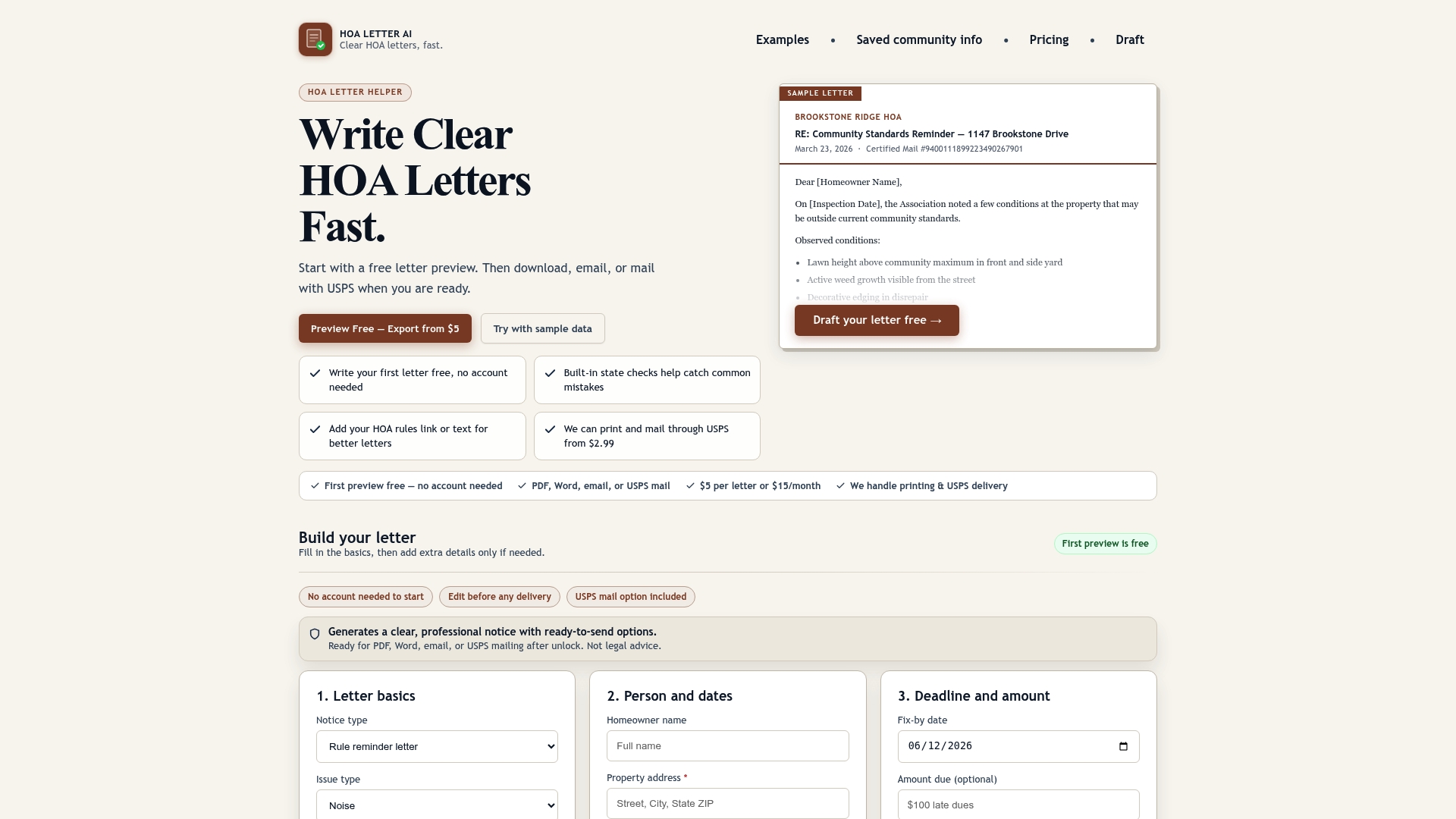
If you want the content of your notice to be complete before you decide how to deliver it, HOA Letter AI lets you start with a free preview and no account. A single letter is $5 on our pricing page, where a self-serve board plan is also listed at $15 per month. USPS mailing is an optional add-on from $2.99 per letter, which covers owners who have not agreed to email.
Property management teams handling many communities can see PM Starter at $199 per month, PM Pro at $399 per month and a 30-day pilot at $499 on our property manager page. You can also draft an HOA notice now and judge the preview for yourself.
FAQ
Is an HOA required to accept email as official notice?
No law cited here forces an owner to accept email. California, for instance, says members need not provide an email address, and Washington and Maryland require written consent. The decision to offer email sits with the association and the choice to accept it sits with each owner.
Can the board use a personal Gmail account for HOA notices?
No statute in our research bans it, but it is a poor practice. Records live in a personal inbox, and when a board member leaves the association loses access to the proof it may need. A dedicated association address keeps the log, the consent records and the notices in one place.
What if an owner’s email keeps bouncing?
Treat it as a delivery failure and switch that owner to mail. The model uniform act treats consent as revoked after two consecutive failed notices, and Maryland’s statute says the same failures can make electronic delivery ineffective. Log each bounce and the date you moved the owner to paper.
Can I email the whole community at once?
You can send an informal update to everyone who gave you an address, but an official notice should go only to owners with valid consent, and you should hide the recipient list. Owners without consent need the paper version. Do not disclose owner emails to other owners without written consent.
Can a violation letter be sent by email only?
Only if your state and governing documents allow it and the owner has opted in. Because a violation can lead to fines and hearings, many boards mail the notice too so delivery is never in question. Check your state’s notice rules before you rely on email alone.
Sources
- HOA Email Communication: Laws, Privacy, and Rights
- California Civil Code § 4041
- California Civil Code § 5615
- Notice Requirements for HOA Meetings (ECHO)
- Florida Statutes § 720.306
- Community Communications: A Florida Board’s Guide
- RCW 64.38.110
- Washington HOA Compliance Notes
- Manage Email Notice Consent
- Maryland Real Property § 11B-113.1
- Louisiana Revised Statutes § 9:1141.38
- Not All Notices Can Be Sent By E-mail
- Electronic delivery consent rules
- HOA parking management software