
Email can satisfy HOA notice requirements, but only when federal law, state statute, and your own governing documents all line up. The federal baseline comes from the E-SIGN Act, which demands affirmative owner consent before electronic notice replaces paper. State law and your CC&Rs can tighten that standard further, and some notices, like liens or foreclosure warnings, still call for certified mail. Before sending a single email notice, check your governing documents, adopt a written email policy, and test every address on file.
TL;DR:
- Before activating an owner’s address, obtain written consent, explain paper notice rights and withdrawal, define covered notices, and test the address with a reply.
- California requires annual delivery preference checks, treats transmission to an address that does not bounce as delivery, and revokes consent after two consecutive failures.
- Keep substantive board debate and voting out of email threads; make decisions at properly noticed meetings and record any email discussion in the minutes.
- Use certified or registered mail for liens, foreclosure demands, and notices whose statutes or governing documents require formal delivery, while retaining tracking and receipt records.
- Check state law and CC&Rs before switching channels, because governing documents may still require paper delivery even when statutes permit email.
HOA Letter AICreate Clearer HOA Compliance NoticesDraft professional HOA notices with guided writing, state-specific context, community rules, built-in checks, and a one-page preview.Visit HOA Letter AI
Table of Contents
- The legal framework: E-SIGN, state statutes, and your CC&Rs
- State rules in practice: California, Florida, Colorado, and DC
- How to get and prove valid email consent
- Open meetings, email threads, and the limits on voting by email
- When certified mail still beats email
- Building a board-ready email policy and checklist
- Why conservative, documented processes protect boards
- Practical ways we help boards send compliant email notices
- FAQ
- Sources
The legal framework: E-SIGN, state statutes, and your CC&Rs
The federal E-SIGN Act is the floor, not the ceiling, for electronic HOA notices. Under E-SIGN’s consent requirements, an association cannot simply switch an owner to email because it is convenient. The law requires an affirmative, informed consent process before an electronic record can legally substitute for a paper one.
That consent process has to include specific disclosures, not a vague “we’ll email you from now on” notice buried in a newsletter.
- The owner’s right to receive paper notices instead of email.
- A clear method for withdrawing consent at any time.
- The scope of what the consent covers, meaning which notices will arrive by email.
- Instructions for obtaining paper copies even after consenting to electronic delivery.
- The technical requirements for reading and retaining the electronic notice.
State law builds on top of that federal floor. Several states require associations to solicit owners’ preferred delivery method on a recurring basis, not just once at move-in, and some require a technical step to confirm an email address actually works before it becomes a valid delivery channel. Practical legal guidance for HOA boards consistently recommends building a written policy around whichever rule is strictest, since boards that default to the loosest standard tend to run into trouble when a notice gets challenged.
Your CC&Rs and bylaws sit on top of both of those layers. If your governing documents were written before electronic notice was common, they may require “mailed” or “hand-delivered” notice in language that a court could read literally, meaning email would not count no matter what state law allows. When bylaws are stricter than the state statute, the bylaw controls. Boards sometimes assume state law gives them permission to switch to email, then get surprised when their own CC&Rs still require something more. Reviewing your formal communication policy against both your state statute and your governing documents before adopting email as a standard channel.
State rules in practice: California, Florida, Colorado, and DC
State statutes do not treat email notice the same way, and the differences matter for how a board builds its policy.
California offers the most detailed statutory framework. Under Civil Code §4041, associations must solicit each owner’s preferred delivery method annually. A “valid” email address is defined as one that does not generate a bounce or failure notice, and delivery to that address is considered complete at the moment of transmission, not when the owner opens it. Two consecutive delivery failures can automatically revoke the owner’s consent to electronic notice, which means a board that ignores bounce messages risks sending notices to an address that no longer counts as valid under the statute.

Florida takes a more restrictive posture on what email can accomplish inside board governance. State administrative rules explicitly prohibit board members from casting votes by email, and emailed board communications have increasingly been treated as association records subject to disclosure, even though the question has been contested in practice.
Colorado and the District of Columbia address electronic notice through their own condominium and common-interest-ownership statutes, generally permitting it where owners have consented but layering on disclosure procedures similar to the federal E-SIGN standard.
| State | Key rule | Practical effect |
|---|---|---|
| California | Annual delivery-preference solicitation; valid-email and bounce definitions under Civ. Code §4040–4055 | Delivery is deemed complete on transmission to a non-bouncing address |
| Florida | Administrative rule limits email voting by board members | Email cannot replace a vote taken at a properly noticed meeting |
| Colorado | Electronic notice permitted with owner consent under state common-interest statutes | Boards still need a documented consent process |
| DC | Electronic notice permitted with disclosure procedures | Consent and disclosure steps mirror federal E-SIGN requirements |
The pattern holds even for boards outside these four states: look for an annual consent-renewal requirement, a definition of what counts as a “valid” email address, and any explicit restriction on voting electronically. Those three elements show up in some form across most state statutes governing common-interest communities.
How to get and prove valid email consent
Consent is the foundation every other rule sits on, so it needs to survive a challenge months or years after it was collected.
- Collect consent in writing, whether through a signed form or a documented reply to an email, before treating any address as valid for official notice.
- Include every required disclosure: the right to request paper, the withdrawal method, the scope of notices covered, and the technical requirements for access.
- Send a test email to the address and require a reply before activating it as the owner’s official channel.
- Log the test, the reply, and the date in a timestamped record tied to that owner’s file.
- Monitor for bounce or failure notices on every subsequent send, and treat two consecutive failures as an automatic trigger to fall back to paper mail.
Several HOA policy templates, including one used by the Rancho Santa Fe Association, build this test-and-reply step directly into their electronic communications rule rather than treating consent as a one-time checkbox.
Pro Tip: Keep a simple spreadsheet or your management software’s delivery log with three columns per owner: consent date, last successful delivery, and bounce count. That record is what you hand to an attorney if a notice is ever challenged.
When an email does bounce, don’t just skip the owner. Automatic revocation after repeated failures, a pattern drawn from California’s statute, is a reasonable default even where your own state is silent, because it forces a fallback to mail rather than letting a stale address quietly fail every notice going forward.
Open meetings, email threads, and the limits on voting by email
Email is a fine tool for logistics. It becomes a legal risk the moment it turns into a substitute for a board meeting.
Open meeting and sunshine laws exist to make sure owners can observe how decisions get made, and a deliberative email thread where board members debate a motion back and forth defeats that purpose just as effectively as a closed-door meeting would. Florida’s restriction on email voting reflects this concern directly, but the underlying principle shows up in open-meeting statutes well beyond Florida.
- Use email freely for administrative notices, meeting reminders, and circulating documents owners need in advance.
- Avoid using email threads to debate motions, negotiate contract terms, or reach informal consensus before a vote.
- If a substantive discussion does happen over email, disclose it in the next meeting’s minutes along with a clear decision-making timeline.
- Never treat an emailed exchange of opinions as a final vote, even when every board member appears to agree.
The safest practice is to treat email as the channel for information and the noticed meeting as the only channel for decisions. A board that keeps that line clear avoids the awkward position of defending an email thread as equivalent to a properly noticed vote.
When certified mail still beats email
Some notices carry legal weight that email simply cannot match, no matter how good your consent process is.
- Lien notices and other filings that affect an owner’s property interest typically require a method that produces a verifiable delivery record.
- Foreclosure-related and collection demand letters often fall under statutory formal-service requirements that predate electronic notice entirely.
- Ballot materials and certain amendment notices may require mailed delivery under your specific state statute or governing documents, regardless of whether the owner has consented to email elsewhere.
Certified mail and registered mail each come with a verifiable chain, a signature or delivery confirmation that holds up far better in a dispute than an email timestamp. Legal guidance on HOA notice documentation consistently points to certified mail as the stronger evidentiary choice whenever a statute or governing document requires proof of delivery.
The practical move is to combine both: send the email copy immediately for speed and send the certified or registered mail copy for the formal record, complemented by clear HOA signage to ensure owners notice important updates. Keep the green return receipt card, log the certified mail tracking number alongside the email timestamp, and store both in the owner’s file. That pairing gives you the speed of email without losing the evidentiary weight certified mail provides, and it matches the approach outlined in resources on why HOA notices require documentation in the first place.
Building a board-ready email policy and checklist
A written policy turns every rule above into something your board can actually follow without re-researching the law each time a notice goes out.
- Draft a written electronic communications policy that mirrors whichever applicable rule, federal, state, or your own CC&Rs, is strictest.
- Require a documented consent flow for every owner, either a signed form or a test-email-and-reply, before activating email as their notice channel.
- Define exactly which notice types may go by email and which require paper or certified mail.
- Set a retention period for consent records, delivery logs, and bounce notifications.
- Establish a bounce-and-fallback procedure so two failed deliveries automatically trigger a paper notice instead of a silent gap.
- Restrict privileged attorney communications to designated addresses, separate from general board discussion threads.
Pro Tip: Build your policy around the strictest rule that applies to you, not the most common one. A policy written for California’s annual-solicitation standard will satisfy a looser state’s requirements automatically; the reverse is rarely true.
Boards that manage this manually usually end up tracking consent dates, state citations, and notice wording in a patchwork of spreadsheets and old templates. State-aware templates that build in the required consent language and delivery tracking, paired with optional mail fulfillment when certified or registered delivery is required, remove most of that manual work without changing what the law actually requires of you.
Why conservative, documented processes protect boards
The boards that avoid trouble are the ones who treat every piece of board-related email as something a judge, an attorney, or an angry owner might eventually read. That means association business stays on official addresses, not personal accounts, and every notice that carries real legal consequence, a lien, a fine escalation, a foreclosure step, gets the paper or certified-mail treatment even when email would technically pass muster.
Convenience is not the same as evidentiary strength. Email is excellent for speed and terrible as a substitute for a decision made at a properly noticed meeting with minutes that reflect what was actually discussed and when. The boards that get burned are rarely the ones who used email too little. They’re the ones who let a convenient channel quietly replace a legal requirement nobody checked.
— Blake
Practical ways we help boards send compliant email notices
We built our letter drafting tool around the exact gap this article describes: boards know email can work, but building a compliant consent process and notice library from scratch eats hours most volunteer boards don’t have. Our templates carry the legal context and required disclosure language for consent forms and common notice types, so you’re not drafting E-SIGN disclosures from memory.
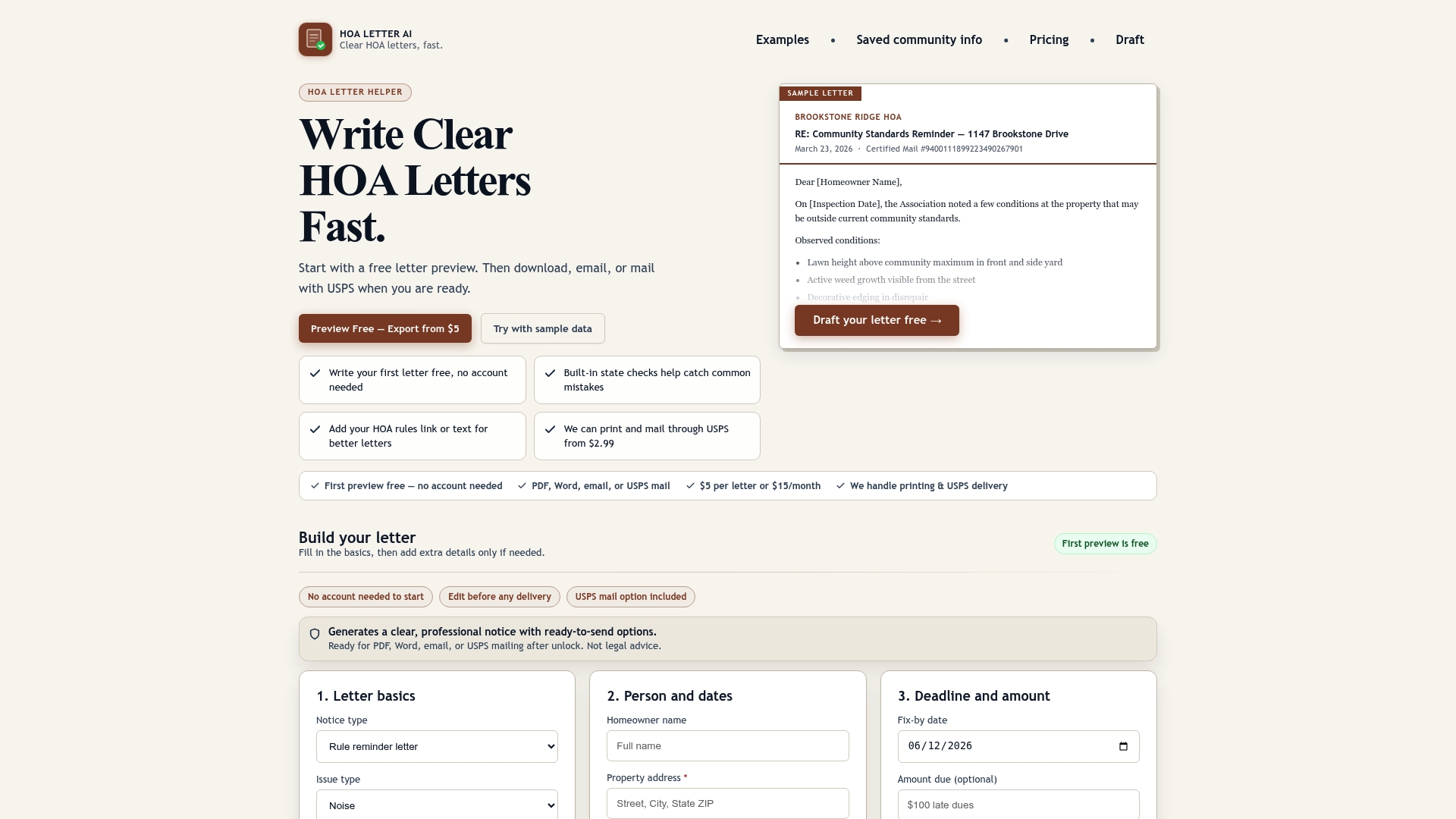
For notices that still need certified or registered delivery, whether that’s a lien notice, a collection demand, or a fine escalation flagged as formal, an optional USPS mailing integration lets you generate the letter once and route it to mail without switching tools. That pairing matters most for a few recurring jobs: sending the annual email-consent solicitation, drafting meeting notices that need to go out fast, and issuing warning letters before fines, where getting the language and the delivery method right the first time avoids a second round entirely.
- Generate a single notice for $5 at our pricing page, with no subscription required for occasional use.
- Property management teams running notices across multiple communities can use PM Starter or PM Pro, detailed on our property manager plans page.
- Add certified or standard USPS mailing directly from the draft screen, starting at $2.99 per letter, when a notice calls for a paper trail.
Start with a free preview of a notice on our homepage to see how the state-specific language and formatting come together before you commit to sending anything.
This article is general information, not a substitute for advice from a qualified lawyer. Consult a qualified legal professional about your own circumstances before acting on anything here.
FAQ
What are the most common HOA violations?
The most frequent HOA violations tend to involve exterior maintenance, unapproved alterations, parking rule breaches, and landscaping upkeep. Pet policy and noise complaints also appear regularly across associations of different sizes.
What are the new requirements for homeowners associations in California in 2026?
California’s electronic notice framework under Civil Code §4040 through §4055 already requires annual solicitation of delivery preferences and defined bounce-handling rules. Boards should confirm with current statutory text or legal counsel for any amendments, since common-interest-ownership law is revised frequently.
How enforceable are HOA bylaws?
HOA bylaws and CC&Rs are generally enforceable as a contract between the association and the homeowner, provided they do not conflict with state statute or public policy. Where bylaws impose a stricter notice requirement than state law allows, courts typically hold the association to its own stricter bylaw language.
What are the signs of a dysfunctional HOA board?
Common signs include inconsistent enforcement of rules, missing or incomplete meeting minutes, poor communication with owners, and decisions made outside properly noticed meetings. Boards that rely on informal email threads to debate or decide matters, instead of documenting discussion and votes in open meetings, often show this pattern early.
Sources
- California Civil Code §4041 (Davis‑Stirling Act)
- Legal rules for HOA email communication (summary of E-SIGN implications)
- Florida administrative rule on electronic transmission and meeting notice effect
- Legal rules for HOA email communication (Vertex Legal)