
An HOA fire lane letter is a written notice to a resident or guest whose vehicle was parked in, or blocking, a marked fire lane. A good one names the exact rule, states what was observed, sets a short deadline, explains what happens next, and tells the recipient how to respond. Whether the HOA can fine or tow depends on one thing first: whether the lane is on private, association-controlled property or on a public street.
This guide walks through that question, then the contents of the letter, the signage that makes enforcement hold up, and the follow-up steps. It is written for board members, property managers, and homeowners who received one.
HOA Letter AIWrite Clearer Fire Lane NoticesHOA Letter AI helps boards and managers draft compliance notices with community rules, state-specific context, and built-in checks.Create a compliance letterTL;DR
- Check who controls the road first. On association-controlled streets the HOA can enforce; on public streets, local law enforcement handles it.
- Cite the CC&R or rule section and the local fire code, and describe the vehicle, place, date, and time.
- Fire lanes need clear marking and signs. Towing rules vary by city and state, so confirm yours before you write “will be towed.”
- Give a deadline, the consequence, and a way to respond or appeal.
- If the vehicle is blocking access right now, call the authorities. A letter is not the tool for an active emergency.
Table of Contents
- Start with jurisdiction: private road or public street
- Who to call when a fire lane is blocked
- What the letter needs to include
- Signage and marking: the part that makes enforcement stick
- What authority does the HOA actually have?
- Deadlines, follow-up, and appeals
- Parking letters vs. fire lane letters
- If you received a fire lane letter
- Perspective: why the letter matters as much as the sign
- Write and send your fire lane letter
- FAQ
- Sources
Start with jurisdiction: private road or public street
Before drafting anything, find out who owns and controls the pavement. The Pioneer Fire District, in its guidance for HOAs, explains that on association-controlled streets the board can enforce fire lane rules and tow, while on public streets the HOA has no jurisdiction and local law enforcement is primarily responsible. The same guidance notes that failing to understand this split leads to enforcement that goes nowhere.
In practice that gives you two paths:
| Situation | Who acts | What the letter does |
|---|---|---|
| Fire lane on private, association-owned road or lot | HOA board or manager, within CC&Rs and local law | Formal violation notice, possible fine or tow under your documents |
| Fire lane on a public street | Police or fire department | Not an HOA enforcement letter; a note to residents or a report to the city |
| Vehicle blocking access right now | Fire department or police | Call them; document it for the letter later |
The parking rules in your governing documents matter just as much. If you are not sure what your association is allowed to do, our explainer on HOA governing documents shows where to look. Clear approval and enforcement rules in those documents are what keep everyone out of disputes later, and the same logic applies to other rules, such as the approvals many condo owners need before renovating.
Who to call when a fire lane is blocked
A letter is for the pattern, not the emergency. If a blocked lane could stop a fire truck from reaching a building, contact the authorities, not the mail room.
Local practice differs. In Colorado Springs, for example, the city says to report a blocked fire lane to the Fire Marshal or the police department, and to call 911 for a life-threatening emergency. Other cities publish their own non-emergency numbers, so a property manager should keep the right number for each community on file.
The fire district also has a stake in your compliance. The Pioneer Fire guidance says a blocked lane can keep responders from reaching their destination, and that the HOA itself can be held responsible and fined by the fire district for non-compliance with codes. That is a good reason to treat repeat violations seriously and keep records.
What the letter needs to include
There is no single national form. These elements make a fire lane letter clear, fair, and easy to defend. They are our recommended practice, so check them against your governing documents and local rules.
- Recipient and property. Owner or resident name, mailing address, and the unit or lot. If the vehicle belongs to a guest, address the host resident.
- Date, time, and location of the observation. Be specific: “the marked fire lane along Building C, east entrance,” not “near the clubhouse.”
- Vehicle details. Make, color, plate number, and state. Attach a photo showing the vehicle and the fire lane marking or sign in the same frame.
- The rule being cited. Quote the CC&R, bylaw, or rules section number. Add the local fire code or ordinance if your documents reference it.
- What must happen and by when. For a fire lane, the answer is usually “do not park there again,” so the deadline is about confirming compliance or responding.
- Consequences. Fine amounts, towing, or escalation, only if your documents and local law support them.
- How to respond or appeal. A contact name, an email or address, and the hearing process if your documents provide one.
- Delivery record. Note how and when the letter was sent.
Sample structure
A short first-notice letter can look like this:
Re: Fire lane parking violation, [address]
On [date] at approximately [time], a [color, make] vehicle, plate [number], was observed parked in the marked fire lane at [location]. Section [number] of the community’s [CC&Rs/rules] prohibits parking in designated fire lanes. Fire lanes must remain clear so emergency vehicles can reach every building.
Please make sure this vehicle is not parked in the fire lane again. Continued violations may result in [fine/tow, as authorized by the governing documents and applicable law]. If you believe this notice is in error, contact [name] at [contact] by [date] to respond or request a hearing.
Keep the tone factual. Leave out accusations and guesses about motive. The letter is a record that may be read by a hearing panel or a judge.
Signage and marking: the part that makes enforcement stick
A letter that cites a fire lane nobody can see is weak. Marking requirements are set locally, so look up your own jurisdiction, but these examples show how specific they get.
In Anaheim, California, the fire department says a private fire lane may be designated by a red curb or paint, a visible sign, or red outlining with contrasting “FIRE LANE” lettering. The same document says that before a property owner tows from a private fire lane, signs must be posted in plain view at all entrances. The signs must be at least 17 by 22 inches, state that stopping in a fire lane is prohibited and that vehicles will be removed at the owner’s expense, and include the local traffic enforcement agency’s phone number.
In Grover Beach, California, the city places the responsibility for installing and maintaining “No Parking, Fire Lane” signs on private property on the property owner. For an HOA, that means the association.
Many jurisdictions, including Arizona cities such as Phoenix and Mesa, adopt the International Fire Code, which requires fire lanes to stay unobstructed, according to a Phoenix property manager guide. If your city has adopted a version of that code, your fire department can tell you which edition and what it requires on your property.
A quick signage audit before you send letters:
- Is the curb or pavement marked and the paint still visible?
- Are signs posted, undamaged, and readable from the driver’s seat?
- Do the signs match the wording and size your city requires?
- Is the enforcement phone number on the signs current?
If any answer is no, fix it first. A resident who gets a letter about a faded lane has a fair complaint.
What authority does the HOA actually have?
The HOA’s power comes from three layers: state law, local ordinance, and the association’s own documents.

Your documents. Pioneer Fire’s guidance says an HOA can write fire lane rules into its CC&Rs. FirstService Residential, a property management company, advises HOAs to review state and local laws and make sure their governing documents clearly explain the parking policy, including when and whether towing is authorized.
Towing. The Pioneer Fire guidance describes a few approaches: posted signage, general written authorization to a contracted towing company, and, on association-controlled streets, towing without notice or specific authorization. Whether that last option is lawful in your state is a separate question, which is why you should confirm your state’s rules. Our piece on how to avoid illegal tows covers the mistakes boards make most often, and the state-by-state notice rules page is a good starting reference.
Citations by officials. Some towns give enforcement to officers, not associations. In Fountain Hills, Arizona, the town code says an action over an alleged parking violation may begin with a citation issued by a peace officer or the Town Manager or a designee, and that the citation may be affixed to the vehicle. The same code requires anyone who tows a vehicle from a private lot without the owner’s express permission to immediately notify local law enforcement and provide details such as the vehicle, owner, reason for removal, destination, and the towing company. If a tow happens in your community, report it the way local law requires.
Fines. Pioneer Fire notes that fines can deter violations but only work when the HOA can identify the owner and collect. For guests and visitors, that is often hard, which is one reason towing and law enforcement reports matter for fire lanes.
Deadlines, follow-up, and appeals
Fire lane violations are different from a messy yard. The hazard exists only while the vehicle is there, so the “cure period” many HOAs give for other violations may not fit. Still, the letter should say what the resident can do and when.
Look at how one municipality handles process. In Westampton Township, New Jersey, fire officials may issue a summons or notice of violation and serve it in person or by certified mail to the last known address when the offender is not with the vehicle. A person pleading not guilty can present a defense in Municipal Court or before the county construction board of appeals, according to the township code. That is a municipal process, not an HOA one, but it shows what a complete notice does: it names a method of service, a place to respond, and a route to contest.
For your association, a reasonable follow-up ladder looks like this:
- First observation: photo, then a courtesy or first notice. Our warning letter template fits this stage.
- Repeat violation: formal violation notice citing the earlier letter by date.
- Continued violation: fine or tow, only as your documents and law allow, with hearing rights preserved if your documents give them.
- Active blockage: call the fire department or police right away, whatever stage the letter process is in.
Hold on to every photo, every letter copy, and proof of mailing. If a resident disputes a fine, that file is your case.
Parking letters vs. fire lane letters
Most HOAs already have a parking letter. A fire lane letter is a stricter cousin. It should reference safety, not just convenience, and it should be firmer about repeat behavior. If your community needs the broader version covering guest, street, RV, and boat parking, start from the parking violation letter template, and read the board guide to parking violation letters for how those notices are structured. Then adapt the citation to your fire lane rule and local code.
One caution from experience: do not send an HOA enforcement letter about a vehicle on a public street as though the association can fine for it. Point the resident or the complainant to the police or fire department instead.
If you received a fire lane letter
Homeowners get these letters too, sometimes unfairly. Before you respond:
- Read which rule is cited and whether the letter names the location precisely.
- Check whether the spot is on private community property or a public street.
- Look for marked curbs and signs. If they were missing or faded, say so and attach photos.
- Confirm the vehicle was yours or your guest’s, using the plate and time.
- Reply in writing before the deadline and request a hearing if your documents provide one.
If you want help checking the notice and drafting a clear reply, the notice check and response generator walks through it, and the parking violation response letter page covers the response side.
Perspective: why the letter matters as much as the sign
We see the same pattern in fire lane cases. The sign goes up, the paint gets refreshed, and then the first real dispute turns on a letter that left out the date, the rule section, or a way to respond.
Our view is that a fire lane letter should be fast to write and hard to pick apart. That means guided drafting that asks for the facts a hearing would ask for, state-aware context so the notice does not promise something local law may not allow, and a one-page preview you can review before anything is sent.
Boards and property managers are rarely short of goodwill. They are short of time, and a letter written in a hurry is where avoidable errors come from. We built HOA Letter AI so the careful version is also the quick version, with one clear price per letter and no account needed to preview.
Safety issues deserve a record that reads as calm and factual. A good letter protects the residents who need the lane clear, and it protects the board that enforces it.
Blake
Write and send your fire lane letter
If you are a board member or manager, you can preview a state-aware fire lane or parking notice for free, with your rule and CC&R citation built in. A single letter is a one-time $5, and the self-serve board lane is $15 per month for boards that send notices regularly. Optional USPS mailing starts from $2.99 per letter on the draft page, so the notice can go out without a trip to the post office.
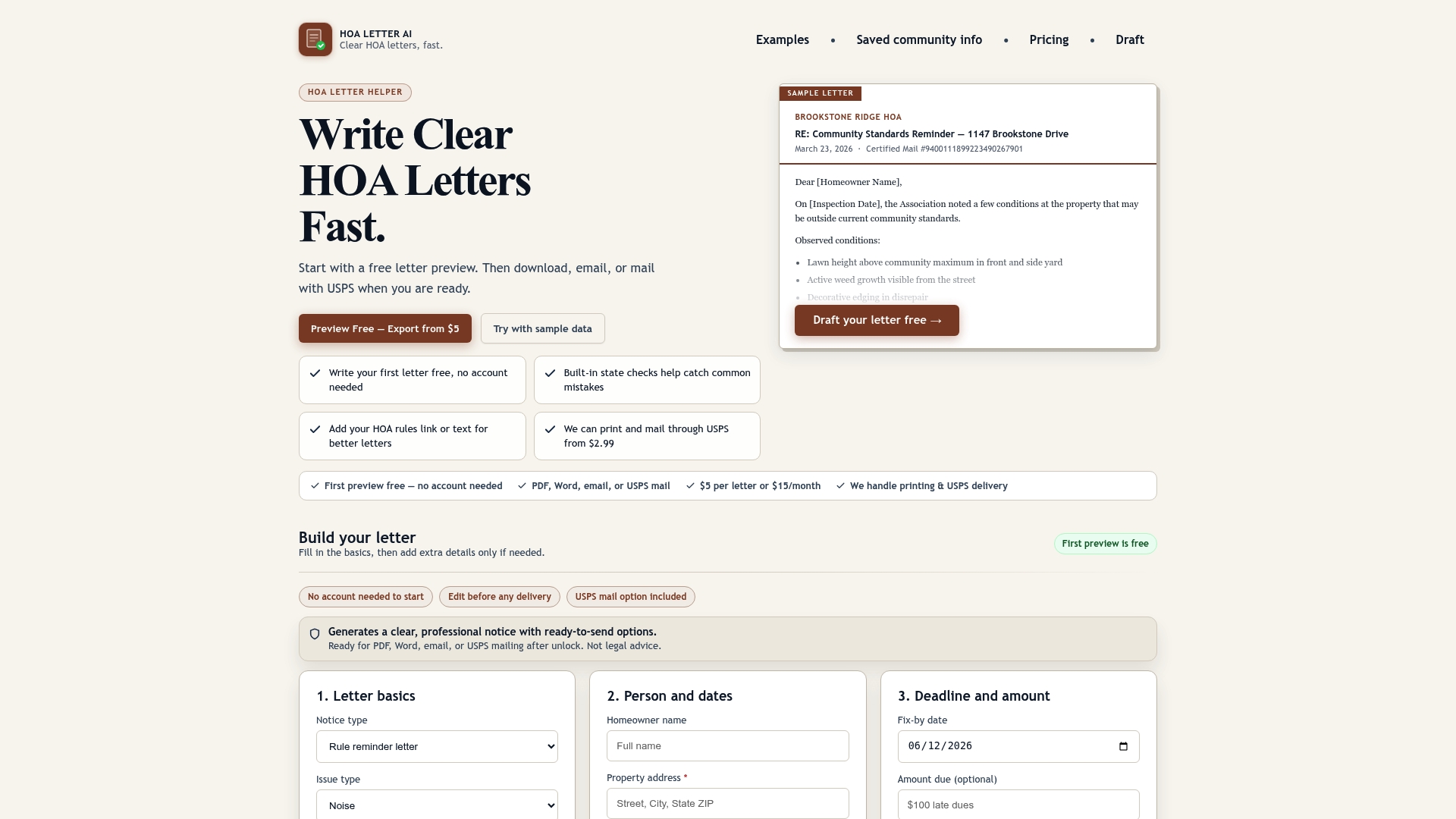
Property management teams handling many communities can see the Starter ($199 per month), Pro ($399 per month), and 30-day pilot ($499 one-off) on the property manager page. Homeowners who received a notice can generate a response for a one-time $5 on the pricing page.
FAQ
Can an HOA tow a car parked in a fire lane?
Often yes on association-controlled private roads, but the conditions vary by state and city. Some places require specific signs at every entrance before towing, as in Anaheim. Check your governing documents and local law first, and use a towing company that follows both.
Can my HOA send a fire lane letter about a public street?
It can send a reminder, but it has no enforcement jurisdiction on public streets. Local law enforcement handles rules there. Fire lane violations on a public street should be reported to the police or fire department.
Who do I call about a car blocking a fire lane right now?
If it blocks emergency access or someone is in danger, call 911. Otherwise use the fire marshal, fire prevention office, or police non-emergency line for your city. Colorado Springs, for example, directs reports to the Fire Marshal or its police department.
What should I do if I think the HOA’s fire lane notice is wrong?
Respond in writing before the deadline. Cite the section the letter relies on, point out missing markings or signs, attach photos, and ask for a hearing if your documents allow one. Keep copies of everything you send.
Does the association have to mark the fire lane?
Marking rules are local, but the guidance cited above puts sign installation and upkeep on the property owner in places like Grover Beach, and an HOA is the owner of common areas. Keep curbs and signs maintained so letters are enforceable.
Sources
- Handling Fire Lane Parking Rules in an HOA, Pioneer Fire District
- Contact the Fire Department, Colorado Springs
- Private Fire Lanes, Anaheim Fire & Rescue
- Fire lane sign requirements, City of Grover Beach
- Phoenix’s most common parking violations, property manager guide
- Five tips for solving HOA parking problems, FirstService Residential
- Parking article, Town of Fountain Hills
- Article IV: General Provisions, Township of Westampton, NJ