
Send a letter requesting a certificate of insurance or declarations page showing active HO‑6 coverage, whenever the association’s governing documents require unit owners to carry it. Acceptable proof must show the policy is active, name the correct insured, and meet the liability and loss‑assessment limits set in your CC&Rs. The immediate move: send a state-compliant letter with a firm deadline, typically within a reasonable timeframe, and clear instructions for how to submit proof.
TL;DR:
- Sending a clear, state-compliant letter with a firm deadline and specific instructions is essential when requesting proof of HO-6 or HO-3 insurance coverage.
- The proof must show active coverage, correct insured naming, and meet the liability and loss-assessment limits specified in the CC&Rs.
- Associations should request either a certificate of insurance or a declarations page, preferably naming the HOA as an interested party rather than an additional insured.
- The typical deadline for submitting proof is 10 to 30 days, with reminders at halfway and final notices, to ensure compliance before enforcement actions.
- Enforcement steps escalate from reminders to fines, force-placed insurance, assessments, and liens, all supported by documented procedures and proper authorizations.
HOA Letter AIhoaletterai.comCreate Clearer Insurance NoticesDraft professional HOA compliance letters with guided context, community rules, built-in checks, and a one-page preview.Create a compliance letter
Table of Contents
- What Counts as Acceptable Proof of HOA Insurance?
- How Do You Write an HOA Insurance Proof Request Letter?
- What’s a Reasonable Deadline for HOA Insurance Proof?
- What Happens If an Owner Won’t Provide Proof of Coverage?
- An Editor’s Take on Getting Owners to Actually Comply
- Draft Your Insurance Proof Request in Minutes, Not Hours
- Where to Verify the Legal Details
- Sources
What Counts as Acceptable Proof of HOA Insurance?
Two documents dominate this request, and they are not interchangeable. A certificate of insurance is a short summary an insurance agent issues specifically to confirm coverage exists, often built for exactly this purpose. A declarations page is the actual policy summary the insurer mails the homeowner, listing coverage types, limits, and the policy period. Either one works for verification purposes, but the certificate is usually cleaner because it avoids exposing unrelated policy details, and most brokers will issue one within a day or two of a request.
Boards should require personal insurance only when the governing documents actually authorize it. Most CC&Rs written or revised in the past two decades include a clause requiring HO‑6 coverage for attached units, or HO‑3 for detached single-family homes inside a planned community, and a right for the association to request proof on demand. If that clause is missing, a proof request has no legal footing. Check the CC&Rs and bylaws first, every time, before drafting a letter.
Once you know the request is valid, ask for these fields specifically:
- Named insured (must match the deed or ownership record)
- Policy type (HO‑6 or HO‑3, not a renters or umbrella policy)
- Policy number
- Effective and expiration dates
- Liability coverage limit
- Loss‑assessment endorsement, if your CC&Rs require it
- Insurer name and NAIC number
On the “who gets listed” question, most associations should ask to be named an interested party rather than an additional insured. Interested-party status means the insurer will notify the association if the policy lapses or is not renewed, without handing over full policy details. Additional-insured status extends liability protection to the association itself, which is rarely necessary for an owner’s individual HO‑6 policy and can create coverage confusion during a claim. Reserve that designation for contractors and vendors, not homeowners.
Stay out of claims history. Requesting past claims, denial letters, or full underwriting files goes beyond what’s needed to confirm active coverage, and it creates a privacy and liability headache for the board if that information is mishandled. Keep only what you need to confirm the policy is active and meets your limits, then store it in a locked file or a system with access controls, not a shared spreadsheet on someone’s desktop.
How Do You Write an HOA Insurance Proof Request Letter?
A defensible letter follows a fixed structure every time. Consistency matters here almost as much as content, because a board that varies its wording owner to owner opens itself up to claims of selective enforcement.
- Header — Association name, address, and a designated contact for insurance matters (not a rotating board member’s personal address).
- Authority citation — Quote the specific CC&R article or bylaw section, or reference the board resolution, that requires HO‑6 coverage.
- The ask — State plainly which document is required (certificate of insurance or declarations page) and the fields it must show.
- Acceptable formats — Email attachment, secure upload portal, or mail. Say which ones you accept.
- Deadline — A specific date, not “promptly” or “as soon as possible.”
- Consequences — What happens if the deadline passes, stated factually, not as a threat.
- Contact info — Who to call with questions.
Here’s a short version of an initial request:
“Per Article 7, Section 3 of the [Association Name] CC&Rs, all unit owners must maintain an active HO‑6 policy with minimum liability coverage of $300,000 and a loss‑assessment endorsement of at least $10,000. Please submit a current certificate of insurance or declarations page to [email/portal] by [date]. Failure to provide proof by this date may result in a compliance fine as outlined in the association’s fine schedule.”
And an escalation notice, once the deadline has passed:
“This is a second notice regarding our request dated [date] for proof of HO‑6 coverage. Our records show no response. Per Board Resolution [number], failure to provide proof by [new date] will result in a $[amount] fine and may lead the association to secure coverage on your behalf, with the premium added to your account, per Article [X] of the CC&Rs.”
For delivery, certified mail with return receipt gives you the strongest paper trail, but a tracked email to the owner (with a read receipt or delivery confirmation) works fine for a first notice. Log every submission in a spreadsheet or your management software the moment it arrives: date received, document type, expiration date, and who reviewed it.
Pro Tip: Never send the escalation notice from a different email address or letterhead than the original request. Owners who dispute enforcement later often point to inconsistent formatting as evidence the board wasn’t following its own process.
What’s a Reasonable Deadline for HOA Insurance Proof?
Most associations set a 10 to 30 day window, which mirrors the administrative timelines management companies already use for other compliance requests. A tighter window than 10 days rarely survives a dispute, since it doesn’t give an owner time to contact their agent. Anything past 30 days starts to look like the board isn’t taking the requirement seriously, which weakens later enforcement.
- Day 0: Initial request sent, deadline set
- Day 15 (mid-window): Reminder sent to non-responders
- Day 30: Final notice with explicit consequence stated
- Day 40+: Enforcement action begins
Tie the initial request to your fiscal year or each owner’s policy renewal month, and log every notice sent, every response received, and every non-response, so your timeline holds up if an owner challenges the fine later.
What Happens If an Owner Won’t Provide Proof of Coverage?
Enforcement escalates in a specific order for good reason: skipping steps is what gets fine schedules overturned in disputes. The sequence runs reminder, then fine, then force-placed insurance, then special assessment, then collection or lien, and each step needs its own paper trail.
Force-placed insurance is a policy the association buys on the owner’s behalf when they refuse to provide proof, and it typically costs more than a policy the owner would have obtained directly, since insurers price these policies for higher risk with less underwriting information. Associations can charge the premium back to the owner as an assessment. Unpaid fines and assessments can result in a lien on the unit, which is the outcome every step before it is designed to avoid.
Before assessing a fine or placing a lien, confirm four things:
- The CC&Rs actually authorize the insurance requirement
- A board resolution documents the fine schedule and force-placement policy
- Meeting minutes reflect the board’s decision to enforce
- Your state’s lien and assessment procedures were followed exactly
Boards that document every attempt at cooperation before force-placing insurance face far fewer successful disputes than boards that jump straight to the most aggressive option. Treat force-placement as the last resort, not the first response to a missed deadline.
An Editor’s Take on Getting Owners to Actually Comply
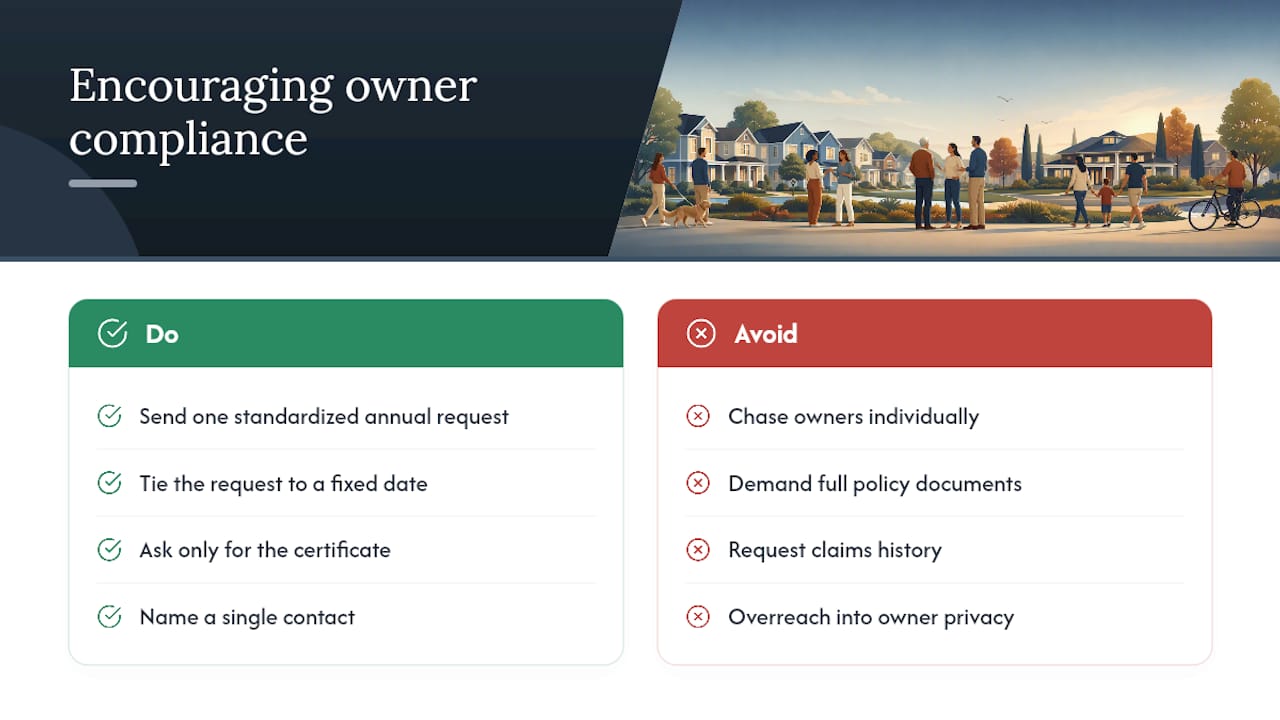
The boards that get consistent insurance compliance aren’t the ones with the scariest fine schedule. They’re the ones who send one standardized request a year, tied to a fixed date like the fiscal year start, instead of chasing owners individually whenever someone happens to notice a gap. That single-annual-cycle approach produces measurably better compliance than ad hoc requests, mostly because owners learn to expect it, like a tax deadline.
The mistake I see most often is boards asking for more than they need. A full policy document or a claims history is not just unnecessary, it’s the kind of overreach that turns a routine compliance request into a privacy complaint. Ask for the certificate, name one contact, keep a log, and stop there.
— Blake
Draft Your Insurance Proof Request in Minutes, Not Hours
Writing a legally sound proof-request letter from scratch, citing the right CC&R clause, listing the right fields, setting a defensible deadline, takes most boards an hour or more per owner, and errors in that letter are exactly what owners exploit during a dispute. Some letter generation tools include guided drafting, state-aware wording adjusting notice language to match jurisdiction, and one-page previews to check documents before sending.
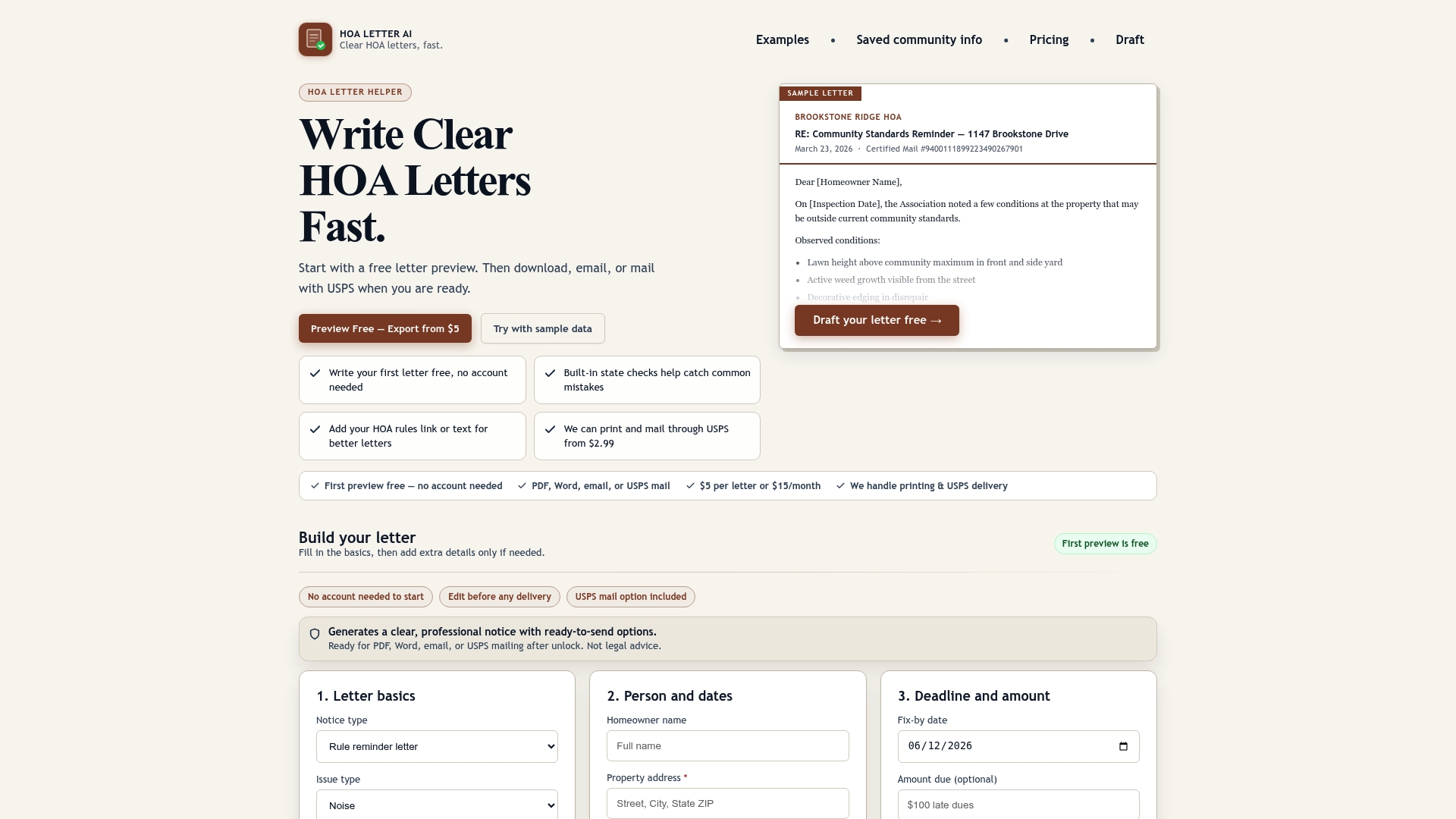
Property managers handling multiple communities can save a reusable community profile once and reuse it across every insurance cycle, avoiding rebuilding the letter each time. Notices often include mandatory language required by state rules, and mailing integrations can handle delivery to provide a documented paper trail without a trip to the post office. Start from the HOA Warning Letter Template to see the format, or check the property manager pricing page if you’re managing insurance compliance across several associations at once.
Where to Verify the Legal Details
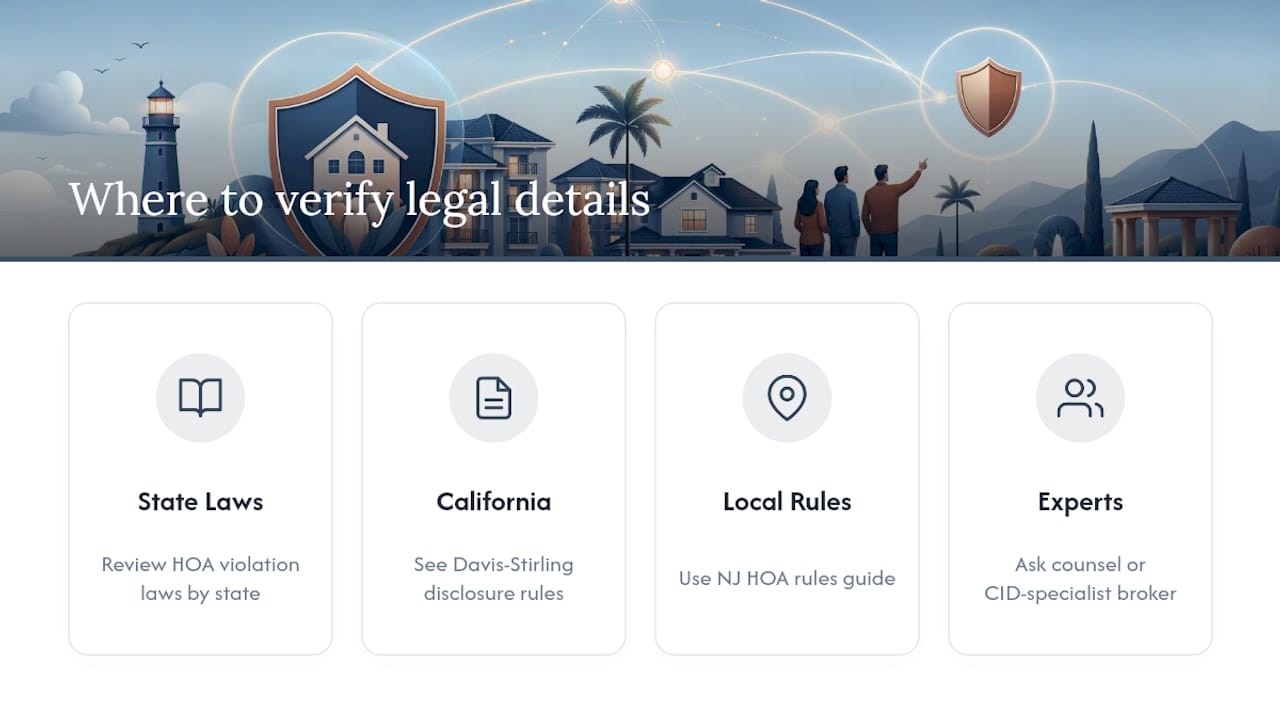
For state-specific notice and fine rules, review HOA violation letter laws by state before finalizing your deadline language. California boards should reference the Davis‑Stirling insurance disclosure requirements directly. For governing-document interactions with local rules more broadly, this New Jersey HOA rules guide is a useful reference point. When in doubt, consult association counsel or a broker who specializes in common-interest developments before enforcing.
Sources
- Is HO-6 Insurance Mandatory? Lender and HOA Rules - LegalClarity
- HOA insurance duties (Davis‑Stirling summary) - Davis‑Stirling
- Homeowners Insurance Requirements: Enforcing Peace of Mind - Onyx Capital Management