
Send this line: “Per [rule citation], all holiday decorations must be removed by [date], which is 14 days after the holiday.” Name the governing paragraph of your CC&Rs or rules, state one fixed deadline, and give residents a contact for questions. A specific citation and a concrete date are what make a removal notice clear and defensible.
TL;DR:
- Before citing a policy, verify it appears in current governing documents or recorded amendments; ask an attorney if its legal status is unclear.
- Use objective limits such as removal dates and lighting hours, apply them consistently, and provide a contact for travel, illness, weather, or religious observances.
- A deadline set 14 days after a holiday leaves little room for travel or bad weather; lighting hours often end at 10 PM or midnight.
- Send notices through email or the resident portal, post and deliver copies, then keep dated photos, replies, and mailing receipts to document equal treatment.
- After the deadline, inspect homes by the same criteria, send a courtesy reminder before formal notice, and use hearings or fines only when governing documents allow.
HOA Letter AIWrite Clearer HOA Compliance NoticesHOA Letter AI combines guided drafting, state-specific context, community rules, and built-in checks to help teams create clear compliance letters.Create a compliance letter
Table of Contents
- Sample holiday decoration removal notice you can copy
- How should you customize the notice and check your legal footing?
- What timing windows do most boards use?
- How do you deliver the notice and communicate with residents?
- What should you do after the removal deadline passes?
- Why a short, clear notice beats a long warning
- Get a compliant notice drafted in minutes
- FAQ
- Sources
Sample holiday decoration removal notice you can copy
Below is a full notice. Replace every bracketed item before sending.
Subject: Holiday Decoration Removal Reminder
Dear [Resident Name / Homeowner],
[Association Name] thanks you for helping make our community festive this season. Under [Rule Citation, such as Article X, Section Y of the CC&Rs], all holiday decorations, lighting, and displays must be removed from exterior areas by [Removal Deadline Date].
Please take down all seasonal items, including lights, inflatables, yard signs, and ground stakes, by that date. If you need more time because of illness, travel, or weather, contact us at [Contact Name, Phone, Email] before the deadline and we will work with you.
Thank you for keeping [Association Name] looking its best.
Sincerely, [Board Member / Manager Name], [Title] [Date of Notice]
Fill in the placeholders with these points in mind:
- Association name: Use the legal name that appears on your recorded documents so the notice matches your governing records.
- Rule citation: Cite the exact article and section. Residents are far more likely to comply when they can read the rule themselves.
- Removal deadline: Write a calendar date, not “soon” or “after the holidays.”
- Contact details: Give one person and one channel so exception requests do not get lost.
Follow these steps to prepare the notice:
- Confirm the rule you are citing is in your current governing documents.
- Choose the deadline date and double-check it against the calendar.
- Fill in each placeholder and read the finished notice once aloud.
- Have the board president or manager approve it before sending.
For a pre-deadline reminder, use this shorter version: “Friendly reminder from [Association Name]: holiday decorations must come down by [Date] under [Rule Citation]. Questions? Contact [Name and Email].”
How should you customize the notice and check your legal footing?
Start with the documents that carry legal weight: your CC&Rs, your adopted rules, and any recorded amendments. One attorney commentary notes that a board policy should be a recorded dedicatory instrument in county property records, because an unrecorded resolution may lack the weight needed for formal enforcement. If you are unsure whether your policy qualifies, ask your attorney before citing it.
Wording matters as much as the source. Community Associations Institute guidance in its holiday decorations blog post says courts have found decoration guidelines unenforceable when they lack specific, actionable criteria, and vague terms like “offensive” tend to fail against concrete rules about timing and hours.
Keep these principles in your draft:
- Use objective criteria: dates, lighting hours, and size limits.
- Apply the same window to every holiday and every resident.
- Avoid judging the content or message of a display.
- Offer a simple process for exception requests, including religious or multi-week observances.
Pro Tip: Before you adopt a permanent rule, ask residents for input and publicize the final version. CAI guidance recommends building community consensus first, which cuts complaints later.
What timing windows do most boards use?
Many boards start with a practitioner rule of thumb: allow displays two weeks before and two weeks after a holiday, and set defined lighting hours. From there, pick the window that fits your community:
- 14 days after the holiday: Tight and easy to explain, but it leaves little room for travel or bad weather.
- A longer period after the holiday: Gentler on residents, though it can keep decorations up long enough to draw neighbor complaints.
- Fixed removal date for everyone: Simplest to enforce and to document, especially for winter holidays that overlap.
- Lighting hours: Common examples run from dusk until 10 PM or midnight, which respects neighbors and reduces cord and circuit risks.
Whatever you choose, write the dates into the notice itself.
How do you deliver the notice and communicate with residents?
Layer your channels so every resident gets the message and you have proof of it.
- Announce the rule by community email or your resident portal.
- Post the notice at common bulletin boards or the clubhouse.
- Deliver a copy to each door for homes with visible decorations.
- Send certified mail for any formal enforcement notice.
Space your messages: an initial notice, a reminder before the deadline, and a final notice on the deadline. Keep a copy of every version, mail receipts, and dated photos, plus any resident replies. If a dispute reaches a hearing, that file is your evidence that residents were told clearly and in time. If your community also tracks seasonal maintenance, this seasonal maintenance checklist is a useful workflow companion.
What should you do after the removal deadline passes?
After the deadline, inspect using the same criteria for every home. Record the date, the inspector’s name, and photo evidence of each address.
Escalate in steps your documents allow:
- Send a courtesy reminder first to homes still displaying decorations.
- Follow with a formal notice that cites the rule and the deadline.
- Move to an ARB hearing or your fine process only if your CC&Rs provide for it.
Vague rules are the biggest risk. In one case, a Virginia court overturned enforcement because the seasonal guidelines did not adequately specify what constituted a violation. Consistent, documented enforcement protects you. Our HOA violation notice checklist walks through the paper trail step by step.
Pro Tip: Photograph every inspected home, including compliant ones. Records of equal treatment are your best defense against a claim of selective enforcement.
Why a short, clear notice beats a long warning

I have seen the same pattern in HOA disputes: most holiday conflicts start with confusion, not defiance. A concise notice that names one rule and gives one date leaves little to argue about. Long, stern letters tend to turn a seasonal reminder into a feud.
Ask residents before adopting anything permanent, announce early, and apply the rule evenly. If your governing documents are ambiguous, pay for a short consult with counsel before sending anything formal. That costs far less than defending a rule a court may reject.
— Blake
Get a compliant notice drafted in minutes
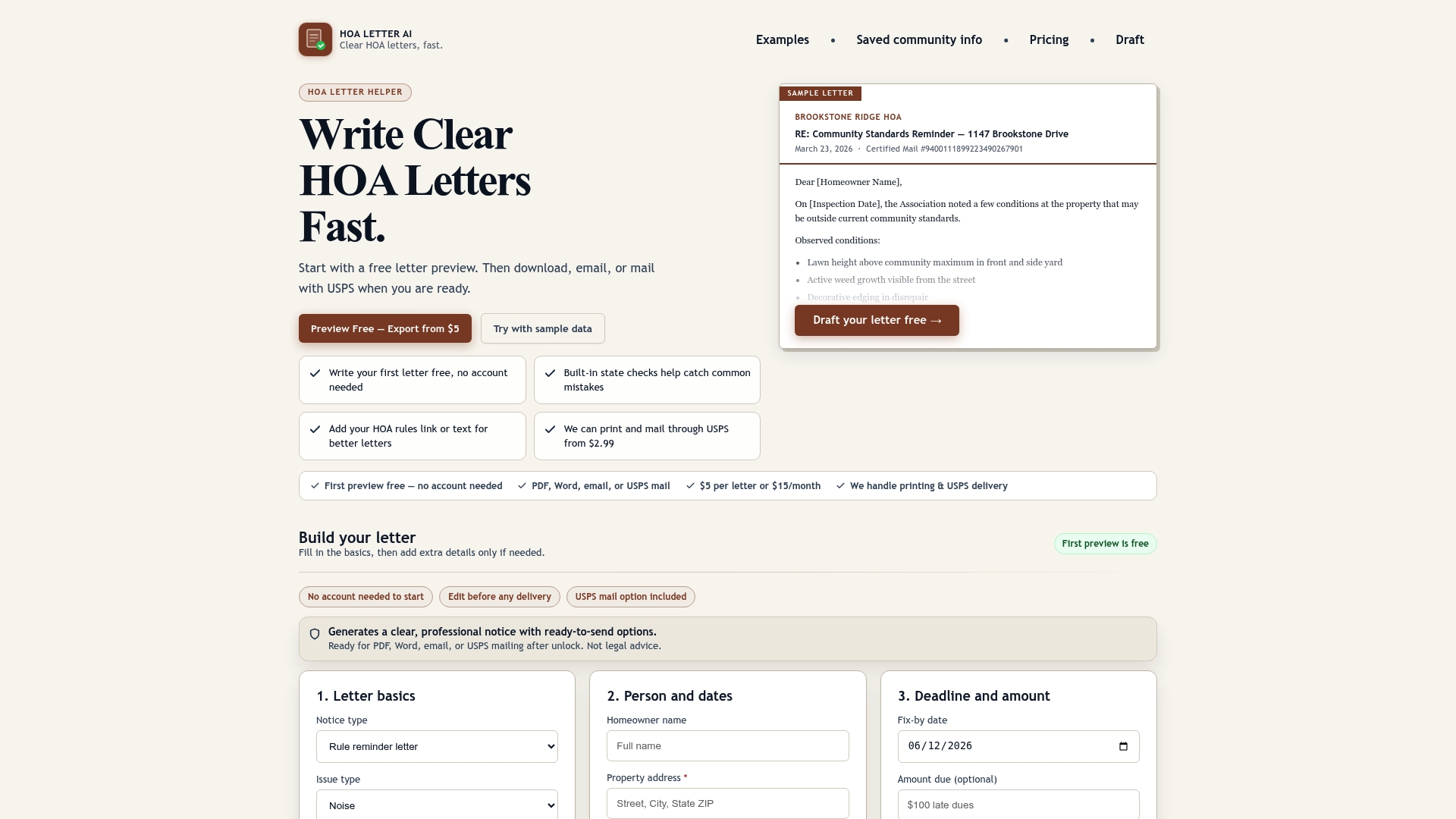
We built HOA Letter AI so boards do not start from a blank page. Our guided drafting gives you a free preview, lets you cite your own rules and CC&Rs, and runs built-in checks before you send. A single letter is a $5 one-time fee, and optional USPS mailing starts at $2.99. Start with our HOA warning letter template, add your rule citation and deadline, and preview the result today.
FAQ
How do I write a letter to an HOA?
State your purpose in the first sentence, cite the specific rule or issue, and propose a clear next step. Keep the tone calm and factual, include your address and contact information, and keep a dated copy. Our guide on writing an HOA violation letter includes a calm, rule-cited example.
Can you put inflatables outside if you have an HOA?
It depends on your CC&Rs and rules. Some communities limit size, height, or placement, while others say nothing. Read your governing documents first, and ask the board in writing if the language is unclear.
What are the most common HOA violations?
Exterior appearance issues are among the most frequent, including landscaping, trash bins, parking, and seasonal decorations left up past a deadline. Violations tied to clear, written rules are the easiest for boards to enforce fairly.
How long can holiday decorations stay up?
Practitioners often cite a window of about two weeks before and two weeks after a holiday as a starting point. Your governing documents control, so choose a specific number of days and write it into your notice.
Sources
- The ultimate guide to the best HOA holiday ever: Decorations - Ungated: Community Associations Institute Blog
- Regulating Season’s Greetings in HOAs - HOAresources