
If your HOA letter states a response deadline, reply in writing by that date. If it does not, send your written response within 14 days and keep proof you sent it. Acting fast protects your right to a hearing or appeal, and a documented paper trail matters more than how persuasive your letter sounds.
TL;DR:
- Most HOA deadlines are based on the receipt date, not the notice or mail date, making prompt recording of receipt crucial.
- Response windows for violations typically range from 10 to 30 days, with shorter periods of 10 to 14 days for hearings, depending on jurisdiction.
- State laws often set minimum notice periods, but HOA-specific rules can impose stricter deadlines, which take precedence over general guidelines.
- A well-structured response letter should be concise, factual, and include case details, evidence, and a clear remedy request, sent via tracked methods.
- If the HOA misses a deadline, homeowners should follow up in writing within two weeks and document all enforcement actions to protect their rights.
HOA Letter AICreate a Clear HOA Response LetterDraft a professional, state-aware response with community rules, built-in checks, a one-page preview, and delivery options.Create your response letter
Table of Contents
- How to read an HOA notice and extract the deadline you must meet
- Common response windows and state examples to know
- What to put in your response letter: format and required elements
- How to send the letter and create a defensible paper trail
- What to do when the HOA fails to reply or misses a deadline
- Copy-ready template, checklist, and sample timeline
- How state-aware templates and automated checks cut down errors
- Why most HOA disputes get worse from silence, not disagreement
- Get a state-aware response letter without starting from a blank page
- Where to check next for your specific case
- FAQ
How to read an HOA notice and extract the deadline you must meet
Every HOA notice buries the real deadline somewhere in the fine print, and the first mistake homeowners make is confusing the notice date with the date that actually starts the clock. The notice date is when the letter was written. The mailing date may be a day or two later. The receipt date, when you actually got it in hand or in your inbox, is often what governing documents use to calculate your response window. A cure period is different again: it is the time you have to fix the violation itself, which may run longer or shorter than your window to simply respond in writing.
Look for a specific line referencing your community’s CC&Rs or bylaws, usually something like “pursuant to Article [X], Section [Y].” If the notice cites a state statute, that citation controls the minimum timeline the HOA must follow, even if the board’s internal rules say something different.
Run through this before you do anything else:
- Find the date stamped or typed on the notice itself, not the envelope postmark.
- Note the date you actually received it, by mail, email, or hand delivery.
- Locate any cure period separate from the response or hearing-request deadline.
- Check whether the notice references your CC&Rs, bylaws, or a specific state statute.
Most governing documents and enforcement procedures give homeowners a few weeks to respond or cure a violation, though the exact number depends entirely on your community’s documents and state law.
Common response windows and state examples to know
Once you know which deadline applies, the next question is how much time you actually have. There is no single universal number, but a few patterns show up again and again across HOA enforcement procedures.
- Routine violation notices (landscaping, parking, exterior changes) often allow 10 to 30 days to respond or cure.
- Hearing-request deadlines tend to run shorter, often 10 to 14 days from the date of notice.
- When a notice gives no deadline at all, a couple of weeks is a widely used, conservative default.
State law sometimes sets a floor under these timelines. California statutes require at least 10 business days’ notice for certain meeting and records requests. Florida statutes set a 14-day minimum notice period before a hearing on a violation can proceed. Texas hearing statutes, depending on the governing chapter, can run closer to 30 days. These are illustrative examples of how timelines vary by jurisdiction, not a complete list of every rule that might apply to your property, so check your own state’s notice requirements before you calendar anything.
When the date on your notice conflicts with a general guideline like the ones above, the notice and your governing documents win. State minimums set a floor, not a ceiling, and your HOA may have adopted stricter internal deadlines that apply to your case specifically.

What to put in your response letter: format and required elements
A response letter that protects your rights does not need to be long. It needs to be complete, dated, and specific. Start with a header block: your name, property address, the date, a reference to the violation or case number from the original notice, and the HOA’s or management company’s name and address… Skipping the case number is one of the most common reasons responses get misfiled or ignored.
Structure the body in four short paragraphs.
- State plainly whether you dispute the violation, agree to cure it, or need more information, and reference the exact notice date and violation described.
- Summarize the relevant facts and attach or reference your evidence, such as photos, receipts, or prior correspondence.
- State what you want: more time to cure, a hearing, a rescinded fine, or written clarification of the rule cited.
- Close by requesting written confirmation of receipt and a reply by a specific date you set, typically 10 to 14 days out.
Keep the tone flat and documentary. Avoid words like “unfair” or “ridiculous,” even if you feel that way. A board reviewing a stack of letters responds more predictably to a letter that reads like a record than one that reads like a complaint. If you attach photos or documents, reference them by name and date in the body (“see attached photo dated March 3, 2026”) rather than assuming the reader will connect the dots.
If the original notice cited a specific CC&R section or statute, you can reference that same citation back, briefly, to show you read it carefully. Do not invent legal arguments or cite statutes you have not actually read in full. Overreaching on legal language can undercut an otherwise solid, factual letter, and it rarely moves a board that is following its own internal procedure.
Pro Tip: Write your closing paragraph first. Deciding exactly what you’re asking for, a hearing, a rescission, more time, forces the rest of the letter to stay focused.
For examples of how this structure plays out for specific violation types, see sample formats for a noise complaint response or a trash violation response.
How to send the letter and create a defensible paper trail
How you send your response matters almost as much as what it says. A well-written letter that never reaches the right desk, or that the HOA later claims it never received, does not protect you.
- Send by certified mail with return receipt requested, and keep the green card or tracking confirmation.
- Email a PDF copy to both the management company and board, using a service that logs delivery or read receipts.
- For hand delivery, get a signed and dated acceptance from whoever receives it, even if that is just an initialed copy of your letter.
- Save digital evidence as you go: email headers, scanned receipts, and timestamped photos of the violation or your mailing.
If part of your letter requests a hearing, say so in a standalone sentence and ask for written confirmation of the hearing date in return. A verbal “sure, we’ll schedule it” from a property manager is not something you can point to later.
What to do when the HOA fails to reply or misses a deadline
HOAs miss their own deadlines more often than most boards would like to admit, usually from volunteer turnover or management-company backlog rather than bad faith. Either way, a missed reply does not mean the matter disappears, and it does not automatically mean the violation or fine is rescinded.
- Send a dated follow-up letter referencing your original response by date and requesting a written reply within a reasonable window, 14 days is a common choice.
- Do not assume a fine or violation is automatically void just because the HOA missed its own deadline. Document the continued fine or any lien activity in writing and keep paying under protest if your documents require it, while you pursue a remedy.
- If the HOA keeps enforcing a fine or lien despite the missed deadline, escalate: request internal dispute resolution if your community offers it, check whether your state agency handles HOA complaints, or consult an attorney, especially once money or property rights are at stake.
Keep every follow-up letter in the same file as your original notice and response. A clean, dated record is often what settles a dispute without anyone needing a hearing at all.
Copy-ready template, checklist, and sample timeline
A usable template has a few blanks and otherwise writes itself. Fill in: your name and address, the violation or case number, the notice date, a one-sentence position statement, a one-sentence evidence summary, your requested remedy, and your requested reply-by date. For a full worked example, a violation response letter template walks through each section line by line.
On the day you receive a notice:
- Read the entire notice, including any attachments or cited rules.
- Record and photograph the date and method you received it.
- Calendar both the response deadline and any separate cure deadline.
- Draft your response using the four-paragraph structure above.
- Send it by certified mail or tracked email, and save proof of delivery.
| Day | Action |
|---|---|
| Day 0 | Read notice, record receipt date, calendar deadlines |
| Day 1 to 3 | Photograph evidence, draft response letter |
| Day 3 to 5 | Send by certified mail and email, save proof of delivery |
| Day 14 (if no reply) | Send dated follow-up requesting written confirmation |
How state-aware templates and automated checks cut down errors
Getting the deadline math right, and citing the correct governing-document language, is where most homeowner and board letters go wrong. State-aware templates fill in the right notice periods and statutory references for your state automatically, and a notice-completeness check flags a missing case number or deadline before you send anything. A one-page preview lets you see the finished letter before committing to it, which catches formatting errors that are easy to miss in a word processor.
For property managers handling multiple communities, bulk delivery with tracked mailing and reusable community profiles removes the risk of sending the wrong state’s language to the wrong property. Browse state-specific notice rules or a California compliance guide before drafting your next letter.
Why most HOA disputes get worse from silence, not disagreement
The homeowners who end up in real trouble are rarely the ones who disagreed with their HOA. They are the ones who waited, assumed the letter would sort itself out, or fired back an angry email with no documentation behind it. A delayed reply, heated language, and a missing paper trail cause more escalated disputes than the underlying violation ever does.
Build one habit: a single folder, physical or digital, for every notice, photo, and reply tied to a case. Calendar every deadline the day you get the notice, and always ask for written confirmation of anything a board member tells you over the phone.
— Blake
Get a state-aware response letter without starting from a blank page
Writing a deadline-sensitive response under pressure is exactly where a guided draft helps most. HOA Letter AI’s Homeowner responses service turns your notice details into a complete, state-aware letter for $5, with a free one-page preview before you pay anything.
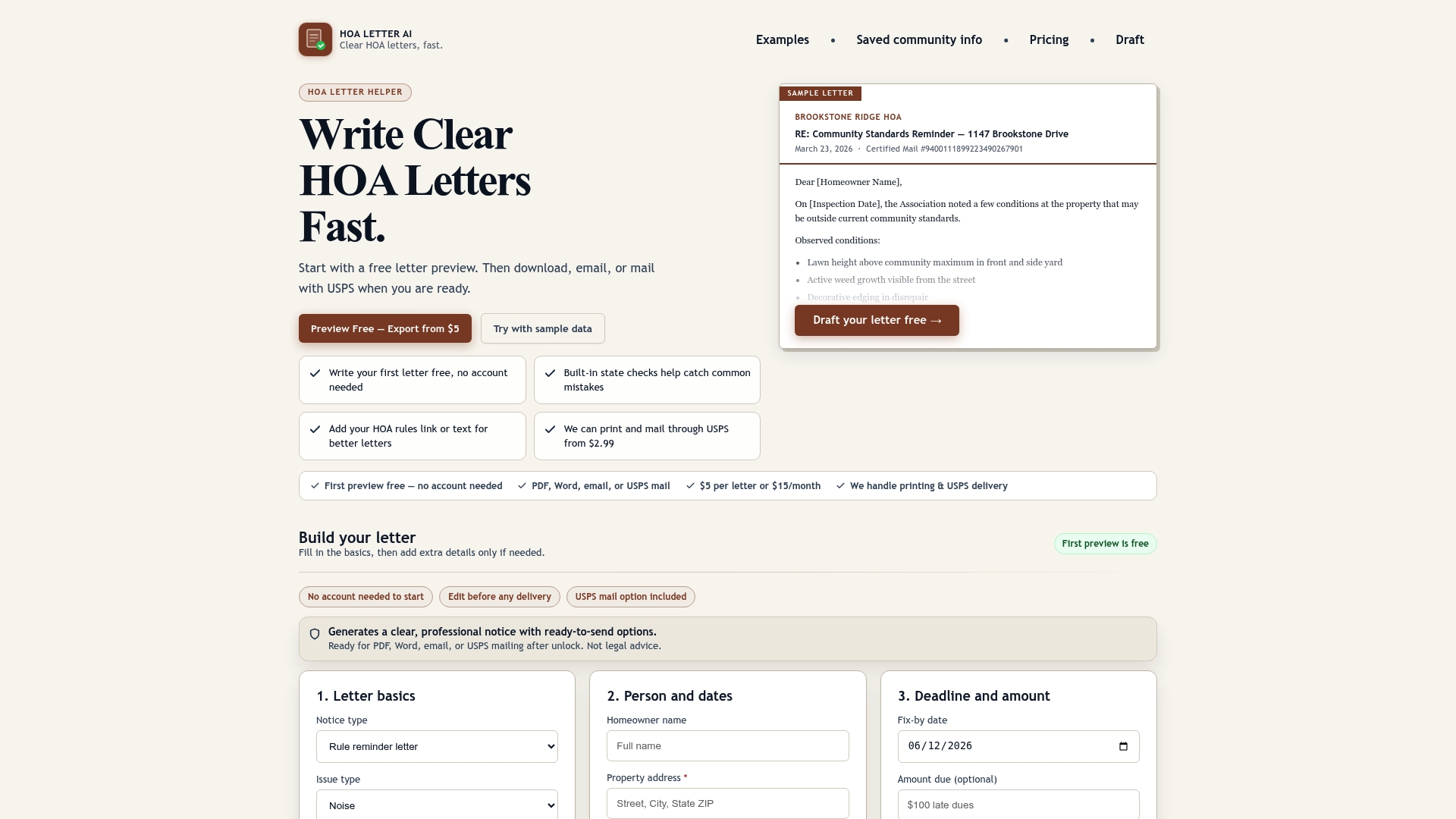
- Built-in checks catch a missing deadline, case number, or required citation before you send.
- Templates adjust to your state’s notice and hearing requirements automatically.
- Optional USPS mail fulfillment adds tracked delivery starting at $2.99 per letter.
- Property managers handling multiple communities can compare PM Starter and PM Pro plans for reusable profiles and bulk delivery.
Preview your draft free, and only pay once you’re ready to send it.
Where to check next for your specific case
Start with your own CC&Rs and bylaws, since they usually set the deadline that actually governs your case. Then check your state’s statute for any floor on notice or hearing timelines, and use a template built for that state rather than a generic form.
- HOA violation response letter template
- Property manager vendor checklist for mailing and fulfillment
FAQ
How long does an HOA have to respond to a request in California?
California statutes require certain meeting and records notices to go out at least 10 business days in advance, though the specific requirement depends on the type of request. Check your community’s CC&Rs alongside the state’s notice requirements since internal rules can set a stricter timeline.
What should I do if the HOA does not respond to my letter?
Send a dated follow-up letter referencing your original response and request a written reply within a reasonable window, commonly 14 days. Keep documenting any continued fines or enforcement action in writing, and escalate to internal dispute resolution or legal counsel if the HOA keeps enforcing the matter without responding.
Why do HOAs take so long to respond to letters?
Most delays come from volunteer board turnover, management-company backlogs, or letters getting routed to the wrong person rather than deliberate stonewalling. A missed deadline on the HOA’s end does not usually void a violation or fine automatically, so keep responding in writing regardless.
How do I respond to an HOA letter?
Include a header with your name, address, the date, and the violation or case number, then state your position, summarize your evidence, and state what remedy you’re requesting, whether that’s a hearing, a rescinded fine, or more time to cure. Send it by certified mail or tracked email so you have proof of delivery, and request written confirmation of receipt by a specific date.