
An HOA can often require a lease copy, but only if that authority traces back to a specific rule in the CC&Rs, bylaws, or a properly adopted board resolution, and the request should be limited to what verifies compliance. Before you send anything, ask the board in writing to cite the exact clause or statute it’s relying on and to list precisely what it needs. Everything else, timelines, redaction, delivery, and what to do if the board stalls, follows below.
TL;DR:
- The HOA’s authority to request a lease copy must be explicitly outlined in the CC&Rs, bylaws, or a properly adopted board rule, not just verbal requests.
- Most community documents specify tenant registration requirements, but only demand lease copies if supported by clear rules or covenants, not for broad financial or personal tenant details.
- Responding to lease requests should involve redacting sensitive financial information and submitting the lease through secure means, with a cover letter confirming what is redacted.
- HOAs typically must respond to records requests within specific legal deadlines, such as five to thirty days depending on the state, or a reasonable time if no deadline exists.
- When facing denial or delay, homeowners should request a written legal basis, send follow-up notices within law-defined timelines, and escalate through official complaints or legal avenues if necessary.
HOA Letter AICreate Clearer HOA Lease LettersDraft professional compliance correspondence with state-specific context, community rules, built-in checks, and a one-page preview.Visit HOA Letter AI
Table of Contents
- Requesting a Lease Copy From HOA: When the Board Has Authority
- How Long Does an HOA Have to Respond to a Records Request?
- Redacting a Lease Before You Send It to the HOA
- What to Do If the HOA Denies or Delays Your Request
- Sample Letters: Requesting Authority and Submitting a Redacted Lease
- Template Generator or Attorney? Knowing When You Need Which
- What I’d Do in the First 48 Hours
- How HOA Letter AI Handles State-Aware Leasing Correspondence
- Sources
Requesting a Lease Copy From HOA: When the Board Has Authority
The board’s power to see your lease comes from paper, not habit. If the governing documents never mention leasing disclosure, a manager’s verbal demand carries far less weight than a recorded covenant or a rule adopted through proper procedure. That distinction is the first thing to check before you comply with any request lease copy HOA letter.
Most CC&Rs written in the last two decades include some version of a leasing or rental registration clause. It usually shows up under headings like “Leasing Restrictions,” “Rental Registration,” or “Occupancy Requirements.” These clauses typically require owners to notify the association when a unit becomes a rental, provide basic tenant contact information, and sometimes submit a copy of the lease itself so the board can confirm occupancy limits, lease term, and whether the tenant has agreed to follow community rules.
Bylaws work a bit differently. They govern how the board operates internally, board elections, meeting notice, quorum, but many associations also fold rental oversight into board-adopted rules that sit outside the recorded CC&Rs. A board can typically adopt a new rule by vote, provided the CC&Rs grant rule-making authority and the process (notice, comment period, recording where required) was followed. That’s different from an actual recorded amendment to the CC&Rs, which usually requires a supermajority vote of the ownership, not just the board.
Here’s where homeowners get tripped up: an HOA that wants tenant registration information is on solid ground if a rule or covenant supports it. An HOA that wants your tenant’s full lease, including rent amount, security deposit terms, and financial history, without a documented rationale is overreaching. Associations can often inspect executed contracts and leases as legitimate association records for a valid purpose, but that access typically comes with an expectation that private financial details get redacted before sharing, not disclosed wholesale.
Before responding to any lease request, pull your governing documents and check for these specific things:
- A leasing or rental cap clause (some communities limit what percentage of units can be rented)
- Language requiring “notice of lease” or “tenant registration” within a set number of days of tenancy start
- Any reference to submitting a copy of the lease itself, versus just a summary or tenant information form
- Whether the requirement was part of the original recorded CC&Rs or added later as a board rule
- Fee language tied to leasing approval, some associations charge an administrative or application fee
If you can’t find any of this in your documents, that’s not proof the board is wrong, some associations rely on bylaws provisions or separately adopted rules that aren’t indexed clearly. But it does mean you’re entitled to ask exactly where the authority comes from before you hand over a private contract. Reviewing your HOA governing documents line by line is worth the twenty minutes it takes.
Property managers face the flip side of this problem constantly. A board asks them to enforce a leasing disclosure rule that’s ambiguous, poorly worded, or contradicts state law, and the manager gets stuck defending a request they didn’t draft. If you manage a community, get the board to point to the specific clause before you send the demand letter, or you’ll be the one fielding the pushback.
How Long Does an HOA Have to Respond to a Records Request?
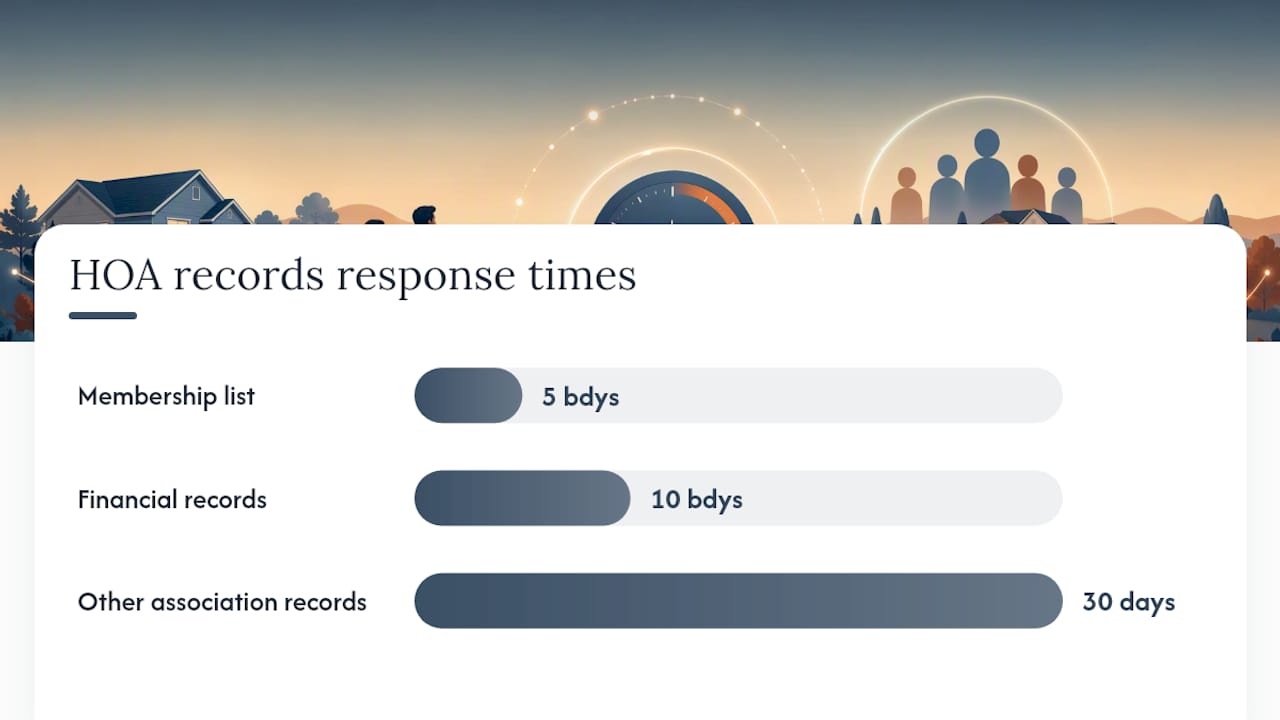
State law sets the clock, and it varies more than most homeowners expect. California offers the clearest example: Civil Code Section 5200 requires associations to produce membership lists within 5 business days, current fiscal-year financial records within 10 business days, and most other association records within 30 calendar days of a written request. Those numbers only apply in California, but the tiered structure, fast turnaround for financial or membership data, longer window for everything else, shows up in some form across many state HOA statutes.
If you’re outside California, don’t assume there’s no deadline at all. Many states have adopted similar records-access statutes modeled on the Uniform Common Interest Ownership Act, and even states without a specific timeline often require associations to respond to written records requests “within a reasonable time.” That phrase is vaguer than a hard deadline, but it’s not meaningless. It gives you leverage in a follow-up letter: if thirty days pass with no response, you can reasonably argue the board has failed a reasonable-time standard.
Statutory deadlines matter because they convert an open-ended waiting game into an enforceable timeline. Once you know your state’s window, silence past that date isn’t just frustrating, it’s a documented failure you can cite in your next letter.
Here’s what those timelines actually let you do:
- Set a firm date in your own correspondence (“per [state] law, records requests must be answered within X days”)
- Build a paper trail that shows exactly when the board became noncompliant
- Support an escalation letter or complaint filing with a specific, citable violation
- Strengthen your position if the dispute ever reaches mediation, arbitration, or small claims court
Some states also allow fee-shifting or penalties when a board unreasonably withholds records it’s obligated to produce, which is a real incentive for boards to comply rather than stall. If your state statute includes that kind of penalty provision, cite it directly in your follow-up letter. Boards that ignore a first request tend to move faster once they see a specific code section and a mention of potential fee exposure.
Before you write that follow-up, though, confirm you’re not the one holding things up. Check your state’s specific records-access statute (a quick search for “[your state] HOA records request law” usually surfaces it), note the deadline, and mark your calendar the day you send your original written request. That single step turns a vague complaint into a dated, defensible claim.
Redacting a Lease Before You Send It to the HOA
Handing over an unredacted lease is rarely necessary, and it’s the single easiest way to overexpose your tenant’s private information. Most associations only need enough to confirm occupancy and compliance, not a full financial profile of the renter.
What the HOA typically needs to see:
- Tenant name(s) and the names of any additional occupants
- Lease start and end dates (the term)
- Number of occupants, if the community enforces occupancy limits
- Pet clauses, if the community has pet restrictions or a pet registration requirement
- Parking assignment or vehicle information, if parking is limited or assigned
What to redact before submission:
- Rent amount and payment terms
- Security deposit amount and bank account or payment details
- Social Security numbers or other government ID numbers
- Emergency contact phone numbers and personal medical information
- Any co-signer or guarantor financial information not relevant to occupancy
Boards frequently accept a lease that clearly shows tenant names and lease dates while everything financially sensitive is blacked out, and that compromise holds up because it satisfies the board’s actual verification need without exposing your tenant’s finances to anyone with community document access.
Pro Tip: Don’t use a black rectangle drawn over a PDF in a basic viewer. That method often leaves the underlying text selectable and searchable, meaning anyone who copies the text or opens the file in a different reader can recover exactly what you tried to hide. Use a proper redaction tool that strips the text and metadata, not just the visual overlay.
Once the lease itself is properly redacted, assemble the full packet:
- A short cover letter identifying what’s attached and confirming what’s been redacted and why
- The redacted lease copy itself
- A signed tenant acknowledgment form, if your community requires tenants to agree to abide by the CC&Rs
- Tenant photo ID copies, but only if your governing documents explicitly require them
- Proof of any background check, only if the HOA’s own leasing packet lists it as a requirement
Some associations, particularly larger managed communities, use a formal lease application packet that spells out every required attachment and processing fee upfront. Reviewing a sample packet before you assemble your own submission saves you a second round of paperwork.
Send the completed packet through a secure management portal if your community has one, since those systems usually timestamp submission automatically. If there’s no portal, certified mail with a return receipt is the next best option. Keep a full copy of everything you send, redacted lease, cover letter, and proof of mailing, in a labeled folder. You’ll want that record if the board later claims it never received your submission.
What to Do If the HOA Denies or Delays Your Request
A denial or a long silence isn’t the end of the process, it’s the point where your paper trail starts doing real work. Handle it in a specific order, because skipping steps weakens your position if things escalate further.
- Send the written demand first. Ask the board to cite the specific CC&R clause, bylaw provision, or state statute that governs the leasing disclosure requirement, and request a single, complete list of what’s needed so you’re not chasing supplemental demands one at a time.
- Deliver it in a way that creates proof. Certified mail with return receipt, or a management portal that logs submission time, gives you a dated record the board can’t dispute later.
- Wait out the statutory or reasonable-time window. If your state sets a specific deadline, mark it. If it doesn’t, thirty days is a common benchmark for “reasonable” in most jurisdictions.
- Send a certified follow-up if the deadline passes. This letter should cite the exact statute, restate the original request, and demand a written explanation for any denial or continued delay.
- Escalate only after the paper trail is complete. A documented pattern of ignored requests is far more persuasive to a mediator, arbitrator, or attorney than a single unanswered email.
If the board does respond with a denial, experts recommend requesting a written explanation before doing anything else. A surprising number of denials trace back to something fixable, an incomplete application packet, an outstanding fine on the account, or missing paperwork rather than a genuine legal dispute. Clearing that up often resolves the issue faster than any formal complaint.
If the explanation doesn’t hold up, or the board simply won’t respond at all, here’s where to go next:
- File a complaint through your state’s HOA regulatory or ombudsman office, if one exists
- Request pre-suit mediation or arbitration, which many state statutes require or encourage before litigation
- Consider small claims court for straightforward statutory violations involving modest amounts
- Send a formal attorney demand letter when the dispute involves recurring fines, a disputed leasing ban, or unclear CC&R authority
A reliable escalation sequence, formal request, certified follow-up citing statute, demand for written explanation, resolves most disputes before anyone needs to hire a lawyer. Save legal counsel for cases involving real financial exposure or a board that’s clearly acting outside its authority.
Sample Letters: Requesting Authority and Submitting a Redacted Lease
You don’t need to draft language from scratch. Two templates cover most situations: one for demanding the board’s legal basis before you comply, and one for the cover letter that accompanies your redacted lease submission.
Template A: Request for Governing Authority and Required Items
Dear [Board/Management Company Name],
I am writing regarding your request dated [date] for a copy of the lease agreement for the property at [address]. Before submitting any documentation, I am asking the association to identify the specific provision of the CC&Rs, bylaws, or adopted rules that authorizes this request.
Please provide:
- The exact section or rule number granting this authority
- A complete list of every document or item required, so I can submit everything in a single response
- Confirmation of the applicable state statute governing the association’s timeline to respond to this letter
I intend to comply with any valid, documented requirement. Please respond in writing within [state’s statutory window, or 14 days if none applies].
Sincerely, [Name and address]
Template B: Cover Letter for Redacted Lease Submission
Dear [Board/Management Company Name],
Enclosed is a redacted copy of the lease agreement for [address], submitted in response to your request dated [date] and consistent with [CC&R section or rule cited by the board].
The following information has been redacted to protect tenant privacy and is not required for occupancy verification: rent amount, security deposit terms, and any government identification numbers. The lease clearly shows tenant name(s), lease term, occupancy dates, and [pet/parking terms, if applicable].
Please confirm receipt of this submission in writing within [X] days. Retain a copy of this letter along with the enclosed materials for your association’s records; I have done the same.
Sincerely, [Name and address]
Adapt both templates by inserting your actual state statute citation once you’ve confirmed it, along with accurate dates and the correct board or management company address. Name your PDF files clearly, something like “Smith_Lease_Redacted_2026.pdf”, so there’s no confusion about what was submitted and when. These structures echo the brevity found in tenant-advocacy form letters, which work precisely because they’re specific and short.
| Situation | Template to use | Key adaptation |
|---|---|---|
| Board sends a vague or verbal leasing request | Template A | Insert your state’s specific records statute citation |
| You’ve confirmed the authority and are ready to submit | Template B | List exact redacted items and required response window |
| Board denies your original submission | Template A (revised) | Add a demand for written explanation of the denial |
| You’re a property manager drafting on behalf of a board | Either, adapted | Reference the homeowner response letter guide for tone and formatting |
Template Generator or Attorney? Knowing When You Need Which
A generator earns its keep on the routine cases: the leasing disclosure request that has a clear CC&R basis, the redaction cover letter, the follow-up citing a statutory deadline. State-aware templates add language specific to your jurisdiction’s notice requirements, so you’re not guessing whether your letter needs a particular statutory reference or mandatory disclosure phrase.
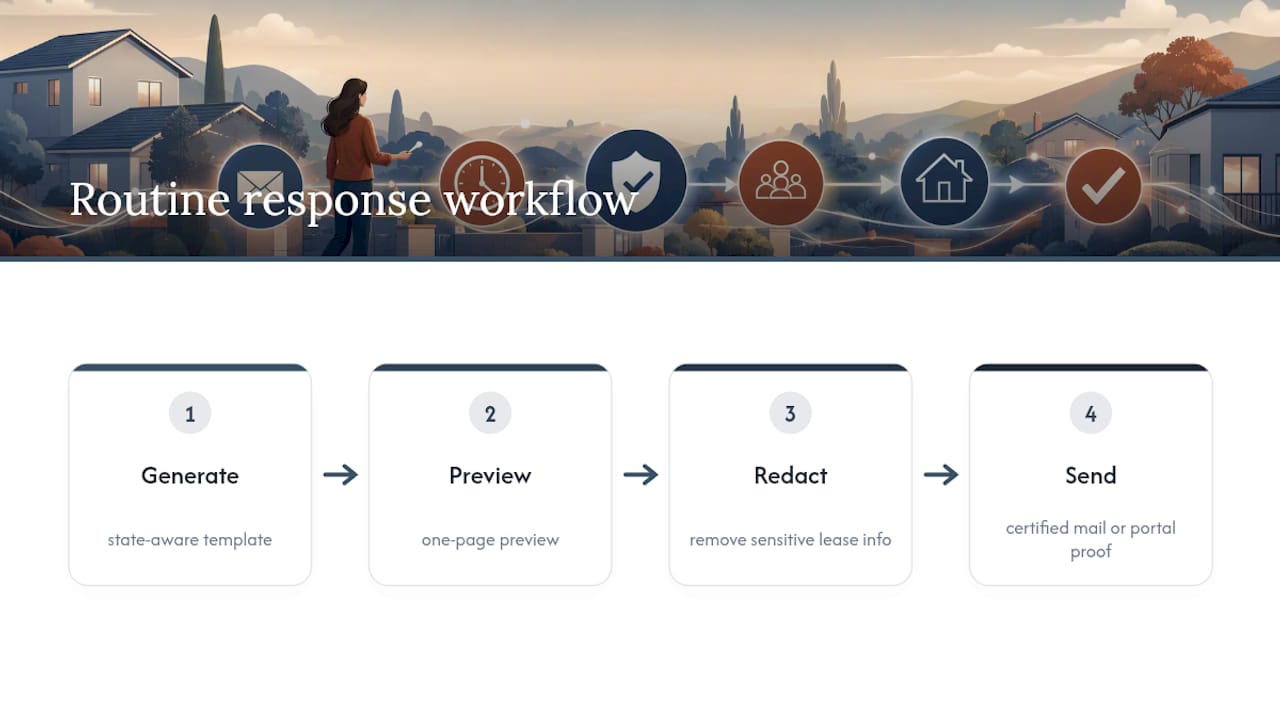
The practical workflow looks like this: generate the letter, preview it, redact anything sensitive from the attached lease, then send with proof of delivery, certified mail or a portal timestamp. That sequence covers the overwhelming majority of lease-copy requests without ever touching a law office.
Where you need an attorney is narrower: a board that denies your request without citing any authority, a CC&R clause so ambiguous that two readings support opposite conclusions, or fines large enough that a mistake gets expensive. The drafting side with guided prompts, state-specific context, and a one-page preview before anything goes out covers the routine cases well. It’s not a substitute for legal review when the dispute turns genuinely adversarial.
What I’d Do in the First 48 Hours
If a leasing request lands on your desk today, don’t reach for your lease. Reach for the CC&Rs. My single best piece of advice: demand the statute or covenant citation in writing before you send anything unredacted. Boards that have real authority will produce it in minutes. Boards that don’t will often quietly drop the request.
Your 48-hour checklist:
- Request the governing citation in writing
- Pull your CC&Rs and confirm (or dispute) the authority
- Assemble the packet and redact anything financial or personal
- Send via certified mail or a timestamped portal
- Keep copies of everything, dated
— Blake
How HOA Letter AI Handles State-Aware Leasing Correspondence
Drafting a leasing disclosure letter that holds up depends on getting the statute, the CC&R language, and the tone right on the first try, not the third revision after a board pushes back. HOA Letter AI builds each letter with guided drafting, state-specific legal context, and a free one-page preview before anything gets sent, so you’re not stuck reverse-engineering what a compliant HOA letter is supposed to look like.
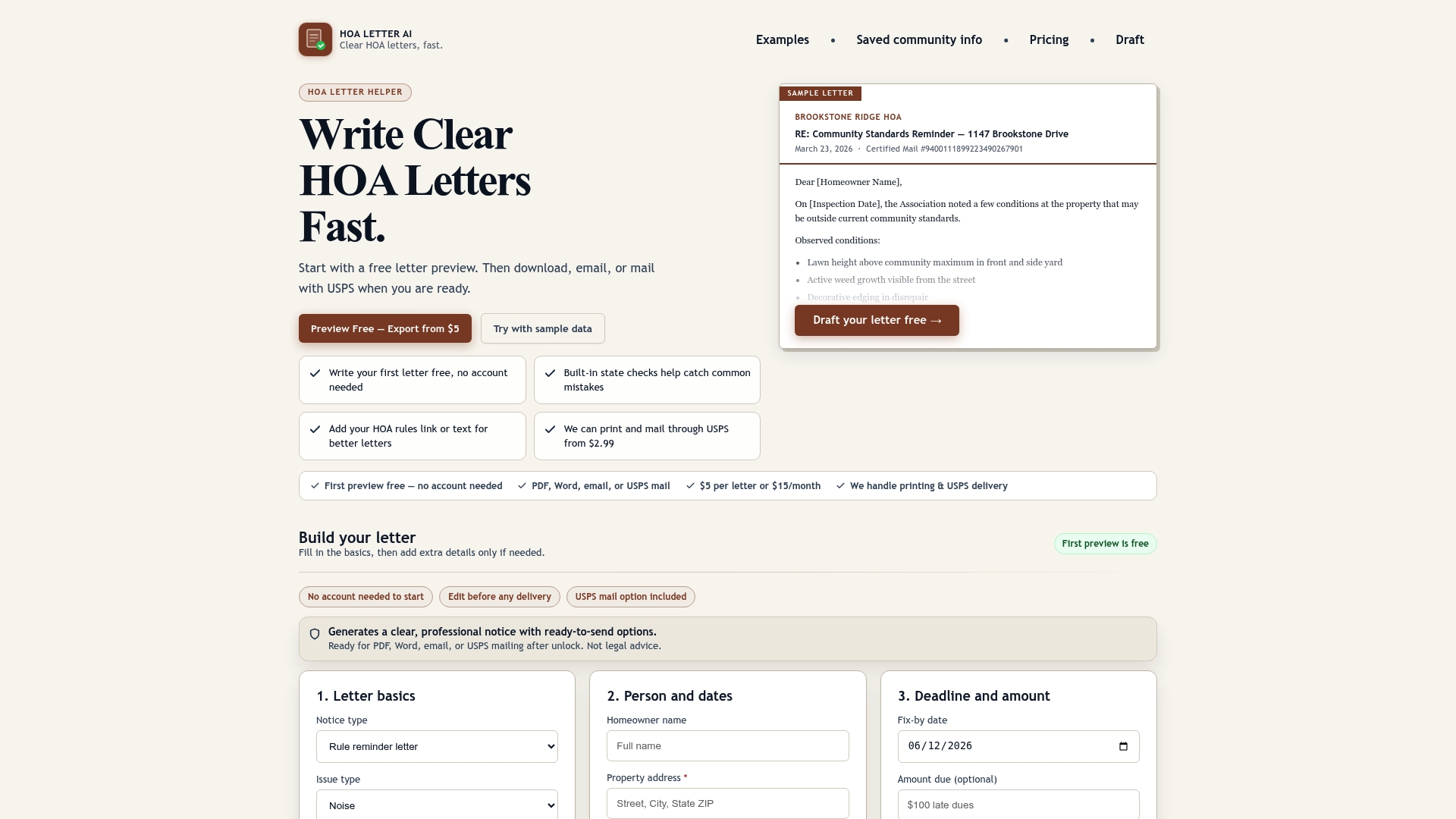
USPS mailing can be handled directly, which matters when certified delivery and proof of receipt are the difference between a documented paper trail and a dispute you can’t win. If you’re responding to a leasing notice or first notice from your board right now, start with the HOA First Notice Response Letter template and preview it free before deciding whether you need anything more formal.
Sources
State statutes and management-industry guides both back the claims in this article, and it’s worth checking your own state’s version directly before you send anything.
- Your complete guide to HOA document rights — Civil Code 5200 (LS Carlson)
- Realtor
- How to get your HOA’s governing contracts (Legal Clarity)
- Request for copy of lease (HOME Line)
Recommended
- HOA Unauthorized Modification Response Letter (State-Compliant HOA Letter)
- HOA Violation Response Letter: Template & Tips for Homeowners
- HOA Parking Violation Response Letter (State-Compliant HOA Letter)
- Homeowner Response Letter to HOA: Full Guide
Drafting support for HOA notices
Use the HOA letter drafter to turn this guidance into a resident-ready notice, compare reusable HOA letter templates, or review the property manager workflow for higher-volume enforcement work.