
An HOA letter about an unauthorized tenant should go to the property owner, not the person living in the unit. It should name the specific rule that is being broken, describe what you actually observed, say what the owner must do and by when, and explain the owner’s right to respond or be heard. Get those four things right and the letter is clear, fair and much harder to challenge later.
This guide is for board members, property managers and homeowners who have received or need to send this kind of notice. It covers who the letter is addressed to, what to verify first, what to put in it, how notice and hearing deadlines differ by state, and what happens when the owner does nothing.
HOA Letter AIWrite Clearer HOA Compliance LettersHOA Letter AI helps boards and property managers draft compliance notices with state-specific context, community rules, and built-in checks.Draft a compliance letterTL;DR
- Address the letter to the owner. The owner is the member bound by the governing documents, and the association generally enforces through the owner, not the tenant.
- Cite the exact provision (a leasing restriction, a registration rule, an occupancy limit) and separate what you confirmed from what you assume.
- Include evidence, the action required, a deadline and the owner’s right to a hearing. Notice periods are set by state law, so check yours before you send.
- An HOA cannot evict a tenant. Eviction runs through the landlord’s own legal process, so the letter’s job is to push the owner to act.
- Keep copies of every notice and observation. The file is your protection if the matter escalates.
Table of Contents
- Who the letter should go to
- What counts as an unauthorized tenant
- Check the facts before you write
- What the letter must include
- Sample wording you can adapt
- Deadlines, hearings and fines depend on your state
- If the owner does not respond
- Can a tenant be evicted immediately?
- If you are the owner who received this letter
- Our perspective
- Draft the letter with HOA Letter AI
- FAQ
- Sources
Who the letter should go to
Most people searching for this are unsure whether the tenant or the owner gets the notice. In nearly every association, the homeowner is the member bound by the declaration and bylaws. The tenant has no contract with the association, so the association generally enforces through the owner and holds the owner responsible for the tenant’s conduct. Direct action against a tenant is possible only where a specific authority allows it.
That matches the practical advice HOA commentators give: a board generally has no direct legal authority over renters, but it may require that rental agreements follow HOA rules and make the landlord responsible for enforcing them.
So the answer to “does the HOA apply to renters?” is: indirectly. The rules reach the tenant through the owner’s lease, and the letter reaches the tenant through the owner’s response.
If the owner lives elsewhere or uses a property manager, send the letter to the owner’s address of record and copy the manager if the file names one. If the owner is a company, address it to the registered contact. A letter sent only to the occupant can be ignored with good reason, and it can muddy any later fine.

What counts as an unauthorized tenant
“Unauthorized” can mean several different things, and the letter must say which one applies. Look at your governing documents for the exact trigger:
- A rental that is banned or capped. Some communities restrict leasing entirely, cap the number of rented units, or require a minimum ownership period before an owner can lease.
- A rental that was never registered. The unit may be leased legally, but the owner skipped a required lease submission, tenant application, or contact form.
- A rental that breaks a term. Many documents set a minimum lease length and prohibit short-term or transient rentals.
- An extra occupant. The owner has an approved tenant, but additional people have moved in beyond the lease or an occupancy limit.
If your issue is a rental the board never approved, our guide to the HOA unauthorized rental letter walks through that version in more detail.
Check the facts before you write
The most common reason these letters fail is not the wording. It is that the facts were thin. Before you send anything, work through this list.
- Verify the property and the occupancy facts. Confirm the address, the owner of record and who actually lives there. Guidance for associations says to record concrete observations without entering the unit or confronting occupants.
- Tell guests from occupants. A visiting relative is not a tenant. Property security professionals advise that managers distinguish unauthorized occupants from short-term social guests by knowing residents and applying guest rules, periodic audits and documentation. If your documents define a guest stay limit, such as a number of consecutive nights, use that definition.
- Name the rule. Property managers handling lease violations are advised to identify the specific rule or lease clause that was broken, separate confirmed observations from assumptions, and keep photos or inspection records. A neighbor’s complaint is a lead, not proof.
- Identify the owner or authorized representative. Pull the deed record or your homeowner database. Do not rely on the name on a mailbox.
- Check your own process. Look for a required warning letter before a fine, a required cure period, and whether your board must adopt the enforcement policy in a recorded resolution.
- Check state law. Notice and hearing rules differ widely. Our state-by-state HOA violation letter laws page is a good starting point for the rules that apply to you.
Keep every note, photo, email and mailing receipt together. The advice for associations is to preserve notices, reports and case references in controlled files so there is a clear trail of the association’s enforcement actions.
What the letter must include
State regulators who train association boards describe the same core pieces. An HOA letter about an unauthorized tenant should be written clearly, and Nevada’s Real Estate Division training on fining says it should specify the alleged violation, the governing document provision, and the action required to fix it. It should include evidence such as photographs where possible, and outline the owner’s rights, including the chance for a hearing.
Turned into a checklist, a strong letter has these parts:
- Date, owner name, property address and a reference number. Use the address of record. Add a case or file number so later correspondence can be matched.
- A one-sentence purpose. For example: “This letter concerns the occupancy of the unit at the address above by a person who is not listed in the association’s records as an approved resident.”
- The provision. Quote or cite the article and section of the declaration, bylaws or rules, plus the date the rule was adopted if it was amended.
- The facts. What was seen, by whom, on what dates. Stick to observations: vehicles registered to the unit, a person receiving mail, a lease the association learned about, a listing found online. Avoid guesses about motives or immigration status, or any comment about the occupants personally.
- The required action. Be specific. “Submit a copy of the lease and the tenant registration form,” or “end the unauthorized occupancy,” or “remove the listing.” Say who must do it: the owner.
- The deadline. Give a number of days and the resulting date. Make the cure period reasonable and consistent with your documents and state law.
- The consequence. Name the fine, suspension or other remedy that your governing documents and state law allow, and no more.
- The owner’s rights. Explain how to respond in writing, how to request a hearing and by when, and who to contact.
- Enclosures. Attach photos, the rule excerpt and a copy of any registration form.
If you are choosing between a first warning and a formal notice, a courtesy letter is often the better opening move. Our HOA warning letter template shows how a courtesy notice before fines is structured, and the HOA violation process article shows where that step sits in the sequence.
Sample wording you can adapt
The wording below is a model, not legal advice. Adjust it to your documents and state.
Dear [Owner name],
The association’s records show that [Owner name] is the owner of [address]. On [dates], association representatives observed that the unit is occupied by [a person / persons] who are not identified in our records as approved residents. Section [X] of the [Declaration / Rules] requires that [owners register leases with the association before occupancy / leasing is limited to …].
To resolve this matter, please [submit a copy of the current lease and completed registration form / end the unauthorized occupancy] by [date, at least X days from the mailing date]. If the matter is not resolved, the board may consider [fine or remedy allowed by the documents and state law].
You have the right to submit a written response and to request a hearing before [the board / the committee] by contacting [name and contact] by [date]. Photographs and the rule excerpt are enclosed.
Notice what the sample leaves out: accusations, speculation, threats outside the board’s power, and any demand that the tenant leave. The association asks the owner to fix a rule problem. The owner decides how to deal with the tenant.
Deadlines, hearings and fines depend on your state
The number of days in your letter is not a style choice. Many states require written notice of a violation, a chance to cure, and a hearing before a fine or suspension. A few examples from official sources show how much they vary.
| State | What the source says | Why it matters for your letter |
|---|---|---|
| Florida | An HOA board may fine a member or their tenant, guest or invitee for failing to comply with governing documents, provided it gives at least 14 days’ written notice of the right to a hearing to the owner and, where applicable, the occupant. | Send notice to both owner and occupant when fining, and state the hearing right clearly. |
| Florida | The hearing for a fine or suspension must be held within 90 days of the initial notice, before a committee of at least three members who are not officers, directors or employees of the association (same statute). | Plan the hearing committee before you send the notice. |
| California | Notice of a member-discipline meeting must be given in writing at least 10 days beforehand and state the time and place, the alleged violation, and the right to appear and be heard. | Build the date, place and right to be heard into the letter. |
| Nevada | NRS 116.31031 sets the notice, cure, hearing and fine procedures for violations in common-interest communities. | Follow the statute’s sequence, since a fine without it can be challenged. |
These are only examples, and statutes get amended, so confirm the current text for your state before you send. The California material is a Law Revision Commission memorandum, so California boards should also read the current Davis-Stirling provisions; our California HOA violation letter requirements page and the California HOA violation notice guide cover that state in more depth, and there is a similar guide for North Carolina.
Two habits keep you safe whatever the state. First, count the days from the mailing date or delivery date as your documents and state law specify, and write the actual calendar date in the letter. Second, use the same wording and the same cure period for every owner facing the same violation. Inconsistent enforcement is the argument owners most often raise.

If the owner does not respond
A properly documented first letter often resolves the issue, because the owner learns the association is paying attention. If not, the next steps depend on your documents and state law.
In Virginia, for instance, county guidance for HOAs explains that an association may assess authorized charges, suspend use privileges after notice and a hearing, and seek legal or injunctive relief. It may also ask the owner to have the tenant evicted. Other states have their own list of remedies, so your attorney should confirm which are available to you.
A typical escalation looks like this:
- Courtesy or first notice, with a cure period.
- Second notice that restates the facts, cites the rule and offers a hearing.
- Hearing, held with proper notice, where the owner can present their side.
- Written decision, with any fine or suspension the documents allow.
- Referral to the association’s attorney for collection or injunctive action if the violation continues.
Do not take matters into your own hands. Associations are advised against physically removing people, and where a person has been given notice and returns, that is a police matter rather than something for board members to handle. Trespass laws also vary: depending on the jurisdiction, posted signs or fencing and oral or written warnings can count as notice.
Can a tenant be evicted immediately?
No, and the HOA is not the party who evicts. County guidance in Virginia states plainly that an HOA has no authority to evict an owner’s tenant. Eviction runs through the landlord’s own legal process in court.
That process has its own notice periods. Arizona’s court guide, for example, specifies a 10-day notice for material non-compliance with a lease. In Texas Justice Court eviction suits for nonpayment or holding over, a corporation may be represented by its property manager or other authorized agent. Those details come from two states, so owners elsewhere should check their own courts.
This is why the owner-focused letter matters. It tells the landlord what the association needs, and it gives the landlord a written record to use when dealing with the tenant. Property managers advise landlords to identify the lease obligation, confirm and document the facts, choose the correct notice and track any cure, escalating only when state law supports it.
If you are the owner who received this letter
A letter about an unauthorized tenant can feel alarming, but it usually has a clear path:
- Read the cited rule. Compare it with the declaration you have on file. Make sure the provision exists, was properly adopted and applies to your unit.
- Check the facts. If the association mistook a guest or family member for a tenant, say so and offer proof.
- Respond in writing before the deadline. Request a hearing if you want one, and do it within the time stated.
- Fix what is fixable. If you forgot to register a lease, submit it. If the extra occupant is not allowed, work with your tenant on a plan, and keep the plan in writing.
- Keep your own file. Save the letter, envelope, photos and your reply.
Our HOA violation response letter template and tips shows how to structure a reply.
Our perspective
Most unauthorized-tenant letters go wrong in the same three places: they are addressed to the wrong person, they state conclusions instead of observations, and they leave out the state-required language. None of those are hard to fix, but they are easy to miss when a board is writing from a blank page after a hard week.
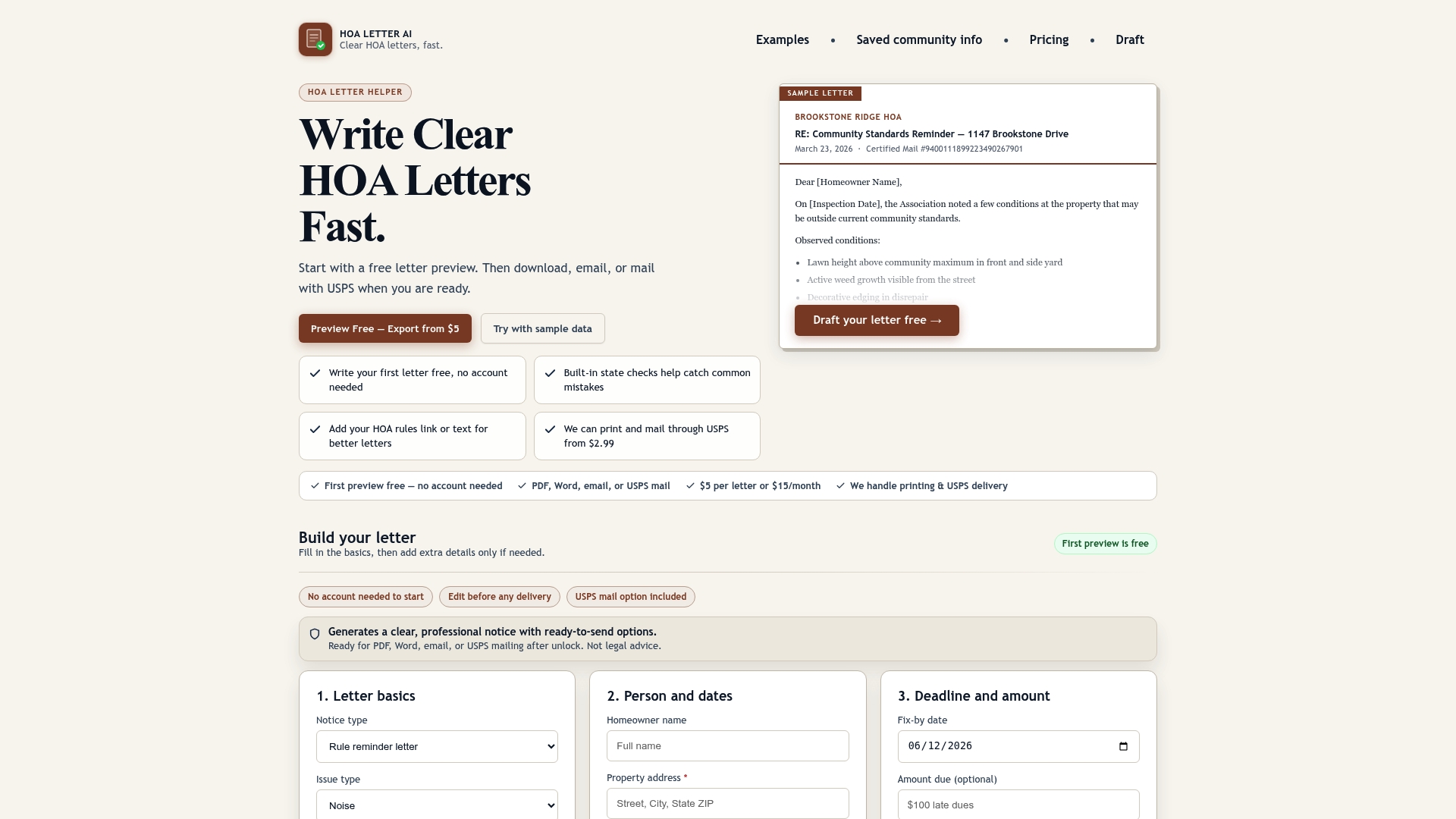
We built HOA Letter AI around that problem. You describe the situation, the tool guides you through the facts, cites the rule or CC&R provision, adds state-aware context and checks for mandatory language, and shows you a one-page preview before you pay anything. No account is needed to see the preview.
Our view is that clear, consistent letters resolve more violations than aggressive ones. A calm notice that names the rule, gives a fair deadline and explains the hearing right is also the one that holds up if the matter goes further. Our pricing is meant to make that standard easy to meet: one clear price per letter, not a retainer for something you need once.
Blake
Draft the letter with HOA Letter AI
If you are ready to put the notice on paper, HOA Letter AI helps you build it step by step. You can preview a letter for free, then unlock it for $5 per letter. Boards that send notices regularly can use the self-serve board lane at $15 per month, and homeowners can generate a response letter for $5. Optional USPS mailing starts from $2.99 per letter when you draft and send from the platform.
Management companies handling many communities can look at PM Starter at $199 per month, PM Pro at $399 per month or the 30-day PM Pilot at $499, which add reusable community profiles and branded templates for standardized notices.
FAQ
Does an HOA apply to renters?
Indirectly. The governing documents bind the owner, and the association generally enforces through the owner, who must make sure the tenant follows the rules. Many associations require leases to include the HOA rules, which is how those rules reach the renter.
Should the HOA send the letter to the tenant or the owner?
Send it to the owner of record, and copy the property manager if one is on file. Where state law specifically allows fines against tenants, as Florida does with proper notice, the occupant may also need to receive the hearing notice. Check your state’s statute and your documents first.
How long should I give the owner to respond?
Use the period your governing documents and state law require, and write the actual calendar date in the letter. Some states set minimums for hearing notice, such as 14 days in Florida or 10 days in California for discipline meetings. A first courtesy notice often gives a short, reasonable window to submit paperwork or correct the issue.
Can the HOA evict an unauthorized tenant?
No. An HOA generally cannot evict an owner’s tenant. The owner, as landlord, must use the court process, and the association’s role is to enforce the rules against the owner through notices, hearings, fines or legal action where allowed.
What evidence should I attach?
Attach dated photos, copies of registration or lease records, and the rule excerpt. Note only what you observed, and do not enter the unit or confront occupants to collect it.
Sources
- Ask the HOA Expert: Can a Board Control the Tenant Approval Process (RealtyTimes)
- Can an HOA charge you for a violation by your tenant (OurHOA)
- What can an HOA do about squatters? (OurHOA)
- How to Spot Unauthorized Occupants (Chris E. McGoey, AOA)
- Tenant Lease Violations in Richmond, VA (PMI James River)
- Fines, Sanctions, & Towing in CICs (Nevada Real Estate Division)
- Florida Statutes Section 720.305 (Online Sunshine)
- Memorandum 2001-55 (California Law Revision Commission)
- 2018 Legislative Update: Landlord, tenant and HOAs (Prince William County, VA)
- How does an HOA board stop trespassers from using the pool or clubhouse (OurHOA)
- Ultimate Guide to Evictions (Arizona Courts)
- Information Packet for Evictions (Tarrant County Justice of the Peace)