
To verify a U.S. mailing address right now, use the USPS ZIP Code Lookup for a single check. It is free, official, and takes about ten seconds per address. For a list of addresses, or for verification you need to run automatically inside your own software, move to the USPS Addresses API, the AIS Viewer, or a CASS certified vendor workflow, all of which can be paired with DPV checking to confirm delivery point accuracy.
Here is the catch nobody puts up front: USPS standardization tells you an address matches the postal database’s formatting rules. It does not always prove a house or unit physically exists at that spot.
- Single address, right now: USPS ZIP Code Lookup.
- List of 50, 5,000, or 500,000 addresses: Addresses API, AIS Viewer, or CASS certified software.
- Need proof you mailed something: get a Certificate of Mailing at the post office counter when you drop it off, not after.
- Need proof it was received: none of the tools above do that. You need certified mail with return receipt.
TL;DR:
- USPS ZIP Code Lookup accurately verifies address formatting and ZIP+4 but does not confirm the physical existence of the address or dwelling.
- Large-scale verification requires tools like the Addresses API or CASS-certified software that perform DPV checks and support NCOA updates for list accuracy.
- DPV codes indicate whether the primary address and unit are confirmed, with ‘D’ commonly meaning an incomplete secondary unit rather than a nonexistent address.
- Proof of mailing is separate from address verification; certified mail with return receipt provides legal proof of mailing and receipt when necessary.
- HOA Letter AI automates address validation, USPS formatting compliance, and delivery documentation to streamline high-volume notices and reduce delays.
Table of Contents
- Verify Mailing Addresses USPS: The Single-Address Lookup
- How Do Businesses Verify Large Address Lists?
- What Do DPV, CASS, and ZIP+4 Actually Confirm?
- What to Do When an Address Fails Verification
- How HOA Letter AI Handles Address Checks Before You Mail
- Key Takeaways
- Why Most Address Verification Advice Misses the Point
- Get Compliant Notices Out the Door Without the Guesswork
- Sources
Verify Mailing Addresses USPS: The Single-Address Lookup
Most people only need to check one address, and the USPS ZIP Code Lookup handles that job better than any third-party app because it draws straight from the postal database itself.
1. Open the tool and select “By Address.” You will see two fields worth filling in carefully: the main street address and Address 2, which is where apartment, suite, or unit numbers belong. Skipping Address 2 is the single most common reason a lookup returns a “close but not quite” result.
2. Test the variations that actually matter. “123 Main St Apt 4” and “123 Main St #4” usually resolve the same way, but a PO Box entered as if it were a street address often will not. If a homeowner gave you “123 Main St” with no unit and the property is a duplex or condo, run it both with and without a unit number to see which the database recognizes.
3. Read the output like a professional would. A clean result shows the standardized address, the 5-digit ZIP Code, and a ZIP+4 extension. That ZIP+4 matters more than people realize. It narrows the address down to a specific block, floor, or even a single large building, which is a big step up from a bare ZIP match. If the tool returns a generic or “default” address message instead of a specific one, treat that as a yellow flag, not a green light.
Pro Tip: If a lookup fails, try the address with common abbreviation swaps first, “St” for “Street,” “APT” for “Unit,” “STE” for “Suite,” before assuming the address itself is bad. USPS’s own formatting standards are stricter than most people expect.
If a lookup still fails after those adjustments, the fastest fix is a phone call to the local post office serving that ZIP Code. Carrier-level staff often know about new construction or recent redistricting that hasn’t hit the database yet.
How Do Businesses Verify Large Address Lists?
Checking one address by hand works fine for a single homeowner notice. It falls apart fast once you’re managing 300 units across a community or a client roster spread across a state, and that’s where the choice of tool actually starts to matter.
AIS Viewer is the right call when you want interactive, human-driven lookups without writing code. It pulls from the Address Information System, updates monthly, and returns ZIP+4, delivery type, and carrier route data in a printable report. It cannot export encrypted USPS data sets, but for a property manager checking a few hundred addresses a month, that limitation rarely matters.
The Addresses API fits a different job: verification built into your own software so addresses get checked the moment they’re entered, not batch-reviewed later. It corrects common errors, returns ZIP+4 and DPV indicators, and supports up to five lookups per transaction. Getting access means registering through the USPS Business Portal and securing an API license before you can pull a single result.
CASS certified vendor software earns its keep at real volume. These tools carry official USPS certification for address matching accuracy, and pairing CASS with DPV checking is often what qualifies a mailing for discounted postage rates.
- Standardize the address format first.
- Run a DPV check to confirm delivery-point accuracy.
- Apply NCOA (National Change of Address) data to catch anyone who moved.
- Presort and finalize for postage rate qualification.
For move-related list cleanup specifically, the Address List Correction Service and NCOA processing exist precisely because so many residents relocate every year, and a list that was accurate in January can be stale by June.
What Do DPV, CASS, and ZIP+4 Actually Confirm?
These terms get thrown around interchangeably in marketing copy, and that’s exactly how boards and businesses end up trusting an address more than they should.
Standardization, as defined in Publication 28, means an address has been reformatted to match official postal conventions, correct abbreviations, capitalization, directional prefixes. It’s a formatting exercise, not proof of deliverability.
DPV (Delivery Point Validation) goes a step further and checks whether that specific address, unit number included, exists in the USPS delivery file. DPV responses come back coded: ‘Y’ means the primary address and secondary unit are both confirmed, ‘D’ means the primary is confirmed but the secondary is missing, ‘S’ means a secondary exists but wasn’t confirmed, and ‘N’ means no confirmation at all. Those four codes are the real triage tool here.
- CASS certification verifies that a piece of software meets USPS accuracy standards for address matching and standardization.
- ZIP+4 narrows a ZIP Code down to a specific delivery segment, far more precise than a 5-digit match alone.
- AIS/AMS systems are the backend databases and matching logic that both AIS Viewer and the Addresses API draw from.
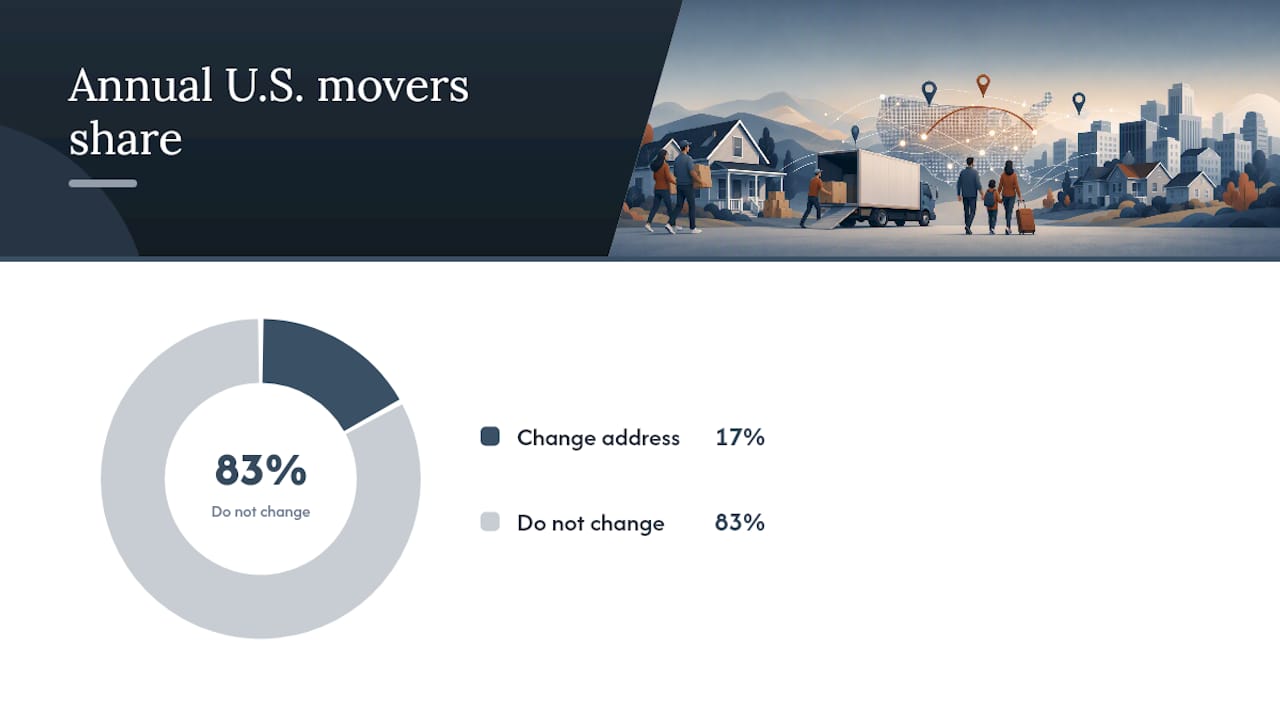
Roughly 17% of Americans change addresses every year, which is exactly why a list verified in one quarter can’t be assumed accurate in the next. A ZIP match alone tells you almost nothing about whether mail will actually reach a doorstep.
What to Do When an Address Fails Verification
An unconfirmed address isn’t a dead end. It’s usually a data problem with a quick fix.
- Check spelling and abbreviations first. Street type errors (“Rd” versus “Drive”) and missing directional prefixes cause more failures than genuinely bad addresses.
- Add or correct the secondary unit. A DPV code of ‘D’ almost always means the apartment or suite number is missing, not wrong.
- Confirm PO Box versus street delivery. Some addresses only accept one or the other, never both.
- Escalate stubborn cases. If corrections don’t resolve it, contact the local delivery unit or Business Mail Entry Unit (BMEU) directly.
Pro Tip: If you’re mailing a legally required HOA notice and the address still won’t confirm, don’t wait on it. Get a Certificate of Mailing (PS Form 3817 for single pieces, PS Form 3665 for bulk) at the counter when you drop it off. It proves USPS accepted the piece for mailing, which matters enormously if a homeowner later disputes receiving a notice, though it does not prove delivery itself. When delivery confirmation matters as much as proof of mailing, certified mail with return receipt is the fallback worth the extra cost.
How HOA Letter AI Handles Address Checks Before You Mail
Every HOA board and property manager runs into the same problem: a violation letter is drafted, approved, and ready to go, but nobody double-checked whether the mailing address on file is still good.
HOA Letter AI builds that check into the process itself. Before a notice goes out, the platform runs the address through verification and formats the letter to meet USPS addressing conventions, which cuts down on returned mail caused by simple formatting errors rather than genuine bad data.
- Pre-send address checks catch common formatting issues before a notice is printed or mailed.
- Organizational delivery confirmation documents each mailing event, which supports the kind of recordkeeping boards need if a notice is ever disputed.
- State-aware templates and built-in compliance checks reduce the manual review burden on volunteer board members.
- For a single homeowner notice, HOA Letter AI’s built-in check is often faster than pulling up a separate USPS lookup. For truly high-volume mailings across dozens of communities, pairing it with a CASS certified vendor for the initial list cleanup still makes sense.
Key Takeaways
Verifying a U.S. mailing address correctly means matching the tool to the job: ZIP Code Lookup for one address, API or CASS workflows for lists, and a Certificate of Mailing whenever proof matters.
| Point | Details |
|---|---|
| Use the right tool for scale | ZIP Code Lookup for single checks, Addresses API or AIS Viewer for lists of any real size. |
| Standardization isn’t proof of existence | USPS confirms format and delivery-file matches, not that a physical address is occupied. |
| DPV codes tell you what’s missing | A ‘D’ code usually means the secondary unit number, not the whole address, needs fixing. |
| Proof of mailing is separate from proof of delivery | Get a Certificate of Mailing at drop-off; use certified mail with return receipt if delivery confirmation is required. |
| HOA Letter AI checks addresses before letters go out | It formats notices to USPS standards and documents delivery events to support compliance recordkeeping. |
Why Most Address Verification Advice Misses the Point
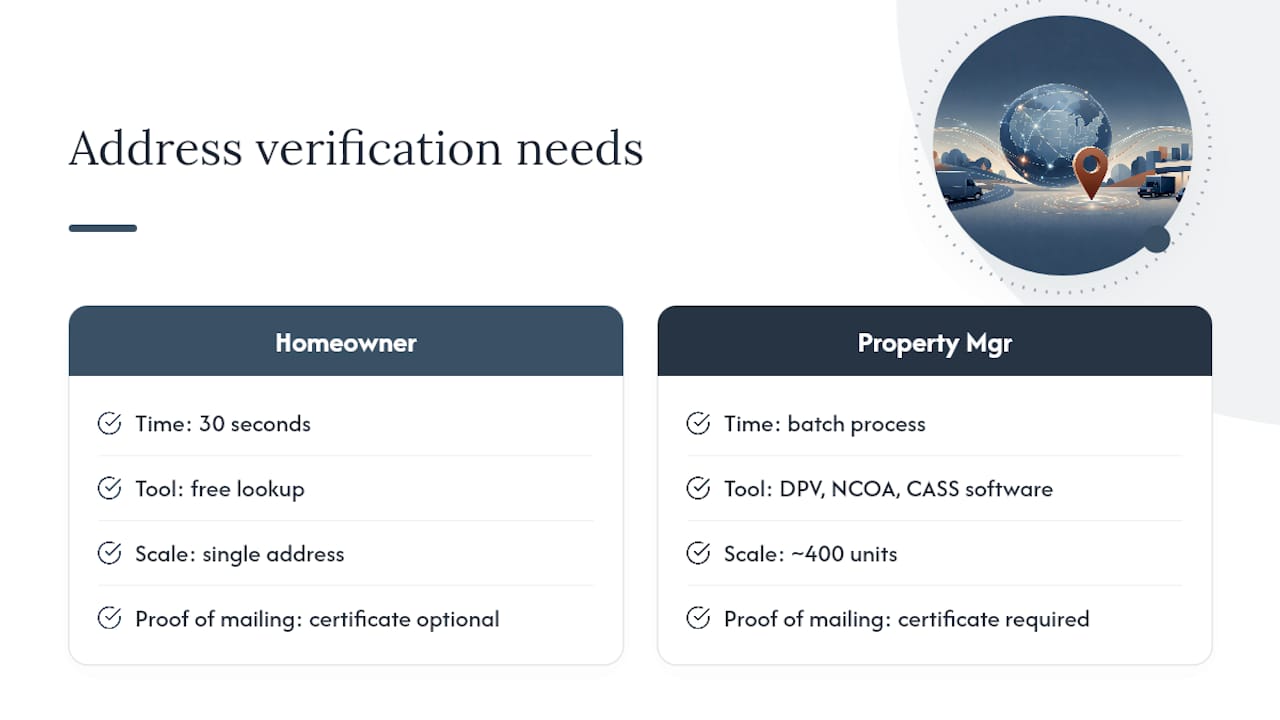
The conventional advice on this topic treats “verify the address” as a single action with a single tool. It isn’t. A homeowner checking their own mailing address needs thirty seconds and a free lookup. A property manager mailing notices to 400 units needs a completely different pipeline involving DPV checks, NCOA updates, and probably CASS certified software, because postage rates and delivery accuracy both depend on it.
Where the advice really falls short is proof of mailing. Boards obsess over getting the address right and then treat the mailing itself as an afterthought, no Certificate of Mailing, no documentation, nothing to show if a dispute ever lands in front of an arbitrator or judge. An address can be perfectly verified and the mailing still becomes legally worthless without a record that it happened.
Prioritize both halves. Verify the address, then document that you mailed to it. Skipping either one defeats the purpose of doing the other.
— Blake
Get Compliant Notices Out the Door Without the Guesswork
Running every violation notice through a separate USPS lookup, then reformatting it to meet your state’s requirements, then figuring out how to document that it was mailed, eats hours a board or management team doesn’t have. HOA Letter AI folds all three steps into one workflow: address checks, state-aware formatting, and delivery documentation happen automatically as part of generating the letter, not as three separate errands.
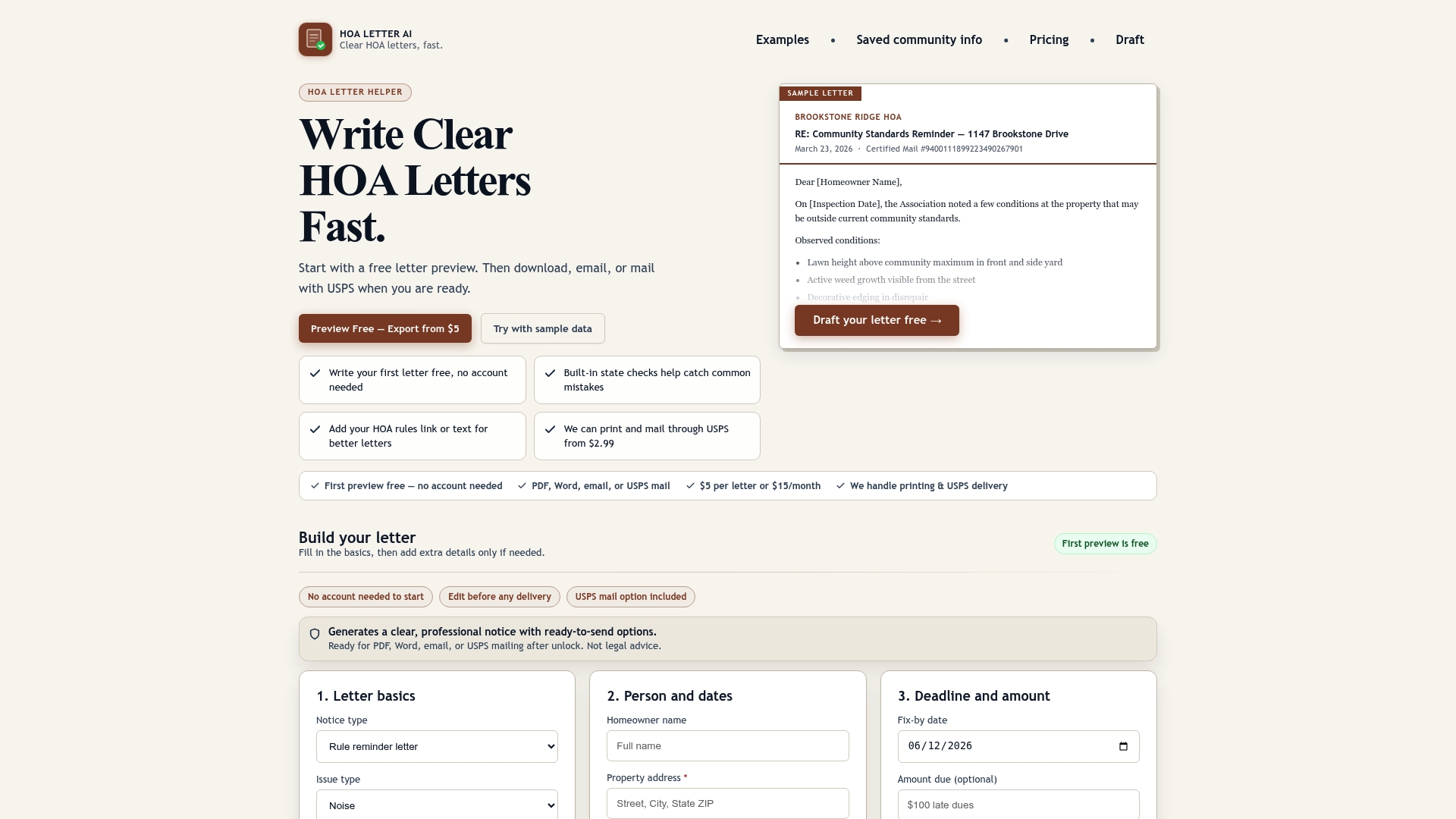
That matters most for boards juggling dozens of active violations at once, where a single returned envelope because of a bad apartment number can delay enforcement by weeks. If you manage properties across state lines, HOA Letter AI’s state-specific compliance templates handle the notice-requirement differences automatically, something a generic mail merge never will.
Start with the free HOA violation letter generator and preview a notice before committing to anything. If you’re managing multiple properties, the $15/month unlimited-letter plan is worth checking against what you currently spend piecing this process together manually.
Sources
- Look Up a ZIP Code™ | USPS
- Address Validation APIs | USPS Web Tools & APIs
- Address Information System (AIS) Viewer | PostalPro