
A compliance notice lands in your mailbox and your first reaction is probably confusion, maybe frustration. You’re not alone. Homeowners across the US receive these formal written alerts every day, and most of them had no idea a violation existed until the letter arrived. Understanding why homeowners receive compliance notices, and what to do next, is the fastest way to turn a stressful situation into a manageable one.
What is a homeowner compliance notice and why does it get issued?
A compliance notice is an official written document sent to a property owner when their property does not meet community or municipal standards. It is not a fine. It is a formal warning that starts a clock, giving you a defined window to correct the problem before penalties begin. Think of it as the enforcement system’s first move, not its last.

These notices come from two distinct sources: local government code enforcement agencies and homeowners associations. A city or county inspector issues a Notice of Violation when your property breaches local ordinances or adopted building codes. An HOA issues a violation letter when you breach the community’s recorded governing documents, known as CC&Rs (Covenants, Conditions, and Restrictions). The two systems operate independently, which means you can receive notices from both at the same time for related or unrelated issues.
The core purpose is not punishment. Enforcement exists to protect property values, public safety, and the shared standards that make a neighborhood function. Common reasons homeowners receive these notices include:
- Unpermitted construction or renovation work
- Exterior maintenance failures such as peeling paint, broken fencing, or damaged roofing
- Landscaping violations like overgrown vegetation or dead grass
- Parking violations on community property
- Safety hazards visible from a public street or common area
- Storage of junk vehicles, debris, or prohibited items
- Failure to obtain required permits before starting work
What legal authority actually backs these notices?
Municipalities draw their enforcement power from local ordinances and adopted model codes. Most US jurisdictions base their building standards on the International Building Code (IBC) or the International Residential Code (IRC), published by the International Code Council, with local amendments layered on top. The National Electrical Code (NEC), maintained by the National Fire Protection Association (NFPA), governs electrical installations. These are not suggestions. They carry the force of law, and inspectors are authorized to act on them.
HOA enforcement authority comes from a different place entirely. It flows from private contract law, specifically the CC&Rs recorded with the county when the community was established, combined with applicable state statutes. When you purchased your home in an HOA community, you agreed to those rules as a condition of ownership. That agreement is what gives the board legal standing to issue violation letters and impose fines.
Key legal sources that shape compliance authority in the US:
- Local municipal codes and zoning ordinances
- State statutes governing HOA operations (these vary significantly by state; see HOA laws by state for a breakdown)
- Recorded CC&Rs and community bylaws
- The International Building Code and International Residential Code
- The National Electrical Code (NEC)
- Federal law, including lead paint disclosure requirements under 42 U.S.C. § 4852d for pre-1978 homes
One distinction that trips up homeowners: a government-issued Notice of Violation is a public record that follows the property, not just the owner. An HOA violation letter is a private contractual matter. Both carry real consequences, but they operate through different legal channels.
Compliance enforcement ensures community equity and safety rather than penalizing individuals. Boards and inspectors treat enforcement as a framework for shared standards, not a personal attack on any one homeowner. Understanding that mindset makes it far easier to cooperate effectively and reach a fast resolution.
Pro Tip: Check your state’s HOA statute before assuming your association has unlimited enforcement power. Many states cap fines, require specific notice formats, and mandate hearing rights before penalties can be imposed.
How the notice, hearing, and appeal process actually works
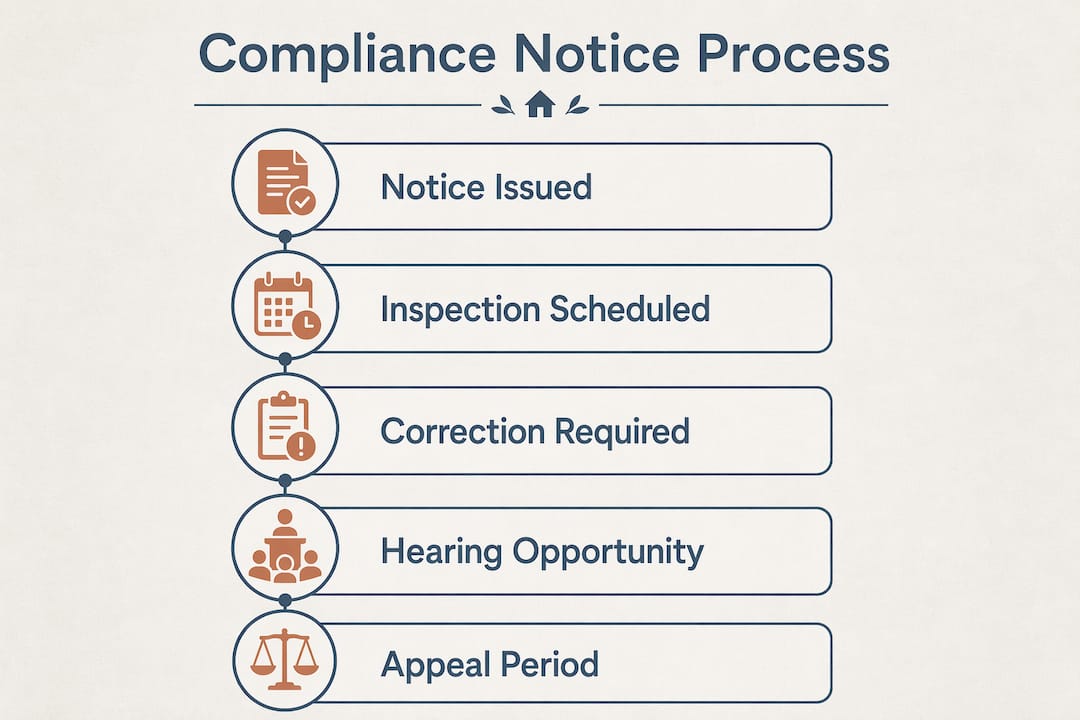
The sequence from violation to resolution follows a predictable path, though timelines vary by jurisdiction and severity.
-
Detection. Violations are identified through permit inspections, neighbor complaints, or plain view observations by inspectors standing on public property. An inspector who can see an unpermitted structure or overgrown vegetation from the sidewalk can issue a notice without ever entering your yard.
-
Notice issuance. You receive a written notice identifying the specific violation, citing the exact code or CC&R section, naming the inspector or enforcement officer, and stating a correction deadline. The notice also includes permit numbers or case identifiers you will need for all follow-up paperwork.
-
Correction window. Deadlines depend on severity. Non-hazardous violations typically allow 60–90 days for correction. Hazardous conditions, such as structural instability or faulty electrical systems, can compress that window to 24 hours. Some jurisdictions use a three-tier system with separate deadlines for each severity level.
-
Re-inspection. Once you complete repairs, contact the issuing office to schedule a formal re-inspection. The inspector verifies the work meets code. If it does, the violation is cleared from the record.
-
Close-out documentation. Most building departments require a formal correction document, sometimes called a Certificate of Correction, along with copies of closed-out permits and any required professional certifications. Submit everything before the deadline, not on it.
-
Appeal. You are not required to accept every notice as written. If you believe the inspector misapplied the code or that your property actually complies through an alternative method, you can appeal. Under the International Building Code framework, most jurisdictions maintain a Board of Appeals. Filing deadlines are tight, typically 20 days from notice under the model code, though local rules vary.
One point that catches homeowners off guard: an open violation creates a permanent public record that can surface during a title search, complicate a home sale, or trigger insurance complications. Correcting the physical problem is only half the job. Getting the formal close-out on file is the other half.
Common reasons homeowners receive multiple notices and pitfalls to avoid
Repeat notices usually trace back to a handful of predictable mistakes, not bad luck.
The most frequent triggers for initial and follow-up notices include:
- Starting construction without pulling a permit first
- Completing repairs that do not fully meet code, leading to a failed re-inspection
- Missing the correction deadline and triggering daily fines
- Failing to schedule the required close-out inspection after repairs
- Landscaping that falls out of compliance seasonally, generating recurring notices
New homeowners are a specific target for deceptive mailers that mimic official compliance notices. These fraudulent mailers use public deed records to time their arrival shortly after closing, exploiting the transition period when buyers are least familiar with what legitimate government correspondence looks like. Legitimate agencies use official contact information that matches their public websites. Suspicious mail typically uses different phone numbers and buries disclaimers in fine print.
When homeowners act as their own general contractors, the legal exposure multiplies. Owner-builders bear full legal responsibility for code compliance, permitting, and inspections, identical to a licensed contractor. The City of Chandler’s building permit manual is explicit: working without a permit doubles permit fees, can result in an order to remove non-compliant work at the homeowner’s expense, and can block FHA financing at resale.
Ignoring a notice is the single most expensive mistake you can make. The escalation path is predictable: notice, daily fines, lien on the property, and in extreme cases, foreclosure. Fines of $100 to $1,000 per day are not unusual for unresolved violations in many municipalities.
Pro Tip: Always verify a compliance notice by calling the issuing agency directly using a phone number from their official website, not the number printed on the letter. This one step protects you from both scams and miscommunication.
How to respond to a compliance notice effectively
Reading the notice carefully is the first and most important step. The document tells you exactly what is wrong, which code or rule applies, who issued it, and when you need to fix it. Most homeowners who escalate their situations do so because they skimmed the notice or misread the deadline.
Proactive communication with the issuing office is your best defense. Inspectors and board members prioritize compliance over punishment. Calling to clarify requirements or request a deadline extension, before the deadline passes, almost always produces better outcomes than silence. A documented request for an extension, submitted in writing, protects you if the situation later becomes a dispute.
Key response steps for homeowners:
- Read the full notice and note the exact deadline and violation code
- Contact the inspector or HOA enforcement contact to clarify requirements
- Secure any required permits before starting repair work
- Hire licensed contractors when the scope of work requires it
- Document all correspondence, repair receipts, and contractor agreements in writing
- Schedule the re-inspection and obtain formal close-out documentation
- Keep copies of everything for at least three years after resolution
For HOA-specific notices, the HOA compliance response guide covers state-specific procedures and hearing rights in detail. If the violation involves landscaping, the process has some nuances worth reviewing separately.
How HOA enforcement actually works behind the scenes
Most homeowners picture the HOA board as the enforcement authority, and that is partially correct. The board sets policy, approves fine schedules, and conducts hearings. But in communities with a professional property management company, day-to-day enforcement, including inspections and initial notice drafting, is typically handled by the management firm or a third-party compliance service.
The governing documents, specifically the CC&Rs and the community’s fine schedule, define what the board can and cannot do. State law adds another layer. Many states require HOAs to provide written notice, a reasonable cure period, and a formal hearing opportunity before imposing fines. Boards that skip these steps risk having their fines challenged and overturned. The HOA rule enforcement checklist covers the procedural requirements boards must follow to keep their notices legally defensible.
The rationale behind enforcement is straightforward: property values in planned communities depend on consistent standards. A single property with deferred maintenance or unpermitted structures affects neighboring home values and, in some cases, community-wide insurance rates. Enforcement is not about control for its own sake. It is the mechanism that keeps the shared investment intact for everyone.
Transparent communication between boards and homeowners reduces conflict significantly. Boards that explain the reason behind a notice, rather than just citing a rule number, tend to see faster voluntary compliance. Homeowners who engage respectfully and document their progress tend to avoid escalation. The enforcement ecosystem works best when both sides treat it as a shared problem to solve, not a contest to win.
Key Takeaways
Compliance notices are formal warnings, not fines, and responding promptly with documented communication and proper permits resolves most violations before penalties begin.
| Point | Details |
|---|---|
| Notices are warnings, not fines | A compliance notice starts a correction clock; penalties only begin if you miss the deadline. |
| Two separate systems | Government code enforcement and HOA enforcement operate independently and can both apply to the same property. |
| Close-out inspections matter | Fixing the problem physically is not enough; formal close-out documentation clears the public record. |
| Owner-builders carry full liability | Homeowners acting as their own contractors are legally responsible for permits, inspections, and code compliance. |
| Scam mailers target new buyers | Deceptive notices mimicking official letters arrive shortly after closing; always verify using the agency’s official website. |
Recommended
- Notice of Non-Compliance Property: What Owners Must Know | HOA Letter AI
- Responding to an HOA Compliance Notice: 2026 Guide | HOA Letter AI
- Why Homeowners Need Readable Violation Letters | HOA Letter AI
- HOA Landscaping Violation Notice Explained for Homeowners | HOA Letter AI
Drafting support for HOA notices
Use the HOA letter drafter to turn this guidance into a resident-ready notice, compare reusable HOA letter templates, or review the property manager workflow for higher-volume enforcement work.