
A common area damage notice is a written, documented demand that the responsible owner or party correct damage or reimburse the association, and it should go out promptly with photos and a clear deadline. Recipients typically include the responsible owner or occupant, the property manager, and the insurer when a claim applies. The immediate outcome is a scheduled inspection, a repair timeline, or a formal assignment of cost.
TL;DR:
- Responsibility for damage depends on the location, cause, and governing documents, with negligence shifting costs to owners and wear typically handled by the association.
- Damage notices must be factual, include exact location, date discovered, evidence, applicable policies, clear corrective requests, and delivery details to be enforceable.
- Consistent documentation, including photos with timestamps, well-organized incident records, and vendor estimates, strengthens the case in disputes or legal challenges.
- Repairs should follow a structured timeline with inspection within three days, response within two weeks, and immediate action for emergencies to minimize liability and conflict.
- Using structured templates and standardized procedures helps ensure notices are compliant, efficient, and maintainable across multiple incidents and community management teams.
HOA Letter AICreate Clearer Damage NoticesHOA Letter AI helps boards and property managers draft professional compliance notices with state-specific context, community rules, and built-in checks.Create a compliance letter
Table of Contents
- Who pays for damage to shared property
- What belongs in a written damage notice
- Documenting and preserving evidence that holds up
- From notice to repair: the practical timeline
- When owners dispute the notice or ignore it
- Using templates to keep notices consistent and compliant
- Two habits that cut down repeat incidents and paperwork
- Let HOA Letter AI draft your next damage notice
- Templates and resources to keep on hand
- FAQ
Who pays for damage to shared property
Responsibility usually comes down to where the damage happened and who caused it. Common elements, like lobbies, pools, and shared landscaping, are typically maintained by the association and funded through dues. Limited common elements, such as a patio or balcony that only one unit can access, often shift maintenance duty to that owner even though the association may still hold legal title.
Governing documents can override these defaults, so the CC&Rs and bylaws are the first place to check before sending a notice. State law can also step in where the declaration is silent or ambiguous, particularly on structural components.
Cause matters as much as location:
- Negligence or misuse by an owner, tenant, or guest usually shifts the repair cost to that party.
- Normal wear and tear on a common element is typically the association’s responsibility.
- Third-party vandalism or a contractor error may point to an insurance claim or a vendor’s liability coverage instead of the resident.
- A maintenance failure, like a known leak that was never repaired, can expose the association to the cost even if a unit owner reported the damage.
What belongs in a written damage notice
A notice only holds up if it reads as fact, not accusation. Every letter should stick to a consistent structure so nothing gets left out and the board can defend the notice later if it’s challenged.
- Location and description: state exactly where the damage is and what it looks like, using neutral, factual language rather than assigning blame in the wording itself.
- Date and time discovered, along with the name and contact information of whoever reported it.
- Photo or video evidence, referenced by file name and timestamp so the record can be matched to the notice later.
- The specific governing document clause or policy that applies, so the recipient knows the authority behind the request.
- Requested corrective action, a firm deadline, and the consequences of missing it, whether that’s a fine, a lien, or referral to counsel.
- Delivery method and logging details, so there’s a record of when and how the notice was sent.
Pro Tip: Keep a single sentence for the facts and a separate sentence for the requested action: mixing them tends to read as an accusation instead of a record.
A state-compliant warning letter template built around this structure removes most of the guesswork on first drafts.
Documenting and preserving evidence that holds up
Photos and reports only help the board if they’re captured consistently and stored where they can be found later. A documented incident record that separates facts from conclusions is far more useful in a hearing than a folder of unlabeled images.
- Capture wide shots for context and close-ups for detail, with a timestamp visible or logged separately.
- Note the exact common area, such as the elevator lobby, pool deck, or parking structure, rather than a general description.
- Save files with a consistent naming convention that includes the date and location.
- Request a vendor estimate before finalizing cost figures, and attach it directly to the incident file.
Keeping the incident report, the owner notice, and the board’s decision as three separate documents preserves the chain of custody and prevents an early, unverified accusation from being read as a final finding. Route every report as a tracked work order rather than an email thread that can get lost.
From notice to repair: the practical timeline
Most boards can move from discovery to resolution in a matter of weeks if the process stays consistent. A predictable sequence also protects the board if a dispute later goes to a hearing or small claims court.
- Inspect the damage within 1 to 3 days of the report to confirm scope and any safety risk.
- Give the responsible party a response window, commonly 7 to 14 days, to reply, dispute the claim, or propose a fix.
- Bring the matter to the board at the next scheduled meeting, or call a special session if the damage is urgent.
- Assign cost once responsibility is settled: the association pays for common element repairs, the owner reimburses for negligent damage, an insurance claim covers third-party or accidental loss, or a special assessment covers a shortfall.
- Schedule the repair with a vendor once funding is confirmed.
Emergency repairs, like a burst pipe or a downed fence section, shouldn’t wait on this sequence. Fix the hazard first, document everything as it happens, and preserve the board’s right to seek reimbursement afterward.
When owners dispute the notice or ignore it
Disputes are common, and the board’s paper trail is what decides how they end. Every phone call, email, and letter should get logged, and the board should ask the owner for their own supporting evidence, such as photos or an insurance declaration page, before making a final call.
- Tie every fine, hearing notice, or lien filing back to the specific CC&R clause and the dated timeline the board already built.
- Escalate through the steps the governing documents allow, typically a hearing before fines and a lien only after repeated nonpayment.
- Bring in legal counsel or the association’s insurer once the dispute involves real money or a safety claim, and let that professional review the file rather than a single board member’s opinion.
Pro Tip: Assign one board member or the manager to handle all communication on a disputed incident, so the record stays consistent and no one can claim they were told something different.
A fine notice template built for escalation keeps this step consistent with the original notice instead of starting from scratch.
Using templates to keep notices consistent and compliant
A repeatable template does more than save time. It keeps every notice structured the same way, which matters if an owner challenges the process later.
- A state-compliant template accounts for notice requirements that vary by jurisdiction, cutting down on procedural mistakes that can void a fine or delay a lien.
- A solid template already includes space for the facts, the rule citation, the deadline, and the consequences, so nothing gets left out under deadline pressure.
- Pairing the notice with a vendor estimate and a tracked delivery method, mailed through USPS or logged electronically, closes the loop between the incident report and the final resolution.
Routing every incident the same way, from the initial report through the documented process, also makes it easier to compare cases and spot repeat problem areas.
Two habits that cut down repeat incidents and paperwork
The boards that handle damage notices well aren’t doing anything exotic. They standardize photo naming and incident logging so nothing gets lost between the initial report and the final decision, and they use the same notice template every time so residents see a consistent, impartial process rather than one that shifts with whoever is on the board that month.
— Blake
Let HOA Letter AI draft your next damage notice
Writing a defensible common area damage notice from scratch takes time most boards don’t have between meetings. HOA Letter AI gives you guided drafting with state-aware templates, a free one-page preview, and delivery options built in, so the notice reflects your community’s rules without you starting from a blank page.
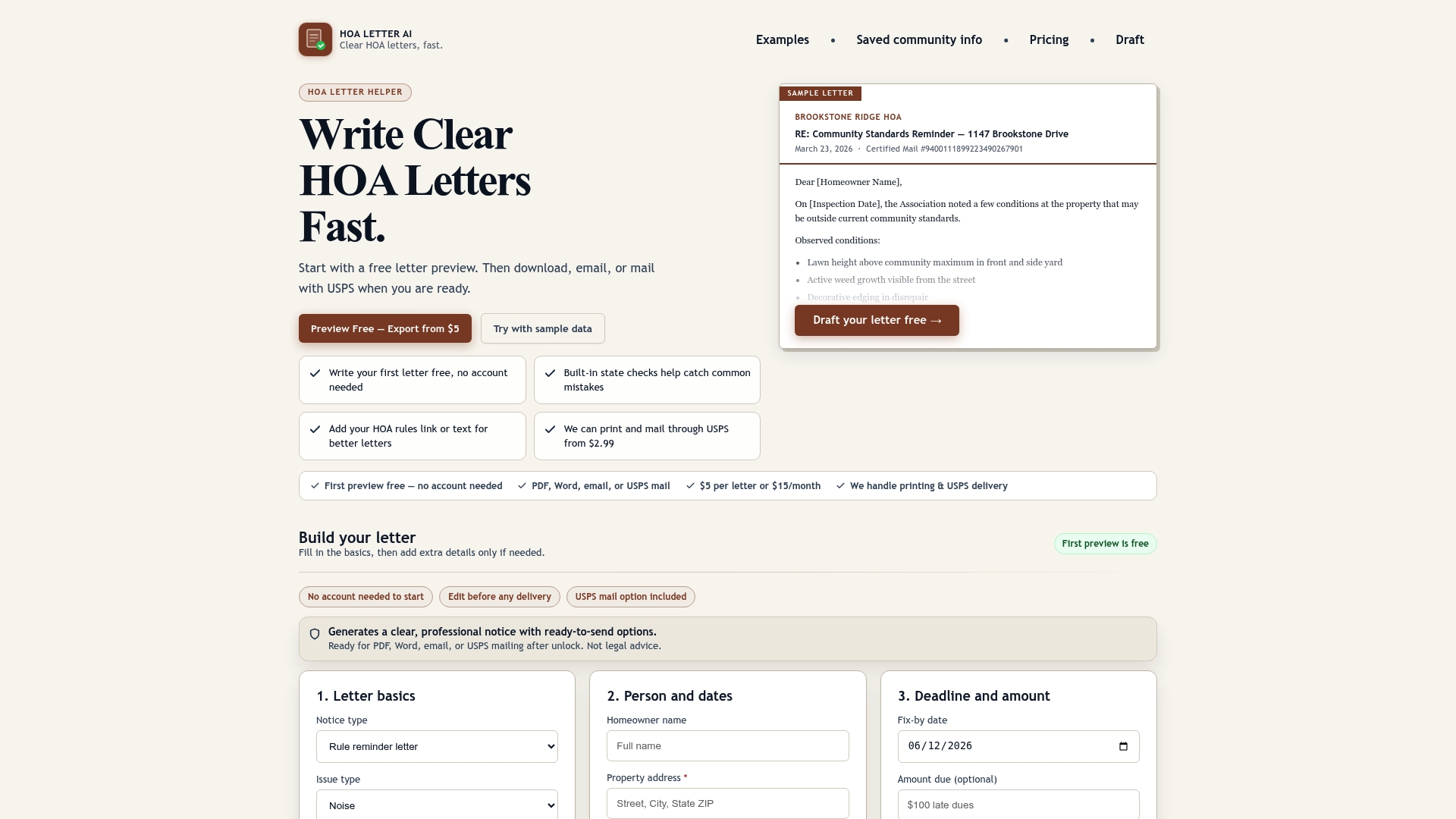
Boards and individual users can generate a single notice for $5, while property management teams handling multiple communities can use the PM Starter or PM Pro plans at Hoaletterai. Preview a template now and see the finished notice before you commit to sending it.
Templates and resources to keep on hand
Keep the warning letter template, the full templates hub, and the fine notice template bookmarked for quick access. For broader training, the property management courses from the Alexander Anderson Center for Real Estate Education and this vendor management checklist are useful references for repair coordination.

FAQ
What does common area mean in an HOA?
Common areas are the shared spaces and amenities owned collectively by the association, such as lobbies, pools, clubhouses, parking areas, and landscaping. Owners don’t hold individual title to these spaces, though they share the cost of maintaining them through dues.
What counts as damage to common property?
Damage includes any physical harm to a shared space or amenity, from a cracked pool deck to a broken gate or a stained hallway carpet. A usable damage report captures the exact location, the date and time discovered, a factual description, and any immediate safety concern.
Who pays for limited common element repairs?
Limited common elements, like a balcony or a reserved parking spot, often place maintenance responsibility on the owner who has exclusive use, even though the association may hold title. The governing documents decide this allocation, so they should be checked before assigning cost.
Who owns common areas in an HOA?
The association typically holds legal title to common areas, while individual owners hold an undivided interest in them as part of their membership. Day-to-day maintenance and repair decisions usually fall to the board, guided by the CC&Rs.