
Send a new manager introduction letter that names the manager and company, states the effective date, provides contact details, explains how rent gets paid and maintenance gets reported, and confirms that existing lease terms remain in effect. Deliver it through multiple channels, then create a dated PDF record with proof of delivery before the transition date passes.
Pro Tip: After sending, confirm receipt through a second channel (a follow-up text or portal message) and save that confirmation as a timestamped PDF in the tenant file. That second touchpoint is what separates a documented notice from a disputable one.
The property management letter documentation process is not just about writing a good letter. It is about creating a paper trail that holds up when a tenant disputes a charge, an owner asks for records, or your team switches software. Most managers get the letter right and skip the documentation. That gap is where disputes live.
Table of Contents
- Key Takeaways
- What does a property manager introduction letter actually accomplish?
- What should every property management letter include?
- Ready-to-use templates for common notice types
- How to document delivery and build an audit-ready record
- What legal and timing rules apply to property management letters?
- Key takeaways
- Why documentation is the part most managers underestimate
- HOA Letter AI covers the full documentation workflow
- Useful sources and further reading
Key Takeaways
A complete property management letter documentation process requires a well-structured notice, delivery through multiple channels, and a dated proof-of-delivery record stored in a consistent file hierarchy.
| Point | Details |
|---|---|
| Letter must-haves | Include manager name, effective date, contact info, payment instructions, maintenance process, and lease-term reassurance. |
| Delivery standard | Send through multiple channels so tenants with different preferences receive and acknowledge the notice. |
| Proof of delivery | Capture a tracking number, delivery receipt, or portal timestamp for every notice and log it in a delivery record. |
| File naming | Use the pattern YYYY_PropertyAddr_Unit_DocType_Tenant so files sort chronologically and are retrievable across systems. |
| HOA Letter AI | Generates state-aware letters with a one-page preview you can save as a PDF audit record before sending. |
Pre-send letter checklist
Before you send any property management notice, confirm these fields are complete:
- New manager or company name (full legal name, not just a first name)
- Designated contact person and their direct phone, email, and office hours
- Effective date of the management change or policy update
- Rent payment instructions: accepted methods, portal URL or mailing address, and due date
- Maintenance request workflow: portal link, email address, phone number, and after-hours emergency contact
- Explicit statement that existing lease terms remain in effect unless a formal amendment is issued
- Any policy changes stated clearly and separately from the reassurance language
- Response instructions: how tenants should direct questions and what response time to expect
Documentation and delivery checklist
- Send through at least two channels: email plus one of certified mail, portal post, or in-person delivery
- Capture proof for each channel: tracking number, delivery/read receipt, portal timestamp, or signed acknowledgment
- Log each notice in a delivery record (date sent, method, tracking reference, file path)
- Save the final letter as a PDF with a canonical file name before archiving
- Store the proof alongside the letter in the tenant’s folder, not in a separate inbox
Distribution timing
Notify tenants well in advance before a management transition takes effect. For a payment-platform switch, allow sufficient time so tenants can update autopay settings without missing a due date. Send a follow-up reminder shortly before the effective date.
“A reusable document checklist answers five quick questions and should be used as a stress test before assuming files are audit-ready: what documents exist, which version is current, how fast can you retrieve them, do they prove condition, and will they survive a software migration?” Property Management Document Checklist
What does a property manager introduction letter actually accomplish?
A property manager introduction letter is a formal written notice that informs tenants of a management change, instructs them on new procedures, and reassures them that their lease protections remain intact. It covers three jobs at once: inform, instruct, and reassure.

Common use cases include portfolio handoffs when an owner hires a new management company, internal manager changes within the same firm, payment-platform migrations (switching from checks to an online portal), and emergency-contact updates after staff turnover.
Success looks like this: rent collection continues on time through the transition, maintenance requests arrive through the correct channel from day one, and your tenant file contains a dated proof-of-delivery record. Tenant questions drop when the letter is complete. When they do not drop, the letter was missing something.
What should every property management letter include?
A complete letter has three layers: header information, core content fields, and administrative attachments. Missing any one of them creates the kind of ambiguity that generates tenant calls, late payments, and, occasionally, legal disputes.
Header information
Start with the date, the property address, the tenant’s full name and unit number, and a clear subject line. A subject line like “Important Notice: New Property Management Effective [Date]” tells the tenant immediately that this is not junk mail.
Core content fields
According to practitioner guidance, every notice should cover these fields in this order:
- New manager or company name — use the full legal name so tenants can verify it independently.
- Designated contact person — name one person, not a department, so tenants know exactly who to call.
- Phone, email, and office hours — list all three. Tenants who cannot reach you by phone will try email; give them both.
- Effective date — state it twice: in the subject line and in the body.
- Rent payment instructions — specify accepted methods (check, ACH, portal), the portal URL or mailing address, and the due date. Vague payment instructions are the single most common cause of late payments during a transition.
- Maintenance request workflow — name the portal or email address for routine requests and a separate phone number for emergencies. Tenants should never have to guess which channel to use at 2 AM.
- Lease-term reassurance — write it plainly: “Your existing lease terms remain in effect. No changes to your rent amount, lease duration, or other conditions are being made by this notice.”
- How questions will be handled — tell tenants the expected response time (e.g., within one business day by email) so they do not call repeatedly.
Tone and sample phrases
Keep the tone neutral and reassuring. Avoid corporate language that sounds like a legal disclaimer. These phrases work:
- “We are excited to serve you and want to make this transition as smooth as possible.”
- “Your lease agreement remains fully in effect, and nothing about your tenancy is changing.”
- “For any questions, please contact [Name] at [email] — we typically respond quickly.”
Pro Tip: Explicitly stating that lease terms continue is not just reassuring, it is protective. Tenant-facing reassurance language that confirms no rent increase or policy change is occurring reduces confusion and the likelihood of disputes escalating.
Administrative attachments to include
- Payment portal setup instructions (a one-page PDF or link)
- Emergency contact card with after-hours phone number
- Link to your maintenance request portal
- A brief FAQ covering the five questions tenants ask most often
Drafting pitfalls to avoid
- Vague payment instructions (“send rent as usual”) without specifying where “as usual” now means
- Language that inadvertently modifies lease terms by referencing new rules without a formal amendment
- Listing only a general office number for emergencies instead of a direct after-hours line
- Forgetting to state the effective date clearly, which leaves tenants unsure when to start using new procedures
Ready-to-use templates for common notice types
New property manager introduction letter
Subject: Important Notice: New Property Management Effective [Date]
Dear [Tenant Full Name],
We are writing to inform you that effective [Effective Date], [New Management Company Name] will be assuming management of your property at [Property Address], Unit [Unit Number].
Your primary point of contact is [Contact Person Name], who can be reached at [Phone Number] or [Email Address] during office hours of [Days and Hours].
Rent payments should be submitted through [Portal Name] at [Portal URL], or mailed to [Mailing Address]. Your due date and all other lease terms remain unchanged.
Maintenance requests should be submitted through [Portal Link] or by emailing [Maintenance Email]. For after-hours emergencies, call [Emergency Phone Number].
Your existing lease agreement remains fully in effect. No changes to your rent, lease duration, or any other conditions are being made by this notice.
If you have questions, please contact [Contact Person Name] at [Email]. We typically respond within one business day.
Sincerely, [Contact Person Name] [Management Company Name] [Phone] | [Email]
Short email or portal version
Subject: Your new property management contact — effective [Date]
Hi [First Name], starting [Date], [Company Name] manages your property. Your contact is [Name] at [Email / Phone]. Rent is due [Date] via [Portal or Address]. Your lease terms are unchanged. Reply here with any questions.
Payment-method change notice
Subject: Action Required: New Rent Payment Instructions Effective [Date]
Dear [Tenant Name],
Beginning [Date], rent payments must be submitted through [New Portal Name] at [URL]. Checks mailed to the previous address will no longer be accepted after [Cutoff Date].
Setup takes approximately five minutes. Instructions are attached. If you need help, contact [Name] at [Email or Phone] before [Date].
Your lease terms, rent amount, and due date are unchanged.
Maintenance-process update notice
Subject: Updated Maintenance Request Process — Effective [Date]
Dear [Tenant Name],
Starting [Date], all maintenance requests should be submitted through [Portal Name] at [URL] or by emailing [Email Address]. For emergencies (no heat, flooding, gas leak), call [Emergency Number] at any hour.
Please do not submit requests through [Old Method] after [Date], as those will no longer be monitored.
Customization notes
For single-family rentals, shorten the letter to one page and remove references to building staff or shared amenities. For multi-unit properties, add a note about common-area maintenance and building-wide emergency procedures. Properties with onsite staff should name the onsite contact separately from the management office contact so tenants know which issues go where.
Pro Tip: Save each template as a reusable community profile so you can populate it with property-specific details in under two minutes. Compliance letter templates built around standard fields make that kind of reuse practical at scale.
How to document delivery and build an audit-ready record
Most property management teams treat document storage as an afterthought. A purpose-built documentation process is what separates a file that survives an audit from one that falls apart the moment a tenant disputes a notice.
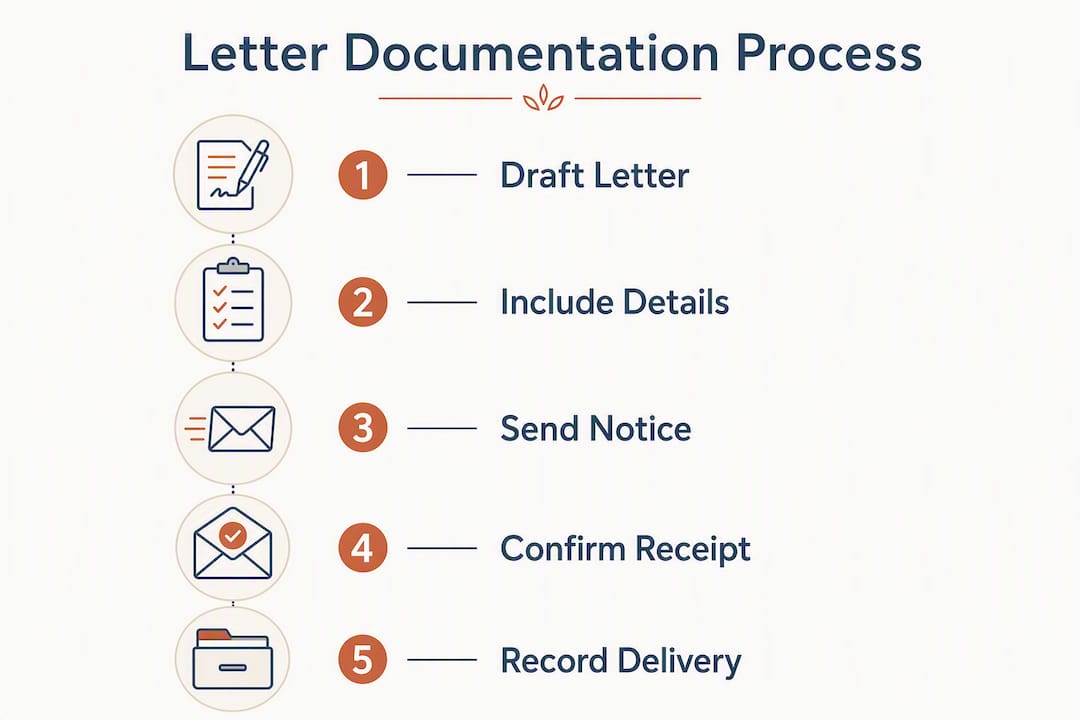
Step-by-step delivery and record process
- Draft and approve. Finalize the letter, have it reviewed by the responsible manager, and lock the version. No edits after approval.
- Send through at least two channels. Best practice is email plus one of: certified mail, portal post, or in-person delivery with a signed acknowledgment.
- Capture proof for each channel. For certified mail, save the tracking number and USPS delivery confirmation. For email, save the delivery receipt or read receipt. For portal posts, screenshot the timestamp. For in-person delivery, get a signed acknowledgment form.
- Confirm receipt through a second touchpoint. Send a follow-up text or portal message asking the tenant to confirm they received the notice. Save that response.
- Record the notice in your delivery log. Log the date sent, method, tracking reference or screenshot link, tenant response, and file path.
- Save the final letter as a PDF with a canonical file name and store it in the tenant’s folder.
File-naming convention
Adopt a standardized filename that encodes date, property, unit, document type, and tenant name:
YYYY_PropertyAddr_Unit_DocType_Tenant
Example: 2026_123MainSt_Unit2A_MgrIntroLetter_Smith
Date-first naming sorts files chronologically across every folder and makes cross-system retrieval reliable when you migrate software.
Four-level storage hierarchy
Organize records at four levels: portfolio → property → unit → tenant. Every document has exactly one correct location. This eliminates the “where is the signed lease?” problem and makes audit responses fast.

Delivery log table
| Date Sent | Method | Tracking / Reference | Tenant Response | File Path |
|---|---|---|---|---|
| 2026 | Certified mail | USPS tracking number | N/A | /Portfolio/123Main/Unit2A/Smith/2026_123MainSt_Unit2A_MgrIntroLetter_Smith.pdf |
| 2026 | Delivery receipt saved | Confirmed receipt 3/2 | /Portfolio/123Main/Unit2A/Smith/2026_123MainSt_Unit2A_MgrIntroLetter_Smith_EmailReceipt.pdf |
Acceptable proof-of-service options
- Certified mail with USPS tracking: best for high-stakes notices; provides a legal delivery record
- Email with delivery/read receipt: fast and scalable; save the receipt as a PDF immediately
- Portal post with timestamp: convenient for tenants already using the portal; screenshot the confirmation
- In-person handoff with signed acknowledgment: strongest proof; use for eviction-adjacent notices or when other methods fail
Treat documentation as risk management: dating notices and tracking delivery method reduces the likelihood of lease disputes escalating to litigation.
Pro Tip: Store finalized PDFs as the source of truth, not the email thread or the portal draft. Run an annual audit of your tenant files using a five-question stress test: what documents exist, which version is current, how fast can you retrieve them, do they prove condition, and will they survive a software migration? Tracking responses systematically is what makes that audit fast.
Digital records, when properly authenticated and preserved with an audit trail, are acceptable for legal and audit purposes. Keep paper originals for high-stakes items: original leases, certain statutory deliveries, and any document a court or arbitrator might require in physical form.
Consistent before-and-after documentation practices used by professional property service vendors illustrate why timestamped, visual evidence matters across the full tenancy record, not just for notices.
What legal and timing rules apply to property management letters?
State landlord-tenant statutes govern notice periods, required phrasing, and acceptable delivery methods. What is legally sufficient in Texas may not satisfy California’s requirements. Before sending any management-transition notice, confirm your state’s rules for notice periods, required disclosures, and approved delivery channels. State-by-state notice requirements vary significantly, and the cost of getting them wrong is a notice that does not legally count.
Timing guidance
Send the management-transition notice at least 30 days before the effective date. For a payment-platform switch, 45–60 days gives tenants time to update autopay without missing a payment. Schedule a follow-up reminder 7–10 days before the effective date. If you are managing HOA-governed properties, check whether the CC&Rs or state HOA statutes impose additional notice requirements beyond standard landlord-tenant law.
When to consult legal counsel
Get a real estate attorney involved when lease language is ambiguous about management-change procedures, when the notice is connected to an eviction or lease termination, or when owner instructions conflict with existing lease terms. A letter that inadvertently modifies a lease term or waives a landlord right can create liability that far exceeds the cost of a legal review. Letter format compliance requirements vary by jurisdiction and document type.
This article provides general information about property management letter practices, not legal advice. Confirm notice requirements and timing rules with a licensed attorney or your state’s landlord-tenant authority before sending formal notices.
Key takeaways
A complete property management letter documentation process pairs a well-structured notice with a delivery log, a canonical PDF, and a four-level file hierarchy that survives audits and software migrations.
- Send a letter that covers all eight core fields: manager name, contact person, contact details, effective date, payment instructions, maintenance workflow, lease-term reassurance, and response expectations.
- Deliver through at least two channels and capture proof for each one before the effective date.
- Log every notice in a delivery record with date, method, tracking reference, tenant response, and file path.
- Use the file-naming pattern YYYY_PropertyAddr_Unit_DocType_Tenant and store records in a four-level hierarchy.
- Run an annual audit to confirm files are complete, current, and retrievable.
Your next concrete step: draft the new-manager introduction letter using the template above, send it through email and certified mail at least 30 days before the transition, and save the delivery confirmation as a PDF in the tenant’s folder before the effective date arrives.
Why documentation is the part most managers underestimate
The letters themselves are not where property management teams fail. Most managers can write a serviceable introduction notice. The failure happens in the 48 hours after sending, when proof of delivery gets left in an email inbox, the file gets saved with a vague name like “tenant letter March,” and the delivery log never gets updated.
That gap matters more than most teams realize. When a tenant claims they never received notice of a payment-method change and withholds rent, the question is not whether you sent the letter. The question is whether you can prove it, retrieve it in under two minutes, and show that the tenant acknowledged it. Without a delivery log and a canonical PDF, you are arguing from memory.
Operational platforms handle workflows well, but they are frequently insufficient for creating a persistent, audit-ready record. When you migrate software or a manager leaves, those records need to exist somewhere that survives the transition. A disciplined export practice and a four-level file hierarchy are not bureaucratic overhead. They are what makes the difference between a dispute that resolves in a phone call and one that goes to mediation.
HOA Letter AI addresses this directly: it generates state-aware letters with built-in completeness checks, produces a one-page preview you can save as a PDF before sending, and supports USPS mailing integration so delivery proof is part of the workflow, not an afterthought.
HOA Letter AI covers the full documentation workflow
Property managers who need letters that are complete, compliant, and documented from draft to delivery have a faster path than building templates from scratch.
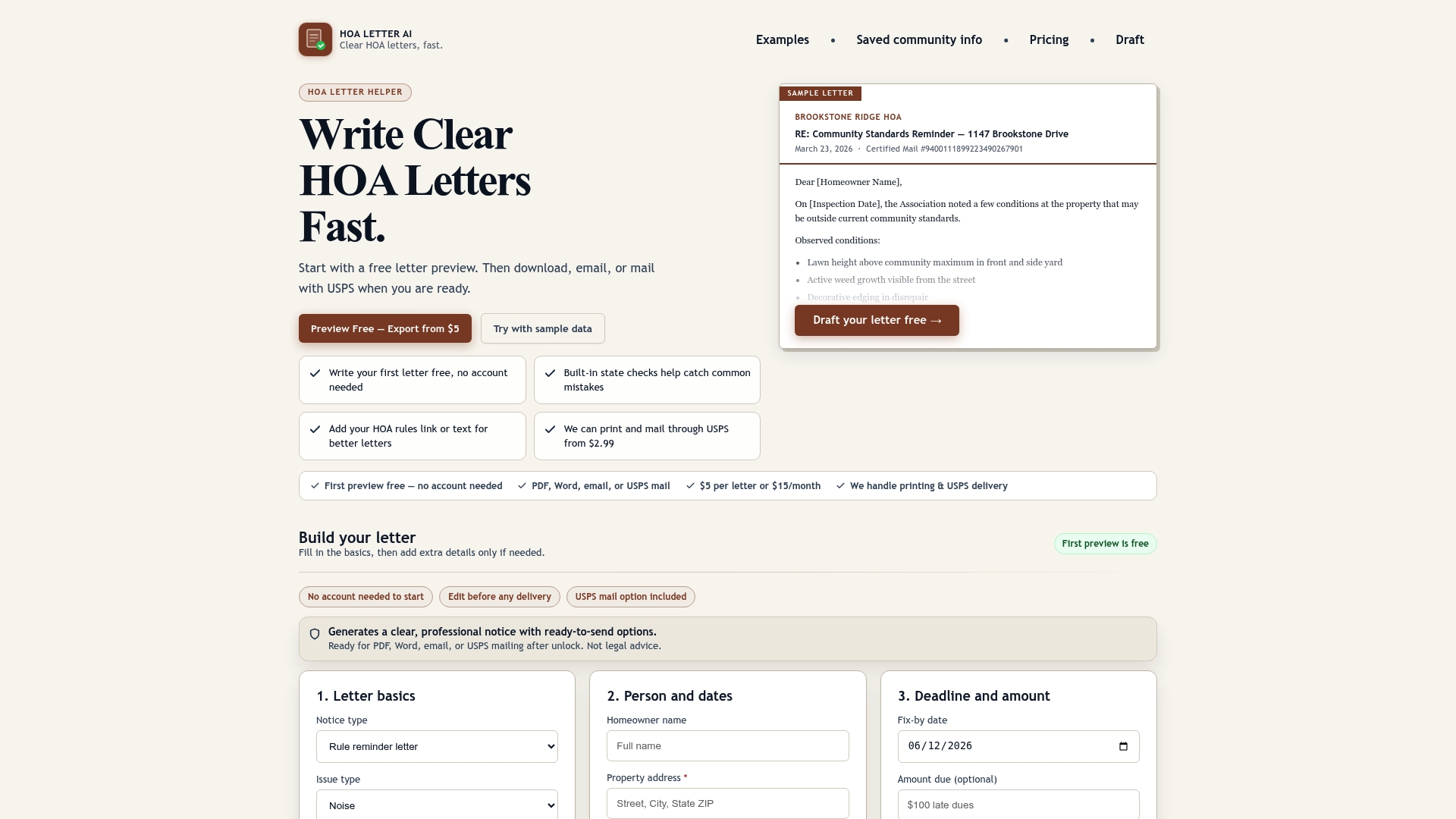
HOA Letter AI generates state-aware property management letters with guided drafting that flags missing fields before you send. The one-page preview exports directly as a PDF, giving you the audit record the moment the letter is finalized. Reusable community profiles let management teams populate property-specific details in minutes rather than starting over for each unit. USPS mailing integration handles certified mail fulfillment so the tracking number lands in your record automatically.
For teams managing multiple properties, the property manager subscription at $15/month covers unlimited letter generation. Individual boards and landlords can unlock a single letter or preview a template free before committing. Preview a template now and see how the documentation workflow maps to the steps in this guide.
Useful sources and further reading
Confirm state-specific notice periods and required phrasing with your state’s landlord-tenant authority or a licensed real estate attorney before sending formal notices. The resources below support implementation and compliance:
- Property Manager Introduction Letter Process (With Template) — field-by-field checklist and sample language for new manager notices
- Property Management Document Checklist — five-question stress test for audit readiness
- HOA Violation Letter Laws by State — state-by-state notice requirements and timing rules
- Compliance Letter Templates for Property Managers — ready-to-use templates with required phrasing
| Resource | Best used for |
|---|---|
| DoorLoop introduction letter guide | Drafting and field checklist |
| Real Estate Ledger documentation system guide | File hierarchy and naming conventions |
| Discovery Mark property documentation reference | Retention schedules and risk management |
| HOA Letter AI state laws page | State notice requirements before sending |
| HOA Letter AI template library | Ready-to-use letter templates |