
A branded HOA letter is a notice that carries the association’s official identity: its legal name, logo or letterhead, return address, a named contact and a consistent layout. That branding is only half the job. A letter that looks official but cites the wrong rule, skips a required hearing notice or uses an angry tone creates more problems than it solves. This guide covers both halves: how to build a branded letter that looks credible, and what has to be inside it so it holds up.
TL;DR
- Brand the letter with the HOA’s official name, management company details if any, the date, a contact person and an authorized signer.
- Keep the wording neutral and factual: the rule, the facts, the fix, the deadline and the next step.
- Cite the specific governing-document section, and check your state’s notice rules before anything is mailed.
- Use one standard template for every notice so every owner is treated the same way.
- With HOA Letter AI you can preview a letter free, then pay $5 to unlock it.
Table of Contents
- What “branded” means for an HOA letter
- The parts of a branded letter, top to bottom
- Tone is part of the brand
- Branded does not mean the same in every state
- How to build your branded template: a step-by-step process
- Common mistakes that undermine a branded letter
- Perspective: why we think the template should do the remembering
- Getting your branded letters out the door
- What owners notice first
- FAQ
- Sources
What “branded” means for an HOA letter
When boards and managers search for branded letters, they usually want one of three things:
- A letterhead. The association’s official name, the management company’s details if one is involved, and the current date.
- A consistent look. The same fonts, logo placement, section order and signature block on every notice, whether it is a friendly reminder or a hearing notice.
- A mailing identity. A return address that owners recognize, so the envelope is opened instead of mistaken for junk.
The letterhead basics are simple. Guidance from a widely used HOA board handbook says the header should show the HOA’s official name, management company details when applicable, and the date, and that the board president or an authorized designee should sign (The HOA Handbook). That is a sound floor.
Branding also protects you. A letter that shows who is writing, on whose authority and who to call is harder to dismiss as a neighbor’s complaint. It signals that the association is acting through its process, not on a whim.
The parts of a branded letter, top to bottom

Header and identity
Put the legal name of the association at the top, with the logo if you have one. Add the property manager’s name and phone number when a management company handles communications. Use the same header on every notice, so owners learn what an official communication looks like.
Recipient, date and subject line
Address the owner by name and the property by address. Use a direct subject line that says what the letter is, such as “Notice of Violation: Trash Receptacles Visible from Street.” Avoid vague subjects that force the owner to open the letter to learn what it is about.
The facts
Describe the issue and the rule. Professional guidance from the law firm Siegfried Rivera says an effective letter states the specific infraction, cites the violated rule or policy, and includes relevant dates and evidence where useful (Siegfried Rivera). In practice that means:
- What was observed, on what date and at what time.
- Where it was observed, such as the front yard or driveway.
- The exact section of the CC&Rs, bylaws or rules, with a short plain-English paraphrase.
- Photos, if your process includes them.
The fix and the deadline
Tell the owner exactly what would resolve the matter. “Please trim the hedge along the front sidewalk so it no longer blocks the walkway” is better than “correct the landscaping.” Cure periods commonly run 10 to 30 days according to the HOA handbook cited above, and one community’s 2025 enforcement manual calls for at least 15 calendar days, or another reasonable period, for a first notice (Babcock Ranch Residential Association). Your own governing documents and state law set the real floor.
Consequences, hearing and appeal
Say what could happen if the issue is not fixed, such as a fine, a hearing, or suspended privileges, and how the owner can respond. Siegfried Rivera’s guidance also lists disclosing authorized penalties and explaining appeal rights. Only state a penalty your documents actually authorize.
Contact and signature
Name one person and give a phone number or email. St. Louis County’s sample guidance for subdivision trustees, for example, calls for a contact person and a polite, factual first notice that gives the resident the benefit of the doubt (St. Louis County). End with the signature of the president or authorized designee.
Tone is part of the brand
Your logo tells owners who is writing. Your tone tells them what kind of association you are.
The Community Associations Institute Foundation describes the objective as reasonable compliance, not punishment, and recommends early, respectful communication with a consistent graduated process (CAI Foundation). Its suggested sequence is:
- A friendly reminder that identifies the rule.
- A firmer letter citing the specific CC&R section and a reasonable correction date.
- An official notice with an opportunity for a hearing before any enforcement action.
Some simple habits keep the tone right:
- Write about the condition, not the person. “The trash bins are visible from the street” beats “you left your bins out again.”
- Skip adjectives and threats. Phrases like “eyesore” or “final warning” invite a fight.
- Use plain words. The federal government’s plain-writing guidance promotes communication the public can easily understand and use, which is a good standard for an owner reading a notice at the kitchen counter.
- Do not embarrass. Neutral wording that explains the rule, facts, remedy and process, without threatening the recipient, is what the Siegfried Rivera piece credits with reducing escalation.
The public conversation around HOA notices shows what happens when this goes wrong. Viral posts about absurd or unfixable violation notices, and complaints about extra mailing charges, are exactly the reputation a clear, consistent template helps you avoid.
Branded does not mean the same in every state
The letter can look identical across your portfolio, but the notice content cannot ignore where the property is. A few examples from official sources:
| State | What the law requires before discipline | Source |
|---|---|---|
| California | Written notice at least 10 days before a meeting to consider discipline, including date, time and place, the alleged violation, and the member’s right to attend and address the board | Civil Code 5855 |
| Florida | At least 14 days’ written notice of the right to a hearing before a fine or suspension; hearing within 90 days before a committee of at least three members who are not officers, directors or employees | Fla. Stat. 720.305 |
| Texas | Before a fine or suspension, written notice by certified mail describing the violation, the amount due, and the right to a reasonable cure period and a hearing | Tex. Prop. Code ch. 209 |
Two more details matter in practice. In Florida, a fine or suspension may not be imposed if the violation is cured before the hearing or as the notice specifies. In Texas, if the association does not deliver its packet of documents and photos at least 10 days before a hearing, the owner is entitled to a 15-day postponement.
This is also why a fixed, one-size template is risky. Some communities add more requirements through their own policies. One Colorado association’s enforcement policy, for instance, calls for the violation date and time, governing-document references, cure actions, fine details, hearing rights and deadlines, and in specified cases delivery in English and the owner’s previously indicated preferred language (Roaring Fork Preserve).
Laws change, so confirm the current text with your association’s attorney before you adopt a template. For a state-by-state starting point, see our HOA violation letter laws by state, and for a worked state example, the Texas Chapter 209 compliance guide.
How to build your branded template: a step-by-step process
- Collect your identity details. Legal name, logo, mailing address, manager contact, and who is authorized to sign.
- Pull your governing documents. List the CC&R and rule sections you cite most often, with their numbers, so every letter points to a real provision.
- Check delivery requirements. Management guidance from Goodwin recommends checking your governing documents for required delivery procedures before sending (Goodwin). Some documents and states require certified or other tracked mail for certain notices.
- Create one template per notice level. A courtesy reminder, a formal violation notice, and a hearing notice have different jobs. Keep the header and signature block identical across them.
- Set default cure periods. Choose a standard cure window that meets your documents and state law, then adjust only when the violation calls for it. A fence that needs permits takes longer than a trash bin.
- Add evidence rules. Decide when photos are attached and how dates are recorded.
- Review before sending. One person drafts, a second checks the citation, deadline and addressee.
- Keep a file copy. Store the sent letter, proof of delivery and any response with the owner’s record.
The point of steps 4 and 5 is consistency. The CAI Foundation guidance stresses applying rules consistently and even-handedly, and a standard branded format makes that easier to show if a decision is ever questioned.
Common mistakes that undermine a branded letter
- A logo with no authority. A letter without a named signer or contact feels anonymous.
- A rule with no citation. “Violates community standards” gives the owner nothing to check.
- An impossible cure. Asking for something the owner cannot do, or setting a deadline that has already passed, is how notices become internet jokes.
- Copying a template from another state. Hearing and delivery rules differ.
- Subjective language. Adjectives read as accusations.
- Missing hearing information. If your state or documents require it before a fine, it has to be in the notice.
- Inconsistent versions. Three managers using three layouts makes enforcement look arbitrary.
For a calm, rule-cited example of the body text, see our guide on how to write an HOA violation letter, and for a ready structure, our free violation letter template. More formats, including fine and welcome letters, are on the free HOA letter templates page.
Perspective: why we think the template should do the remembering
We built HOA Letter AI around a simple observation: most bad HOA letters are not written by bad people. They are written by volunteers and busy managers who are doing five other things, who cannot recall which statute applies, and who are typing the notice from scratch for the third time this week.
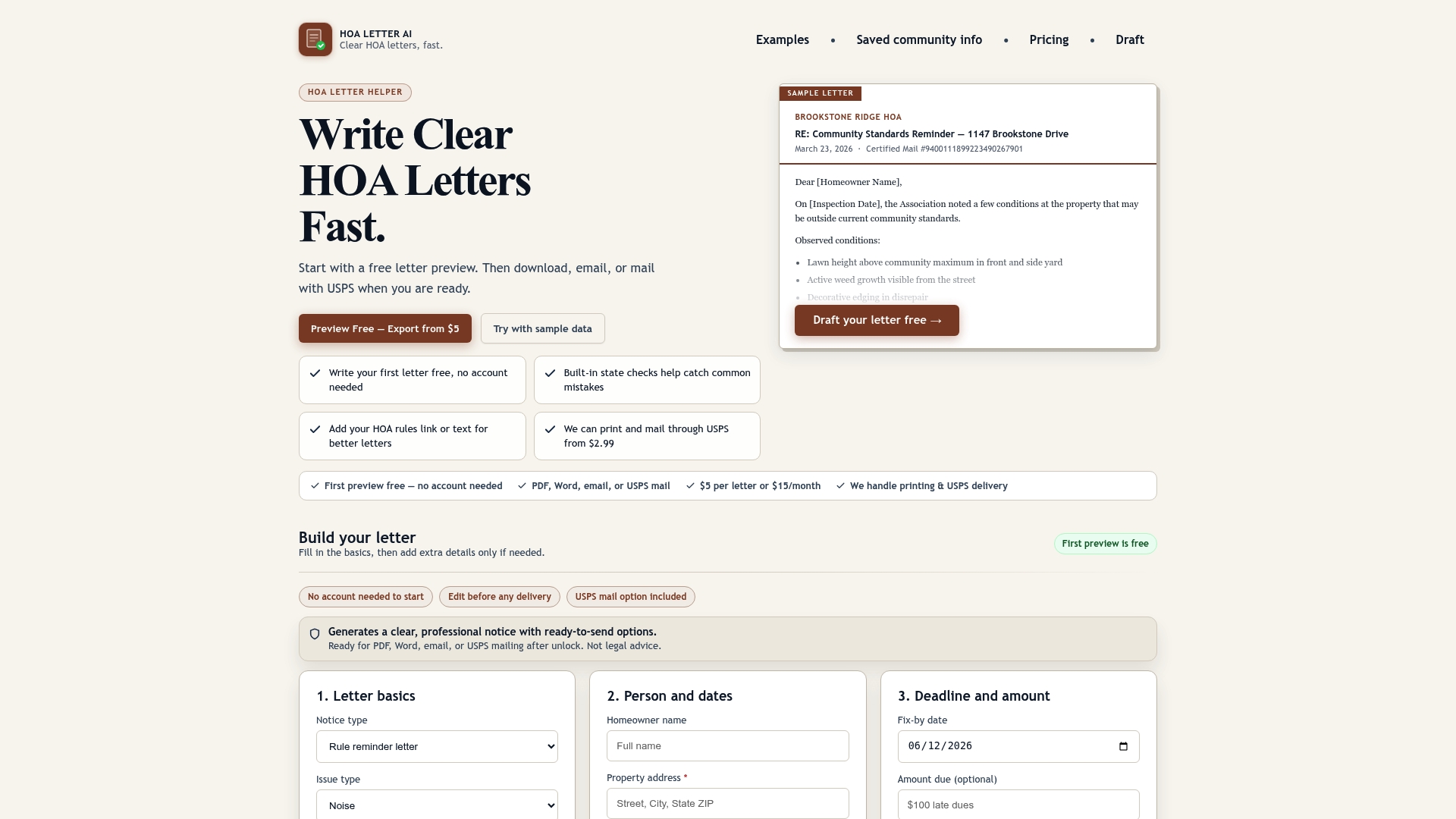
That is why our drafting is guided and state-aware. You choose the situation, the rule and the community details, and the letter is built with the citation, the cure period and the required notice language in place. Built-in checks flag mandatory language that may be missing before you send anything. You see a one-page preview first, free, with no account required.
We also think a letter should be readable by the person who receives it. A clear notice that names the rule, the fix and the next step gets resolved faster than a stern one that leaves the owner guessing. Branding gives the letter credibility, and clarity gives it a chance of working.
We price it plainly too: one clear price per letter, and optional mail delivery when you want us to handle the envelope.
Blake
Getting your branded letters out the door
Once the letter is drafted, delivery is the next place to lose time. Printing, folding, addressing and stamping a notice is where small boards fall behind. With HOA Letter AI you can export the finished letter, or add optional USPS mailing from the draft page, starting from $2.99 per mailing.
What suits you depends on how many notices you send:
- One-off notices. A single letter is $5, one time, and you see the preview before you pay.
- A volunteer board with regular notices. The self-serve board lane is $15 per month.
- Property management teams. PM Starter is $199 per month and PM Pro is $399 per month, and a 30-day PM Pilot is $499 one time. Details are on the property managers page.
- Homeowners replying to a notice. A response letter is $5 one time, so you can answer an HOA formally and clearly.
You can compare everything on the pricing page.
Try a branded letter before you pay
Open the HOA violation letter generator, enter your community and state, and see a one-page preview. If it reads the way you want, unlock it for $5. If you run a portfolio, start with the property manager plans.
What owners notice first
Owners rarely read statutes, but they do notice patterns. A consistent header tells them the notice came from the association. A specific rule citation tells them it is not personal. A clear deadline and hearing path tell them they will be heard. Our piece on why homeowners need readable violation letters goes deeper on that experience.
If your community is moving to a standardized format, roll it out in this order: adopt the header and signature block first, then the courtesy reminder, then the formal notice, and finally the hearing notice with your state’s required language. That sequence lets volunteers get comfortable before the higher-stakes letters come into play. Keep a shared list of rule citations so every author pulls from the same source.

FAQ
Does an HOA letter need a logo to be official?
No. What makes a notice official is the association’s correct legal name, an authorized signer, accurate rule citations and the content your documents and state law require. A logo adds recognition, but the name, date, contact and signature carry the weight.
Who should sign a branded HOA letter?
Common practice is for the board president or an authorized designee to sign, with the manager’s contact details included when a management company is involved. Check your bylaws for who may act on the board’s behalf, since some documents restrict this.
How long should the deadline be in an HOA violation letter?
Cure periods often run 10 to 30 days, and one community enforcement manual calls for at least 15 calendar days for a first notice. The right number depends on the violation, your governing documents and state law, so use your attorney’s guidance for fines and hearings.
Can I use the same letter template in every state?
You can keep the same look, but the notice content should change with the state. California, Florida and Texas each set different timing and delivery requirements before discipline, so confirm the current rules for your state before sending.
Can homeowners reply with a formal letter?
Yes. An owner who disagrees with a notice or has fixed the issue can send a clear written response. HOA Letter AI offers an editable homeowner response letter for a one-time $5.
Sources
- The HOA Handbook: How to write an HOA violation letter
- Siegfried Rivera: Effective association violation letters
- St. Louis County: Sample violation letter
- Babcock Ranch Residential Association: Covenant enforcement manual
- CAI Foundation: Best practices in governance
- FTC: Plain writing
- California Civil Code 5855
- Florida Statutes 720.305
- Texas Property Code chapter 209
- Roaring Fork Preserve enforcement policy
- Goodwin: How to craft an effective HOA violations letter