
An authoritative HOA letterhead needs five things at minimum: the full legal association name, a monitored mailing address, a phone number, a professional email, and the date and document title on every notice. Official letterhead is expected, not optional, for violation notices, assessment demands, liens, and any legal correspondence. Newsletters and casual reminders don’t carry the same requirement.
TL;DR:
- The full legal HOA name must match formation documents, including any corporate designator, to ensure notice validity.
- The monitored mailing address should be checked regularly and not simply a registered agent’s address, to facilitate homeowner responses.
- USPS mail formatting rules require address left-justification, correct ZIP codes, and avoidance of logos or graphics in barcode zones to ensure proper mail sorting.
- Official letterhead is necessary only for notices with legal weight, such as violations, assessments, or liens, while casual updates can be sent without it.
- Regular updates after board elections, management changes, or contact information shifts are essential to maintain compliance and prevent disputes.
HOA Letter AICreate Clearer HOA Compliance LettersHOA Letter AI combines guided drafting, state-specific context, community rules, and built-in checks for professional compliance notices.Create an HOA letter
Table of Contents
- HOA Letterhead Requirements: What to Include on Official Stationery
- Why State Law and Governing Documents Drive the Rules
- USPS Formatting Rules That Shape Your Letterhead Layout
- Design Best Practices for Readable, Mailable Letterhead
- When Does an HOA Need Official Letterhead vs. Email?
- How Often Should You Update HOA Letterhead?
- HOA Letterhead Template You Can Copy
- Getting Letterhead Right With Less Guesswork
- Why Letterhead Consistency Matters More Than Design
- Draft State-Aware HOA Letters Without Starting From Scratch
- Sources
- FAQ
HOA Letterhead Requirements: What to Include on Official Stationery
Before you touch fonts or logos, get the identification fields right. This is where most boards trip up, usually by grabbing whatever address is on file with the state instead of one someone actually checks.
Start with the full legal name exactly as it appears in your formation documents, including the corporate designator (Inc., Association, Corp.) if your articles of incorporation use one. A shortened or informal version of the name on a violation notice can become an argument point if a homeowner later disputes the letter’s validity.
Your mailing address needs to be monitored, not just official. A registered agent’s address exists for legal service of process. It is not built for receiving homeowner responses, and using it as your primary contact address on letterhead can delay replies and complicate enforcement timelines when a deadline is running.
Here’s the essential checklist:
- Full legal HOA name, matching formation documents
- Monitored mailing address (not a registered agent unless someone actively checks that mailbox)
- Phone number and professional email address
- Website, if the association maintains one
- Optional: logo or seal in a print-friendly format
- Optional: entity type and state of incorporation, EIN, and management company contact
Skip listing individual board officer names in the permanent header. Boards turn over every year or two, and a header with an outdated president’s name looks sloppy at best and raises questions about authority at worst. Put officer names and titles in the signature block instead, where they naturally update letter by letter.
Why State Law and Governing Documents Drive the Rules
There’s no single federal letterhead law for HOAs. What actually governs your notices is a mix of your state’s statutes and your association’s own governing documents, and the two don’t always say the same thing.
Arizona’s ARS 33-1242 is a useful example of how specific state rules can get. It requires that a violation notice include an address for the homeowner’s certified-mail response, along with required content and response timelines. Miss that address field or get it wrong, and you risk invalidating the enforcement step that follows, since the statute ties the response window directly to that address.
This is also why identification accuracy matters beyond appearances. According to LegalClarity’s overview of letterhead rules, no single federal law dictates every business’s letterhead content, but state corporate statutes and certain federal rules, like CAN-SPAM’s requirement for a valid postal address in commercial email, fill the gaps. Industries like law and debt collection carry extra disclosure requirements on top of that baseline.
A few practical warnings worth keeping in mind:
- A mismatch between your letterhead name/address and your formation records gives a contesting homeowner an opening.
- Attorneys and debt collectors face additional federal disclosure rules that HOAs generally don’t, but the underlying principle (accurate identification protects enforceability) applies to everyone.
- For contested notices, liens, or anything headed toward legal action, run the letter by counsel before it goes out.
USPS Formatting Rules That Shape Your Letterhead Layout
If your letters get mailed, USPS rules for mailpiece formatting directly constrain how you design the header and address block. This isn’t a suggestion. Machine sorting depends on it.
The Domestic Mail Manual specifies a minimum 8-point type size for addresses, with sans-serif fonts preferred and dark ink on a light background for scanability. Your return address belongs in the upper-left corner, and USPS reserves a barcode clear zone on the address side of the envelope or mailpiece where nothing else should print.
For letterhead that will end up in an envelope window or on a mailed page, a few habits keep you compliant:
- Left-justify the recipient address block
- Use two-letter state abbreviations and full ZIP+4 codes where available
- Keep logos, watermarks, and decorative elements out of the barcode clear zone
- Follow USPS addressing conventions for element order and return-address placement, especially for any bulk mailings
Get this wrong and you’re not risking a legal problem so much as a delivery one. A notice that never machine-sorts correctly can sit in a processing facility while your response deadline ticks down.
Design Best Practices for Readable, Mailable Letterhead
Good HOA letterhead design isn’t about looking fancy. It’s about staying legible, staying scannable by USPS equipment, and staying out of your own barcode zone.
Keep your header to about 1.5 to 2 inches of vertical space. Anything taller starts crowding the address block and risks bumping into mailability zones lower on the page. Leave generous whitespace around the header so the address area and barcode clear zone stay untouched, no matter where the letter physically sits in an envelope.

For fonts, stick with something clean and OCR-friendly, Arial or Calibri both work well, and avoid decorative or script typefaces anywhere near the address. Contrast matters too: dark text on white or very light backgrounds reads clearly both to a human and to a sorting machine.
Logo placement deserves its own thought:
- Use a single-color or simplified logo version for print, since full-color logos can wash out on a home printer or in a low-resolution scan
- Keep the logo away from the top-right and bottom-right corners, where barcode zones typically sit
- Reserve board officer names and management company contact details for the signature block, not the header
Pro Tip: Print a test letter and fold it into the envelope you actually use. If any header element lands inside the window or the barcode zone, fix the layout before you print a full batch.
For a deeper walkthrough of header sizing and logo placement, see this HOA letter formatting guide.
When Does an HOA Need Official Letterhead vs. Email?
Not every message needs the full formal treatment. The line is whether the communication carries legal weight or just informs.
Use official letterhead for violation notices, assessment demands, liens, policy amendments, formal demand letters, and any correspondence tied to a legal process or deadline. These are the standardized notice types where governing documents and state statutes expect a formal, identifiable source.
Reserve informal channels, email blasts, community bulletin boards, newsletters, casual reminders, for exactly that: casual communication with no enforcement weight behind it.
One habit worth breaking if your board still does it: sending formal HOA notices on the management company’s letterhead. It blurs who actually issued the notice, and homeowners sometimes respond to the vendor instead of the association, which can stall the very response the notice was trying to trigger. Reporting on management company disputes has documented exactly this kind of confusion playing out in real communities.
How Often Should You Update HOA Letterhead?
Letterhead isn’t a set-it-and-forget-it document. Treat updates like any other governance task with a schedule and an owner.
- Review after every board election. New officers mean the signature block changes, even if the header doesn’t.
- Review after management company changes. Contact info and sometimes the mailing address will shift.
- Update immediately when contact details change, phone, email, or mailing address, rather than waiting for the next scheduled review.
- Set a minimum annual review, even with no obvious changes, since outdated letterhead invites disputes from owners claiming improper notice.
- Require board sign-off on changes and archive dated copies of every version you’ve used.
Before sending anything formal, a 30-second check (correct legal name, monitored address, authorized signer, current date) catches most letterhead mistakes before they become someone’s legal argument.
HOA Letterhead Template You Can Copy
You don’t need custom design work to get this right. A clean, compliant template covers the same ground every time.
Structure it like this: header with name/address/phone/email, date line, recipient block (homeowner name and property address), a clear subject line stating what the letter is (Violation Notice, Assessment Demand, etc.), a brief opening paragraph, the body content, a signature block with officer name and title, and a cc/attachments line if relevant.
Before any formal letter goes out, run this pre-send check:
- Confirm the legal name matches formation documents
- Confirm the mailing address is monitored, not a static registered agent address
- Confirm the signer is currently authorized (post election changes, this slips)
- Confirm the date and document title are both present and correct
Most boards do well maintaining three master versions: a full formal template for legal notices, a simplified version for routine communications, and an email signature block that mirrors the same contact information. For layout specifics on formal notices specifically, this formatting standards guide walks through the same structure in more depth.
Getting Letterhead Right With Less Guesswork
Building compliant letterhead from scratch, and then remembering to update it every election cycle, is exactly the kind of task that falls through the cracks on a volunteer board. Some software tools build state-aware templates directly into the drafting process, so the notice-type rules and required fields for your state show up automatically instead of living in someone’s memory.
Such platforms may provide a notice-completeness check before you send, flag missing required language, and give you a one-page preview so you can catch formatting problems before they become mailing problems. If a letter needs to go out physically, optional USPS mail fulfillment handles that step too.
For jurisdiction-specific notice rules, the state-by-state violation letter guide breaks down requirements by state, including examples like California’s notice and fine rules. Boards can also check partner guidance like this outdoor compliance resource for related record-keeping practices.
Why Letterhead Consistency Matters More Than Design
Boards spend a surprising amount of time on logo color and font choice and almost none on whether the address field actually gets checked weekly. That’s backward. A beautifully designed header on top of a stale address is worse than a plain header with a monitored one, because the plain version actually does its job when a deadline matters.
The fix is boring but effective: add letterhead review to your standard post-election checklist, right next to updating signers on the bank account. It takes ten minutes and prevents the kind of dispute that turns a routine violation notice into a drawn-out argument about whether the homeowner was properly notified at all.
— Blake
Draft State-Aware HOA Letters Without Starting From Scratch
HOA Letter AI is the alternative to piecing together letterhead and notice language from old templates and guesswork. Instead of hunting down your state’s notice rules every time a violation comes up, the guided drafting process builds them into the letter as you go, with a free preview before anything gets finalized.
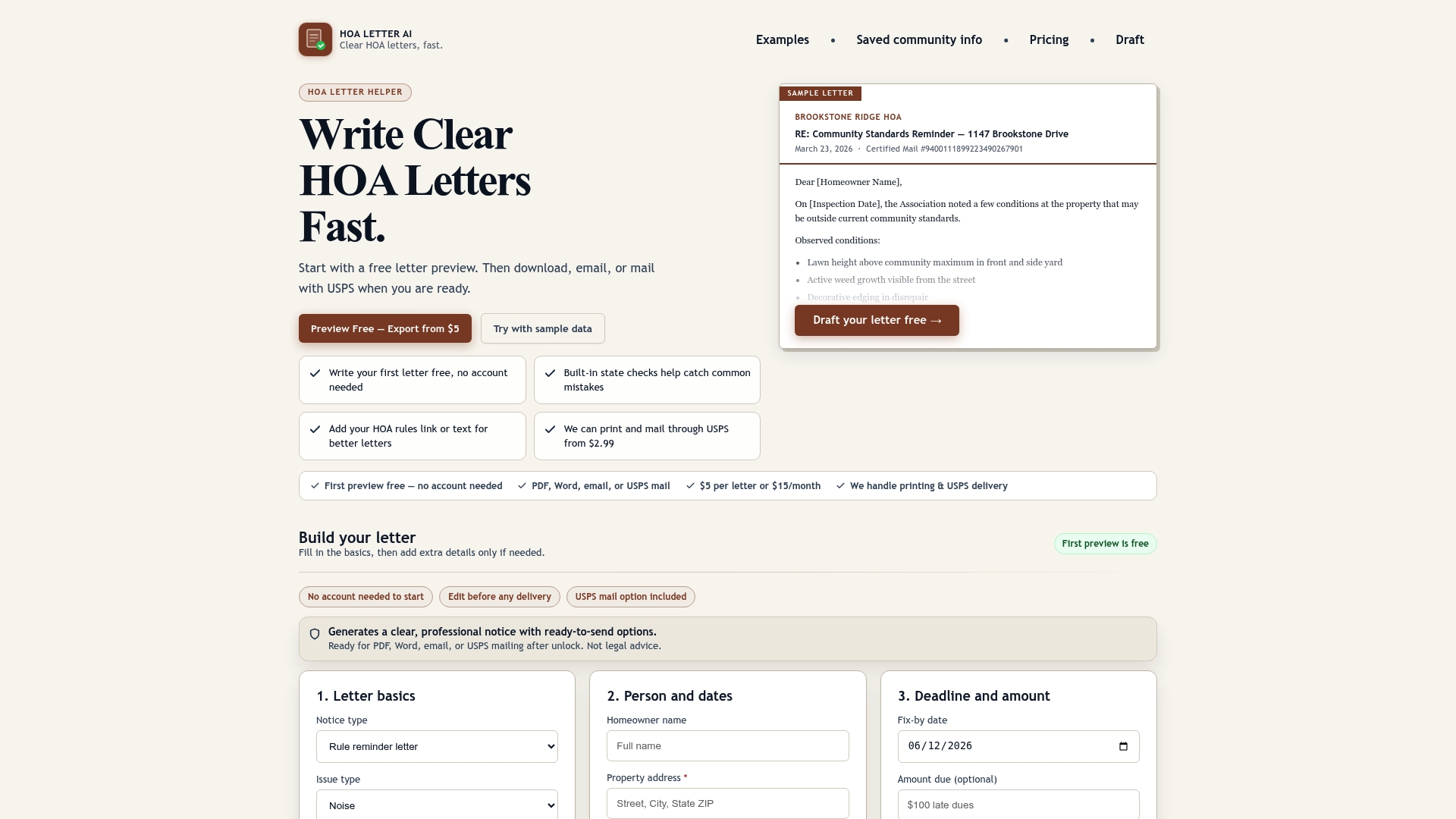
Boards handling occasional notices can use the $5 one-time letter option or the $15-per-month self-serve board lane for ongoing needs. Property management teams managing multiple communities have more room to grow into PM Starter at $199 per month or PM Pro at $399 per month, both built around reusable community profiles instead of rebuilding letterhead and rules for every client.
Try a free preview on your next notice, verify the fields match what your state requires, and decide from there whether the one-time letter or a monthly plan fits your board’s volume.
Sources
- DMM 202 Elements on the Face of a Mailpiece for Commercial Letters, Flats, and Parcels
- 33-1242 - Powers of unit owners’ association; notice to unit owner of violation
- Letterhead requirements: rules for every industry - LegalClarity
- HOA letterhead template | The HOA Guide
FAQ
What Is Legally Required on HOA Letterhead?
At minimum, letterhead should show the full legal association name, a monitored mailing address, and a way to respond, phone or email. Beyond that baseline, requirements depend on your state statutes and governing documents, since no single federal rule covers every association.
How Do You Write a Formal HOA Letter?
Start with the header identifying the association, add the date and recipient block, use a clear subject line stating the letter’s purpose, and close with a signature block naming the authorized signer. Formal letters, like violation notices or assessment demands, should always go out on official letterhead rather than informal email.
What Qualifies as Official HOA Letterhead?
Letterhead qualifies as official when it accurately reflects the association’s legal name and a monitored contact address, matching the association’s own formation and governing documents. A management company’s letterhead generally doesn’t qualify for HOA notices, since it can confuse homeowners about who issued the notice.
What Details Should Appear on HOA Letterhead?
The core fields are the full legal HOA name, monitored mailing address, phone number, and professional email, with a logo and website as common additions. Board officer names work better in the signature block than in the header, since officer turnover otherwise makes the letterhead outdated fast.
Can I Use HOA Letter AI to Generate Compliant Letterhead and Notices?
Yes. HOA Letter AI offers state-aware templates with a free preview, and pricing runs from a $5 one-time letter up to monthly plans for property managers on the PM Starter and PM Pro pages. Current pricing details are always listed on the site.