
A legal disclaimer in an HOA letter can manage expectations and clarify that a notice isn’t formal legal advice, but it does not substitute for state-required language, proper redaction, or a documented hearing process. Boards that lean on generic disclaimer wording instead of following statutes like Arizona’s A.R.S. §33-1807 or privacy rules tied to member records still carry legal risk. Some HOA letter tools build state-aware checks into their templates precisely because disclaimers alone leave gaps.
TL;DR:
- Disclaimers in HOA letters cannot replace mandatory statutory language or properly follow state-specific notice and hearing requirements.
- Proper placement and precise wording of disclaimers are crucial, ideally placed under the signature line and tailored for each notice type.
- Redacting sensitive homeowner data and choosing the correct delivery method are essential steps to ensure disclaimers remain effective and legally sound.
- Skipping procedural steps or using accusatory language exposes associations to legal risks despite disclaimers, especially in privacy or defamation matters.
- Using specialized HOA drafting tools can help generate state-aware drafts you review efficiently and reduce the risk of procedural mistakes.
HOA Letter AIDraft Clearer HOA NoticesCreate professional compliance letters with state-specific context, community rules, built-in checks, and delivery options in one guided workflow.Create an HOA letter
Table of Contents
- What Legal Disclaimers Can and Cannot Do in HOA Correspondence
- Sample Disclaimer Language and Where to Place It
- How State Statutes Change What You Must Include
- Redaction, Delivery, and Recordkeeping That Make Disclaimers Effective
- Where Boards Get Burned Despite Having a Disclaimer
- What I’d Tell Every Board Before Hitting Send
- Draft State-aware drafts you review Faster With HOA Letter AI
- Statutes and Practice Resources Referenced
- Sources
- FAQ
What Legal Disclaimers Can and Cannot Do in HOA Correspondence
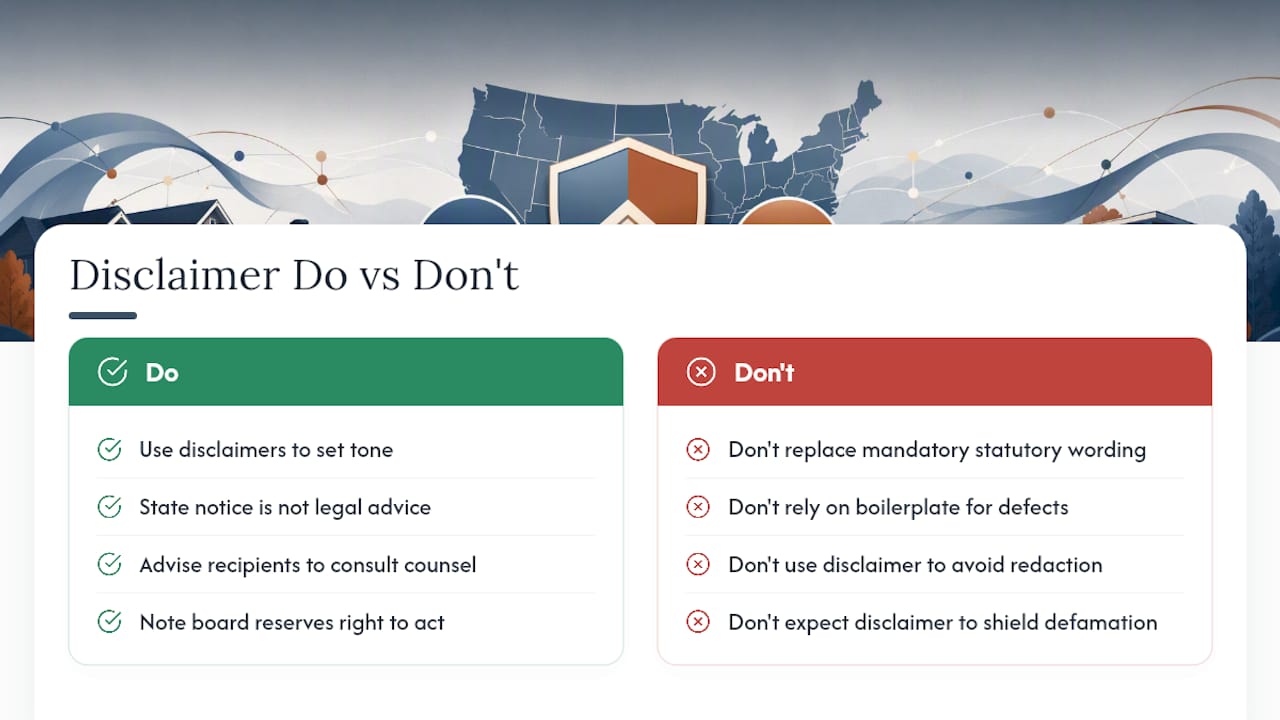
A disclaimer is a sentence or paragraph that tells a homeowner how to interpret a letter. It might say the notice isn’t legal advice, that the board reserves the right to pursue further action, or that recipients should consult an attorney. That’s informational language, and it’s genuinely useful for setting tone and limiting misunderstandings.
What it can’t do is replace mandatory statutory notice language. If your state requires specific wording, a hearing opportunity, or a delinquency statement written a certain way, no disclaimer fixes a letter that skips those steps. Courts routinely look past disclaimer boilerplate when a notice was procedurally defective, contained defamatory accusations, or exposed private member data. A privacy disclaimer, for example, doesn’t excuse an association that fails to redact sensitive information under statutes like California Civil Code §5205 or the inspection carve-outs in Texas Property Code §209.005.
Think of a disclaimer as a seatbelt, not an airbag. It reduces certain risks around interpretation and communication, but it won’t save you if the underlying notice process was built wrong from the start.
Sample Disclaimer Language and Where to Place It
Placement matters as much as wording. Most disclaimers belong directly under the signature block, in a smaller font but still legible, never buried in fine print that looks designed to be missed.
Here’s language you can adapt for common letter types:
- Violation notice footer: “This notice is provided pursuant to the Association’s governing documents and does not constitute legal advice. Homeowners with questions about their rights should consult independent counsel.”
- Final demand letter: “This letter serves as formal notice of delinquency under [state statute citation]. Failure to respond by [date] may result in additional fees, interest, or legal action as permitted by law.” Arizona associations should mirror the specific delinquency formatting called for under A.R.S. §33-1807(L).
- Hearing notice: “You have the right to attend and be heard at the scheduled hearing. This notice does not waive any procedural rights afforded under state law or the Association’s bylaws.”
- Newsletter privacy blurb: “Personal information shared in this newsletter has been redacted or summarized to protect homeowner privacy in accordance with Association policy.”
Avoid disclaimers so broad they contradict your CC&Rs or overstate the board’s authority. A line claiming the board can waive any state law protection is unenforceable, and it makes the association look like it doesn’t understand its own governing documents.
How State Statutes Change What You Must Include
Generic disclaimer templates fail the moment a state statute prescribes specific language, and several states do exactly that. Arizona is the clearest example: A.R.S. §33-1807(L) sets formatting and content requirements for final demand and delinquency notices, which means a board can’t just paste in boilerplate and call it compliant.
Privacy statutes create a second layer of complexity. California’s Civil Code §5205 allows associations to withhold or redact information that could enable identity theft or violate a member’s privacy, but it doesn’t give boards blanket discretion to hide records from legitimate inspection requests. Texas Property Code §209.005 carves out categories of member information that fall outside standard inspection rights, which is different from California’s framework in practice even though both aim at similar privacy goals.
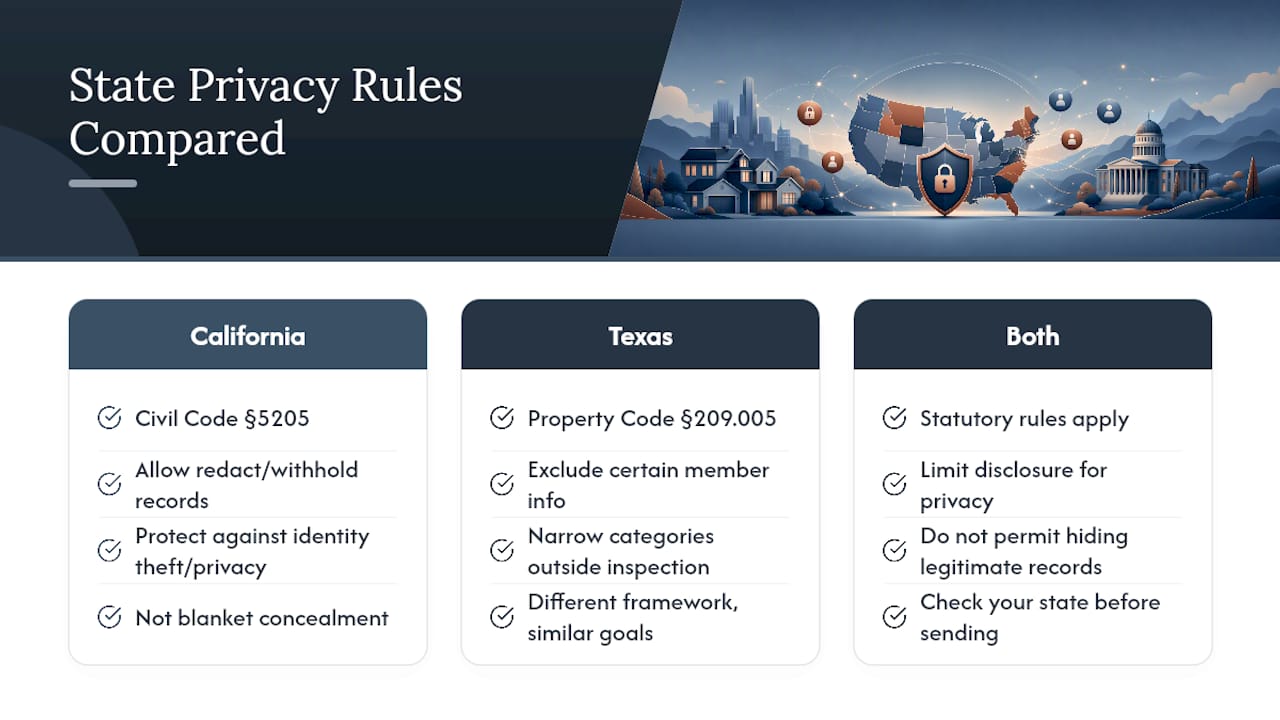
State statutes vary enough that no single disclaimer template covers every jurisdiction correctly. Before finalizing a notice, check your state’s specific HOA laws rather than assuming a neighboring state’s rules apply to you.
Redaction, Delivery, and Recordkeeping That Make Disclaimers Effective
A disclaimer only holds up when the process behind it is sound. That starts with redaction: strip Social Security numbers, bank account details, and sensitive complaint specifics from any letter or record a homeowner might see, while preserving enough context that the notice still makes sense. Associations that fail to redact properly can face liability for identity theft or privacy violations regardless of what disclaimer language sits at the bottom of the page.
Follow these steps before any notice goes out:
- Confirm which delivery method your state or governing documents require. Certified mail or hand delivery is often necessary; email alone frequently fails to create a verifiable record of service.
- Save the certified mail receipt or delivery confirmation with the homeowner’s file.
- Document board approval for enforcement action in meeting minutes before the letter is sent.
- Keep a redaction log noting what was removed and why, in case the decision is ever challenged.
- Require any third-party vendor handling homeowner data to sign a confidentiality clause.
Pro Tip: Run every notice draft through a checklist that flags state-specific requirements before it leaves your desk. A five-minute review catches missing statute citations or improper redactions that a rushed final read will miss.
Where Boards Get Burned Despite Having a Disclaimer
The biggest mistake is accusatory language. Calling a homeowner’s behavior “reckless” or “malicious” in a violation letter invites a defamation claim, and no disclaimer neutralizes that risk. Stick to facts: cite the exact CC&R section, describe the observed condition, and state the required corrective action.
Skipping hearing steps is another common trap. If your governing documents or state law require a hearing before a fine, sending a fine notice without one is unenforceable, disclaimer or not, and associations following a courtesy notice then formal warning three-step process tend to face fewer disputes.
Publishing sensitive details in a widely distributed newsletter, even with a privacy disclaimer attached, still exposes the association to claims. And individual board members remain personally exposed when notices are poorly worded or approved informally rather than through recorded board action.
What I’d Tell Every Board Before Hitting Send
Run this checklist before any notice leaves your hands: confirm the governing document section you’re citing, verify your state’s statutory language requirements, redact sensitive data, choose a delivery method that creates proof of service, document board approval in minutes, keep copies of everything, avoid subjective language, and double check hearing rights were honored.
Most enforcement disputes trace back to skipped steps, not bad intentions. Some state-aware templates and completeness checks exist to catch exactly these gaps before a letter goes out, which matters more than any disclaimer wording ever will.
— Blake
Draft State-aware drafts you review Faster With HOA Letter AI
Certain tools can help you get a compliant, well-cited notice in minutes instead of hours spent second-guessing whether your template matches state requirements. Some applications build state-specific context, governing-document citations, and completeness checks directly into the drafting process, so the checklist above happens automatically rather than resting on memory.
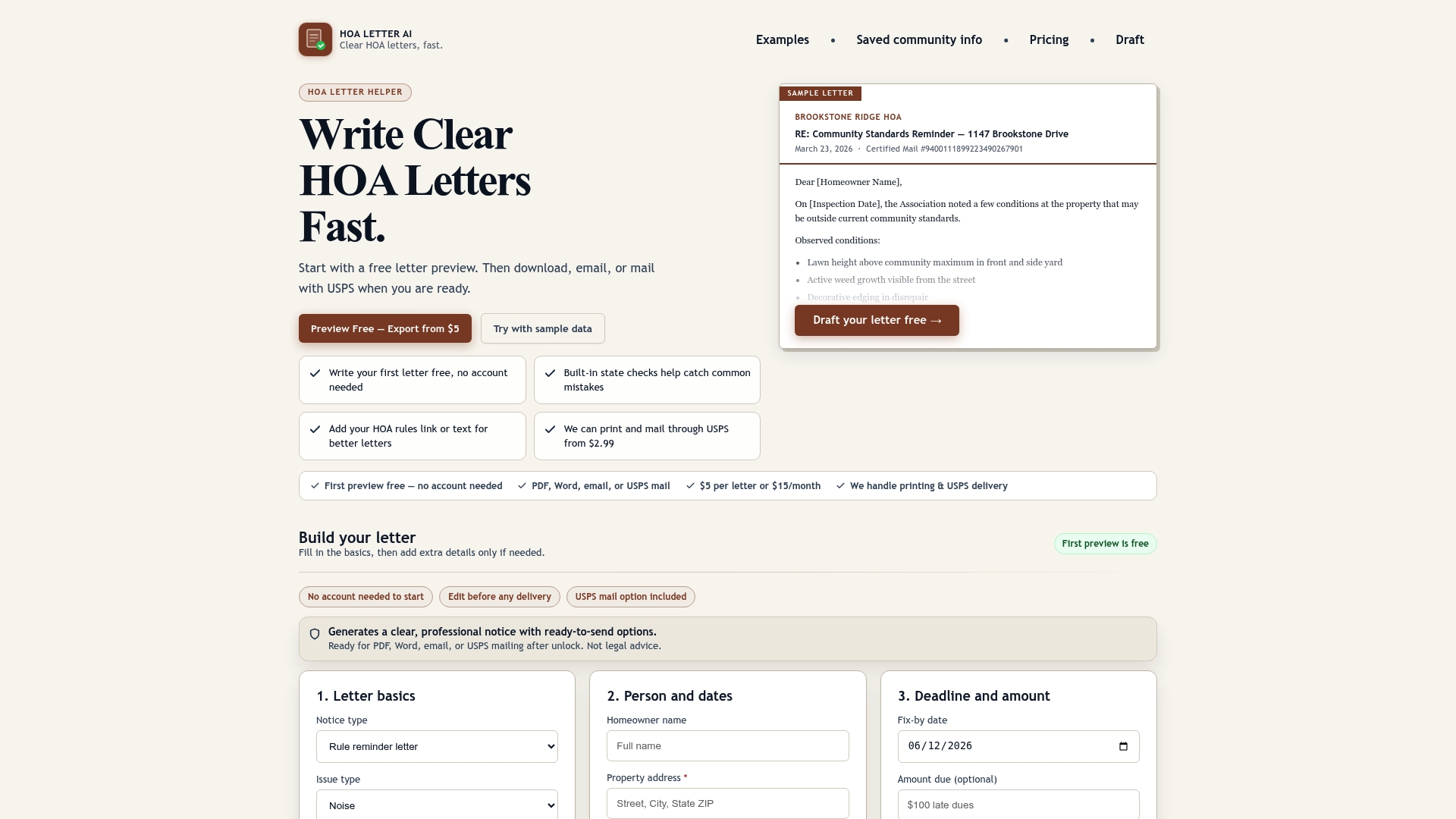
You still control the tone and the facts. Some tools flag missing elements, like a delinquency statement that doesn’t match your state’s format or a disclaimer placed where mandatory statutory language should be, and provide a one-page preview before anything gets mailed. For boards ready to stop reworking templates from scratch, start with the HOA warning letter template and generate your next notice today.
Statutes and Practice Resources Referenced
- Arizona Revised Statutes §33-1807 — final demand and delinquency notice requirements
- HOA data privacy responsibilities — redaction and disclosure balance
- HOA violation letter template guidance — enforceable notice structure
- HOA liability for data breaches — privacy exposure and board duties
This article is general information, not a substitute for advice from a qualified lawyer. Consult a qualified legal professional about your own circumstances before acting on anything here.
Sources
- HOA liability for data breaches and cyber attacks | LS Carlson
- Free HOA Violation Letter Template | Zorex
- Arizona Revised Statutes §33-1807
FAQ
Can You Provide an Example of a Legal Disclaimer?
A common example reads: “This notice is provided pursuant to the Association’s governing documents and does not constitute legal advice.” It sets expectations but doesn’t replace statutory language your state may require.
How Do You Write an HOA Violation Letter?
Cite the exact CC&R or rule section violated, describe the observed condition factually, state the required corrective action and deadline, and follow any state-mandated notice or hearing steps before adding disclaimer language. Tools like HOA Letter AI build these elements into a guided draft so nothing gets skipped.
Can an HOA Board Member Be Sued Personally?
Yes. Board members can face personal liability when notices contain defamatory language or when enforcement skips required procedural steps, regardless of any disclaimer attached to the letter.
Do Disclaimers Hold Up in Court?
Disclaimers hold up for their intended purpose, clarifying that a letter isn’t legal advice, but courts routinely disregard them when the underlying notice was procedurally defective or violated privacy or defamation law.