
A community profile template is a single reusable record storing owner contacts, board member details, CC&R citations, and notice preferences, so a board can generate a compliant notice in minutes instead of reconstructing facts from scratch every time. It replaces the scramble through spreadsheets, old emails, and someone’s memory of “which section covers parking violations.” Boards that keep one live profile per property send faster notices, produce cleaner audit trails, and stand on firmer ground if a homeowner challenges a fine in a hearing.
TL;DR:
- Maintaining an accurate, updated community profile ensures notices contain correct contact information, rule citations, and notice preferences, reducing legal risks.
- Building the profile from initial data sources and assigning a dedicated owner helps prevent outdated addresses, missing consent, or incorrect citations.
- Notices must include specific content like rule citations, observation dates, and clear deadlines, with the profile auto-filling key elements from stored data.
- Delivery proof, whether via certified mail or electronic tracking, is essential for legal compliance and should be retained for at least five to seven years.
- HOA letter tools use profiles to automatically generate compliant notices, streamlining the process and minimizing manual errors.
HOA Letter AICreate Clearer HOA NoticesHOA Letter AI helps you draft professional compliance letters with guided context, community rules, built-in checks, and delivery options.Create an HOA letter
Table of Contents
- What Fields Belong in Your HOA Community Profile Template
- How Do You Fill Out and Maintain an HOA Profile?
- What Must a Notice Actually Contain?
- How Should You Deliver Notices and Prove You Sent Them?
- What a Reusable Profile Actually Fixes
- Where HOA Letter AI Fits Into Your Template
- Where to Check State Rules and Mailing Requirements
- Sources
- FAQ
What Fields Belong in Your HOA Community Profile Template
A workable community profile template splits into five field groups. Skip one and the notices you generate later will have gaps that come back to bite you during a hearing or a legal review.
- Contact block: association legal name, official mailing address, designated posting location (bulletin board, website, or newsletter), and board officer names with roles and direct contact information.
- Unit and owner record: unit ID, owner name, owner mailing address, an alternate mailing address, tenant name and contact if the unit is rented, and the closing or transfer date.
- Governing document citations: the specific CC&R or bylaw section number, a short quoted excerpt, and a hyperlink to the full document when one exists. This is what turns a vague warning (“you’re violating the rules”) into a defensible one (“Section 4.2(b), pet waste disposal”).
- Notice preferences and consent flags: whether the owner has given electronic consent (yes or no, with the date recorded), and their preferred delivery method.
- Notice defaults and metadata: default cure period length, the fine schedule reference tied to that violation type, and a timestamp showing when the record was last updated and by whom.
That last group matters more than most boards realize. A default cure period field means nobody has to guess whether a first violation gets 10 days or 30. It’s already sitting in the profile, pulled straight from your CC&Rs.
How Do You Fill Out and Maintain an HOA Profile?
Building the profile once is the easy part. Keeping it accurate is where most boards fall behind, usually because nobody owns the job. Follow this sequence to get it right from the start.
- Pull initial data from three sources: closing documents from the title company, county parcel records for legal descriptions and mailing addresses, and a management intake form the new owner fills out at closing.
- Assign a single owner of the data, typically the property manager or a designated board secretary. Two people editing the same profile without coordination is how addresses go stale.
- Capture electronic consent properly. Under the E-SIGN Act and applicable state statutes, a valid consent record needs a dated signature or a portal-logged acceptance, not a verbal “sure, email is fine.” Treat any later opt-out as an automatic trigger to revert that owner to physical mail.
- Run an annual audit of every profile, cross-checking mailing addresses against returned mail logs and updating tenant information for rental units.
- Build a new-owner onboarding checklist so the intake form gets completed at closing, not three months later when the first notice bounces.
- Define a role matrix: who can edit fields, who signs affidavits of mailing, and who has final approval on notice text before it goes out.
Associations aren’t required to chase down owners who move without telling anyone. The obligation is to mail to the owner’s last known address on file, which is exactly why an alternate mailing address field earns its place in the profile. It’s the cheapest insurance you can build into a template.
Pro Tip: Require the alternate mailing address field at purchase closing, not later. Owners are far more responsive to a form request from their title company than to a follow-up email from the HOA six months after they’ve moved in.
What Must a Notice Actually Contain?
A profile is only as useful as the notices it produces, and each notice type has its own non-negotiable content.
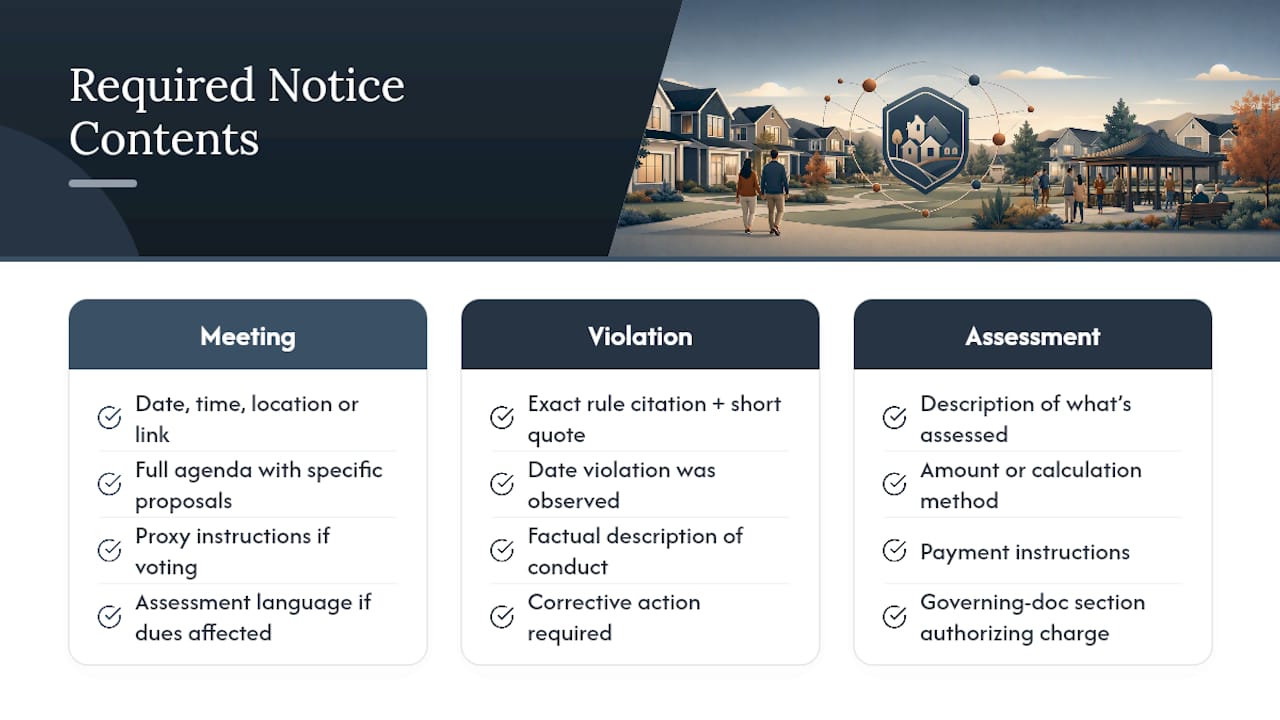
Meeting notices need the date, time, and location or virtual link; a full agenda with specific proposals (not “general business”); proxy instructions if voting is involved; and assessment language when a vote touches dues. California’s Davis-Stirling framework requires members receive notice at least four days before a board meeting unless governing documents set a longer window, and the agenda itself is mandatory, not optional.
Violation notices carry more legal weight and need more precision: the exact rule citation (section number plus a short quote), the date the violation was observed, a factual description of what happened, the corrective action required, a specific cure deadline stated as a calendar date rather than “promptly,” the hearing-request procedure, and the fine or escalation schedule that applies if the issue isn’t resolved.
Assessment notices need a description of what’s being assessed, the amount or the calculation method behind it, payment instructions, and the governing document section authorizing the charge.
The profile does the heavy lifting here because most of these items are fields, not fresh research. Owner name and mailing address auto-populate from the unit record. Rule citation and default cure period pull from the governing-document block. A violation notice checklist built around these fields keeps a board from ever sending a notice missing a required element, and a documented hearing notice template shows how the same data maps into an enforcement hearing invitation.
How Should You Deliver Notices and Prove You Sent Them?
Delivery method depends on notice type and what your governing documents require, but the underlying rule is consistent: whatever method you choose, you need contemporaneous proof it happened.
- First-Class Mail works for routine notices where governing documents don’t require certified delivery, but it leaves you with no tracking if a homeowner claims they never received anything.
- Certified Mail with USPS Form 3800 (certificate of mailing) or Form 3811 (return receipt) gives you a paper trail tied to a specific date and tracking number, which matters most for violation and fine notices that could end up in a hearing.
- Electronic delivery requires documented consent under the E-SIGN Act and applicable state statutes; some notice types still require physical mail regardless of consent, so track preferences per notice category, not just per owner.
- Affidavits of mailing should record the date mailed, every address the notice went to, the delivery method, tracking numbers, and who prepared it, ideally signed by that preparer.
- Outsourced mailing fulfillment can handle Certified Mail preparation and return certified proof of mailing, which reduces the administrative load for boards sending volume notices but adds a per-piece cost worth weighing against your notice volume.
Retention guidance commonly recommends keeping notice and mailing records for 5 to 7 years to support any future hearing or legal challenge. Attach the mailing proof directly to the unit record in your profile rather than filing it separately. A documented mailing trail is worth more than the notice itself if a dispute ever lands in front of a judge or arbitrator.
What a Reusable Profile Actually Fixes
The failures I see repeated across boards aren’t complicated: an address nobody updated after a sale, a consent that was verbal and never logged, a rule citation pulled from memory instead of the actual CC&R section. Every one of those is a five-minute fix once the field exists in a profile. Notice drafting works best when built around a structure of reusable profiles, state-aware wording, and delivery tracking, because the notice is only as good as the record behind it. Start small: require the top 10 fields at onboarding rather than trying to backfill every unit at once.
— Blake
Where HOA Letter AI Fits Into Your Template
Some HOA letter tools use a structure involving a reusable profile per community that stores contacts, board members, CC&R citations, and notice preferences, then feed that data into state-aware notice drafts. Profiles save information like owner addresses and rule citations to carry forward automatically, often with previews before notices are sent.
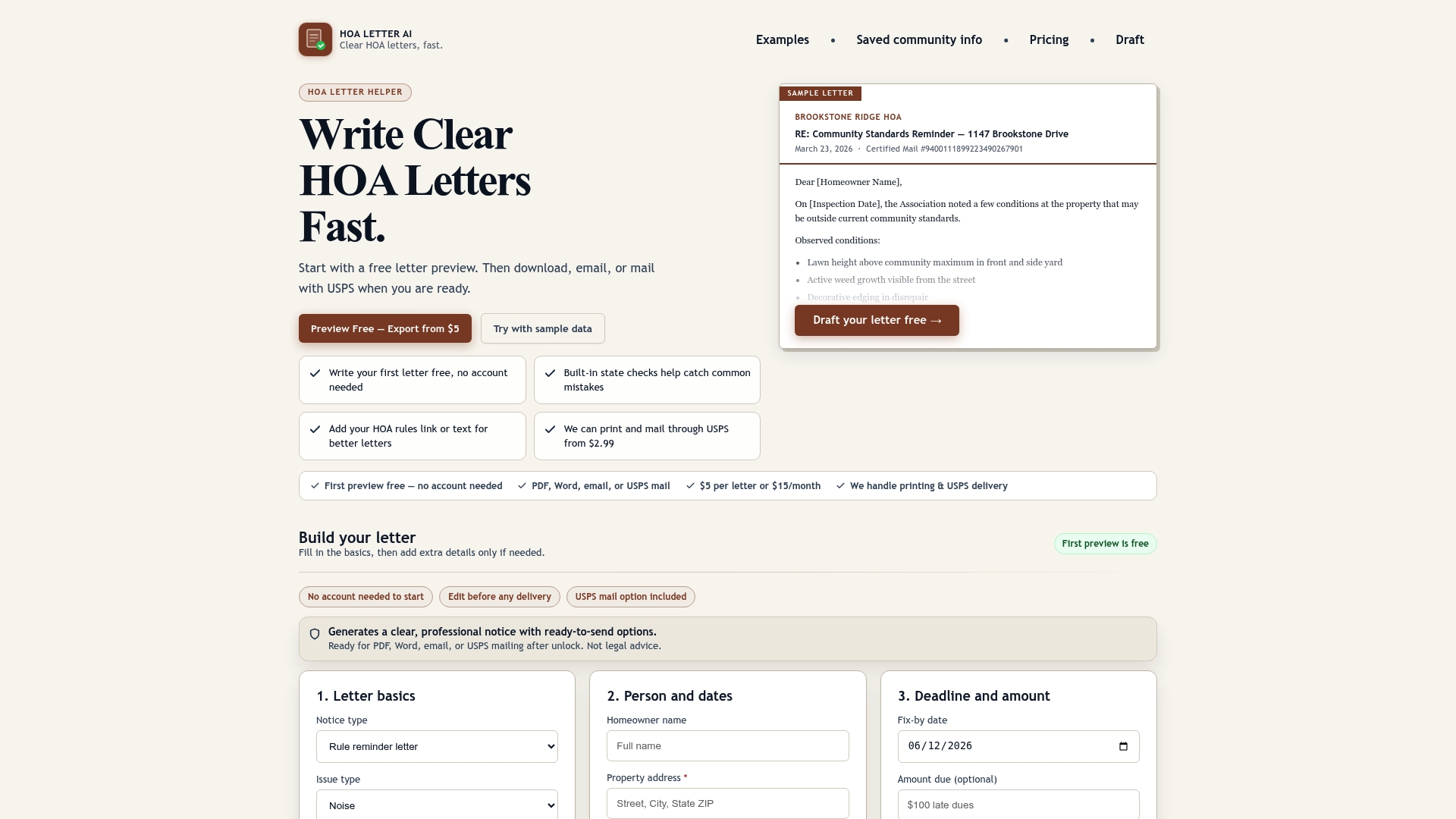
If you’re managing a single association, start with the HOA warning letter template to see how a courtesy notice pulls fields directly from a profile before escalating to fines. Property managers running multiple communities can check the pricing page for unlimited letter generation across properties, and boards unsure what their state actually requires should review state-specific violation letter rules before finalizing a cure deadline. Consider trying a free preview on your next notice to see how many fields a profile can fill in automatically.
Where to Check State Rules and Mailing Requirements
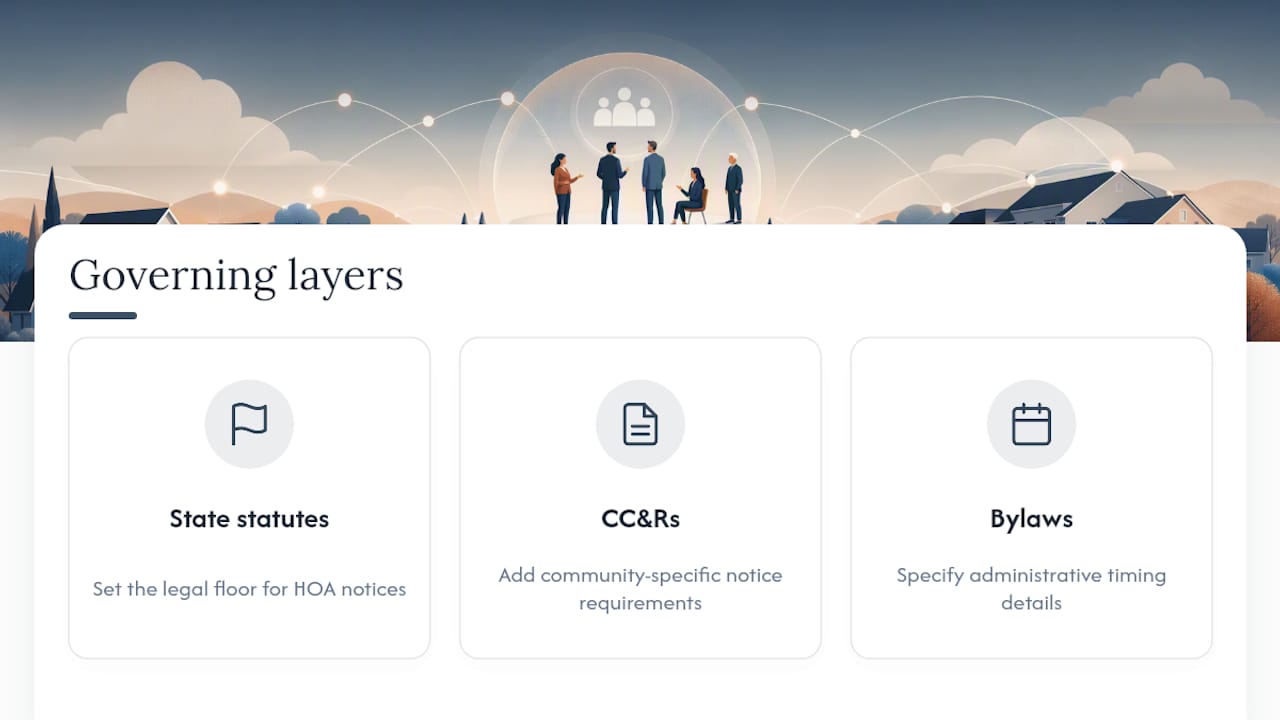
Governing authority for HOA notices runs in three layers: state statutes set the floor, CC&Rs add community-specific requirements on top, and bylaws fill in administrative timing details. Davis-Stirling’s board meeting notice guidance is a solid reference point even outside California for understanding agenda and timing norms. For mailing mechanics, review guidance on Certified Mail documentation and best practices for fair violation tracking. Boards drafting governance policy from scratch may also find a primer on association structure useful for understanding how bylaws and CC&Rs interact legally.
Sources
- HOA Notice Delivery Methods: Rules and Requirements - LegalClarity
- HOA Board Meeting Notice & Agenda
- HOA Violation Letter Mailing: Rules, Certified Mail & Documentation
- HOA Violation Tracking: How to Run a Fair, Consistent Enforcement Process | AffordableHOA
FAQ
What Is an HOA Community Profile Template?
It’s a reusable record per association or unit that stores contact information, board members, CC&R citations, mailing addresses, and notice preferences, used to auto-populate compliant notices instead of drafting each one from scratch.
Do I Need Separate Profiles for Each Unit or One per Community?
Both: keep one association-level profile for board contacts and governing-document citations, and a separate owner record for each unit covering mailing address, tenant information, and consent status.
How Long Should We Keep Mailing Records?
Guidance commonly recommends retaining notice and mailing proof for 5 to 7 years so records are available if a hearing or legal challenge arises later.
Can We Send Violation Notices by Email?
Only with documented consent under the E-SIGN Act and your state’s statutes, and even then some notice types still require physical mail regardless of consent on file.
How Does HOA Letter AI Use the Profile Data?
HOA Letter AI pulls contact, mailing, and rule-citation fields from a saved community profile to auto-populate state-aware notice drafts, with a preview step before the letter is finalized or sent.