An HOA (or condominium) questionnaire is a lender-requested project certification used to verify an association’s finances, governance, insurance, and project completion for mortgage underwriting. The archetype is Fannie Mae’s Form 1076, the Condominium Project Questionnaire, which lenders submit to HOA boards or management companies before approving a conventional mortgage on a condo or planned community unit.
What to do right now, based on your role:
- Borrower: Ask your lender which questionnaire form they need, then contact your HOA or management company immediately to confirm they have it and know the deadline.
- Lender: Confirm the return deadline in writing when you send the request, and specify which attachments (reserve study, insurance declarations, litigation documents) you need alongside the completed form.
- HOA board or manager: Pull your reserve study, current financial statements, insurance declarations page, and any pending litigation files before you open the form. You will need all of them.
Key Takeaways
An HOA questionnaire is a project certification that can determine whether any buyer in your building can obtain conventional financing, making accuracy and speed equally important.
| Point | Details |
|---|---|
| Form 1076 is the standard | Fannie Mae’s Form 1076 is the project-level questionnaire lenders use for conventional loan eligibility review. |
| Red flags that stop loans | Delinquency above 15%, pending structural litigation, underfunded reserves, and excessive commercial space are the most common hard stops. |
| Turnaround and fees matter | Lenders typically set a 5–10 business day return window; HOAs may charge a processing fee that the borrower usually covers. |
| Gather documents first | Reserve study, insurance declarations, bank statements, and litigation files should be assembled before opening the form. |
| HOA Letter AI speeds prep | HOA Letter AI’s completeness checks and reusable community profiles reduce rework and help boards respond faster and more accurately. |
Table of Contents
- What exactly is an HOA questionnaire?
- What sections does a typical HOA questionnaire cover?
- How do lenders use questionnaire answers to make underwriting decisions?
- How long does the process take, and who pays for it?
- How should HOA boards and managers fill out the questionnaire?
- Where do you find Form 1076 and how do lenders use it?
- Why accurate questionnaires protect everyone involved
- HOA Letter AI helps boards and managers prepare faster, with fewer errors
- Sources
What exactly is an HOA questionnaire?
The term “HOA questionnaire” covers two distinct categories that often get conflated, and knowing which one applies saves everyone time.
Project-level questionnaires are what lenders mean when they say “HOA questionnaire” in a mortgage context. Fannie Mae’s Form 1076 is the standard. It asks about the entire condominium project or planned community, not just the unit being purchased. Freddie Mac uses its own equivalent form, and FHA/HUD has separate approval requirements. The lender sends this form to the HOA or management company, which completes and returns it. A board member or authorized manager typically signs it.
Unit-specific lender questionnaires are shorter forms some lenders use for individual unit review, covering things like monthly dues, special assessments on the subject unit, and whether the unit owner is current on dues. These are narrower in scope than Form 1076.
HOA membership and application forms are entirely different animals. A homeowners association membership form collects owner contact information, meeting notice preferences, and membership fee acknowledgment. No lender uses this for underwriting. It is an administrative document, not a project certification.
| Form Type | Who Requests It | Who Completes It | Primary Purpose |
|---|---|---|---|
| Fannie Mae Form 1076 (project-level) | Mortgage lender | HOA board or management company | Conventional loan project eligibility |
| Freddie Mac equivalent | Mortgage lender | HOA board or management company | Conventional loan project eligibility |
| FHA/HUD condo approval | Lender or HOA | HOA board or attorney | Government-backed loan eligibility |
| Unit-specific lender questionnaire | Mortgage lender | HOA or management company | Individual unit due diligence |
| HOA membership/application form | HOA board | Homeowner/buyer | Administrative membership record |
FHFA oversight of Fannie Mae and Freddie Mac is what drives lenders to enforce these project eligibility checks uniformly. When the regulator sets the standard, lenders have little flexibility to waive it.
What sections does a typical HOA questionnaire cover?
Form 1076 and the lender questionnaires that mirror it follow a consistent structure. Here is what each section asks, and which answers tend to stop a loan in its tracks.
Project identification and completion status
Basic project data: name, address, total number of units, number of units sold and closed, number of units under construction or not yet built. Lenders want to know the project is substantially complete. A project with a relatively low percentage of units sold and closed often triggers additional review or a limited review waiver requirement.
Owner-occupancy and unit ownership
How many units are owner-occupied versus investor-owned? Fannie Mae’s standard guidelines generally require a moderate level of owner-occupancy for established projects. A project with heavy investor concentration raises default-risk flags, and some lenders apply stricter thresholds than the agency floor.
Financial health and reserve funding
This section asks for the association’s annual budget, total reserve balance, and whether the reserve fund is adequately funded. Lender questionnaires typically ask whether the association has a current reserve study and whether reserves meet the study’s recommended funding level.
Delinquent assessments
The number of unit owners 60 or more days delinquent on HOA dues is one of the most closely watched figures. Form 1076 also asks whether mortgagees become responsible for delinquent assessments after foreclosure. If a significant portion of units are 60+ days delinquent, most conventional programs will decline the project.

Insurance coverage
Does the association carry hazard, liability, and (where required) flood insurance? Are the coverage limits adequate for full replacement cost? Missing or inadequate insurance is a hard stop for most lenders.

Pending litigation
Any active or pending litigation involving the association must be disclosed. Structural defect claims, construction defect suits, and slip-and-fall cases that could result in a large judgment are the most serious. Even a disclosed lawsuit does not automatically kill the loan, but it triggers a full legal review and often requires a lender attorney opinion.
Commercial space and short-term rentals
LendSure’s questionnaire and similar lender forms ask about commercial square footage as a percentage of total project space, and whether the project allows short-term rentals (Airbnb-style). Fannie Mae generally caps commercial space at a certain portion of total project square footage. Projects that permit unrestricted short-term rentals face heightened scrutiny.
Special assessments and leased land
Is there a current or pending special assessment? Is the project built on leased land rather than fee-simple ownership? Both can affect loan eligibility or require additional documentation.
Red-flag answers at a glance:
- More than 15% of units 60+ days delinquent on dues
- Pending structural defect or construction defect litigation
- Reserve funding below recommended levels (especially below 10% of annual budget)
- Commercial space exceeding 35% of total square footage
- Project on leased land
- Unrestricted short-term rental policy
- Incomplete project phases with unsold developer inventory above investor thresholds
Pro Tip: Before completing the delinquency field, pull a current aging report from your accounting software. Estimating this number is the single most common source of material misrepresentation on HOA questionnaires.
How do lenders use questionnaire answers to make underwriting decisions?
When a completed questionnaire lands on a lender’s desk, the review is not a formality. It is a project certification, and if the project fails, the lender may reject loans for every unit in the building, not just the one being purchased. That is the part most buyers and even some HOA managers do not fully appreciate.
The typical workflow runs like this: the lender sends Form 1076 (or its equivalent) with a return deadline. The HOA or management company completes it and returns it with attachments. The lender’s underwriter then checks each answer against investor guidelines. A clean form with adequate reserves, low delinquencies, no litigation, and proper insurance usually clears in a day or two. A form with one or two borderline answers goes to a senior underwriter or a limited review exception process. A form with a hard-stop answer, such as active structural litigation or reserves below the minimum threshold, results in project ineligibility.
Consider a concrete example: a buyer is under contract on a condo unit. The lender cannot approve a conventional loan for any unit in that project until the delinquency rate drops. The buyer’s only options are to wait, find a portfolio lender with different standards, or walk away.
A different scenario: the questionnaire discloses a slip-and-fall lawsuit filed two years ago. The lender requests the pleadings and a letter from the association’s attorney. The attorney confirms the suit is covered by the association’s liability policy and the claim amount is within policy limits. The lender accepts the project with a condition, and the loan closes.
Pro Tip: When litigation is disclosed, attach the attorney’s coverage opinion letter and the relevant insurance declarations page proactively. Lenders who receive those documents with the questionnaire rarely need to issue a follow-up request, which can save a week or more in processing time.
How long does the process take, and who pays for it?
Lenders typically set a return deadline of 5 to 10 business days from the date they send the questionnaire request. Some lenders include the deadline on the cover letter; others state it verbally. Either way, missing it can push the loan closing date back or trigger a rate-lock extension fee that the borrower pays.
HOA boards and management companies are not legally required to complete questionnaires for free, and many charge a processing fee. Fees vary widely. Some management companies charge a processing fee per questionnaire; fees vary widely and some charge more for rush turnaround. The borrower typically pays this fee, either directly to the HOA or reimbursed through the closing cost line. Lenders rarely absorb it.
Questions borrowers and lenders should ask the HOA or manager upfront:
- What is your standard turnaround time, and do you offer rush processing?
- What is your fee, and how should payment be submitted?
- What format do you prefer for the completed form (email, portal, fax)?
- Which attachments do you need from us, and which will you provide?
- Who is the authorized signer, and are they available before our deadline?
Getting these answers on day one prevents the most common delay: a borrower who assumes the HOA will return the form in 48 hours and discovers on day seven that the management company has a two-week queue.
How should HOA boards and managers fill out the questionnaire?
Accuracy matters more than speed here. A signed questionnaire is a legal representation to a mortgage lender, and inaccurate answers, even unintentional ones, can constitute material misrepresentation. The steps below give boards and managers a defensible workflow.
- Designate an authorized preparer. Decide in advance whether the board president, property manager, or HOA attorney will complete and sign the form. Lenders expect a consistent, identifiable signer. Rotating signers or unsigned forms create delays.
- Pull your source documents before you open the form. You will need: the current reserve study, the most recent financial statements (balance sheet and income statement), the current insurance declarations page, board meeting minutes referencing any special assessments, and any litigation filings or attorney correspondence.
- Complete each field from the source document, not from memory. The delinquency count comes from the aging report. The reserve balance comes from the bank statement. The insurance coverage amount comes from the declarations page. Never estimate.
- Attach supporting documents proactively. Reserve study, insurance DEC pages, litigation summary or attorney letter, and the most recent bank statement should accompany every completed questionnaire. Lenders who receive these attachments upfront rarely send follow-up requests.
- Sign, date, and retain a copy. Keep a dated copy of the completed form and all attachments in an evidence folder. If the lender later claims the form was incomplete or inaccurate, your dated copy is your defense.
- Involve board counsel for complicated questions. Litigation disclosures, leased-land situations, and phased-project questions can have legal nuance. A 15-minute call with your HOA attorney before you answer those fields is worth far more than a correction letter three weeks later.
Pro Tip: Create a shared digital folder labeled “Lender Questionnaire Documents” and update it every time you renew insurance, complete a reserve study, or close out a special assessment. When the next questionnaire request arrives, you will have everything in one place.
The Foundation for Community Association Research’s homeowner satisfaction survey shows that a significant share of associations already engage professional management and track reserve and governance metrics. If your association is in that group, the documents you need for a questionnaire are likely already organized. The challenge is usually retrieval speed, not existence.
Where do you find Form 1076 and how do lenders use it?
The official Fannie Mae Condominium Project Questionnaire (Form 1076) is available directly from Fannie Mae’s single-family forms library. Lenders download it, pre-fill the project address and loan information, and send it to the HOA or management company. Some lenders use their own branded version that mirrors Form 1076’s sections; others use it verbatim.
The standard lender workflow:
- Lender issues the questionnaire request with a cover letter specifying the return deadline and required attachments.
- HOA board or management company completes the form, attaches supporting documents, and returns it by the deadline.
- Lender’s underwriter reviews answers against investor guidelines (Fannie Mae, Freddie Mac, or FHA/HUD via the HUD condo look-up).
- Underwriter either clears the project, issues conditions for additional documentation, or declines project eligibility.
- If conditions are issued, the HOA or manager provides the requested documents and the underwriter re-reviews.
Attachments lenders most commonly request alongside Form 1076:
| Attachment | Why Lenders Need It |
|---|---|
| Reserve study (current) | Confirms reserve funding adequacy against a third-party assessment |
| Insurance declarations page | Verifies coverage type, limits, and policy period |
| Most recent bank statements | Corroborates reserve balance stated on the form |
| Litigation filings or attorney letter | Allows legal review of pending claims and coverage confirmation |
| Board meeting minutes (special assessments) | Documents authorization and scope of any current or pending assessments |
| Occupancy report or unit roster | Supports owner-occupancy percentage stated on the form |
Why accurate questionnaires protect everyone involved
The conventional wisdom treats the HOA questionnaire as a bureaucratic hurdle, something to get through as fast as possible so the loan can close. That framing gets it exactly backward.
A well-documented, accurate questionnaire protects the association’s resale market. When a project is consistently certifiable, buyers can obtain conventional financing, which keeps demand and values stable. Projects that repeatedly fail lender review, or that develop a reputation for slow or incomplete responses, see their buyer pool shrink to cash buyers and portfolio lenders. That is a real, measurable hit to every owner’s equity.
For the signer, accuracy is also a liability question. A board president or property manager who signs a questionnaire stating that no litigation is pending, when in fact a lawsuit was filed six months ago, has made a material misrepresentation to a mortgage lender. The consequences can extend well beyond a delayed closing.
The practical fix is not complicated: keep an evidence folder, involve your attorney on anything legally ambiguous, and treat the questionnaire as a governance document rather than a form to fill out quickly. Associations that approach it that way rarely have problems. Those that treat it as a nuisance tend to create their own delays.
This article is general information, not legal or financial advice. Confirm current investor guidelines with your lender and consult a qualified HOA attorney for questions specific to your association.
HOA Letter AI helps boards and managers prepare faster, with fewer errors
Completing a lender questionnaire accurately requires pulling the right documents, formatting responses clearly, and making sure nothing is missing before you sign. That is exactly where boards and managers lose the most time.
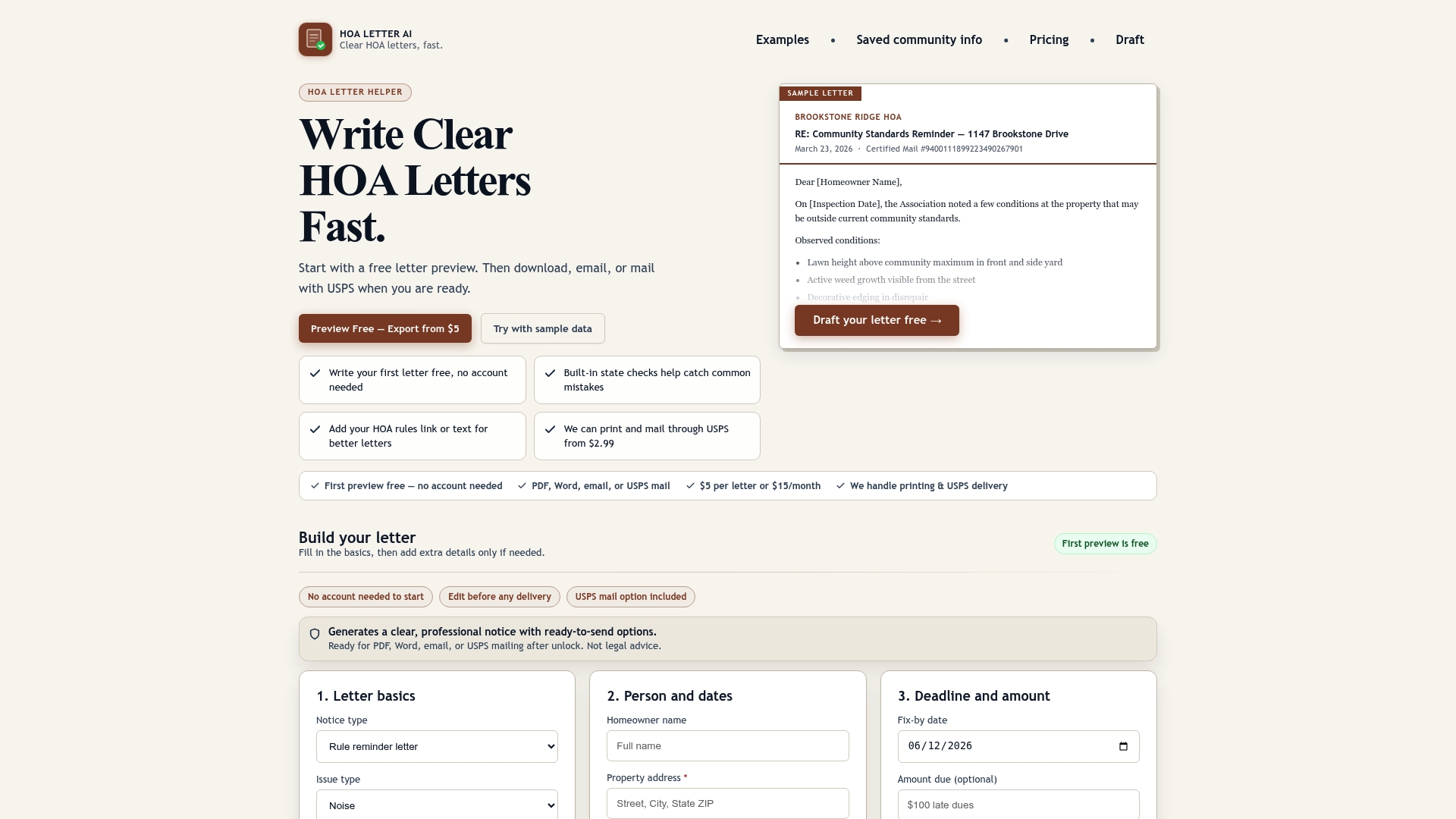
HOA Letter AI’s state-aware templates and completeness checks for HOA boards help you organize supporting notices, draft cover letters, and flag missing fields before a document goes out. Reusable community profiles mean you are not re-entering the same project data every time a new lender sends a request. For property managers handling multiple communities, the property manager platform keeps each community’s documents and templates separate and ready.
HOA Letter AI is not a substitute for board counsel on legally complex disclosures, but it cuts the administrative friction that causes most delays. Start with a free HOA violation letter template to see how the completeness checks and state-aware guardrails work, then apply the same workflow to your questionnaire preparation process.
Sources
These are the primary references for anyone working with HOA and condominium questionnaires in a mortgage context.
- Form 1076 Condominium Project Questionnaire
- Fhfa
- Condominium Project Questionnaire – Full Form
- Condo / HOA Questionnaire TO BE COMPLETED BY A REPRESENTATIVE OF THE HOA
- Homeowner Satisfaction Survey