
A defensible photo evidence set for an HOA violation typically includes multiple images from different angles, saved as original files with intact EXIF metadata, paired with a dated log naming the inspector, location, and specific governing provision. Anything less leaves room for a homeowner to challenge authenticity or timing. This standard exists because boards need images that hold up in a hearing or a courtroom, not just a snapshot that looks convincing on its own.
TL;DR:
- Include a permanent marker, such as a house number or mailbox, in at least one frame; daylight and unobstructed views improve clarity.
- Photograph only exterior conditions visible from public or common areas unless governing documents authorize lot entry; record that authority and seek counsel if unclear.
- If images need cropping or annotation, retain untouched originals, save edited copies separately, and record each change; screenshots can strip or alter EXIF metadata.
- Attach captions with the date, time, location, inspector, cited rule, and factual description, then submit photos and logs before discovery or exhibit deadlines.
- Use the same inspection checklist and photo method for every homeowner to reduce selective enforcement claims; reshoot images that are blurry or dark.
HOA Letter AITurn Documentation Into Clear NoticesHOA Letter AI helps boards and property managers create professional compliance letters using community rules and state-specific context.Create a compliance letter
Table of Contents
- How to shoot photos that hold up in a hearing
- Keeping photos authentic: originals, metadata, and storage
- Privacy, entry rights, and legal limits on photographing lots
- Building photos into notices, proof packets, and hearings
- Common technical pitfalls and how to avoid them
- Quick checklist and caption template for photo evidence
- Why consistent documentation matters more than the camera
- Turning photo evidence into a compliant notice
- FAQ
- Sources
How to shoot photos that hold up in a hearing
Good HOA photo evidence follows the same pattern every time: a wide shot that places the violation on the lot, a medium shot that shows the specific area in context, and a close shot that captures the detail in question, like a cracked fence board or an unauthorized structure. Each angle answers a different challenge a homeowner might raise. The wide shot proves location, the medium shot proves context, and the close shot proves the condition itself.
At least one frame in the set should include a permanent, verifiable marker, a house number, a mailbox, or a distinctive lot feature, so nobody can later argue the photo was taken somewhere else. Shoot in daylight when possible, and avoid photographing through a car window, which introduces glare, reflection, and distortion that weaken the image’s clarity. Keep the frame free of people, pets, or unrelated items that could distract from the violation or raise privacy questions.
- Wide shot: shows the lot and the violation’s location relative to the property line.
- Medium shot: shows the violation in its immediate surroundings.
- Close shot: shows the specific detail, damage, or object clearly.
If the inspection required stepping onto the lot itself rather than observing from a street or common area, note that in the inspection log along with the authority relied on to enter.
Pro Tip: Shoot the wide shot first so you capture the full scene before anyone notices you and adjusts anything.

Keeping photos authentic: originals, metadata, and storage
Authenticity is what separates evidence from a picture. Always export or save the original image file straight from the camera, phone, or inspection app. Never substitute a screenshot, since screenshots typically strip or alter EXIF metadata, the embedded timestamp and device data that proves when and how an image was captured. If a photo needs cropping or annotation for a notice, save a new copy and keep the untouched original, noting in the log exactly what was changed and why.
- Export the original file directly from the device or app, never a screenshot.
- Preserve the EXIF data and leave timestamps untouched.
- Use a consistent file-naming pattern, such as address, date, and sequence number.
- Log every inspection in one place: date, time, inspector, location, and the rule cited.
- Store files in a secure, read-only archive folder that can be exported quickly for a hearing.
One documented standard, repeatable every time: boards that use the same angles, captions, and storage method for every inspection avoid the appearance of selective enforcement and strengthen the credibility of every photo they submit, according to practitioner guidance from an HOA law blog.
Privacy, entry rights, and legal limits on photographing lots
Boards and inspectors need clear limits on what they can photograph and where they can go to get the shot. A reasonable expectation of privacy applies to interiors, bathrooms, and bedrooms, so photography should stay focused on exterior conditions visible from a street, common area, or a lot entry authorized by the declaration.
- Never photograph through windows into living spaces or areas where residents expect privacy.
- Confirm entry authority in the governing documents before stepping onto a homeowner’s lot; a Virginia appellate opinion upheld a board officer’s authority to enter a lot specifically to photograph a violation needed for restoration assessment.
- Check state law before restricting homeowner security cameras; Utah’s SB0031 bars associations from prohibiting owners from installing personal security cameras on their own unit or structure, while allowing reasonable limits in common areas.
- Document the date, time, and authority relied on whenever an inspection requires entering a lot.
- When entry rights are unclear, get legal counsel before proceeding rather than guessing.
Readers managing access issues tied to inspections, like lock changes needed for gate or common-area entry, may find practical guidance on HOA lock rules useful for understanding what owners must submit before modifying access points.
Building photos into notices, proof packets, and hearings
A photo without context is weak evidence. Every image submitted with a notice or presented at a hearing should carry a caption with the date, time, location, inspector name, the governing provision cited, and a short factual description of what the image shows. That caption turns a picture into a record.
- Pair each photo with a caption naming the date, inspector, location, and cited rule.
- Assemble a one-page summary that references the notice served and lists the selected images.
- Keep a running timeline across inspections to show whether a violation is recurring.
- Submit photos and logs before any discovery or exhibit deadline to avoid exclusion.
| Proof packet element | What it contains |
|---|---|
| Photo set | Wide, medium, and close images with originals preserved |
| Caption block | Date, time, inspector, location, provision cited |
| Summary page | One paragraph describing the violation and prior notices |
| Timeline | Dates of each inspection and whether the issue recurred |
Courts have excluded photos that were taken long after the alleged event or produced late under a scheduling order, according to a Wisconsin Court of Appeals opinion, which found that lateness and a lack of contemporaneous documentation undermined the evidence’s reliability. A board that documents at the time of the violation and files promptly avoids that trap entirely. For guidance on matching documentation to local timelines, boards can review state-by-state notice requirements.
Common technical pitfalls and how to avoid them
Most weak photo evidence fails for the same handful of reasons.
- Screenshots strip metadata, so always keep the original exported file.
- Blurry, dark, or low-resolution images carry little weight; reshoot when the first attempt is poor.
- Unlogged edits or filters raise authenticity questions; keep the original and note any change made.
- Switching inspection methods between homeowners invites claims of selective enforcement; use the same checklist every time.
Quick checklist and caption template for photo evidence
Before closing out an inspection, confirm the following:
- Three-shot set captured: wide, medium, close.
- Original files saved, no screenshots.
- File names follow a consistent pattern.
- Caption fields filled: date, time, inspector, location, provision, description.
- Images stored in the designated archive location.
Caption template: Date, Time, Inspector name, Location or address, Governing provision, Short factual description. Attach the completed caption directly beneath each image in the notice or proof packet so reviewers never have to guess at context.
Why consistent documentation matters more than the camera
Boards spend a lot of time debating camera gear when the real gap is usually process. A phone camera with a disciplined three-shot habit and a dated log beats an expensive camera used inconsistently. Our one-page proof packet and notice-tracking resources exist to make that discipline easy to repeat inspection after inspection.
— Blake
Turning photo evidence into a compliant notice
Capturing good photos is only half the job. We built HOA Letter AI templates with dedicated space for photo captions, so each notice ties the image directly to the governing provision cited, without the board writing that language from scratch every time.
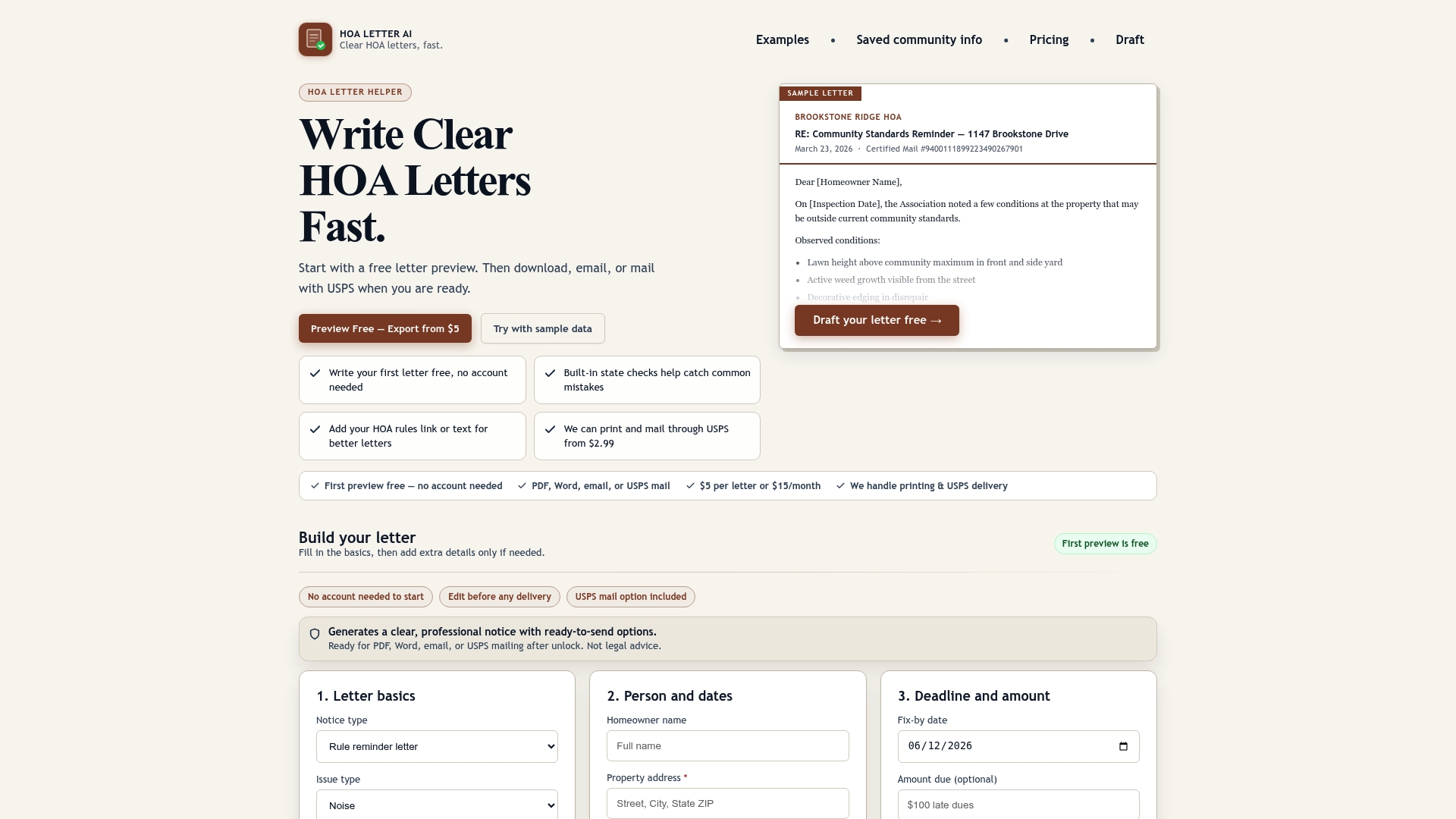
- Preview a notice for free before committing to anything.
- Generate a compliant letter for a flat $5 as an individual or small board.
- Property manager teams can use PM Starter or PM Pro plans for recurring notice volume.
- Add USPS mailing from $2.99 when a notice needs to go out the same day.
Start with a free preview of a notice or try our one-page proof-packet template to see how captioned photos and cited provisions come together in a single document.
FAQ
Can a neighbor take pictures of your property?
A neighbor or board representative can generally photograph what is visible from a street, sidewalk, or common area, since there is no reasonable expectation of privacy in those views. Photographing into windows, interiors, or clearly private spaces crosses a legal line and should be avoided.
What is the most common HOA violation complaint?
Exterior maintenance issues, landscaping neglect, unauthorized structures, and parking violations are frequently cited as the most common sources of HOA complaints and enforcement letters. Boards that document these consistently with the three-shot method reduce disputes over whether a violation actually occurred.
What is the best security camera for an HOA to recommend?
HOA governing documents generally cannot prohibit an owner from installing a personal security camera on their own unit or structure, though associations can set reasonable limits for common areas, as reflected in Utah’s SB0031. Rather than recommending a specific brand, boards should focus on written rules that distinguish personal units from shared spaces.
Why might a photograph not be admissible in court?
Photos can be excluded when they lack a clear chain of custody, when metadata shows the image was altered, or when they were taken long after the event or produced late under a discovery deadline, as seen in a Wisconsin Court of Appeals opinion. Keeping original files with intact timestamps and filing them promptly avoids most of these issues.
Do boards need homeowner consent before photographing a violation?
Consent is not typically required for photos taken from public-facing areas like the street or common grounds, but entering a private lot to photograph a violation should follow the authority granted in the governing declaration. A Virginia appellate opinion confirmed a board officer’s authority to enter a lot for this purpose when tied to restoration assessment.
Sources
- Utah SB0031 legislative text
- Virginia Court opinion on board entry and photographing violations
- Evidence of violations is necessary — HOA Lawyer Blog
- Wisconsin Court of Appeals opinion discussing exclusion of photographs at trial